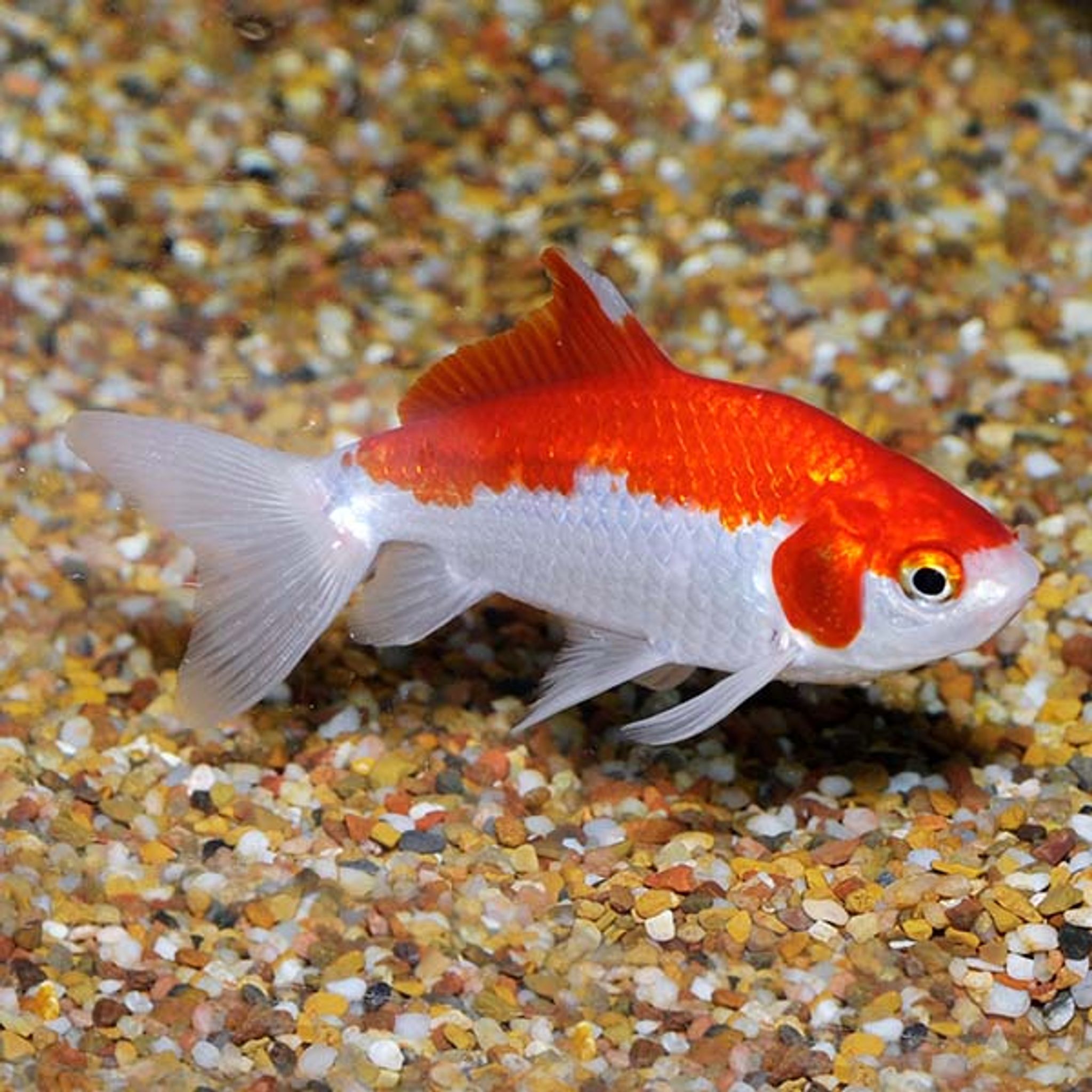

How Big Do Goldfish Get? Growth Rate, Adult Size and Tank Planning
A goldfish bought as a 1-inch fairground prize or feeder-tank fish is not a "small fish" — it is a juvenile that, given real space and clean water, will keep growing for years. Most goldfish reach somewhere between 6 and 12+ inches as adults depending on variety, and undersized housing doesn't stop that growth so much as damage the fish while slowing it down. This guide breaks down exactly how big each type gets, how fast they grow, and how to size a tank or pond correctly from day one.
Adult Size by Goldfish Type
The single biggest factor in adult goldfish size isn't diet or genetics on their own — it's body shape. Goldfish split into two broad groups, and confusing them is the root of most undersized-tank problems.
- Single-tailed (slim-bodied) goldfish — common goldfish, comets, and shubunkins — have a streamlined, torpedo-shaped body built for strong swimming. In a large enough tank or pond, these routinely reach 10–12 inches, and some individuals exceed 12 inches in body length.
- Fancy (double-tailed, egg-shaped) goldfish — fantails, orandas, ryukins, black moors, telescopes, lionheads, and ranchus — have a rounder, compressed body and paired tail fins. These typically top out around 6–8 inches of body length, noticeably smaller and slower-growing than their single-tailed cousins.
That split matters more than any individual variety name. Two fish that look completely different — a plain orange comet and a fringe-tailed shubunkin — belong to the same "single-tailed" size category, while a fantail and an oranda belong together in the "fancy" category despite different head and fin shapes. When sizing a tank, plan by this category first, not by nickname.
Measuring Correctly
Quoted lengths almost always refer to body length — snout to the base of the tail fin — not total length including flowing tails and fins. A fancy goldfish's total length (body plus tail) can look considerably longer than its body length alone, so measure body length when comparing your fish to size benchmarks, and expect total length to run larger, especially on long-finned varieties.
How Fast Do Goldfish Grow?
Growth is front-loaded. A healthy fry can go from under an inch to 2–3 inches within its first few months given good food and stable water quality. After that first growth spurt, the pace slows into a gradual multi-year climb toward full adult size.
| Approximate age | Typical body length | Growth stage |
|---|---|---|
| 1–2 months (fry) | Under 1 in (2.5 cm) | Rapid early growth |
| 3–6 months | 2–3 in (5–7.5 cm) | Fast juvenile growth |
| 12 months | 3–5 in (7.5–13 cm), variety-dependent | Growth slows, body shape defines |
| 2 years | 4–7 in (10–18 cm) | Steady, gradual growth |
| 3–5 years | Approaching adult size | Slow finishing growth |
| 5+ years | Full adult size (6–8 in fancy / 10–12+ in single-tailed) | Very slow continued growth possible |
These numbers are approximate — real growth depends heavily on space and water quality, described next — but the shape of the curve (fast, then slow, then a long tail of minor growth) holds across virtually every goldfish.
The "Grows to Fit the Bowl" Myth
It's a persistent piece of folklore that a goldfish "grows to the size of its container." That's backwards. Goldfish size is driven by tank or pond volume, water quality, diet, and genetics working together — not by a container magically capping growth at a healthy size.
What actually happens in a bowl or undersized tank is stunting: growth slows or stalls, but the fish's internal organs and skeleton don't stop developing on the same schedule. The result is a fish with organs compressed inside an undersized body, skeletal and muscular problems, and a substantially shortened lifespan. A small tank doesn't produce a small, healthy goldfish — it produces a stressed one.
Tank Size Guidelines
Because single-tailed and fancy goldfish differ so much in eventual size and swimming needs, tank sizing should always be split by type rather than treated as one-size-fits-all.
Minimum Starting Tank Sizes
- One fancy goldfish: 20 gallons (76 L) as an absolute floor, with 30 gallons (114 L) recommended as the comfortable, future-proofed starting point.
- One common, comet, or shubunkin goldfish: 40 gallons (151 L) minimum, reflecting their eventual foot-long size and heavy waste output. Some sources push this as high as 55 gallons; 40 gallons is a reasonable working minimum as long as a pond upgrade is on the horizon.
Adding More Goldfish
- Additional fancy goldfish: add roughly 10–20 gallons (38–76 L) per fish.
- Additional common/comet/shubunkin goldfish: add roughly 10–12+ gallons (38–45 L) per fish, though because these fish get so much larger, real-world stocking often benefits from the higher end of that range.
Treat these as ranges, not fixed formulas — filtration capacity and each fish's actual body size matter as much as raw gallons. A well-filtered tank with excellent water changes has more headroom than the number alone suggests; a lightly filtered tank has less.
Gallons at a Glance
| Tank size | Fancy goldfish | Common/comet/shubunkin |
|---|---|---|
| 10 gallons (38 L) | Not suitable long-term — fry grow-out or quarantine only | Not suitable at any life stage |
| 20 gallons (76 L) | One adult, long-term, if well filtered | Not enough space |
| 40 gallons (151 L) | A pair (roughly 1 fish per 20 gal) | One adult as a starting point |
Goldfish are also social, shoaling fish that generally do better in pairs or small groups than kept alone — but only once the tank or pond is sized to match the group, not the other way around.
A glass aquarium in the 30–40+ gallon range gives a single fancy goldfish or a starter pair real room to grow, and browsing goldfish stock lets you compare varieties like ryukins before committing to a tank size.
Filtration and Water Care
Goldfish are unusually messy for their size — their bioload rivals fish twice their length. A commonly cited target is filtration rated for roughly double the tank's actual gallons, alongside weekly 20–30% water changes. Undersized filtration is one of the most common reasons a technically "big enough" tank still runs into ammonia and nitrite problems.
Goldfish are also coldwater fish, comfortable roughly 65–75°F (18–24°C) and tolerant down toward 50–60°F (10–16°C) seasonally. Most homes don't require a heater at all, and hardy varieties can overwinter in outdoor ponds. Browsing filters sized for at least double your actual tank volume is a practical way to build in that margin from the start.
Is a Bigger Tank Actually Easier?
Counterintuitively, yes. More water volume dilutes waste swings, giving more stable pH and ammonia levels and a wider margin for error when feeding or water changes slip. For a beginner, a larger tank is generally more forgiving than a small one, despite the higher upfront cost — the opposite of what many new owners assume when they start small "to be safe."
When to Move to a Pond
Single-tailed goldfish in particular will eventually outgrow any typical indoor tank. A practical decision point: once a common, comet, or shubunkin exceeds roughly 6–8 inches of body length, or once a household wants to keep several goldfish long-term, an outdoor pond becomes the realistic endpoint rather than a bigger tank. Ponds for this purpose are often 200+ gallons with adequate depth to avoid freezing solid in winter.
Routine Pond Care
Keeping a goldfish pond healthy is a routine, not a one-time setup:
- Weekly testing for ammonia, nitrite, and pH
- Partial water changes on a regular schedule
- Removing debris and dead leaves before they decay
- Checking pumps and filters for clogs
- Adjusting feeding seasonally
- Dosing dechlorinator on every refill
Algae and Green Water Control
Green water — free-floating single-cell algae — usually stems from excess nutrients and sunlight. Effective controls include a UV clarifier/sterilizer, cutting back on overfeeding, adding floating or marginal plants to compete for nutrients, partial water changes, and limiting direct sunlight hours on the pond.
Connecting Pond Equipment
A standard setup sequence is: pump feeds filter, filter feeds a UV clarifier (if used), then water returns via a waterfall or spillway. Plumb the system to avoid air locks, and size the pump so it turns over the full pond volume roughly every 1–2 hours.
Winter Care
In cold climates, a floating de-icer or pond heater keeps a hole open in the ice for gas exchange — it isn't meant to warm the whole pond. Goldfish and koi go semi-dormant near the bottom in cold water and need only minimal feeding once temperatures drop below about 50°F (10°C).
Jumping and Flashing
Jumping or flashing (rubbing against surfaces or the pond floor) usually signals poor water quality, parasites, or low oxygen rather than simple playfulness. Check ammonia and nitrite first, then inspect the fish closely for visible parasites before assuming it's harmless behavior.
Anchor Worm Treatment
Anchor worms (Lernaea) are visible, thread-like parasites that embed in the skin. Treatment typically involves:
- Manually removing the visible worm with tweezers after dabbing the site with an antiseptic.
- Following up with a medicated bath or dip, such as potassium permanganate or an anti-parasitic treatment.
- Repeating treatment on a schedule, since a single round misses the parasite's earlier life-cycle stages.
Skipping quarantine on new goldfish is one of the more common ways anchor worms and flukes get introduced to an established tank or pond in the first place. A medication formulated for external parasites is worth having on hand before an outbreak, not after.
Koi vs. Goldfish: Different Origins
Koi and goldfish are often confused, but they come from different ancestry. Koi descend from common carp selectively bred in Japan (with earlier ornamental color-carp breeding in China) for their color patterns. Goldfish descend from wild Prussian/crucian carp, domesticated in China roughly a thousand years ago. Both end up in similar ponds, but they're genetically distinct fish with different typical adult sizes and care details.
Common Mistakes to Avoid
- Buying a goldfish for a small bowl or nano tank without knowing its true adult size and 10–20 year lifespan.
- Underfiltering and under-changing water because a goldfish "looks like" a small tropical fish.
- Assuming stunted growth means the fish is fine — organ compression and skeletal problems still occur even when the fish stays small.
- Housing slow, poor-swimming fancy varieties with fast, boisterous common or comet types, risking stress and fin damage.
- Skipping quarantine for new arrivals, which can introduce anchor worms or flukes to an established system.
- Overfeeding, which speeds up waste buildup and fuels green water and algae problems, especially in ponds.
- Adding a heater goldfish don't need — they're coldwater fish that generally do fine at stable room temperature or in an unheated pond.
- Not planning ahead for an eventual pond transfer when keeping common, comet, or shubunkin types.
Goldfish Facts Worth Knowing
- Goldfish have good long-term memory measured in months, not the "three-second memory" myth, and can learn to recognize their owners.
- They have no true stomach, so small, frequent feedings suit them better than one or two large meals.
- Named varieties include common, comet, shubunkin, fantail, oranda, ryukin, black moor, telescope, lionhead, and ranchu — all falling into the single-tailed or fancy categories covered above.
Frequently Asked Questions
How big do goldfish actually get?
It depends on variety: single-tailed types like commons, comets, and shubunkins typically reach 10–12+ inches, while fancy types like fantails, orandas, and ryukins typically reach 6–8 inches. Either group needs several years in an adequately sized tank or pond to reach that full size.
Do goldfish really grow to the size of their tank?
No. A small tank stunts growth rather than producing a healthy, permanently small fish — internal organs and skeletal development continue on their own schedule, which causes real health problems even as body growth slows.
How fast do goldfish grow?
Growth is fastest in the first year, with fry reaching a couple of inches within months given good food and water quality. After that, growth slows into a gradual climb that continues for three to five years or more before leveling off.
What size tank does one goldfish need?
A single fancy goldfish needs at least 20–30 gallons, while a single common or comet goldfish needs 40+ gallons due to its eventual foot-long size. Add roughly 10–20 gallons per additional fancy goldfish, or 10–12+ gallons per additional common-type goldfish.
Can goldfish live in a bowl?
No. Bowls lack the surface area for oxygen exchange and the space needed for real filtration, which causes stress, stunted growth, and a shortened lifespan. A filtered tank of at least 20 gallons is the minimum realistic alternative.
How many goldfish can go in a 10, 20, or 40-gallon tank?
A 10-gallon tank isn't suitable for any goldfish long-term — treat it as fry grow-out or quarantine space only. A 20-gallon tank can house one fancy goldfish long-term if well filtered. A 40-gallon tank suits one common or comet goldfish, or a small pair of fancy goldfish.
Do goldfish need a heater?
No. Goldfish are coldwater fish, comfortable roughly between 65–75°F and tolerant of cooler temperatures seasonally, so most homes don't need a heater, and hardy varieties can even overwinter in outdoor ponds.
How long do goldfish live?
Well-kept goldfish commonly live 10–15 years, with many reports of 15–20+ years in spacious, well-maintained tanks or ponds. Short lifespans are almost always traced back to small tanks or poor water quality rather than goldfish biology itself.
Ready to plan a setup that matches your goldfish's real adult size? Browse goldfish varieties on FishyHub to compare fancy and single-tailed types before choosing a tank.


