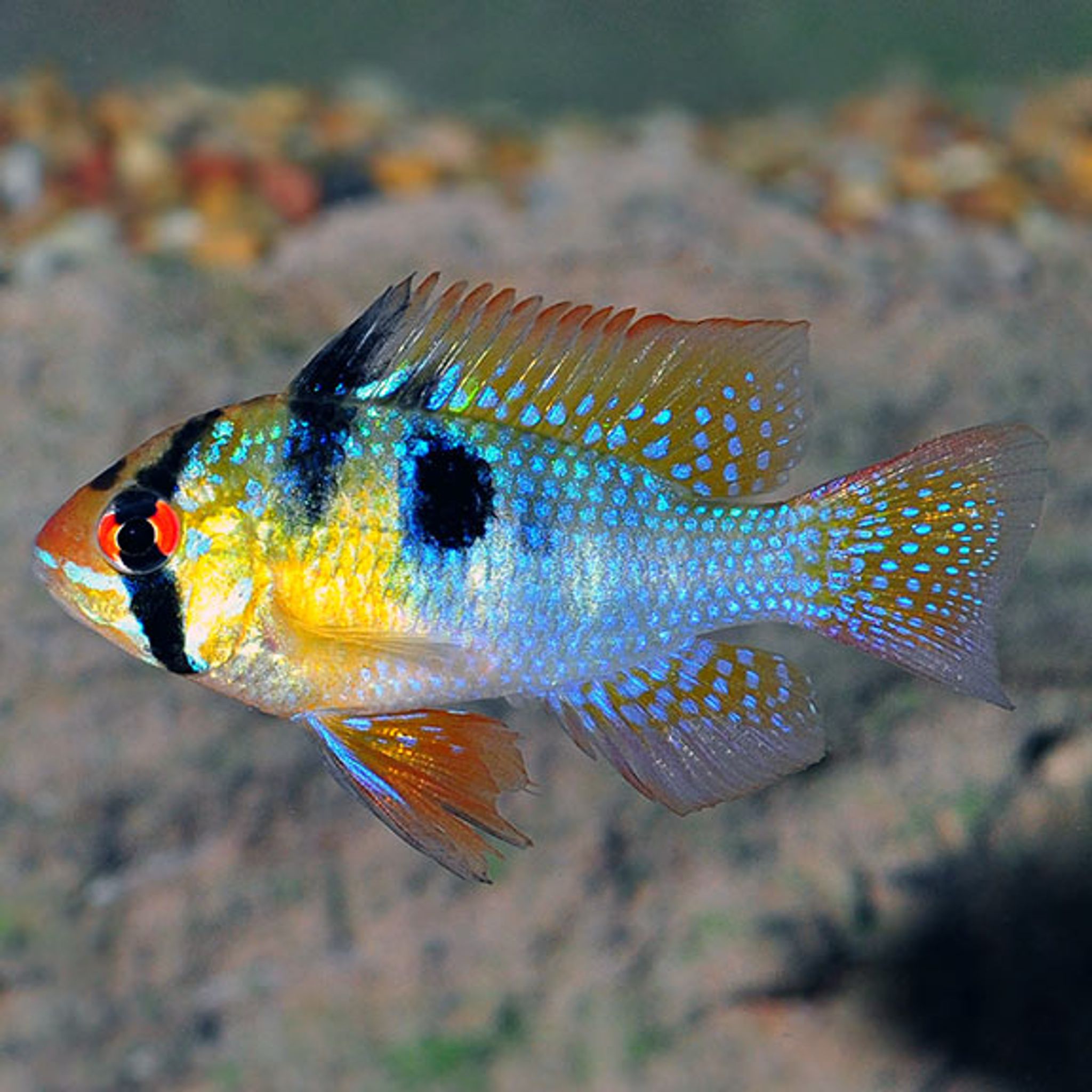

How Big Do German Blue Ram Get? Growth Rate, Adult Size and Tank Planning
German blue rams (Mikrogeophagus ramirezi) top out at roughly 2–3 inches (5–7.5 cm) in body length, with males edging slightly larger than females. Reaching that adult size takes about 8–12 months, and how quickly a ram gets there depends heavily on temperature, diet, and water quality. Below is a full growth timeline, a size comparison by sex, and the tank math you need before bringing a pair home.
Adult Size: What to Actually Expect
Measured from snout to the base of the tail (not including the tail fin or any flowing dorsal streamers), a healthy, tank-bred German blue ram reaches about 2–3 inches (5–7.5 cm) as an adult. This is the range you should plan a tank around.
Wild-caught and wild-type populations can occasionally push larger, up to about 3.5–4 inches in rare cases, since selectively line-bred fish in the trade tend to run smaller and more uniform than their wild ancestors. If you're stocking based on a single number, 2–3 inches is the reliable planning figure; treat anything above that as a bonus, not the baseline.
Measuring Your Ram Correctly
A lot of size confusion comes down to measurement technique, not genetics. To get an accurate reading:
- Measure from the tip of the snout to where the tail fin begins (the caudal peduncle), not to the tip of the tail.
- Ignore flowing dorsal fin extensions and tail streamers on males — these can visually add another 0.5 in or more without reflecting actual body growth.
- Measure against the glass with the fish relaxed, not flared or mid-display, since a startled or displaying ram can look noticeably longer or taller-bodied than its resting size.
Males vs. Females: Size and Visual Differences
Sex affects both final size and body shape in German blue rams:
| Trait | Males | Females |
|---|---|---|
| Typical adult length | 2.5–3 in (6.4–7.5 cm) | 2–2.5 in (5–6.4 cm) |
| Body shape | More elongated | Rounder, more compact |
| Fin extensions | Longer dorsal spines and fin streamers | Shorter, less exaggerated fins |
| Coloration cue | Overall body color, less belly blush | Rosy/pink blush on belly, especially near spawning |
Because of the fin extensions, males can look considerably bigger than the 0.5-inch body-length gap actually is. When sexing a ram for size expectations, look at the belly blush and fin length together rather than length alone.
Growth Rate: A Month-by-Month Timeline
Growth is fastest in the first few months of a ram's life and then tapers as the fish approaches sexual maturity. Most published milestones are scattered across sources, so here is a consolidated timeline:
| Age | Approximate Body Length |
|---|---|
| ~1 month | 0.4 in (1 cm) |
| 4–6 weeks | 1–1.5 in (2.5–3.8 cm) |
| 3 months | 1.2–2 in (3–5 cm) |
| 6 months | 1.5–2 in (3.8–5 cm) |
| 8–12 months | Full adult size, 2–3 in (5–7.5 cm) |
Sexual maturity, full adult coloration, and breeding readiness typically arrive alongside near-adult size, around 6–9 months. A ram that hits full color and starts pairing off before it hits full length is normal — coloration and breeding behavior can outpace the last stretch of body growth by a month or two.
What Speeds Up or Slows Down Growth
Water Parameters
German blue rams are more sensitive to water conditions than many hardier cichlids, and unstable parameters are one of the most common causes of slow or stunted growth.
- Temperature: 78–85°F (25.5–29.5°C), with some keepers running up to 86°F (30°C). This is genuinely a warm-water cichlid — noticeably warmer than the mid-70s°F many community tanks are kept at.
- pH: 6.0–7.5 is a safe, practical range for most tap-water-based setups. Closer to 6.0–6.5 more closely mimics the soft, acidic blackwater habitat rams evolved in, and may support better color and breeding condition (some sources cite pH as low as 5.0, but that extreme isn't necessary or advisable for most home tanks).
- Hardness: Soft to moderate, roughly 2–14 dGH.
Stable numbers matter more than hitting an exact figure. Ammonia or nitrite spikes, temperature swings, and inconsistent filtration all suppress feeding and metabolism, which shows up directly as slowed growth.
Diet
Frequent small feedings of varied, protein-rich foods drive faster, healthier growth than a flake-only diet. A solid rotation includes high-quality pellets or flakes as a base, supplemented with live or frozen brine shrimp, bloodworms, daphnia, and cyclops. Rams fed only flakes tend to grow more slowly and show duller color than those on a varied diet.
Tank Mates and Stress
Overstocking or housing rams with aggressive, fin-nipping tankmates causes chronic stress that suppresses appetite and, over time, growth. Calm dither fish and plenty of territory — caves, plants, driftwood, and flat rocks for potential spawning — help rams feed and grow normally. For dither fish, browsing the small community fishes selection is a good way to find calm, similarly sized companions.
Tank Size: Why Footprint Beats Volume
The generally recommended minimum is a 20-gallon long tank for a single ram or a pair, adding roughly 5–10 gallons per additional individual or when housing dither/community fish. Some keepers treat 20 gallons as an absolute floor and prefer 29–30 gallons for a proper pair with tankmates — a reasonable middle ground is to treat 20g long as the practical minimum and 29g+ as more comfortable for a community setup.
The "long" footprint matters more than raw volume. A tall 20-gallon tank holds the same water as a 20-gallon long, but rams are bottom-and-mid-water dwellers that use horizontal swimming space far more than vertical height. A long footprint (30+ inches) also makes it easier to break sightlines with decor, which reduces territorial stress between a pair and any tankmates — directly supporting the calm conditions rams need to grow and color up normally.
If you're shopping for rams to stock into that footprint, the Angelfish, Discus, Rams & Cichlids category is where they're listed on FishyHub.
Botanicals and Catappa Leaves: Do They Help Rams Grow?
Indian almond (catappa) leaves and other botanicals — seed pods, alder cones, leaf litter — are common additions to ram tanks, and they help indirectly rather than directly.
- Water chemistry: Leaves and botanicals release tannins that soften and mildly acidify water, nudging conditions toward the blackwater habitat German blue rams evolved in.
- Immune support: Those same tannins have mild antibacterial and antifungal properties, which can reduce stress-related illness in a sensitive species.
- Biofilm as a food source: Decomposing leaves grow a layer of beneficial biofilm that rams and any fry will graze on, providing a small but steady supplemental food source.
- Maintenance: Rinse or steep leaves before adding them, and replace them every few weeks as they break down.
Beyond catappa leaves specifically, driftwood, seed pods, and leaf litter in general create a natural, cichlid-appropriate habitat. The added cover reduces stress and buffers water chemistry toward the soft, acidic range rams thrive in — all of which supports steady growth, but none of which substitutes for correct temperature, stable water quality, and a varied diet.
Common Mistakes That Cause Undersized Rams
- Buying too young and misjudging final size. Plan your tank around the 2–3 inch adult, not the small juvenile you bring home.
- Keeping the tank too cool. Temperatures below about 76°F slow metabolism and growth, and increase disease risk in a fish that needs warmer water than most community species.
- Underfeeding or feeding only flakes. This is one of the most common causes of slow growth and washed-out color.
- Overstocking or pairing with aggressive tankmates. Chronic stress suppresses feeding and stunts growth over time.
- Mistaking stunting for a "runt." A genuinely small adult is sometimes just genetics or sex, but true stunting — caused by poor water quality or early-life malnutrition — is often irreversible once growth plates and organ development have been affected. If a ram never grows past 1.5 inches despite good conditions from an early age, it likely was stunted before you got it, not naturally small.
- Confusing German blue rams with other species. Bolivian rams grow larger (around 3 inches) and are hardier, while Asian and "electric blue" color morphs of the German blue ram are the same species with different selective breeding — not a size guarantee either way. Knowing which fish you actually have prevents the wrong size expectations from the start.
Lifespan and Final Size
German blue rams typically live 2–4 years with good care. Genetics, diet, and water quality influence both lifespan and final size together — fish that reach their full genetic lifespan under stable conditions also tend to reach their full genetic size potential, while fish stressed by poor conditions early on often fall short on both counts.
Frequently Asked Questions
How big do German blue rams get in a home aquarium?
Most tank-bred German blue rams reach 2–3 inches (5–7.5 cm) in body length as adults. Males and wild-type strains occasionally run larger, up to around 3.5–4 inches in rare cases.
How fast do German blue rams grow?
Growth is fastest in the first 2–3 months, going from about 0.4 inches at one month to 1.2–2 inches by three months. After that it slows, reaching full adult size by roughly 8–12 months.
Do male or female German blue rams get bigger?
Males generally get bigger, by about 0.5 inch on average, and also develop longer dorsal spines and fin streamers that make the size difference look even larger than it is.
What size tank do I need for German blue rams?
A 20-gallon long tank is the practical minimum for a single ram or a pair. For a community setup with dither fish, 29 gallons or more is more comfortable, and a long footprint matters more than raw water volume.
Why is my German blue ram not growing or staying small?
Check water temperature (should be 78–85°F), water quality stability, diet variety, and tankmate stress before assuming the fish is simply small. Any of these left unaddressed for too long can cause irreversible stunting rather than a naturally compact adult.
Can German blue rams be kept with other cichlids or community fish?
Yes, as long as tankmates are calm, similarly sized, and non-aggressive. Avoid fin-nippers and territorial cichlids, which cause stress that suppresses feeding and growth.
Do catappa leaves or botanicals help rams grow better?
Indirectly, yes — they soften and acidify water, add mild antibacterial properties, and grow grazable biofilm, all of which lower stress and support overall health. Diet and temperature still matter more directly for actual growth rate.
How long do German blue rams live, and does that affect their final size?
German blue rams typically live about 2–4 years with good care. Fish that reach their full lifespan under stable conditions also tend to reach their full genetic size potential, since the same factors (water quality, diet, stress) drive both.
Ready to stock or upgrade your ram setup? Browse available German blue rams and other dwarf cichlids in the Angelfish, Discus, Rams & Cichlids category on FishyHub.


