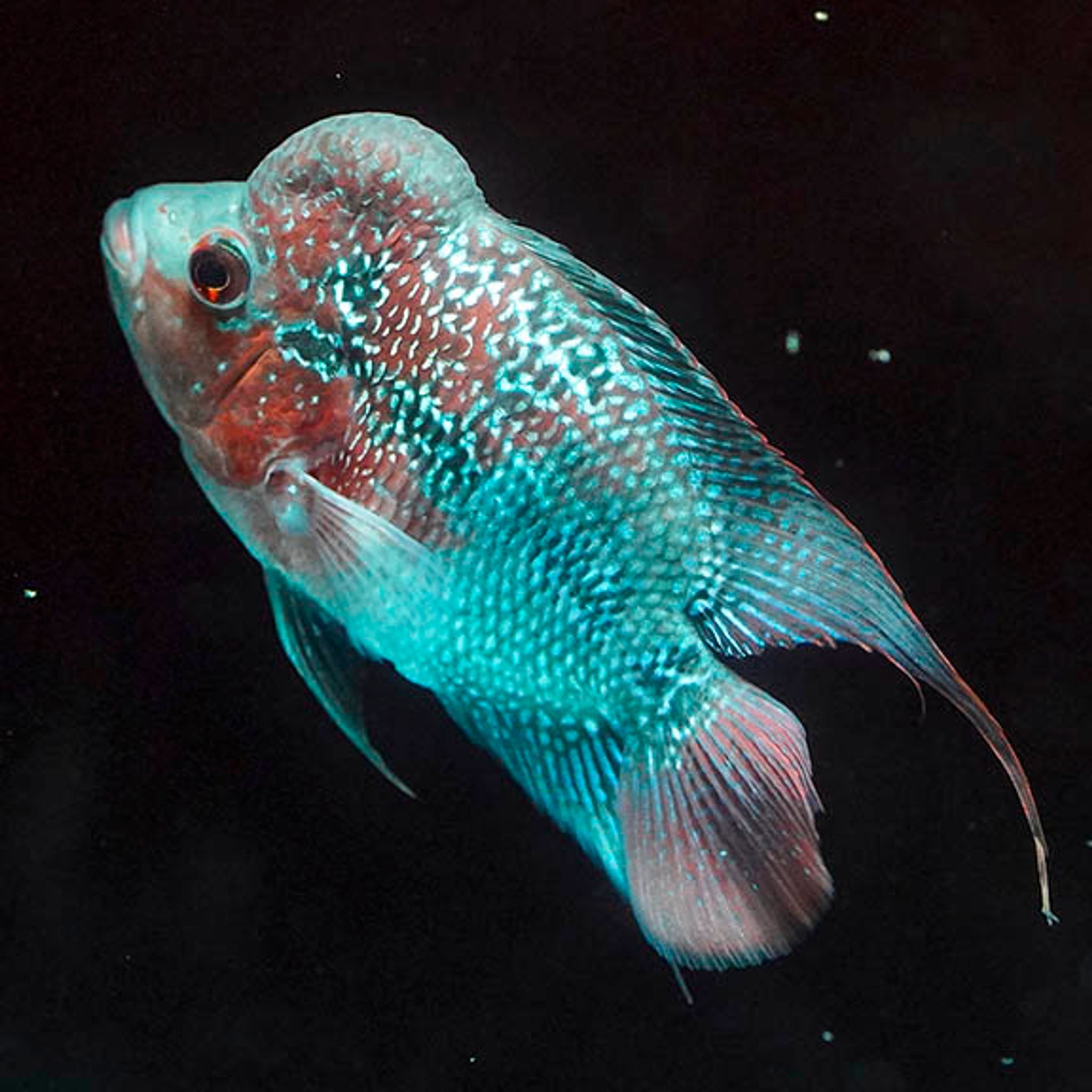

How Big Do Flowerhorn Get? Growth Rate, Adult Size and Tank Planning
Most flowerhorns settle in at 10-12 inches (25-30 cm) as adults, with some large-strain males pushing past that. The exact number depends heavily on genetics, sex and how the fish is raised, so the honest answer is a range rather than a single figure. Below is a growth timeline, the factors that actually move the needle on size, and a tank-planning path that gets you to the right setup without buying two or three tanks along the way.
Why Flowerhorn Size Varies So Much
A flowerhorn is not a wild species with a fixed size standard — it's a man-made hybrid cichlid, bred from crosses between several Central American cichlid lines. Because there is no single genetic blueprint, individual fish and strains can differ noticeably in final length, body depth and head shape. This is the main reason size charts for flowerhorns always come as a range instead of one number: two fish from the same batch can mature at meaningfully different sizes.
- Typical adult length: roughly 10-12 inches (25-30 cm)
- Large-strain males under excellent care: 14-16 inches is possible, though not typical
- Smaller strains and most females: often stay closer to 8-10 inches
Males vs. Females: How Different Are They?
Sex is one of the biggest drivers of adult size. Males generally grow larger overall and develop the prominent nuchal hump (the fatty forehead pad, sometimes called a "kok") that flowerhorns are known for. Females tend to stay smaller and flatter-headed, and they mature earlier relative to their final size.
| Trait | Male | Female |
|---|---|---|
| Typical adult length | 10-16 in (25-40 cm) | 8-10 in (20-25 cm) |
| Nuchal hump | Usually pronounced | Usually minimal to absent |
| Body depth | Thicker, bulkier | Slimmer |
| Growth rate | Faster, longer growth window | Slower, plateaus sooner |
Flowerhorn Growth Rate: A Month-by-Month Benchmark
Growth is fast in year one, then tapers off. Use this table as a rough progress check — a fish that's noticeably behind these marks may be undersized, underfed, or held in cramped conditions.
| Age | Approximate length | Notes |
|---|---|---|
| Fry (newly free-swimming) | Under 1 in (2.5 cm) | Rapid growth begins with high-protein food |
| 3 months | 2-3 in (5-7.5 cm) | Early color and pattern start showing |
| 6 months | 4-6 in (10-15 cm) | Nuchal hump may begin forming in males |
| 12 months | 8-10 in (20-25 cm) | Fastest growth phase winding down |
| 18-24 months | Near full adult length | Body and hump continue filling out |
| 3+ years | Full adult size | Thickening and hump development can continue for another year or two |
What Actually Determines Final Size
Genetics sets the ceiling, but several husbandry factors decide whether a fish reaches it or falls short:
- Tank size: An undersized tank is one of the most common causes of stunted growth in this species.
- Water quality: Frequent, large water changes keep waste and nitrate from suppressing growth.
- Diet: A high-protein diet — pellets formulated for flowerhorn or other large cichlids, supplemented with occasional live or frozen protein — supports faster, fuller growth. Low-protein food slows growth and dulls both color and hump development.
- Temperature: A warmer range within 78-86°F supports a faster metabolism and growth rate; many keepers run toward the upper half of that range during the active growing phase.
- Genetics/strain: Strain determines the realistic ceiling regardless of care quality.
It's worth browsing options in Freshwater Livestock › Angelfish, Discus, Rams & Cichlids when comparing large-cichlid care needs, since flowerhorn husbandry overlaps closely with other big American cichlids.
Does Hump Size Mean the Fish Is Healthy?
Not necessarily. The nuchal hump is influenced by genetics and hormones, and it visibly fluctuates with mood, water quality and diet. A fish can carry a large hump one month and a noticeably smaller one the next without anything being medically wrong — so hump size alone isn't a reliable health indicator, and a shrinking hump isn't automatically a red flag on its own.
Tank Planning: Footprint Matters More Than Gallons Alone
Flowerhorns are active, territorial swimmers that need room to turn around and patrol, not just water volume. Two tanks holding the same number of gallons are not equal for this fish — a tall, narrow "high" tank is worse than a long, wide one at the same volume.
- Look for length and width first, then check that gallons land in an acceptable range.
- A footprint of 48" x 18" (122 x 46 cm) or larger is preferred over tall, narrow shapes.
- Extra floor space also reduces stress-related aggression, since the fish has room to retreat from its own reflection or from tank activity.
Minimum and Recommended Tank Sizes
Sources vary on the exact minimum, largely because "minimum" and "ideal" get conflated. Here's a clearer breakdown:
| Tank size | Suitability |
|---|---|
| 55-75 gallons | Absolute minimum; workable for a smaller or younger fish, but a tight fit for a large-strain adult male |
| 75 gallons | Realistic starting point for most keepers with a single adult |
| 90-125+ gallons | Recommended for full-grown, large-strain males and for the best long-term welfare |
Since flowerhorns are typically kept one per tank, these figures assume a single-occupant setup rather than a community aquarium.
Upgrade Roadmap: Matching Tank Size to Age
Buying the adult tank early avoids repeated upgrades as the fish outgrows each container. A practical path:
- Fry stage (0-4 months): 20-30 gallon tank or tote
- 4-6 months: move to 40-55 gallons as growth accelerates
- 10-12 months: move into the permanent 75-125+ gallon adult tank
If budget allows, skipping straight to the adult-sized tank once the fish is a few inches long saves the cost and hassle of buying, cycling and tearing down an intermediate tank. You can compare tank options under Tanks & Stands › Glass Tanks when planning the jump to a permanent setup.
The 90-Gallon Option
A standard 90-gallon glass tank measures about 48" L x 18" W x 24" H (122 x 46 x 61 cm) — a footprint well suited to a flowerhorn's swimming and territorial habits. It's one of the better "adult flowerhorn" choices for exactly that reason: generous length and width rather than extra height.
Weight is the catch. An empty glass 90-gallon tank weighs roughly 160 lbs, and once filled with water, substrate and rock, total weight can exceed 1,000 lbs. That load needs a rated stand and placement over a supported area of the floor — not against an unsupported span in an older house or upper-story room. This becomes more important, not less, as you move toward 125-gallon setups.
Strain Type and Perceived Size
Not all flowerhorns "look" as big as their length suggests. Short-body or compact strains carry more bulk in a shorter frame, appearing chunkier and denser even at a smaller length. Standard or long-body strains stretch that same mass over a longer profile, so two fish of similar weight can look quite different in the tank depending on strain.
Water Parameters and Filtration for Growth
Stable water conditions matter more for growth than hitting an exact number on any single parameter.
- Temperature: 78-86°F (25.5-30°C), commonly kept toward 80-86°F for active growth
- pH: workable from 6.0-8.0, with 6.5-7.8 the commonly cited sweet spot — stability across water changes matters more than chasing a precise figure
- Ammonia/nitrite: 0 ppm
- Nitrate: under 20-40 ppm
- General hardness: moderate to hard water is well tolerated
Flowerhorns are heavy eaters and produce a correspondingly heavy waste load, so filtration should be oversized rather than just adequate — a canister filter rated for 1.5-2x the tank's actual volume is a reasonable target. Undersized filtration is a common cause of ammonia spikes in this species given how much they eat and excrete. You can browse canister and other filtration options under Filters when sizing up for a large cichlid.
Common Mistakes to Avoid
- Buying a "cute juvenile" tank: A 2-inch fry doesn't need much space, but it will outgrow a small tank within months — plan for the adult size from day one.
- Assuming two flowerhorns will pair up peacefully: They are highly aggressive and often fight to the death when housed together. Only combine two fish for a deliberate, supervised breeding attempt, and always use an escape-proof divider.
- Underfeeding or feeding low-protein food: This slows growth and dulls both color and hump development.
- Skipping large weekly water changes: The heavy waste load from a big, messy eater builds up fast without them, leading to stress and stunted or sick fish.
- Treating hump size as a health gauge: It's genetic and hormonal, and it shifts with mood and conditions — don't panic over a temporary dip.
- Underestimating filtration needs: A filter sized for the tank's gallon rating alone often isn't enough for this species' bioload.
- Ignoring floor support for large tanks: A filled 90-125 gallon tank can weigh close to half a ton; verify the floor and stand can handle it before setup.
Lifespan
With good care, a flowerhorn typically lives 10-12 years, sometimes longer — another reason it's worth investing in the right tank size from the start rather than treating the setup as temporary.
Frequently Asked Questions
How big does a flowerhorn get in a 55-gallon tank?
It can survive in a 55-gallon tank, but growth and long-term health are often compromised at that size. For a fish to reach its full adult potential, 75+ gallons is a better target, especially for males of large strains.
How fast do flowerhorns grow?
Growth is fast in the first year — commonly several inches every few months — with fish reaching 4-6 inches by 6 months and 8-10 inches by 12 months under good conditions. Growth then slows considerably, with fish nearing full size by 18-24 months.
Do flowerhorns stop growing?
Growth slows dramatically after about 2 years, but it doesn't stop completely. Fish continue to fill out and thicken very gradually for another year or two beyond that point.
What is the biggest flowerhorn size ever recorded?
Exceptional large-strain males have reportedly reached up to 16 inches or slightly more, though this is well above the typical 10-12 inch range and not representative of most fish.
Can flowerhorns live in a community tank?
This isn't recommended. Flowerhorns are aggressive and territorial, and are best kept alone or, in rare cases, with very robust, similarly-sized tankmates in an oversized tank.
What size tank do I need for one adult flowerhorn?
Plan for 75 gallons as a realistic minimum, with 90-125+ gallons recommended for full-grown or large-strain fish and for the best long-term welfare.
Does tank size affect flowerhorn hump growth?
Indirectly, yes. A cramped, stressed fish kept in poor water tends to grow a smaller body overall and often develops a less prominent hump than a fish given adequate space and stable conditions.
Male vs. female flowerhorn size — how different are they?
Males typically grow larger, often 10-16 inches, and develop a more pronounced nuchal hump. Females are usually smaller — closer to 8-10 inches — and stay flatter-headed even at full maturity.
Ready to plan a permanent setup for a growing flowerhorn? Browse tank and stand options sized for large cichlids under Tanks & Stands on FishyHub.


