
How Big Do Firemouth Cichlid Get? Growth Rate, Adult Size and Tank Planning
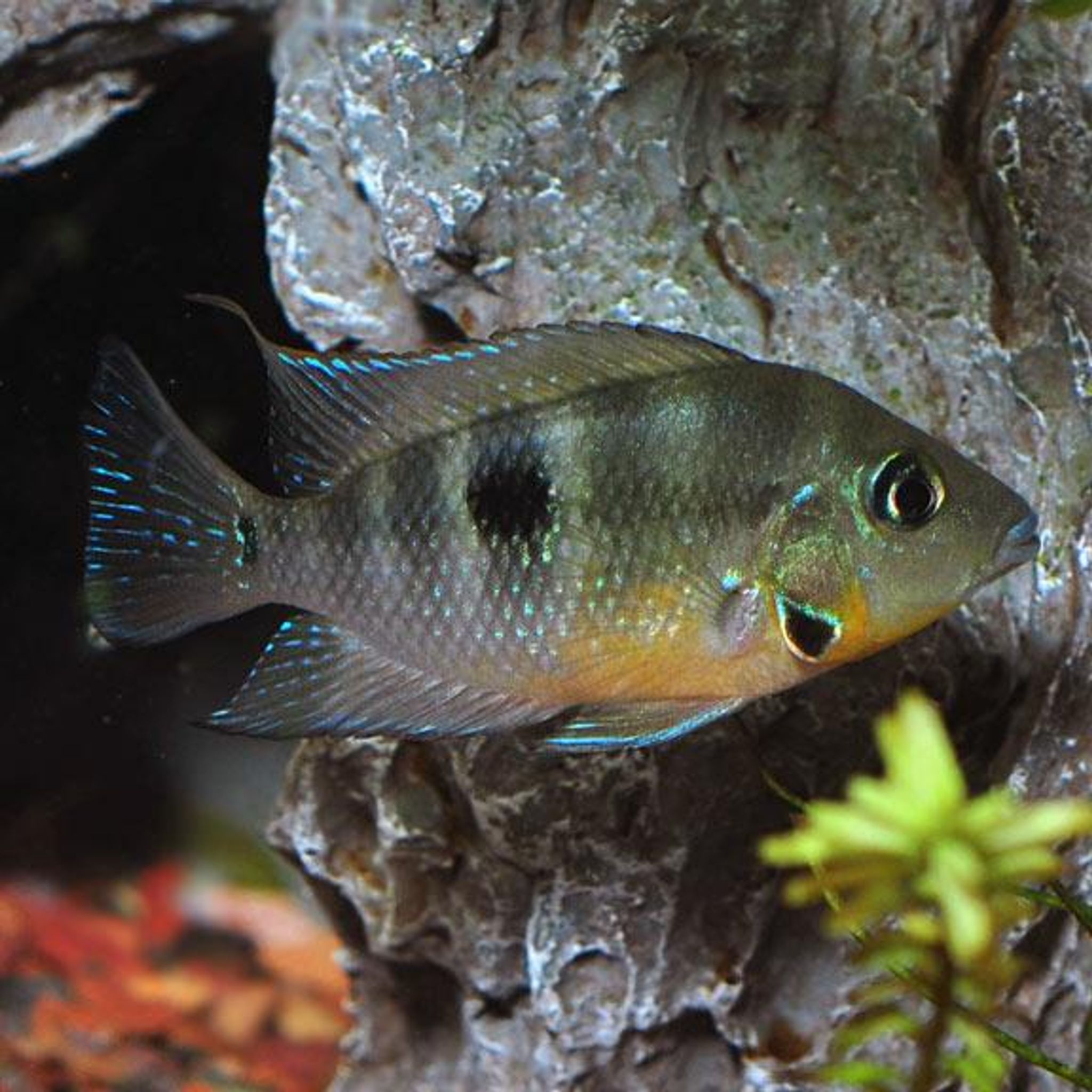
A healthy firemouth cichlid tops out around 6 inches (15 cm) for males and 5 inches (12.5–13 cm) for females, reaching most of that length within 12–18 months. This guide breaks down the growth timeline stage by stage and turns those numbers into a concrete tank-size and stocking plan.
Adult Size: What to Actually Expect
Firemouth cichlids (Thorichthys meeki) are a mid-sized Central American cichlid — bigger than dwarf cichlids like rams and apistogramma (around 3 inches), somewhat larger than convicts (4–5 inches), but well under the size of Texas cichlids, green terrors, or oscars (12–16 inches).
- Males: average around 6 inches (15 cm) total length.
- Females: average around 5 inches (12.5–13 cm).
- Exceptional individuals: wild-caught fish or exceptionally well-fed males in ideal conditions can approach 6.5–7 inches, but 6 inches is the realistic ceiling for most home-tank males.
The gap between males and females isn't just about length. Males typically develop longer, more pointed extensions on the dorsal and anal fins, along with slightly more vivid throat and gill-plate coloration — the "firemouth" flare that gives the species its name. These traits are useful for sexing before the size difference is obvious, though they only become reliable around 4–6 months of age; trying to sex a fish younger than that off body size alone is guesswork.
Growth Rate Timeline: Fry to Adult
Growth isn't linear, and treating "how big will it get" as a single number misses the more useful question of when. Here's the realistic stage-by-stage picture:
| Stage | Approximate age | Approximate length | Notes |
|---|---|---|---|
| Fry | 0–2 months | Under 1 in (2.5 cm) | Rapid early growth with good care |
| Juvenile | 3–6 months | 1.5–3 in (4–7.5 cm) | Sexing becomes possible but not fully reliable |
| Young adult | 6–9 months | 3–4 in (7.5–10 cm) | Fastest growth phase largely complete |
| Near-adult | 12–18 months | 4.5–6 in (11–15 cm) | Length growth slows sharply, approaching adult size |
| Mature adult | 2–4 years | 5–6+ in (12.5–15+ cm) | Length has plateaued; body depth, fin length, and color continue developing |
Sources genuinely disagree on how long it takes to reach "full size," and the disagreement comes down to what "full size" means. Some describe firemouths maxing out within 1–2 years; others, drawing on longer-term anecdotal observation, put true full-size potential at 4–5 years. Both are partly right: length growth is fast and mostly finished by 12–18 months, but body mass, fin extension, and full color intensity keep filling in for another one to three years afterward. Think of it as two separate clocks — one for length, one for overall bulk and maturity — rather than a single finish line.
This growth window also tends to overlap with pair bonding. Firemouths often begin pairing off and showing spawning behavior around the same time length growth is slowing down, which is worth planning for — a bonded pair may need a flat rock or cave as a spawning site, and aggression toward tankmates can spike once pairing starts, independent of how large the fish physically are by that point.
It's normal for visible growth to slow dramatically after the first year. That deceleration isn't a sign of poor health — it's the expected pattern once a firemouth is past its fastest growth phase.
What Drives Growth (and What Stunts It)
Several factors interact to determine whether a firemouth reaches its expected size or falls short:
- Tank size and space: Cramped housing is one of the most commonly cited real-world causes of stunted firemouths — fish kept long-term in undersized tanks frequently never reach the 5–6 inch range, even with otherwise decent care.
- Diet quality and feeding frequency: A poor or inconsistent diet during the juvenile growth window produces smaller adults that never catch up later.
- Water temperature and quality: Stable, appropriate parameters support consistent growth; neglected water quality suppresses it.
- Genetics and parent stock size: Offspring from smaller parent stock tend to run smaller themselves, though environment still has the larger effect.
- Stress from crowding or aggression: Chronic stress from tankmates or overcrowding diverts energy away from growth.
How to Avoid Stunting
Stunting isn't caused by one single mistake — it's usually a combination of undersized housing and inconsistent water quality compounding over months. The fix is proactive, not reactive: size the tank for the fish's eventual adult length rather than its current juvenile size, keep a consistent feeding and water-change schedule from the start, and avoid letting bioload creep up unnoticed as the fish grows. A firemouth that looks fine at 2 inches in a 10-gallon tank can quietly stall out well below its genetic potential by the time it's a year old.
Diet and Feeding for Healthy Growth
Firemouths are hardy omnivores and easy eaters, which makes overfeeding a more common problem than underfeeding.
- Base diet: quality cichlid pellets or flakes.
- Protein supplements: bloodworms, brine shrimp, or chopped shrimp 2–3 times per week.
- Feeding schedule: offer what the fish clears in 2–3 minutes, 1–2 times daily.
Overfeeding in an attempt to "speed up growth" doesn't produce a larger fish faster — it produces fast, unhealthy weight gain and degrades water quality, which works against growth rather than for it. Length is driven by consistent, appropriate feeding over months, not by larger portions in the short term. FishyHub carries a range of prepared foods suitable for a growing cichlid's diet in its Food & Supplements section.
Water Parameters That Support Growth
| Parameter | Recommended range |
|---|---|
| Temperature | 75–86°F (24–30°C) |
| pH | 6.5–8.0, aiming for the middle of that range |
| General hardness | Roughly 8–15 dGH |
| Filtration | Strong enough to handle a growing cichlid's rising bioload |
pH tolerance is one area where sources vary — some cite a narrower 6.5–7.5, others the wider 6.5–8.0. Firemouths are genuinely adaptable, so the wider range is the more accurate one to plan around, but they do best held near the middle rather than pushed to either extreme. Filtration matters more than many keepers expect here too: as a firemouth grows from 2 inches to 6 inches, its waste output climbs substantially, and a filter sized for the juvenile fish can fall behind within months.
Tank Size and Stocking Guide
This is the part that turns size data into an actual buying decision. Tank size recommendations vary across sources — some say a single fish is fine in 15 gallons, others insist on 30 gallons minimum no matter what. The honest middle ground: firemouths are active and territorial even alone, so smaller numbers work only as a stopgap, not a long-term home.
| Scenario | Minimum tank size | Notes |
|---|---|---|
| Single juvenile (short-term) | 15–20 gallons (57–76 L) | Fine temporarily; plan an upgrade as the fish grows |
| Single adult or bonded pair | 30 gallons (114 L), 40+ better for a pair | Territoriality increases once a pair forms |
| Community setup | 40 gallons minimum, 55+ gallons (208 L) commonly recommended | Add roughly 5–10 gallons per additional similarly sized fish |
A practical purchase timeline: if you're bringing home a 1–2 inch juvenile, plan on having a 30-gallon-or-larger tank ready by month 6–9, since that's when growth accelerates fastest and the fish will quickly outgrow a starter setup.
A 10-gallon tank is not recommended for a firemouth, even short-term. It's too small for the fish's eventual size and territorial behavior, and keepers who try it tend to see stress-related aggression well before any stunting from space becomes obvious.
Footprint Matters as Much as Volume
Firemouths are substrate- and territory-oriented fish, so floor space matters more than tank height. A long, shallow footprint beats a tall, narrow tank of the same volume, because it gives the fish more usable territory to establish and defend. When aquascaping, plan for:
- Open sand or fine gravel for natural sifting and digging behavior — firemouths sift substrate regularly, and a few inches of depth lets them do this comfortably.
- Caves or overturned pots for territory and eventual spawning sites.
- Flat rocks as potential spawning surfaces, particularly once a pair bonds.
- Sightline breaks (rockwork, driftwood) to reduce constant visual contact between territorial individuals in shared tanks.
Suitable Tank Mates
Because firemouths grow to a solid mid-size and hold territory, tank mate selection should account for their adult size, not their size at purchase:
- Avoid fish small enough to be seen as food, and avoid delicate invertebrates for the same reason.
- Avoid fish that are much larger or more aggressive, which can bully and stress a firemouth, suppressing its growth.
- Reasonable choices include other robust, similarly sized Central or South American cichlids and larger, fast-moving community fish that can hold their own. FishyHub's Angelfish, Discus, Rams & Cichlids category is a good place to browse appropriately sized companions.
Frequently Asked Questions
How big does a firemouth cichlid get?
Males average around 6 inches (15 cm) and females around 5 inches (12.5–13 cm) at full maturity. Occasionally, well-fed males in ideal conditions reach slightly larger, up to around 6.5–7 inches.
How fast do firemouth cichlids grow?
Growth is fastest in the first 6–9 months, with fry going from under an inch to roughly 3–4 inches in that window under good care. After that, growth slows sharply, with fish reaching near-full length by 12–18 months and full body maturity by 2–3 years.
What size tank does a firemouth cichlid need?
Plan on 20–30 gallons minimum for a single fish, 30–40 gallons for a bonded pair, and 40–55+ gallons for a community setup with appropriate tank mates. Floor space and footprint matter as much as total volume.
Do firemouth cichlids stop growing?
Length growth largely plateaus after 1.5–2 years, but the fish keeps filling out in body depth, fin length, and color intensity for a while after that. Slower visible growth past the first year is normal, not a sign of a problem.
How can you tell if a firemouth is male or female?
Males are typically larger with longer, more pointed dorsal and anal fin extensions and richer throat coloration. These differences are reliable mainly after 4–6 months of age — trying to sex a younger fish by size alone is unreliable.
Can firemouth cichlids be kept in a 10-gallon tank?
No, this isn't recommended even as a short-term arrangement. A 10-gallon tank is too small for a firemouth's adult size and territorial behavior, and tends to produce stress and aggression issues quickly.
Why isn't my firemouth cichlid growing?
Check tank size relative to the fish's adult potential, water quality and parameters, diet quality and feeding frequency, and stress from tankmates or crowding. Any one of these, if inadequate, can suppress growth even when the others are fine.
How long do firemouth cichlids live?
Typically 8–10 years in a well-kept aquarium, with some well-cared-for individuals reaching 10–15 years. Consistent water quality and appropriate tank size over the fish's lifetime play a large role in reaching the higher end of that range.
Ready to plan a firemouth's tank around its adult size? Browse Freshwater Livestock on FishyHub to compare firemouths and appropriately sized tank mates before you buy.


