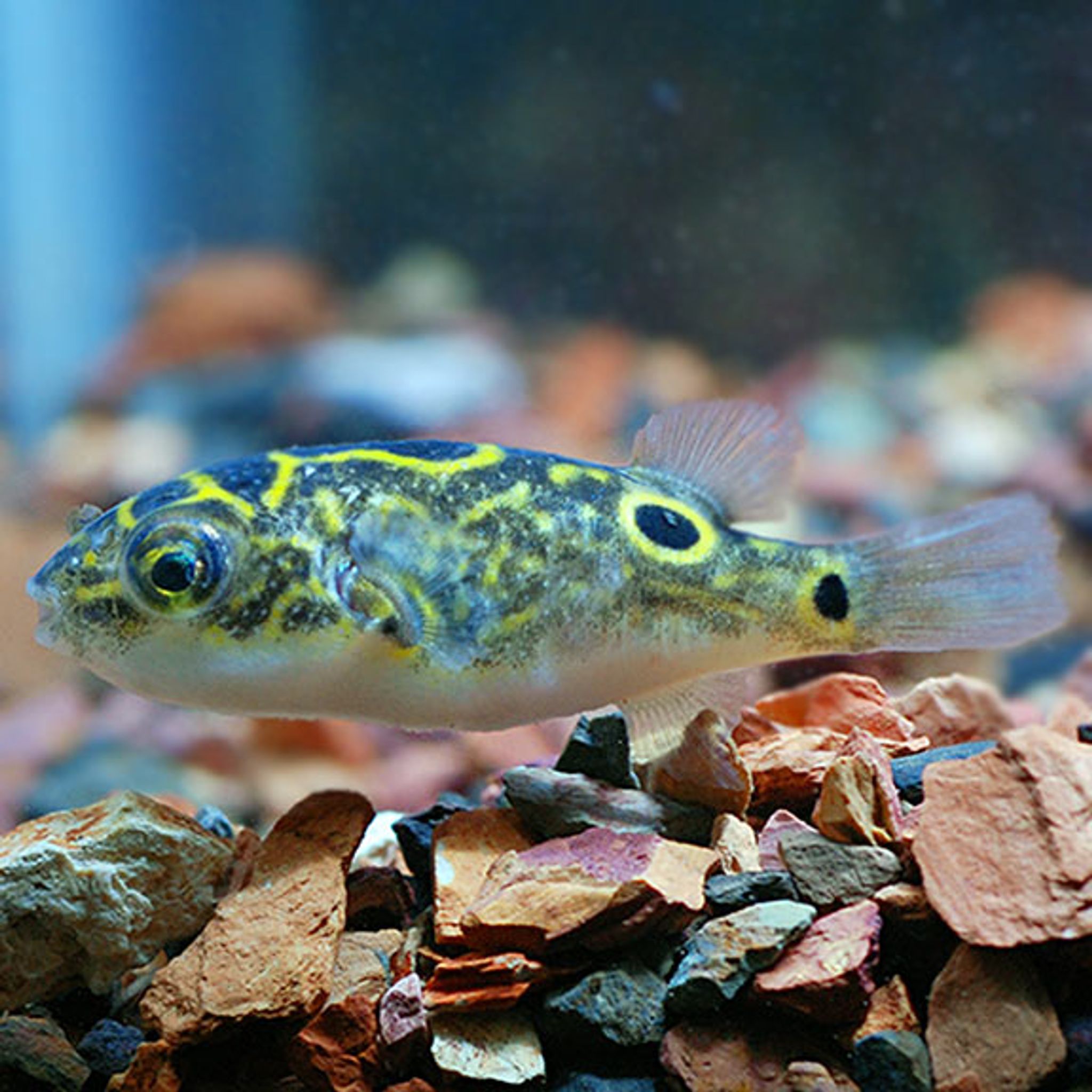
How Big Do Figure 8 Puffer Get? Growth Rate, Adult Size and Tank Planning
A figure 8 puffer usually tops out around 2.5 to 4 inches (6–10 cm), with most adults settling near 3 to 3.5 inches, and it typically reaches that full size within about a year. The bigger planning issue isn't the final length — it's that the half-inch juvenile sold in a freshwater-labeled tank actually needs low brackish water and a proper filtration setup for a decade or more.
Adult Size: Why the Numbers Vary
Care sheets disagree on the exact ceiling for Dichotomyctere ocellatus (also sold under the older name Tetraodon ocellatus), with reported maximums ranging from about 2.5 inches to 4 inches standard length. Treat this as a range rather than a fixed number:
- Typical adult: 3–3.5 inches (7.5–9 cm)
- Realistic maximum: up to 4 inches (10 cm), occasionally reported
- Small end: 2.5 inches (6 cm) for some individuals, especially females in some accounts
Individual size depends on genetics, diet quality, and how early the fish gets consistent brackish conditions. There's no harm in planning around the higher end of the range so your tank never feels undersized.
Growth Rate: What to Expect Month by Month
Figure 8 puffers are purchased small — often under 1 inch — and they grow quickly at first before growth slows sharply as they approach adult size. This asymptotic pattern (fast early, flat later) is typical of puffers generally. A rough, generalized milestone table looks like this:
| Age | Approximate Length | Growth Stage |
|---|---|---|
| At purchase | 0.5–1 in (1.3–2.5 cm) | Juvenile, rapid growth begins |
| 1 month | ~1–1.5 in (2.5–4 cm) | Fast early growth |
| 3 months | ~1.5–2.25 in (4–5.5 cm) | Still gaining steadily |
| 6 months | ~2.25–3 in (5.5–7.5 cm) | Growth starting to slow |
| 12 months | ~3–3.5 in (7.5–9 cm) | Near or at full adult size |
| 12+ months | 3–4 in (7.5–10 cm) | Length essentially stable |
These figures are approximate and meant as a planning guide, not a guarantee — but the pattern holds: expect roughly a half-inch of growth every two months during the first several months, then a plateau. Full size is typically reached by around 1 year old, though some individuals take a bit longer.
Tank Size: Buy for the Adult, Not the Juvenile
The single biggest mistake new keepers make is sizing the tank to the inch-long fish in the store rather than the 3-to-4-inch adult it becomes. Recommendations vary by source, so here's a practical breakdown:
- 15 gallons (57 L): workable only as a temporary juvenile starter tank, not a long-term home
- 20-gallon long (76 L): the real practical minimum for one adult
- 30 gallons (114 L): the comfortable standard for long-term keeping, and better if you want live plants and rockwork
If you're considering more than one figure 8 puffer — generally not advised given their territorial nature — add roughly 10 or more gallons per additional fish, and have a separation plan ready.
Footprint beats height. These are bottom- and mid-water cruisers that patrol and defend territory along the floor, so a long, wide tank with more swimming and sightline-breaking space serves them far better than a tall, narrow one with the same volume. A 20-gallon long footprint will suit a figure 8 puffer better than a taller 20-gallon tank of the same capacity.
Buying the adult-size tank from the start avoids the cost and stress of an unplanned upgrade a few months in — moving an established, territorial fish mid-adolescence is more disruptive than most keepers expect. You can browse glass tanks sized for a long-term brackish setup before you bring a puffer home.
Water Parameters and Salinity
Figure 8 puffers are a brackish species for their entire lives, not just as adults — this is one area where getting it wrong shortens lifespan and increases disease risk.
- Specific gravity: roughly 1.005–1.008 (low-end brackish), maintained continuously
- Temperature: 72–82°F (22–28°C), with many keepers targeting 76–78°F (24–26°C)
- pH: 7.5–8.0 — noticeably higher than a typical freshwater community tank
- GH: roughly 10–12 dGH
- Ammonia/nitrite: 0 ppm at all times; nitrate kept consistently low
Unlike some larger puffer species that need rising salinity as they age, the figure 8 puffer's brackish needs stay low and stable for life — you're not managing a salinity ramp, just consistent low-end brackish water.
A Simple Salinity Cheat Sheet
Specific gravity, parts per thousand (ppt), and marine salt mix dosage all describe the same thing in different units. As a rough starting reference for low-end brackish water:
| Specific Gravity | Approx. Salinity (ppt) | Approx. Marine Salt Mix |
|---|---|---|
| 1.002 | ~3 ppt | ~1 tablespoon per gallon |
| 1.005 | ~7 ppt | ~2 tablespoons per gallon |
| 1.008 | ~11 ppt | ~3 tablespoons per gallon |
Always mix salt separately, dissolve fully, and check with a hydrometer or refractometer rather than dosing by tablespoon alone — these figures are a starting reference, and actual mix strength varies by brand.
Filtration and Bioload
Figure 8 puffers are messy eaters and heavy waste producers relative to their size, and their scaleless skin makes them unusually sensitive to poor water quality. Rather than a vague "get a big filter," aim for:
- Filtration rated for at least double the actual tank volume in turnover capacity
- Weekly partial water changes rather than relying on filtration alone
- Frequent nitrate testing, since brackish setups can mask early ammonia issues that would be more obvious in a plain freshwater tank
Because scaleless fish absorb medications differently, avoid copper-based treatments and standard ich medications formulated for scaled fish — check labels carefully before treating this species for anything. A capable hang-on or external filter sized generously above the tank's rated volume gives you margin for this bioload.
Diet: Feeding for a Healthy Beak
Like all puffers, the figure 8's beak — its fused, continuously growing teeth — needs constant wear from hard-shelled foods, or it can overgrow to the point the fish can't eat properly.
- Good staples: snails, shrimp, krill, mussels, clams, oysters
- Not sufficient alone: pellets or flakes — these don't provide the grinding resistance the beak needs
- Feeding frequency: daily for juveniles; every 1–2 days for adults to prevent obesity
Offering snails regularly does double duty — it wears the beak down and gives an intelligent, easily bored fish something to hunt.
Enrichment and Temperament
Figure 8 puffers are widely considered intelligent for their size, and boredom shows up as glass surfing, hiding, or general listlessness. A sandy substrate, driftwood, rockwork, and dense hardy planting all help by giving the fish territory to patrol and cover to explore. Some keepers report their puffer recognizing them at feeding time, which tracks with general puffer cognition.
Temperament, though, is where expectations need tempering. Figure 8 puffers are solitary and territorial by nature. Aggression ranges from occasional fin-nipping to outright persecution of tankmates, and there's no reliable rule that guarantees peaceful cohabitation — it comes down to individual fish, tank size, and how much you're willing to monitor and intervene.
Peaceful Puffer Species: A Relative Term
Compared to many larger puffers, the figure 8 has a reputation as one of the more manageable species — but "peaceful" here is relative, not absolute. Larger freshwater and brackish puffers tend to be more consistently solitary and aggressive as they mature, while the figure 8 sits toward the milder end of the spectrum. Even so, individual variation is significant: one figure 8 might tolerate tankmates for years, while a sibling from the same batch persecutes anything that shares its space. Never buy one assuming it will be the exception.
Can Figure 8 Puffers Live With Other Fish?
Community keeping is possible in some cases but shouldn't be the default plan. Fish most commonly cited as occasional brackish tankmates include:
- Mollies and other livebearers tolerant of low salinity
- Bumblebee gobies and violet gobies
- Monos
- Glassfish
Each comes with the same caveat: success with a puffer specifically is inconsistent, and what works in one tank fails in another. Community attempts are realistic only in a large, heavily planted or decorated tank with plenty of sightline breaks, close observation, and a backup tank ready if aggression escalates — not as a routine setup.
Other Puffers Worth Knowing About
Species identification matters enormously with puffers, since "puffer" covers wildly different care requirements.
Amazon Puffer: A True Freshwater Alternative
For keepers who want puffer looks without managing salt at all, the Amazon puffer is a genuinely freshwater species — no brackish conversion needed. It prefers warmer water, roughly upper 70s to mid-80s°F, and stays similarly small as an adult, making it a reasonable substitute for anyone put off by the figure 8's brackish requirement.
Leopard (Green Spotted) Puffer: A Cautionary Contrast
The leopard, or green spotted, puffer is often sold alongside figure 8 puffers as a similar-looking juvenile, but it grows much larger — roughly 6 to 7 inches or more — and critically, it shifts from freshwater-tolerant as a juvenile to requiring full marine salinity as an adult. Buyers who don't confirm species at purchase risk ending up with a fish whose adult housing and salinity needs are completely different from what they planned for. Always verify species before buying, since mislabeled puffers at pet stores are a common cause of size-planning surprises.
Which Puffer Fits Your Setup?
| Species | Adult Size | Water Type |
|---|---|---|
| Figure 8 puffer | 2.5–4 in (6–10 cm) | Low brackish for life |
| Amazon puffer | Similarly small | True freshwater |
| Leopard (green spotted) puffer | 6–7+ in (15–18+ cm) | Freshwater juvenile → full marine adult |
Brackish Plants That Tolerate Low Salinity
Most stem and root-feeding plants struggle in brackish water, but a handful of hardy species tolerate the low end of a figure 8's salinity range — provided they're mounted rather than planted directly in salt-exposed substrate:
- Java fern — mount on wood or rock, never bury the rhizome
- Anubias — same mounting approach, very salt-tolerant
- Java moss — attaches easily to hardscape
- Sagittaria — more salt-tolerant than most true aquatic plants
- Crinum-type bulb plants — hardy bulbs that handle low brackish conditions better than fine-rooted species
Mounting on driftwood or rock rather than rooting in substrate protects salt-sensitive roots while still giving the puffer cover and enrichment.
Buy the Adult Tank Now, or Upgrade Later?
For budget-conscious buyers, it's tempting to start with a cheap 10- or 15-gallon setup and upgrade later. In practice, that approach usually costs more overall once you count a second tank, a second filter, and the water quality dips that come with an established, territorial fish being rehomed mid-growth. Buying the 20-gallon-long-or-larger setup from day one, sized and salted correctly, is the more economical and less stressful path for a fish you'll likely keep for a decade or more.
Common Mistakes to Avoid
- Undersizing the tank based on a half-inch juvenile, then facing a stressful upgrade months later
- Keeping the fish in plain freshwater long-term instead of low brackish, which shortens lifespan and raises disease risk
- Feeding only pellets or flakes, leading to an overgrown beak that can prevent the fish from eating
- Skipping quarantine or using copper-based medications on a scaleless, medication-sensitive fish
- Adding tankmates impulsively without a backup plan for when aggression appears
- Under-filtering for the waste load, which risks ammonia or nitrite spikes in a fish already prone to illness from poor water quality
Frequently Asked Questions
How big does a figure 8 puffer get in a home aquarium?
Most adults reach 3 to 3.5 inches (7.5–9 cm), with a realistic range of 2.5 to 4 inches (6–10 cm) depending on the individual. Full size is typically reached by around 1 year old.
How fast do figure 8 puffers grow?
Growth is fast in the first several months — roughly half an inch every two months as a juvenile — then slows markedly as the fish approaches its adult size, usually within the first year.
What is the minimum tank size for one figure 8 puffer?
A 20-gallon long tank is the practical minimum for a single adult, with 30 gallons preferred for long-term comfort and enrichment. A 15-gallon tank should be treated as a temporary juvenile setup only.
Do figure 8 puffers need salt/brackish water?
Yes. They require low-end brackish water, roughly 1.005–1.008 specific gravity, for their entire lives. Unlike some puffer species that need rising salinity with age, their brackish needs stay low and stable.
Can figure 8 puffers live with other fish?
Sometimes, with fast-moving or short-finned brackish-tolerant species like mollies, bumblebee gobies, monos, or glassfish in a large, well-decorated tank — but success is inconsistent fish to fish. Solitary keeping remains the safer default.
What do figure 8 puffers eat to stay healthy?
Hard-shelled and meaty foods like snails, shrimp, krill, mussels, and clams keep the fish's continuously growing beak worn down. Pellets or flakes alone aren't sufficient and can lead to beak overgrowth.
How long do figure 8 puffers live?
With proper brackish care, consistent water quality, and a varied diet, figure 8 puffers are commonly reported to live 10 to 15 years — making tank planning a decade-plus commitment.
Why is my figure 8 puffer glass surfing or hiding?
This usually signals boredom or stress. Check water parameters first, then consider adding more enrichment — rockwork, driftwood, or hardy plants — and reassess whether current tankmates or tank size are contributing to the stress.
Ready to plan a proper brackish setup? Browse puffers and the tank, filtration, and substrate options on FishyHub to build a home sized for the adult fish from day one.


