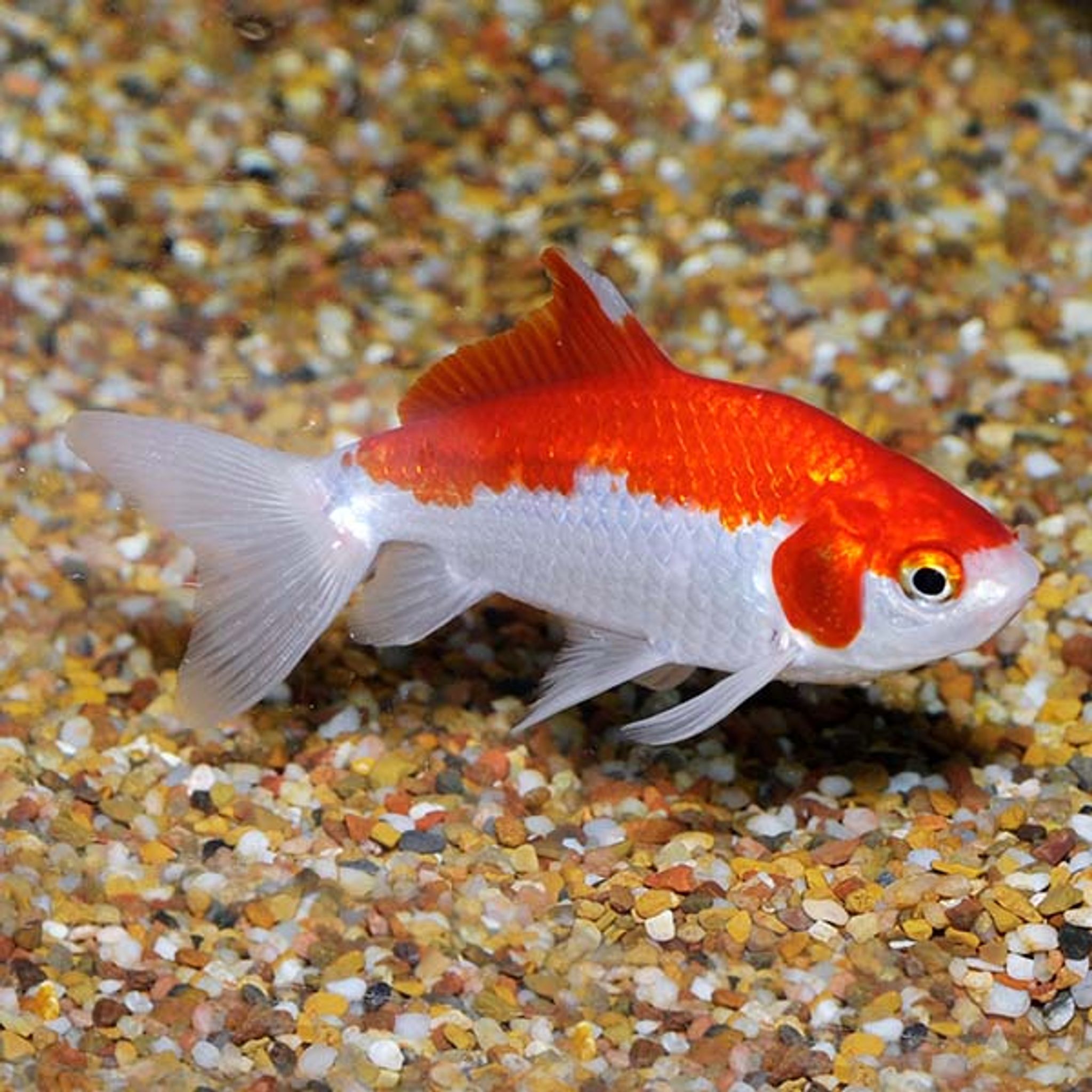

How Big Do Fancy Goldfish Get? Growth Rate, Adult Size and Tank Planning
Most fancy goldfish sold at 1–2 inches long will grow into a 5- to 9-inch adult over several years, with the exact ceiling depending on variety, water quality, and available space. This guide breaks down adult size by variety, a realistic month-by-month growth curve, and the gallon math you need before you buy a tank instead of after.
Fancy Goldfish Are Not "Mini" Goldfish
Fancy goldfish and slim-bodied single-tailed goldfish are all the same species, Carassius auratus. The "fancy" varieties are body-shape mutations selectively bred for a rounded, egg-shaped body and elaborate fins, and that shorter body plan is what keeps them smaller than their slim-bodied cousins — not some inherent property of being "fancy" or "ornamental."
That distinction matters at the shop counter. A comet or common goldfish looks identical in size to a fantail or oranda at the juvenile stage, but the two groups part ways dramatically as adults:
- Fancy (egg-bodied) types: roughly 5–10 inches, variety-dependent
- Single-tailed types (comet, common, wakin, shubunkin): roughly 10–16+ inches, with some pond-raised comets and commons reported even larger
"Fancy" means slower and rounder growing — it does not mean small.
Adult Size by Fancy Variety
Length figures below are total length: body plus tail, measured on a healthy adult kept in adequate space. Head growth ("wen") on hooded varieties adds visible bulk beyond the raw body-length number.
| Variety | Typical adult length | Notes |
|---|---|---|
| Fantail | 6–8 in | Classic double-tail fancy shape |
| Oranda | 8–10 in | Wen/head growth adds bulk beyond body length |
| Ryukin | 6–8 in | High-backed, deep-bodied |
| Ranchu | 5–8 in | No dorsal fin; curved back profile |
| Lionhead | 5–6 in | Similar to ranchu, smaller wen |
| Black moor | 6–8 in | Telescope-eye body type |
| Pearlscale | 4–6 in in tanks, up to 10 in in ponds | Widest range of any fancy variety |
| Telescope-eye | 6–8 in | Fantail-style body, protruding eyes |
| Bubble eye / Celestial | Under 6 in | Smaller and more delicate; poor eyesight/balance |
For comparison, single-tailed types kept as a benchmark: comet around 10–14 inches (with pond reports up to 18 inches), common goldfish 12–14+ inches, and wakin/shubunkin up to 12–16 inches in large ponds.
Two variety notes worth flagging separately:
- Oranda size is genuinely debated across sources — some cap it at 8–9 inches, others report 9–10 inches. The gap is largely the wen: a mature oranda's head growth can make the fish look noticeably bigger than its body-length measurement alone suggests.
- Pearlscale has the widest reported range of any fancy variety (4–10 inches) because tank-kept fish and pond-raised fish of the same strain can end up very different sizes. Plan around 4–6 inches for aquarium keeping and treat anything larger as a pond-level bonus.
Rare and Uncommon Varieties
A handful of fancy varieties are uncommon in the US hobby, often imported and priced higher than standard fantails or orandas: Izumo Nankin, Jikin, Watonai, and Tosakin. Their space requirements track similar or slightly larger fancy-type ranges above — the real difference between them and common fancy goldfish is price and availability, not care or tank sizing.
A Note on Calico Coloration
Calico is a color and scale pattern — white, red/orange, black, and blue-grey patches, usually with a matte "nacreous" scale finish — not a breed of its own. It shows up across multiple breeds, including shubunkin, oranda, and telescope-eye fish. A shubunkin is a specific breed that is commonly (though not always) calico-colored; calico itself does not change a fish's adult size.
How Fast Do Goldfish Grow?
Growth is fastest in the first one to two years of life, then continues at a slower pace for several more years. Most fancy goldfish don't reach full adult length and body shape until age 3–5 — and body shape often takes longer to fill out than length does.
| Age | Typical size (well-kept fancy goldfish) |
|---|---|
| At purchase (often under 1 year) | 1–2 in |
| 6 months | 2–3 in |
| 1 year | 3–4 in |
| 2 years | 4–6 in |
| 3–4 years | 6–8+ in, approaching adult size |
| 5+ years | Full adult length and body shape |
Treat this as a directional guide, not a guarantee — the actual pace depends heavily on what the fish is kept in.
What Actually Drives Growth
Genetics sets the ceiling, but environment decides whether a fish gets anywhere near it. The main levers are:
- Tank or pond volume — more water supports faster, healthier growth
- Water quality — frequent partial water changes and consistently low nitrates
- Diet — both quantity and nutritional quality
- Stocking density — fewer fish competing for the same resources grow larger, faster
A goldfish kept in a bowl or an undersized tank does not grow into a proportionally smaller, healthy adult. It becomes stunted — and stunting is linked to compressed internal organs and a shortened lifespan, not just a smaller-looking fish. This is the core reason "it'll only grow to the size of its tank" is a myth worth retiring: the fish doesn't cap its growth safely, it suffers for it.
A realistic planning number: a 1–2 inch juvenile fancy goldfish can reasonably reach 6–8+ inches within 2–4 years given enough space and good care. Buy the tank for that fish, not for the fish you're holding today.
Tank Planning: The Gallon Math
The Basic Rule
- 20 gallons minimum for the first fancy goldfish
- +10 gallons for each additional fancy goldfish
- Single-tailed comet or common goldfish need substantially more — closer to 30–50 gallons for the first fish — since they grow much larger
Some variety-specific profiles (pearlscale, telescope-eye) recommend a higher per-fish minimum, closer to 30 gallons, because of bioload and fragility. Treat the 20/+10 rule as a floor, not a target — bigger is always better with goldfish.
Worked example: three fancy goldfish → 20 + 10 + 10 = 40 gallons minimum. A standard 40-gallon breeder footprint (roughly 36 × 18 inches) works well because it prioritizes floor space over height, which is exactly what goldfish need.
If you're converting from a metric source, roughly 70–80 liters per fish lines up reasonably well with the 20-gallon-per-fish range once converted — the two systems aren't in real conflict, just different units.
Shape Matters More Than You'd Think
Goldfish prefer a long, wide, shallow-ish "squatter" tank over a tall narrow column. Surface area drives oxygen exchange, and goldfish — being heavy waste producers with high oxygen demand — benefit far more from footprint than from height. A tall 40-gallon column tank is a worse choice for goldfish than a shallower 40-gallon long tank, even though the volume is identical.
Temperature and Filtration
Fancy goldfish are coldwater fish and generally don't need a heater. Room temperature in the roughly 65–72°F range suits them well; they can tolerate a wider swing (often cited around 50–70°F) but do best within the narrower comfort band.
Filtration is where new keepers most often undershoot. Goldfish produce far more waste than a similarly sized tropical community fish, so filtration sized for a "10-gallon tropical community" badly undershoots a 10-gallon goldfish tank. Plan for strong mechanical and biological filtration rated well above the tank's actual volume, plus weekly partial water changes as standard maintenance — not a fix for problems, just the baseline. Browsing filters sized above your tank's rated capacity is the simplest way to build in that margin from day one.
Decor for Delicate Varieties
Bubble eye, telescope-eye, and celestial varieties have fragile eyes and often poor eyesight or balance; long-finned varieties are prone to fin damage from sharp decor. Live or soft fake plants and smooth-edged decor reduce injury risk. These fragile types also don't mix well with fast, nippy single-tailed goldfish or aggressive tankmates that can outcompete them for food or damage their eyes and fins.
If you're shopping for stock, browsing the goldfish category — including varieties like ryukin — is a good way to compare what's actually available before committing to a tank size.
Ponds: Removing the Size Ceiling
An outdoor pond removes the volume ceiling that many aquarium keepers eventually hit, and it's a natural upgrade path once a fancy goldfish outgrows an indoor setup — or the obvious choice from the start for hardier single-tailed varieties.
Ponds 101: Getting Started
- Siting: away from overhanging trees, which drop leaves and debris and can also give predators an access point
- Shell type: a preformed shell is quicker to install and easier to shape precisely; a flexible liner allows custom shapes and depths but needs careful measurement
- Size tiers: small ponds run roughly 100–250 gallons, mid-size 250–500 gallons, and large ponds 500–1,500+ gallons
- Filtration and circulation: sized to the pond's actual volume, not a flat number — bigger volume needs proportionally more turnover
- Seasonal transitions: a planned water-change step at both spring startup and fall shutdown helps the system adjust rather than being shocked by a sudden seasonal swing
Choosing a Liner
A flexible liner is the right call when the excavation has an irregular shape or non-standard depth that no preformed shell matches. Size a liner by measuring the planned excavation's length, width, and depth, then adding extra material to account for folds and edge overlap — underestimating this is the most common liner-sizing mistake.
Which Fish Belong Outdoors
Hardier single-tailed types — comet, shubunkin, common goldfish — are the traditional pond fish for good reason: they tolerate temperature swings and predator risk better than delicate fancy varieties. Bubble eye, celestial, and some orandas are more vulnerable outdoors because of poor eyesight, balance issues, or reduced cold tolerance. If you do move fancy goldfish outdoors, hardier fancy types (fantail, black moor) fare better than the most delicate-eyed varieties.
Pond Water Quality Troubleshooting
Test first, then treat — matching symptoms to a specific parameter rather than guessing at a remedy:
- Ammonia or nitrite spikes: usually overfeeding, overstocking, or insufficient biological filtration; test before assuming illness
- Cloudy or green water: typically an algae bloom driven by excess nutrients and sunlight, not a disease outbreak
- pH swings: often linked to low buffering capacity or heavy rain dilution; test rather than dose blindly
- Low oxygen in summer heat: warmer water holds less dissolved oxygen, so increase surface agitation and aeration during hot stretches
Pond Equipment Troubleshooting
- Reduced flow: usually a clogged pre-filter or intake strainer — check and clean these first
- Algae control failures: a UV clarifier that isn't controlling algae is often due to a worn bulb, insufficient contact time, or flow that's too fast for the unit's rating
- Routine maintenance: filter media needs regular cleaning or back-flushing on a schedule, not just when a problem appears
Insect and Invertebrate Invaders
Dragonfly nymphs, backswimmers (water boatmen), and hydra can prey on eggs, fry, and even the fins of small fish. Fine mesh or screen over the pond — especially while introducing new fish or fry — is a simple, effective physical barrier against these predators.
Common Mistakes to Avoid
- Assuming "fancy" means "stays small" and housing a juvenile in a bowl or nano tank — this leads to stunting, swim bladder issues, and poor water quality
- Undersizing filtration by treating goldfish bioload like a similarly sized tropical community
- Choosing a tall, narrow tank instead of a long, shallow footprint
- Mixing fragile fancy types with fast, nippy single-tailed or aggressive tankmates
- Assuming growth is finished at 1 year — real adult size and body shape can take 3+ years
- Skipping acclimation when moving a goldfish outdoors, or moving it before pond water temperatures are stable
- Chasing symptoms with medication instead of testing ammonia, nitrite, and pH first when a fish looks unwell
Frequently Asked Questions
Do fancy goldfish really get as big as common goldfish?
No. Fancy, egg-bodied types generally top out around 5–9 inches depending on variety, while slim-bodied comet and common goldfish reach 10–14+ inches. Both groups, however, need far more space than their sold size suggests.
How fast do goldfish grow?
Growth is fastest in the first year, then continues more slowly for several more years. Full adult size and body shape can take 3–5 years, and growth is faster and larger in bigger, well-maintained systems.
Can I keep a fancy goldfish in a 10-gallon tank forever?
Not recommended. Twenty gallons is the commonly cited minimum for one fancy goldfish, with an additional 10 gallons per extra fish — a 10-gallon tank falls well short even as a starting point.
Will a goldfish only grow to the size of its tank?
This is a myth. A small tank doesn't safely cap growth at a proportionally smaller size — it causes stunting, which is linked to organ compression and health problems rather than being a harmless space-saving shortcut.
Can fancy goldfish live in an outdoor pond?
Yes for hardier fancy types, but delicate-eyed or heavily finned varieties like bubble eye, celestial, and some orandas are more vulnerable to predators, injury, and cold outdoors. Hardier single-tailed types remain the traditional, lower-risk pond choice.
What's the difference between a calico goldfish and a shubunkin?
Calico is a color and scale pattern — patches of white, red/orange, black, and blue-grey with a matte finish — that can appear across several breeds. Shubunkin is a specific breed that is commonly, but not exclusively, calico-colored.
Why does my goldfish's head keep growing?
In hooded varieties like oranda, lionhead, and ranchu, the fleshy head growth (wen) continues developing with age. This is normal and not a health concern unless it grows enough to obstruct the eyes or gills.
Do rare goldfish varieties need different tank sizes?
Generally not. Uncommon types like Izumo Nankin, Jikin, Watonai, and Tosakin need space comparable to standard fancy varieties of similar body shape — the real difference is price and how hard they are to source, not care requirements.
Once you know the adult size you're planning around, matching tank footprint to fish load gets much easier. You can browse glass tanks sized to fit the long, shallow footprint goldfish need before bringing a new fish home.


