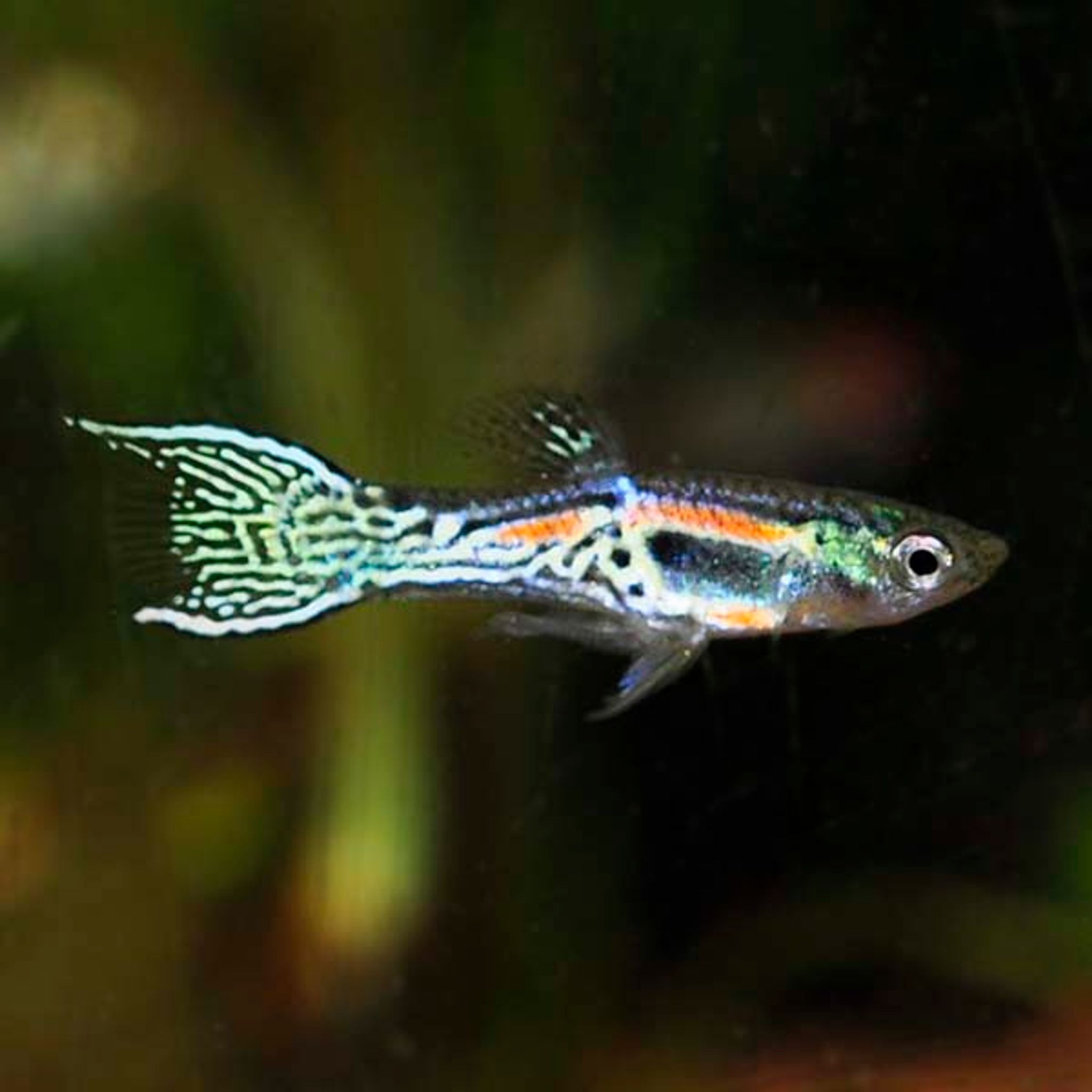

How Big Do Endler's Livebearer Get? Growth Rate, Adult Size and Tank Planning
Adult male Endler's livebearers reach about 0.8–1.2 inches (2–3 cm), while females grow to roughly 1.4–2 inches (3.5–5 cm) — noticeably smaller than standard fancy guppies. This guide breaks down the growth timeline by sex, the factors that affect final size, and how to translate that tiny footprint into real gallons, stocking numbers, and a breeding plan.
Adult Size: Males vs. Females
Endler's are one of the smallest commonly kept livebearers, and the sexes look almost like different species once mature.
- Males: about 0.8–1.2 in (2–3 cm), typically cited around 1 in (2.5 cm). Slender-bodied with intense, often iridescent color patterns.
- Females: about 1.4–2 in (3.5–5 cm), typically cited around 1.8 in (4.5 cm). Rounder, deeper-bodied, and plain silver-gray by comparison.
The size gap isn't a health issue — it reflects reproductive biology. Females carry developing fry internally, so a larger body cavity is normal and expected.
Size Chart: Endler's by Sex and Life Stage
| Stage | Approx. size (in) | Approx. size (cm) | Notes |
|---|---|---|---|
| Newborn fry | 0.2–0.3 in | 0.5–0.8 cm | Free-swimming immediately, no parental care |
| Juvenile (6–8 weeks) | ~0.5–0.7 in | ~1.3–1.8 cm | Males may start showing color |
| ~3 months | ~2/3 of adult size | ~2/3 of adult size | Growth rate slows from here |
| Adult male (3–4 months) | 0.8–1.2 in | 2–3 cm | Full size and color |
| Adult female (4–6 months) | 1.4–2 in | 3.5–5 cm | Continues slight growth for reproduction |
Exact figures vary across sources, which is why a range plus a "typical" midpoint is more useful than a single hard number. Pure, wild-strain Endler's tend to sit at the smaller end of these ranges, while hybridized "Endler-guppy" strains commonly sold in stores often run larger — more on that below.
Endler's vs. Fancy Guppies: The Size Comparison
Common fancy guppies run considerably larger: males typically reach 1.5–2.4 in, and females 2–2.4 in. That makes Endler's roughly 30–50% smaller than standard guppies across both sexes.
If your Endler's seem tiny compared to a friend's guppies, that's not a growth problem — it's the species. A common troubleshooting mistake is assuming a small Endler's is stunted simply because it's being measured against a fish that's naturally larger.
Endler's (Poecilia wingei) and guppies (Poecilia reticulata) are closely related and cross-fertile, but they are distinct species. Here's the nuance that trips up a lot of buyers: most Endler's sold commercially today are actually Endler-guppy hybrids, not pure wild-type stock. Hybrids typically land closer to guppy proportions, which explains why "my Endler's got bigger than expected" is such a common comment. If size consistency matters to you, ask about lineage before buying, and expect hybrid stock to vary more than pure wingei lines.
Growth Timeline: Birth to Full Adult Size
Endler's are livebearers, meaning fertilization happens internally and fry are born fully formed and free-swimming — no egg stage, no incubation period, and no parental care required. This is a key contrast with egg-scattering species, where eggs are laid externally and need days to weeks to hatch before fry become mobile. That difference is part of why livebearer populations grow so fast: every surviving fry is already swimming, feeding, and (eventually) breeding from day one.
A rough growth timeline:
- Birth: Fry are independent immediately, roughly 0.2–0.3 in.
- 6–8 weeks: Males can begin displaying color and mating behavior. This is sexual maturity, not full adult size — an important distinction, since an actively breeding male may still be visibly smaller than he'll eventually become.
- ~3 months: Most fry reach about two-thirds of their eventual adult size.
- 3–4 months: Males are typically full-grown.
- 4–6 months: Females reach full size, growing slightly longer than males due to ongoing reproductive development.
What Affects Final Adult Size
Several factors can push an individual fish toward the smaller or larger end of its range:
- Genetics/lineage: Line-bred and wild-type strains vary meaningfully; hybrid stock trends larger and less predictable than pure Endler's.
- Diet quality and frequency: Inconsistent or nutrient-poor feeding limits growth potential.
- Water quality and temperature stability: Fluctuating conditions stress fish and slow development.
- Stocking density: Crowding is a well-documented cause of stunted growth in livebearers.
- General health: Parasites or disease early in life can permanently cap adult size, even after the fish recovers.
Overcrowding and infrequent water changes are the most common preventable cause of genuine stunting — as opposed to the natural small size that's simply normal for this species.
Water Parameters Endler's Actually Prefer
One nuance that generic guppy care pages often miss: Endler's specifically favor harder, more alkaline water than the standard community-tank range of 6.8–7.8 pH quoted for guppies in general.
- Temperature: 72–82°F (22–28°C) — on the warmer side of typical community tanks, reflecting their tropical Venezuelan origin.
- pH: 7.0–8.5, leaning alkaline.
Keeping Endler's in soft, acidic water borrowed from a tetra or soft-water setup is a common mistake that can reduce vigor, hurt fry survival, and dull coloration over time.
Tank Planning by the Numbers
Because Endler's are so small, it's tempting to think any tiny tank will do. In practice, planning by adult size alone undersells how fast a colony grows.
- Minimum footprint: 5–10 gallons (19–38 L) for a small group.
- Rough stocking guideline: about 1 inch of adult fish per gallon works loosely for many community fish, but with Endler's this should guide starting stock, not long-term capacity — bioload from fry populations matters more than adult body length.
- Sex ratio: Keep 1 male to 2–3 females to reduce harassment, or run an all-male "bachelor" group if you want color without breeding.
Gallons vs. Realistic Population
| Tank size | Starter adults | Realistic long-term capacity | Planning notes |
|---|---|---|---|
| 5 gal (19 L) | 3–5 | 6–8 total incl. some fry | Needs frequent fry thinning |
| 10 gal (38 L) | 6–10 | 15–25 total incl. fry | Comfortable starter colony; still needs management |
| 20 gal (76 L) | 12–15 | 30–40+ total incl. fry | Room for a self-sustaining colony with periodic rehoming |
A 10-gallon tank can comfortably house a starter colony of 6–10 adults with some room for fry survival before the population needs thinning — but "comfortable" assumes you have a plan for the fry, not just the adults.
For habitat that matches natural behavior, a shallow, heavily planted, low-flow setup tends to outperform a tall, sparse rectangular tank — Endler's are dense-cover fish, and floating or fine-leaved live plants give fry places to hide from adults. A well-chosen glass tank in the 10–20 gallon range, paired with gentle filtration, sets this up well.
Why Endler's Colonies Explode So Fast
Endler's are prolific breeders:
- Females can produce a brood every 3–4 weeks.
- Broods typically run 10–30 fry each.
- Females store sperm after a single mating and can produce multiple broods without a male present.
Run the math forward: three unsexed adults from a pet store, at least one gravid female, and a 5-gallon tank can realistically go from a handful of fish to 30–50+ within two to three months if nothing is managed. That's the concrete version of a mistake many beginners make — starting with unsexed fish in a small tank and being caught off guard by exponential growth within weeks. Planning a sex ratio or isolation strategy from day one avoids this.
How to Slow or Stop Guppy-Type Breeding
Complete prevention in a mixed-sex tank isn't realistic, but you can manage the rate:
- Separate sexes into different tanks — the only fully reliable method.
- Keep an all-male group if you want Endler's without any breeding.
- Reduce feeding slightly to slow body condition (not health) in females, which can space out broods.
- Add tankmates that naturally cull some fry without endangering adults — species browsing categories like small community fishes can help here, though the right choice depends on your specific setup.
- Rehome or cull surplus fry on a regular schedule rather than letting numbers climb unchecked.
A floating or hang-on breeding box is a useful tool if you're intentionally growing your numbers: it isolates a pregnant female or newborn fry from adults, boosting fry survival. It isn't required for basic keeping, and leaving a female in one too long can stress her — treat it as a short-term tool, not permanent housing.
A Bit of Background: Guppies and Endler's Naming
Guppies take their common name from a 19th-century naturalist who documented them in Trinidad; their native range spans northern South America — Venezuela, Guyana, Brazil — and parts of the Caribbean. Endler's livebearer is named for biologist John Endler, who studied color and predation dynamics in wild Venezuelan populations during the 1970s–80s. The species was formally described later, once researchers recognized it as genetically distinct from the common guppy rather than a regional variant.
Related Livebearers for Small Tanks
If Endler's size and behavior appeal to you, they're not the only nano-friendly livebearer option. Other small Poecilia and Limia species offer a similar small footprint with their own color and temperament differences, making them worth a look when browsing guppies and related livebearers for a compact setup. Mollies, platies, and swordtails are the more familiar names, but they generally need more swimming room than Endler's.
A Related Curiosity: Molly-Guppy Hybrids
Mollies and guppies both belong to the livebearing toothcarp family Poeciliidae, and hybridization between them (sometimes called a "muppy" or "golly") is possible but uncommon. These crosses typically produce weaker, less fertile, or sterile offspring with unpredictable size and color — unlike true Endler-guppy hybrids, which are fully fertile and account for most of the size variability seen in commercial "Endler's" stock. Cross-breeding mollies and guppies isn't a recommended breeding goal; it's worth knowing about mainly as a related curiosity.
Why Guppies and Endler's Turn White or Lose Color
Fading or whitening color usually traces back to one of a few causes:
- Stress: overcrowding, poor water quality, temperature swings, or aggressive tankmates.
- Disease: fungal or bacterial infections, or parasites like ich, which can present as white spots rather than uniform fading.
- Diet or age: a diet lacking carotenoids, or gradual natural color loss with age.
Fixes follow the cause: correct water quality, reduce stressors, improve diet with a color-supporting food, and treat any diagnosed disease promptly rather than waiting to see if color returns on its own.
Frequently Asked Questions
How big does a full-grown male vs. female Endler's get?
Males typically reach 0.8–1.2 in (2–3 cm), while females grow to 1.4–2 in (3.5–5 cm). Females are visibly rounder and larger-bodied than the slimmer, more colorful males.
How long until an Endler's reaches full size?
Males are usually full-grown by 3–4 months, while females take about 4–6 months since they continue developing slightly longer for reproduction.
Do Endler's get as big as regular guppies?
No. Endler's run roughly 30–50% smaller than standard fancy guppies in both sexes, which is normal for the species rather than a sign of poor growth.
What's the smallest tank I can keep Endler's in?
A well-filtered 5–10 gallon (19–38 L) tank can house a small starter group, but you should plan for regular fry management from the start rather than treating the adult count as the final population.
Why is my Endler's or guppy not growing or looks stunted?
The usual causes are poor water quality, overcrowding, a weak diet, or disease. Correcting these conditions early often allows some catch-up growth, though severe or prolonged issues can cap adult size permanently.
Can Endler's breed with regular guppies?
Yes, the two species are cross-fertile, which is exactly why most pet-store "Endler's" today are actually Endler-guppy hybrids with more size variability than pure wild-type stock.
How do I stop my Endler's colony from overpopulating?
Separate the sexes, keep an all-male group, or manage numbers through regular rehoming and culling combined with tankmates that naturally reduce fry survival. Complete prevention in a mixed-sex tank isn't realistic, so ongoing management is the practical approach.
What water parameters do Endler's prefer?
Warm water in the 72–82°F (22–28°C) range and harder, more alkaline conditions around pH 7.0–8.5 — noticeably higher than the 6.8–7.8 range often quoted for general community tanks.
Once you've matched the tank size to your breeding plan, you can browse live Endler's and other compact livebearers under guppies on FishyHub to find stock that fits your setup.


