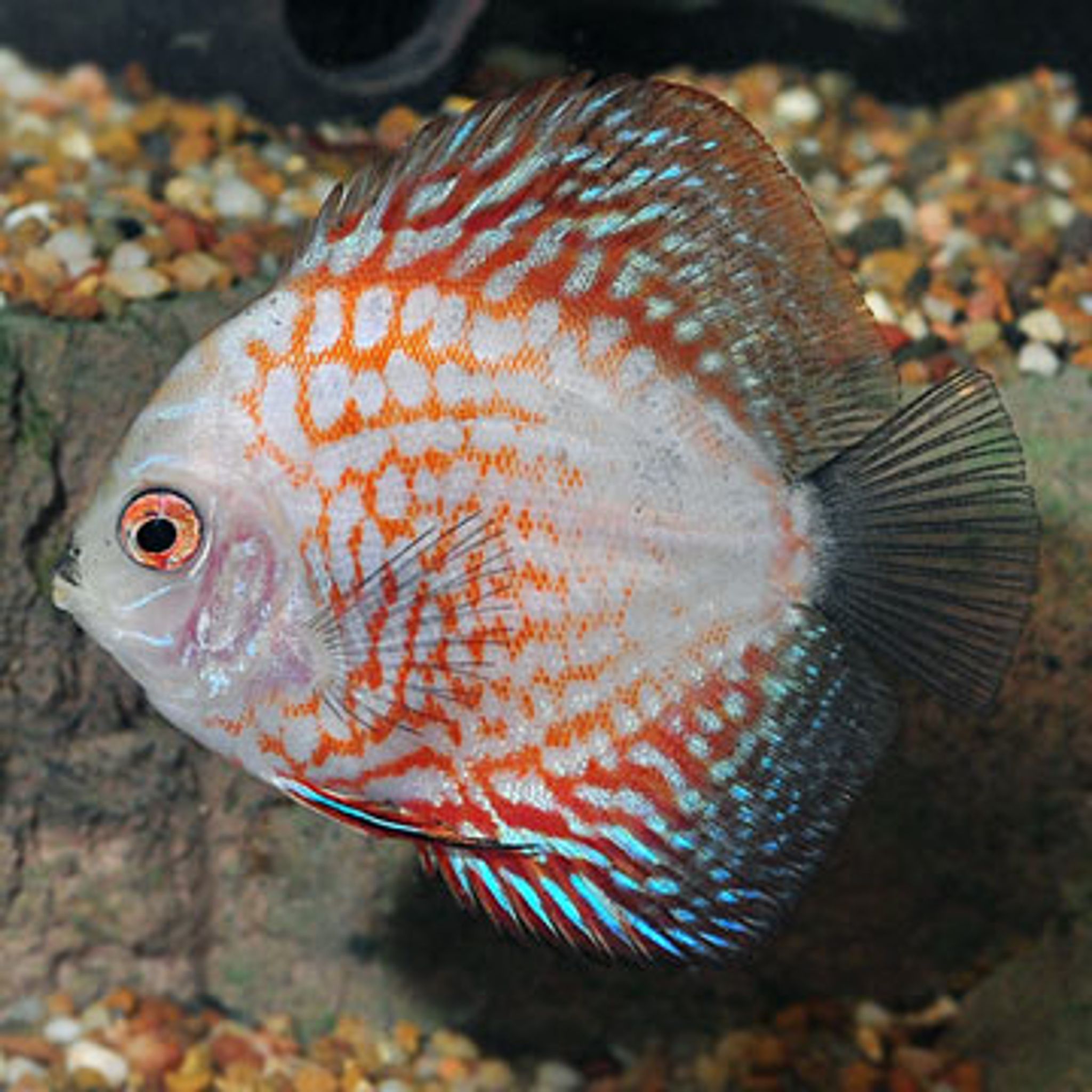

How Big Do Discus Get? Growth Rate, Adult Size and Tank Planning
A full-grown discus typically reaches 6 to 8 inches (15–20 cm) in body size, with large males sometimes measuring up to 9 inches (23 cm) fin-tip to fin-tip. This guide breaks down exactly how discus grow month by month, why sources disagree on the "real" adult size, and how to translate that size into a tank you won't outgrow.
Adult Discus Size: Why the Numbers Vary
Ask five discus keepers how big their fish got and you'll likely hear five different answers. That's not because anyone is wrong — it's because discus are disc-shaped, and "size" can mean three different measurements:
- Body length — the horizontal measurement from mouth to tail base, typically 6–7 inches (15–18 cm) at full maturity.
- Body diameter — the round, plate-like body itself, often compared to a small dinner plate, roughly 5–7 inches (13–18 cm) across.
- Total height — measured vertically from the tip of the dorsal fin to the tip of the anal fin, which is almost always the largest number quoted, commonly up to 8–9 inches (20–23 cm) on a well-developed male.
When a source says "discus get 8 inches," they're usually talking about height, not length. When another says "6 inches," they're describing the body itself. Both can be correct at once — which is exactly why a single number is misleading and a range with context is more useful.
Do Male or Female Discus Get Bigger?
There's mild sexual dimorphism in adult size, but it's subtle:
| Trait | Males | Females |
|---|---|---|
| Height (fin-tip to fin-tip) | Up to ~8 in (20 cm) | ~6–7 in (15–18 cm) |
| Body length | Up to ~6.5 in (16.5 cm) | ~6 in (15 cm) |
| Overall build | Slightly broader, taller finnage | Slightly more compact |
The difference is small enough that you should never rely on size alone to sex a discus — body shape, forehead profile, and breeding behavior are more reliable indicators, and even those aren't foolproof on juveniles.
Discus Growth Rate: A Month-by-Month Guide
Growth is fastest in the first year and then gradually slows as the fish matures. These figures assume a healthy, tank-raised discus kept in good conditions — genetics and care quality can shift any individual fish up or down.
| Age | Approximate Size | Growth Stage |
|---|---|---|
| 0–6 months | 1–2 in (2.5–5 cm) | Juvenile |
| 6–12 months | 3–4 in (7.5–10 cm) | Sub-adult / adolescent |
| 12–18 months | 4.5–6.5 in (11–16.5 cm) | Young adult, filling out |
| 18–24 months | 6–8 in (15–20 cm) | Full adult size reached |
| 2–3 years | Slight additional fill-out | Mature, body depth continues to develop |
How Fast Do Discus Grow?
Growth is quickest during the first 12 months, when a discus can gain several inches under good conditions. From there, growth slows and most fish reach their full adult size somewhere between 18 and 24 months, though body depth and overall condition can keep improving slightly into the third year. If your six-month-old discus is still under 2 inches, or your one-year-old hasn't cleared 3 inches, it's worth reviewing feeding, temperature, and water quality rather than assuming it's simply a "slow grower."
What Drives Growth Speed
Several factors compound to determine how fast — and how large — a discus ultimately grows:
- Water temperature: Discus thrive and grow best at 82–86°F (28–30°C). Cooler water slows metabolism and, with it, growth — a discus kept at a general community-tank temperature of 76–78°F will grow noticeably slower than one kept in its preferred range.
- Feeding frequency and diet: Several small, high-protein, varied feedings per day (rather than one or two large meals) support steady growth. A gel food or frozen/live protein source rotated with other foods tends to outperform a single staple diet.
- Water quality: Pristine, low-nitrate water with frequent partial changes supports uninterrupted growth. Poor water quality is one of the most common — and most preventable — causes of undersized adult discus.
- Low stress and crowding: Discus kept in properly sized groups with adequate space grow more consistently than stressed, crowded fish.
- Genetics and strain: Some strains and individual bloodlines simply mature larger than others, independent of care quality.
Buying Juveniles: What to Look For
Discus are commonly sold as juveniles around 2–3 inches. While these smaller fish are less expensive, many experienced keepers suggest choosing juveniles of 4 inches or larger when possible — they tend to acclimate more easily and are hardier through the stressful early weeks in a new tank than very small specimens.
At the point of sale, a few visual cues can hint at how a juvenile will develop:
- Body shape: Look for a rounded, evenly proportioned body rather than a pinched or elongated one — early body shape is a reasonable indicator of eventual disc quality.
- Finnage: Full, undamaged fins that extend cleanly (not clamped or ragged) suggest a healthier, better-conditioned fish.
- Activity and color: An actively swimming, evenly colored juvenile that isn't hiding constantly is generally a better long-term prospect than a listless or pale one.
- Wild-caught vs. tank-bred: Tank-bred (domestic) strains are the norm and generally grow reliably to the ranges above. Wild-caught discus can vary more in adult size and growth rate depending on the natural population they come from, and may be more sensitive to water parameters during acclimation.
Discus and their tankmates are available to browse in FishyHub's Discus category if you're comparing juveniles before you buy.
Tank Size Planning for Adult Discus
Because discus reach 6–8 inches and are tall-bodied, tank planning has to account for footprint and height, not just gallon count. A long, shallow "standard" tank under about 18 inches tall doesn't suit a fish shaped like a dinner plate — discus feel more secure and swim more naturally in taller tanks.
Gallons-Per-Fish: Why the Rule of Thumb Varies
Recommendations for gallons-per-discus range widely — anywhere from 10 to 40 gallons per fish, depending on the source. That spread exists because discus are unusually sensitive to crowding and water quality, so cautious keepers recommend far more space than the bare minimum. The practical takeaway:
- Use a minimum floor of 50–55 gallons for a starter group, not a per-fish calculation alone.
- Scale up generously as you add fish — treating the higher end of any per-fish rule as the safer default costs less in the long run than dealing with stunted, stressed fish.
- Bigger is always safer than the low end of any rule of thumb, especially for a beginner still learning water-change routines.
| Group Size | Suggested Minimum Tank | Notes |
|---|---|---|
| 1 (not recommended) | N/A | Discus are shoaling fish; single fish become stressed and hide |
| 5–6 (recommended minimum) | 75 gal | Commonly cited comfortable starting point |
| 8–10 | 100 gal | Allows for adult size and swimming room |
Why Height Matters as Much as Length
A tank rated at 55 gallons that's long and shallow is not equivalent to a 55-gallon tank that's tall and compact for discus purposes. Look for tanks with 18 inches or more of height so an 8-inch adult has generous vertical clearance above and below its body — this also makes swimming and territorial displays more natural. You can compare footprint and height options across FishyHub's Glass Tanks selection when sizing up an enclosure.
Discus Need a Shoal, Not a Pair
Discus are a schooling cichlid species and should be kept in groups of 5–6 or more. A single discus or a lone pair tends to hide, stress, and grow more slowly than a properly shoaled group — social stability directly supports feeding confidence and, in turn, healthy growth.
Stunting: The Serious Side of the Size Question
Stunting isn't a minor size trivia point — it's a genuine welfare issue. A stunted discus stays permanently small and often thin-bodied, never reaching its expected adult size even after years in the hobby, and it may carry lasting organ or health problems as a result.
Leading causes of stunted growth:
- Undersized tanks that restrict swimming room and concentrate waste.
- Poor, infrequent water changes that let nitrate and other waste products build up.
- Consistently cool water (mid-70s°F) that slows metabolism during the critical growth window.
- Underfeeding, or a low-protein/low-variety diet that doesn't supply enough nutrition for rapid juvenile growth.
Because these same factors control both size and long-term health, treating "how big will my discus get" and "how healthy will my discus be" as the same question is the right mindset.
Nitrate Management: The Overlooked Growth Factor
Discus are especially sensitive to nitrate, and this connects directly back to the growth and stunting discussion above — a discus growing up in chronically elevated nitrate is a discus at real risk of stunting.
- Target under ~20 ppm nitrate for discus, noticeably lower than the roughly 20–40 ppm many general community tanks tolerate.
- Water changes: A weekly 20–25% change is a common baseline for discus, and many keepers change water even more frequently than that during the juvenile growth phase.
- Live plants: Floating plants such as duckweed or water lettuce, plus stem plants like hornwort, actively take up nitrate between water changes.
- Specialized filtration: Nitrate-reducing filter media or biological products can help extend the interval between large water changes for keepers who want more flexibility, though they don't replace regular maintenance entirely.
Driftwood in a Discus Tank
Driftwood is a natural fit for a discus setup, both functionally and aesthetically.
Benefits:
- Provides natural cover that helps a naturally shy species feel secure, reducing stress.
- Releases mild tannins that mimic the soft, blackwater-influenced conditions discus favor in the wild.
- Serves as an anchor point for attaching plants like Java fern or anubias.
Safe preparation:
- Soak new driftwood in dechlorinated water for a week or more, changing the water daily, to leach out excess tannins and any residual contaminants.
- Alternatively, boil the wood to speed up tannin release and help sterilize it (only practical for smaller pieces).
- Scrub with a stiff brush before and after soaking to remove loose debris.
What to avoid:
- Softwoods and resinous woods such as pine and cedar.
- Toxic woods such as elm and walnut.
- Uncured wood added directly to an established tank — this can cause sudden tannin staining, cloudy water, or even a pH crash in an already water-quality-sensitive discus tank.
Stick to aquarium-safe hardwoods such as mopani or spiderwood, and always cure new pieces before they go in with your fish.
Frequently Asked Questions
How big does a discus get in a 20-gallon tank?
Physically, a discus can still reach its normal adult size of 6–8 inches regardless of tank size — growth isn't capped by the glass itself in the short term. However, a 20-gallon tank is far too small to house even a single discus long-term without serious risk of stunting, stress, and water-quality problems, so it's not a viable permanent home.
How fast do discus grow?
Growth is fastest during the first year, when a healthy juvenile can go from about 1–2 inches to 3–4 inches. Growth then slows and most discus reach full adult size by around 18–24 months, with only minor body-depth changes after that.
Do male or female discus get bigger?
Males tend to finish slightly taller and broader — up to about 8 inches in height versus 6–7 inches for females — but the difference is minor and not a reliable way to determine sex on its own.
Can discus be kept with other fish given their size?
Yes, as long as tankmates are calm, similarly warm-water species and the tank is large enough to accommodate everyone. Avoid fin-nippers and aggressive fish, since discus are slow-moving and can be stressed or injured by more assertive tankmates.
Why is my discus not growing or staying small?
The most likely culprits are poor water quality, an undersized tank, water that's too cool, or insufficient feeding. Reviewing all four against the stunting causes above will usually identify the issue.
How often should I do water changes for discus given their sensitivity?
More often and larger than a typical community tank — a weekly 20–25% change is a reasonable baseline, with many keepers changing water even more frequently while fish are still juveniles and growing quickly.
What tank size do I need for adult discus?
Plan for a minimum of 50–55 gallons for a starter group of 5–6 discus, scaling up as you add fish, and prioritize tank height (18+ inches) over length alone since discus are tall-bodied.
Is driftwood safe and necessary for discus?
Driftwood is beneficial but not strictly required — it provides cover, mild tannin release, and a natural look. It must be properly soaked or boiled before use, since uncured wood can cloud the water or crash pH in a discus tank.
Ready to plan your setup? Browse tank-appropriate tankmates and stock in FishyHub's Angelfish, Discus, Rams & Cichlids category to build out a group that will grow to full size together.


