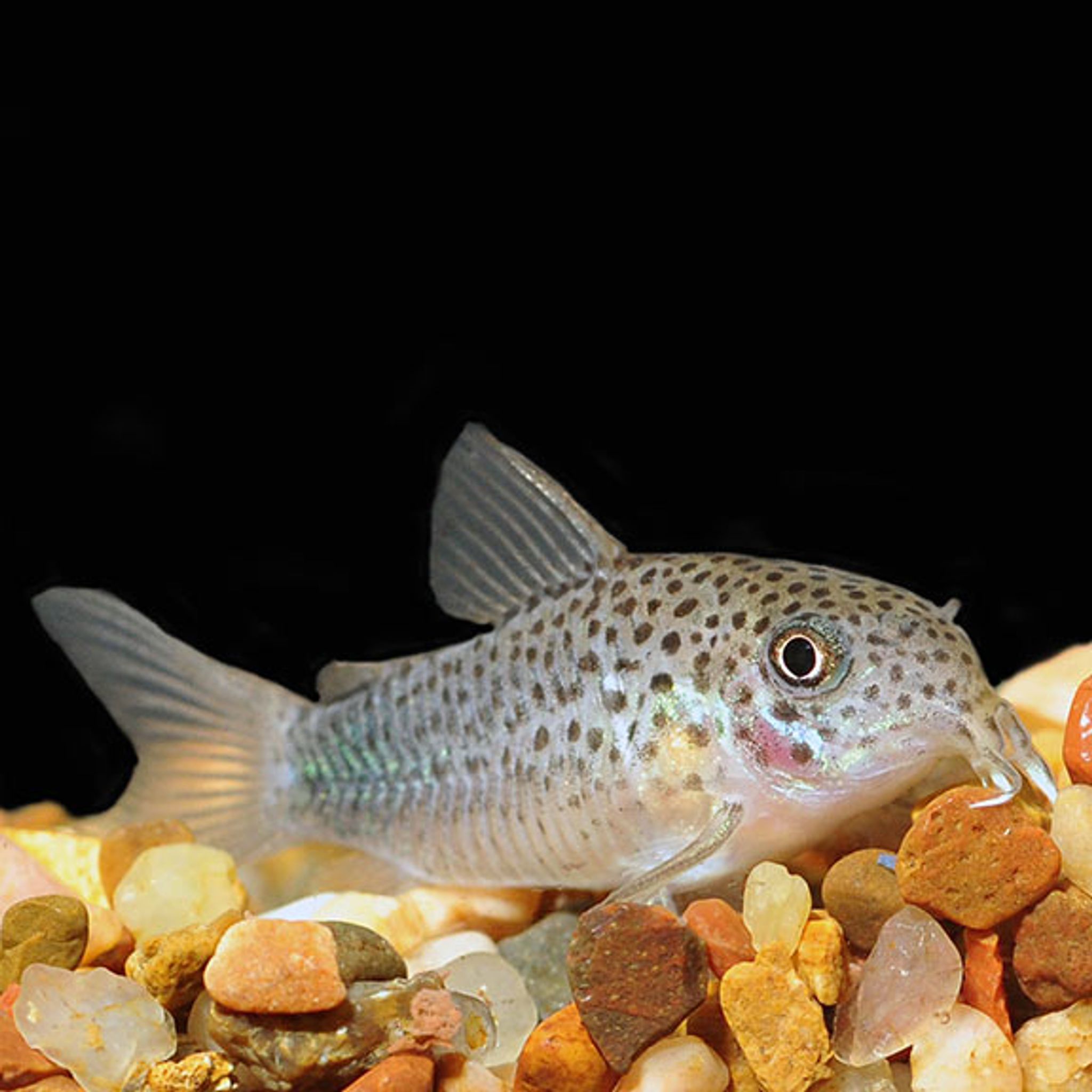

How Big Do Corydoras Catfish Get? Growth Rate, Adult Size and Tank Planning
Corydoras catfish range from about 1 inch to over 4 inches (2.5–10+ cm) as adults, and the number depends entirely on which species you're keeping. Most of the panda, bronze, and peppered types sold in US stores settle into a 2–3 inch adult size, while a few dwarf and giant outliers sit well outside that range. This guide sorts the common species into size tiers, walks through how fast they actually grow, and maps each tier to a realistic tank size.
Cory Size Isn't One Number — It's a Tier
"How big does a cory get" doesn't have a single answer because Corydoras is a large genus with dozens of pet-trade species. Instead of memorizing individual measurements, it helps to think in tiers:
- Dwarf/pygmy tier (~1–1.5 in / 2.5–4 cm): pygmy cory, habrosus cory, hastatus cory, similis (violet) cory.
- Standard tier (~2–2.75 in / 5–7 cm): panda, bronze, albino, peppered, julii, three-stripe/trilineatus, bandit, adolfoi, skunk, sterbai.
- Larger tier (~3–4 in / 7.5–10 cm): black cory, orange laser cory, emerald green cory, hognose brochis.
- Giant/atypical outliers (~3.5–9 in): bearded (barbatus) cory, a cold-water species for advanced keepers, and the hoplo catfish.
A quarter-inch of variation between sources for the same species is normal — wild-caught fish and tank-raised fish differ slightly, and well-fed adults trend toward the top of a given range. Treat every figure below as a range, not a guarantee.
Types of Cory Catfish at a Glance
| Species | Adult size | Tier | Notable trait |
|---|---|---|---|
| Pygmy cory | ~1 in (2.5 cm) | Dwarf | Schools mid-water more than most corys |
| Habrosus cory | ~1–1.25 in (2.5–3 cm) | Dwarf | Very peaceful, good for small setups |
| Panda cory | ~2 in (5 cm) | Standard | Black "mask" marking, cooler-tolerant |
| Bronze cory | ~2.5–3 in (6–7.5 cm) | Standard | Hardy, classic beginner species |
| Albino cory | ~2–2.5 in (5–6 cm) | Standard | Color morph of the bronze/aeneus line |
| Peppered cory | ~2.5–3 in (6–7.5 cm) | Standard | Tolerates cooler water than most |
| Sterbai cory | ~2.5 in (6 cm) | Standard | Orange pectoral fins, warmth-loving |
| Julii / trilineatus | ~2–2.5 in (5–6 cm) | Standard | See ID note below |
| Emerald green cory | ~3–3.5 in (7.5–9 cm) | Larger | Brochis-type body, greenish sheen |
| Black cory | ~3–4 in (7.5–10 cm) | Larger | Deep body, needs more floor space |
How Fast Do Cory Catfish Grow?
Juveniles at a fish store are almost always sold under 1 inch, which surprises new keepers when the adult sizes above look so much bigger. Here's roughly what to expect:
| Age after purchase | Typical size milestone |
|---|---|
| At purchase | Under 1 in (juvenile, sold young) |
| 1–2 months | Noticeable length gain, body filling out |
| 3–6 months | Roughly half to two-thirds of adult size |
| 8–12 months | Full adult length reached under good care |
| Beyond 12 months | Size holds steady; body may thicken slightly with age |
Growth is fastest in the first few months and tapers off as the fish approaches its species' adult size, typically landing at full size somewhere in the 8–12 month window. Corys can live 5+ years, with some species reaching 10–15 years, and their size stays essentially stable for the rest of that lifespan once they mature. Because the store fish you bring home is a fraction of its eventual size, plan the tank around the adult dimensions in the tables above, not around the 1-inch juvenile in the bag.
Temperature also plays a role in growth rate. Running a tank toward the warmer end of a species' safe range speeds up metabolism and growth, but consistently warm water can also shorten a fish's overall lifespan. A stable temperature in the recommended range is a better long-term choice than pushing warm just to speed up growth.
Do Male and Female Corys Grow to Different Sizes?
Yes. Females are typically noticeably larger and rounder-bodied than males at maturity in most species — this is easiest to see in peppered and bronze cories, where a mature female's body has an obvious downward curve when viewed from above. This size difference is one of the more reliable ways to sex a group of corys without specialized equipment. Some keepers also aim for a slightly male-heavy ratio in a group for calmer dynamics, though total group size matters far more than the exact sex ratio.
Julii Cory vs. False Julii (Trilineatus): Does It Matter for Tank Planning?
Most fish sold as "julii cory" in US stores are actually the false julii, Corydoras trilineatus — the two species are frequently mixed up in the trade. The good news for tank planning is that both reach a nearly identical adult size of about 2–2.5 inches, so the ID mix-up doesn't change your gallon math either way. If you want to tell them apart for your own records, look at the spot pattern on the head and back: true julii show isolated, distinct dots, while trilineatus shows a connected, reticulated (net-like) pattern that runs together.
Tank Size Guidance by Size Tier
Corys are obligate shoalers — they need a minimum of 5–6 of the same species to feel secure, regardless of tank size. Combine that group-size rule with the size tier to land on a realistic tank:
| Tier | Small group minimum | Comfortable shoal (6+) |
|---|---|---|
| Dwarf | 5–10 gal (19–38 L) | 10–15 gal (38–57 L) |
| Standard | 10 gal (38 L) absolute floor, small groups only | 20 gal (76 L) recommended |
| Larger (emerald green, black, hognose) | — | 30+ gal (114+ L), long footprint |
| Giant/cold-water outliers (bearded cory, hoplo) | — | 30–40+ gal (114–151+ L) |
Sources disagree on the standard-tier minimum: some call 10 gallons workable for a full shoal, others insist on 20. The safer read is to treat 10 gallons as a floor only for a very small group of 3–4 standard-size corys, and to plan on 20 gallons as the practical standard once you're keeping a proper shoal of 6 or more.
The hoplo catfish deserves a separate callout: it's often marketed alongside true Corydoras, but it belongs to a different genus (Megalechis/Hoplosternum) entirely. It can reach 5–9 inches — several times the size of a standard cory — so a tank sized for cory-typical footprint will undersize a hoplo badly. If a listing groups it with "cory catfish," check the species name before assuming cory-scale space needs apply.
Why Floor Space Matters More Than Gallons
Corys spend virtually all their time on the substrate, so tank footprint (length × width) matters more than water volume or height. A long, low 20-gallon long tank gives a shoal far more usable floor space than a tall 20-gallon tank with the same water volume, because the fish never use the vertical space anyway. As a rough rule of thumb tailored to bottom dwellers rather than generic mid-water stocking guides, aim for at least 2–3 inches of tank length per cory in the shoal, and favor the longest, lowest footprint your space allows over a taller tank of equal gallons. A wide selection of tanks and stands makes it easier to compare footprint options rather than just gallon totals.
Water Parameters and Substrate
Most community-range corys do well at:
- Temperature: 72–79°F (22–26°C); peppered and bearded cory tolerate down to about 67–68°F (19–20°C).
- pH: 6.5–7.8 as a comfortable range, with a wider 6–8 tolerated.
- Hardness: soft to moderate.
Substrate choice affects growth just as much as water chemistry. Corys use sensitive barbels around their mouths to forage in the substrate, and sharp gravel or crushed coral can abrade those barbels over time. Damaged barbels lead to infection risk and reduced feeding ability, which in turn stunts growth — so sand or smooth, rounded fine gravel is the only substrate that should go under a cory tank. Browsing sand and fine gravel options before setup avoids a costly substrate swap later.
Feeding for Proper Growth
Corys are omnivorous scavengers, not algae eaters, and relying on leftover flake food or algae growth is one of the most common causes of thin, undersized adults. A proper diet includes:
- Sinking pellets or wafers formulated for bottom feeders
- Frozen or live foods such as bloodworms and brine shrimp
- Regular, targeted feeding rather than relying on scraps from mid-water fish
Undernutrition shows up as slow growth and a noticeably thin body profile compared to well-fed tankmates of the same species and age.
Common Mistakes That Affect Cory Size and Growth
- Sizing the tank for the juvenile, not the adult. A 1-inch store fish can reach 2–4 inches within a year — plan the tank for full-grown dimensions from day one.
- Keeping fewer than 5–6 per species. Even in a large tank, small groups cause stress and hiding that can suppress appetite and growth.
- Sharp substrate. Gravel or crushed coral wears down barbels, raising infection risk and reducing feeding ability.
- Assuming corys graze enough on their own. Insufficient targeted feeding is a leading cause of stunted, underweight adults.
- Pairing dwarf species with boisterous tankmates. Pygmy and habrosus corys can be outcompeted at feeding time by larger, faster fish, indirectly limiting their growth.
- Confusing a juvenile with a naturally small adult species. A young bronze cory can look similar in size to a full-grown pygmy cory, leading to the wrong tank-size assumptions.
- Overcrowding by species mismatch. Adding an emerald green or black cory to a tank sized for standard-tier footprint underestimates how much floor space that species needs at full size.
- Overcrowding the shoal itself. Too many corys packed into a tank that's too small for the group also causes competition-driven stress and stunted growth — it isn't only a problem of too few fish.
Is My Cory a Small Species or a Stunted One?
If a cory hasn't grown past 1–1.5 inches after several months of good feeding and it's a dwarf species (pygmy, habrosus, hastatus), that's likely its natural adult size. If it's a standard or larger species (panda, bronze, black cory) still stuck under 1.5 inches well past the 8–12 month growth window, check three things first: feeding routine (targeted sinking food, not leftovers), water parameter stability, and whether it's being outcompeted by faster tankmates at mealtime.
Frequently Asked Questions
How big does a cory catfish get on average?
Most common pet-trade species land in the 2–3 inch range as adults. Dwarf species stay under 1.5 inches, while a few outliers such as the emerald green and black cory reach 3.5–4 inches.
How fast do cory catfish grow?
Growth is fastest in the first few months after purchase, with most corys reaching full adult size around 8–12 months given good food and stable water. Growth slows sharply after that, and size stays roughly stable for the rest of the fish's 5+ year lifespan.
What is the smallest cory catfish?
The pygmy cory and its close relatives, habrosus and hastatus, are the smallest, topping out around 1–1.25 inches as adults.
What is the largest cory or cory-type catfish?
Among true Corydoras, the emerald green and black cory reach roughly 3–4 inches. The bearded cory and the related hoplo catfish exceed this, but both need much larger, and in the bearded cory's case often cooler, setups than a typical cory tank.
How many cory catfish can I keep in a 10-gallon tank?
Realistically, a 10-gallon tank suits a small group of 4–6 dwarf-tier species only. Standard-size corys are better matched to a 20-gallon tank once you're keeping a full shoal of 6 or more.
Do male and female cory catfish grow to different sizes?
Yes, females are generally larger and rounder-bodied at maturity than males in most species, which is a useful way to sex a group visually.
Why is my cory catfish not growing?
The most common causes are insufficient targeted feeding (relying on leftovers instead of sinking food), unstable water parameters, or being outcompeted by faster tankmates. Check feeding routine and group dynamics before assuming the fish is simply a slow grower.
Can cory catfish live with bettas or other small tanks?
It depends on the size tier. Dwarf corys can suit a small, peaceful betta setup, but both the tank's footprint and the individual betta's temperament need to check out before adding a shoal.
Once you've matched a size tier to your available footprint, browse corydoras available now to find a species that fits your tank rather than sizing the tank around whatever's in the store bag.


