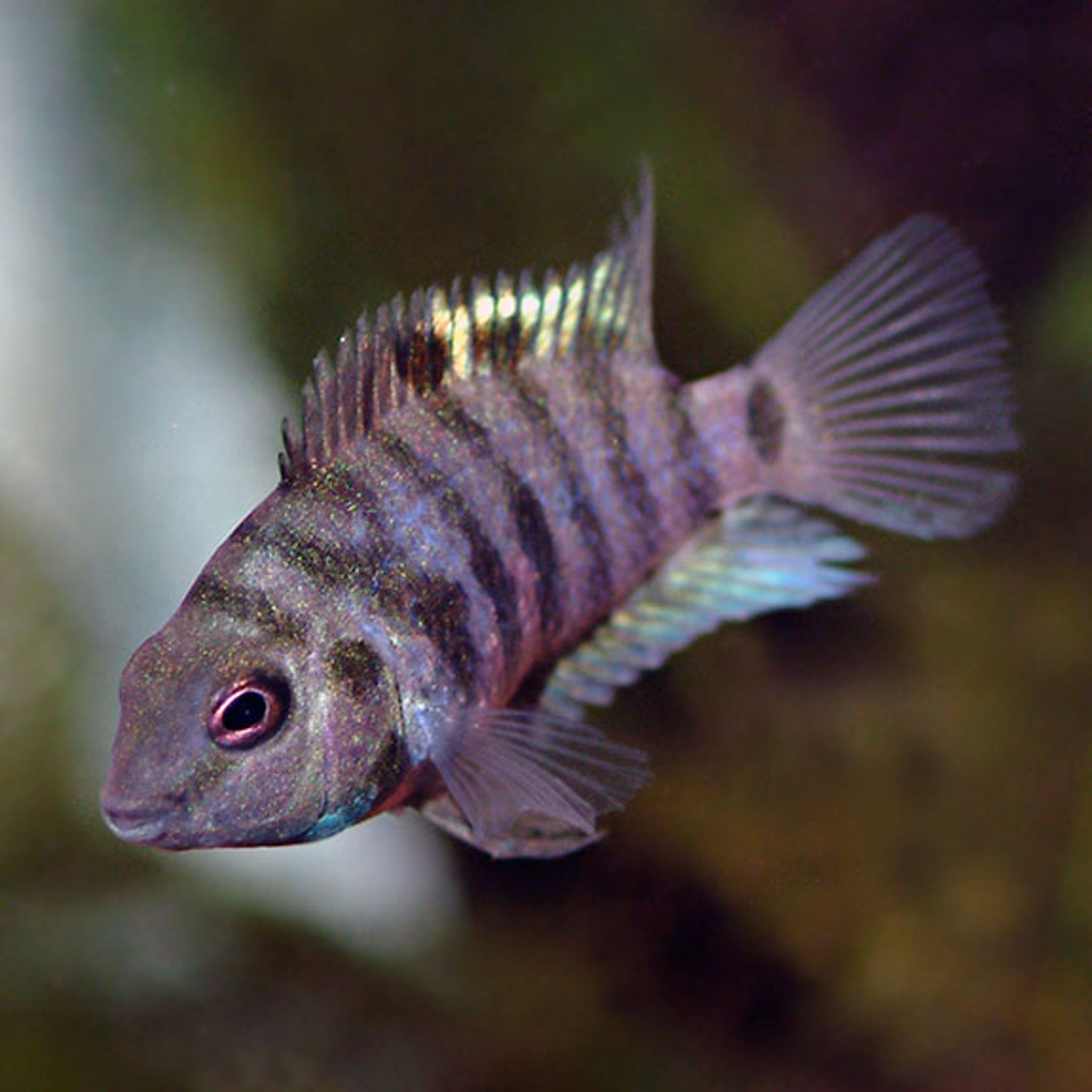

How Big Do Convict Cichlid Get? Growth Rate, Adult Size and Tank Planning
Most convict cichlids top out around 4-5 inches as a species average, though males can push to 6 inches and females usually stay smaller. Full adult size takes 2-3 years to reach, but this fish starts breeding long before that and can outgrow a small tank faster than most new owners expect. Here's the size range, the growth timeline, and the tank plan that actually matches how this species behaves.
Adult Size: The Real Number
The often-quoted "4-5 inches" is a useful headline figure, but it blends two very different sexes together. Convict cichlids are one of the more strongly dimorphic species you'll find at a typical fish size class, and planning around the blended average alone tends to undersell how big a male gets.
- Males: typically 5-6 inches, with some individuals capping out closer to 4.5-5 inches depending on genetics and rearing conditions.
- Females: typically 3.5-4.5 inches, noticeably shorter and rounder-bodied than males.
- Species average (both sexes): 4-5 inches, the figure most often cited when a single number is needed.
Because individual variation and line quality both play a role, treat the male upper end as a realistic ceiling rather than a rare outlier — a healthy, well-fed male reaching 6 inches is not unusual.
Male vs. Female: Telling Them Apart
Size is the most reliable field mark, but it's not the only one. Mature convicts show a clear split in both body shape and color:
- Males grow longer and leaner, with extended, pointed dorsal and anal fin tips that trail past the tail base.
- Females stay shorter and rounder, and develop bright pink-to-orange-gold patches across the belly and lower flank once mature — a trait males don't share.
- Juveniles are monomorphic. There's no dependable way to sex a young convict by size or color; the differences only emerge after several months of growth, once the fish approaches sexual maturity.
If you're buying juveniles hoping to raise a specific sex ratio, expect to wait it out — guessing early almost always gets corrected once the fish matures.
Growth Rate: How Fast Do They Get There?
Growth is fastest early and slows steadily afterward, which is why a single "adult size" number is less useful than a timeline.
| Age | Approx. Size | Notes |
|---|---|---|
| 2-4 weeks (fry) | ~1 inch | Rapid growth under good water quality and frequent small feedings |
| 3 months | ~2-2.5 inches | Still adding close to an inch a month with consistent care |
| 6 months | ~3-3.5 inches | Sexual maturity arrives around this point, well before full size |
| 1 year | ~4 inches | Growth visibly slows; sex differences are now obvious |
| 2-3 years | Full adult size (4-6 in, sex-dependent) | Growth plateaus; males may still add slightly more length |
Sexual maturity — meaning the fish is capable of breeding — typically arrives at just 6-7 months old, at only a few inches in length. That's a meaningful planning detail: a convict cichlid can start spawning long before it looks or behaves like a full adult.
What Speeds Up or Stunts Growth
Genetics set the ceiling, but day-to-day husbandry decides whether a fish gets close to it. The main levers:
- Water quality and change frequency. Stagnant or infrequently changed water slows growth even when temperature looks correct — stability matters as much as the exact numbers.
- Feeding frequency and quality. Two to three smaller feedings a day, mixing a high-quality cichlid pellet with occasional protein like bloodworms or brine shrimp, outperforms one large daily feeding for both growth rate and coloration.
- Tank size and territory. A cramped tank creates chronic low-grade stress that slows growth even when other parameters are fine.
- Breeding activity. A fish devoting energy to guarding eggs or fry — especially a guarding female — often grows slower or stalls entirely during that period.
- Rearing history. Because convicts are bred cheaply and in large numbers for the trade, occasional batches show more size variability or mild stunting traced back to poor early-life conditions, not genetics.
- Digging and decor disruption. This species digs constantly and rearranges substrate and decor. Frequent disturbance to a settled layout can add low-level stress that indirectly dents feeding and growth.
Undersized quarters can genuinely slow growth, but that's a health problem, not a size-control strategy — a stunted fish is a stressed, shorter-lived fish, not a conveniently smaller one.
Tank Size by Scenario
Because convict cichlids are bottom-and-mid-dwelling diggers, floor space matters more than height — a long, low-footprint tank suits them better than a tall, narrow one of the same volume.
| Scenario | Minimum Tank Size | Notes |
|---|---|---|
| Single juvenile, grow-out phase | 20-30 gallons (76-114 L) | Acceptable short-term; plan to upgrade as the fish matures |
| One adult, or a stable long-term pair | 30 gallons (114 L) minimum; 40 gallons (151 L) once territorial | 30 gal is the comfortable standard once fully grown |
| Breeding pair (no tank mates) | 50-55+ gallons (189-208+ L) | Extra length lets the non-guarding fish escape aggression |
| Community tank with tank mates | 55+ gallons (208+ L) | Needs strong filtration for the added bioload |
A 10-gallon tank will hold a tiny juvenile for a short stretch, but growth stalls and aggression rises quickly in that little space — it's not a viable long-term home even at this species' modest adult size. You can browse ready-made setups sized for a growing cichlid in glass tanks built for exactly this kind of upgrade path.
Water Parameters and Diet Snapshot
Convict cichlids are hardy and adaptable, which is part of their popularity, but staying within a sensible range still supports better growth than pushing the extremes.
- Temperature: 74-84°F (23-29°C); the upper end (80-84°F / 27-29°C) favors breeding activity.
- pH: roughly 6.5-8.0 — the species tolerates a wide band, so consistency matters more than hitting an exact number.
- Hardness: moderate to hard water is well tolerated.
- Filtration: standard equipment works, but size it for a heavy bioload and constant digging — an undersized filter falls behind quickly with this species. A dependable option is browsable under filters.
- Diet: omnivorous — a high-quality cichlid pellet or flake as the staple, supplemented with live or frozen bloodworms, brine shrimp, or daphnia, plus occasional blanched vegetables like peas or broccoli. Multiple small feedings beat one large one for both growth and color.
Breeding, Population, and Why Size Planning Matters
Convict cichlids are famously easy breeders, which is exactly why size and tank planning go hand in hand with breeding awareness:
- Sexual maturity arrives around 6-7 months, at only a few inches long — well before the fish reaches full size.
- A mature pair can spawn every 4-6 weeks, with clutches commonly in the 20-30+ egg range.
- Eggs hatch in about 3-5 days, and fry become free-swimming roughly a week after spawning.
- Both parents guard and herd the fry aggressively — one of the more frequently observed examples of cichlid parental care.
- Left unmanaged, an established pair's population can climb into the 100-200+ juvenile range within a few months.
A tank stocked for "one pair" without a plan for what happens after the first spawn is a common setup mistake. Providing flat rocks or caves for spawning sites helps reduce the restless, aggressive behavior that shows up when a ready pair has nowhere suitable to lay eggs.
Aggression and Tank Mate Compatibility
Aggression tracks closely with size and breeding status, not just species reputation:
- Non-breeding singles or same-sex juveniles are comparatively mild.
- A guarding pair becomes sharply more territorial, attacking tank mates and sometimes each other's fins during spawning cycles.
- Convicts are disproportionately aggressive relative to their modest adult size — a common mistake is assuming a "small" 4-6 inch fish is automatically safe with small community species.
- Suitable tank mates need to be similarly sized, robust, and fast enough to avoid cornered confrontations; slow or small fish are at risk regardless of the convict's size.
If you're building a mixed setup, look toward other hardy, similarly proportioned species in the American cichlids range rather than delicate or slow-moving fish.
Lifespan Context for Long-Term Planning
With good care, convict cichlids typically live 8-10 years — long enough that the tank size and tank mate decisions made at purchase time matter well beyond the first year of growth. Sizing the setup for the adult fish (and its likely breeding behavior) from the start avoids a mid-life upgrade scramble.
Common Mistakes to Avoid
- Buying a small, appealing juvenile without planning for a 5-6 inch, territorial adult.
- Picking up a male-female pair with no plan for near-inevitable, frequent breeding and the resulting fry population.
- Keeping the fish in an undersized tank, which amplifies aggression toward tank mates and even between the pair itself.
- Inconsistent feeding schedules or infrequent water changes, which slow growth and dull coloration.
- Assuming juveniles are safe with small community fish because the adult size is modest — convicts punch above their size in aggression.
- Skipping flat rocks or caves for spawning, which leaves a ready pair stressed and more likely to act out.
Frequently Asked Questions
How big do convict cichlids get in a 10-gallon tank?
They'll survive short-term as tiny juveniles, but growth stalls and stress and aggression rise quickly in that little space. A 10-gallon isn't a suitable long-term home even given this species' relatively modest adult size.
How can you tell males from females?
Size is the first clue — males run larger with longer, pointed dorsal and anal fin extensions — combined with the pink-to-orange belly coloration females develop once mature. Juveniles can't be reliably sexed by either trait.
How fast do convict cichlids grow?
Growth is fastest early, with fry adding close to an inch a month through the first several months under good conditions. It then slows steadily, with full adult size arriving around 2-3 years.
Do convict cichlids stop growing if the tank is too small?
Growth can slow or stunt in cramped, poor-quality conditions, but that reflects stress and health decline rather than being a safe way to limit adult size. A stunted fish is a compromised fish, not a conveniently smaller one.
What size tank do I need for one convict cichlid vs. a breeding pair?
Plan for roughly 30 gallons for one fish or a stable pair long-term. Once the pair starts breeding, or you're adding tank mates, step up to 50-55+ gallons with strong filtration.
Can convict cichlids live with other fish given their size?
Only with similarly sized, robust, fast-moving fish in a tank large enough to give everyone room to retreat. Small or slow tank mates remain at risk regardless of the convict's modest adult size, especially once a pair starts breeding.
Why is my convict cichlid not growing?
Check feeding frequency and quality first — two to three smaller feedings a day support faster growth than one large one. Then review your water change schedule, tank size, and whether breeding stress or aggression from a tank mate might be suppressing growth.
Ready to plan the right setup before you buy? Explore compatible stock in Freshwater Livestock and match your convict cichlid's future size to a tank that will still fit it in three years.


