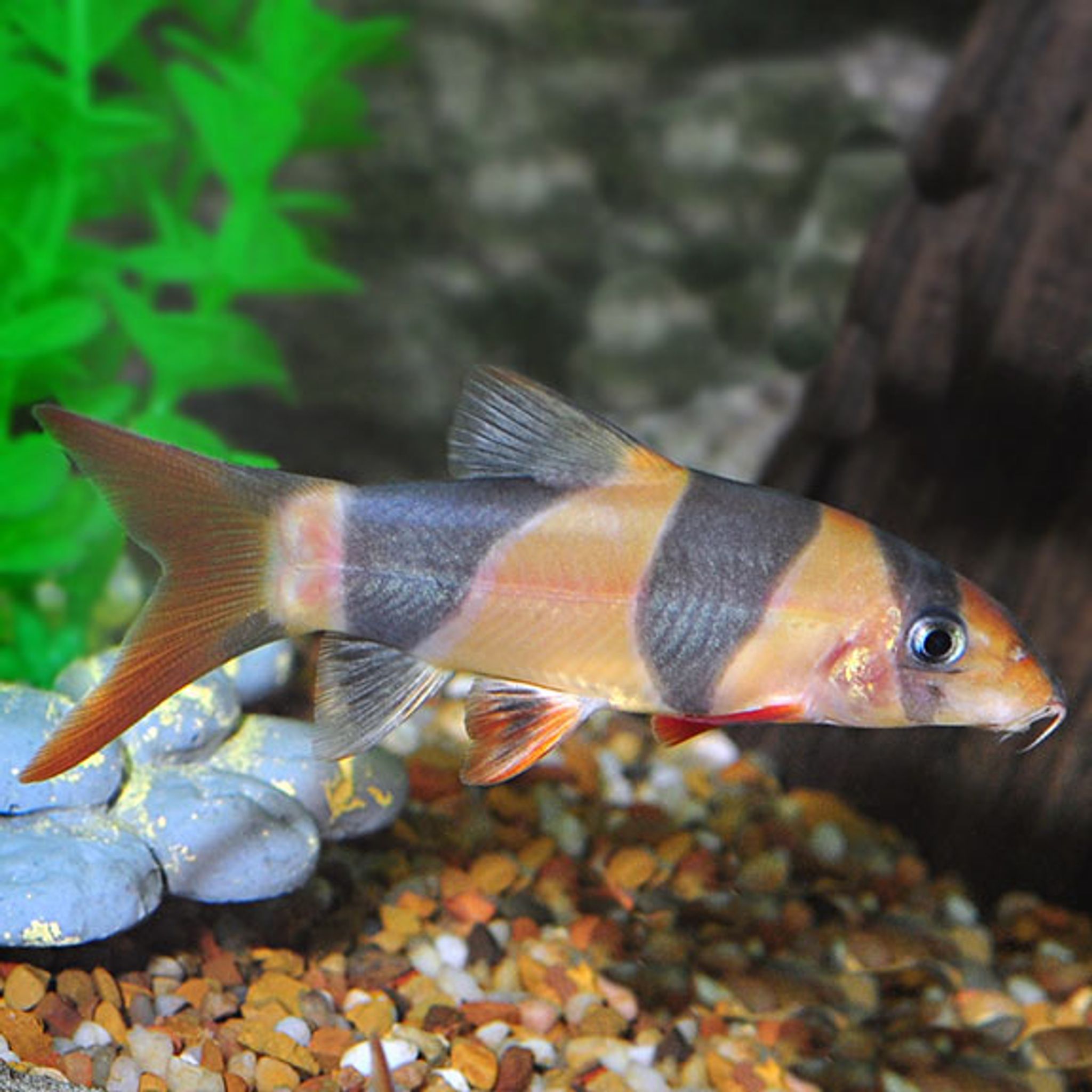

How Big Do Clown Loach Get? Growth Rate, Adult Size and Tank Planning
Most well-kept clown loaches reach 10-12 inches (25-30 cm) as adults, with a rare few pushing past that in exceptional, spacious, long-term setups. Getting there takes years, not months, which is exactly why so many owners undersize their tank early on. This guide breaks down the real growth curve, the gallon-by-gallon tank plan, and the mistakes that quietly stunt this species.
Why the Store Size Is Misleading
The #1 cause of underbuying a tank for this species is simple: the fish sold at 1.5-3 inches gives almost no visual clue about what it becomes. A juvenile that fits in a coffee mug can, over a decade, turn into a deep-bodied, chunky adult that fills a large chunk of open water.
This isn't just a length issue. Clown loaches gain body depth and girth as they mature — a full-grown adult can measure 5-6 inches tall and wide through the body, not just long. That bulk matters for swimming room and bioload far more than length alone suggests, which is why two loaches of the same length can need very different amounts of space depending on age and condition.
Adult Size: What to Actually Expect
- Typical home-aquarium adult: 8-10 in, with many well-kept specimens settling around 10-12 in (25-30 cm).
- Upper end in excellent, spacious setups: individuals in very large systems, especially older fish, have been documented at 12-16 in (30-40 cm).
- Wild-caught extremes: fish in native rivers can exceed even that ceiling, but this is not a realistic aquarium benchmark.
Sources disagree because "adult size" gets reported at very different ages and tank sizes. Treat 10-12 in as the sensible planning target, treat 12+ in as achievable with a genuinely large, long-term tank, and treat anything past 16 in as an outlier, not an expectation.
Growth Rate: A Fast Start, Then a Long Taper
Clown loach growth is front-loaded. The fish adds the most size in its first year, then growth slows in stages for the rest of its life.
| Age | Approximate length | Growth pattern |
|---|---|---|
| At purchase | 1.5-3 in (4-8 cm) | Store/juvenile size |
| End of Year 1 | 4-6 in (10-15 cm) | Fastest growth phase; can add 2-2.5 in with good care |
| Year 2-3 | 6-8 in (15-20 cm) | Tapering to roughly 1-1.5 in per year |
| Year 5 | 8-10 in (20-25 cm) | Growth well under 1 in per year now |
| Year 10+ | 10-12 in, occasionally more | Approaching or at textbook maximum size |
Two numbers get quoted a lot, and both are true in context: some keepers report a fish nearing 6 in by year three, while others say full maximum bulk can take a decade or more, sometimes close to the fish's entire (very long) lifespan. Read this as a curve rather than a single milestone — rapid early growth followed by a long, slow climb toward final size.
How Long Clown Loaches Live
This species is a genuine long-term commitment. Expect 10-15 years with good care, and well-documented individuals have lived 20-25+ years. Anyone buying a 2-inch juvenile should plan as if they're taking on a fish for two to three decades, not a couple of seasoning years in a starter tank.
What Drives (or Limits) Growth
Growth rate isn't fixed — it responds directly to care:
- Swim space and tank volume. Cramped conditions slow growth even when other parameters look fine.
- Water quality. Frequent water changes and consistently low nitrates support steady growth; creeping nitrates as the fish (and bioload) grow will stall it.
- Temperature. A stable warm range of roughly 77-86°F (25-30°C) supports growth, with many keepers targeting the high 70s to mid-80s.
- Diet. A varied, protein-rich diet — sinking pellets or wafers, blanched vegetables, occasional live or frozen bloodworms and brine shrimp — matters more than any single food. Clown loaches also eat snails, which is a nice bonus for pest control.
- Social grouping. Kept in groups of 5 or more, loaches feed and behave more naturally, which supports healthier growth than a stressed, hiding solitary fish.
Stunting Is Real — and Semi-Permanent
Here's the mistake that causes the most long-term damage: keeping a young clown loach in too small a tank "until it grows into needing more room." By the time slow growth or clamped fins become obvious, stunting may already be locked in. A permanently undersized environment during the juvenile growth window can cap the fish's size for life — moving it to a bigger tank later does not reliably reverse the damage. This is why upgrade timing should be planned in advance, not reacted to.
Tank Size Roadmap by Growth Stage
Because clown loaches must be kept in groups of 5 or more, tank planning has to account for a shoal, not a single fish. Use this as a staged roadmap rather than a single number:
| Life stage | Approx. length | Minimum tank size | Notes |
|---|---|---|---|
| Young juveniles | 1.5-3 in | 20-40 gal (76-151 L) | Short-term only; start planning the next upgrade immediately |
| Growing juveniles/sub-adults | 3-6 in | 55-75 gal (208-284 L) | A realistic starting point if you intend to keep them past year one |
| Approaching adult, group of 5+ | 6-10 in | 100-125 gal (379-473 L) | Body depth becomes noticeable; swim space matters as much as footprint |
| Full adult group (5-6+ fish) | 10-12+ in | 150-200+ gal (568-757+ L) | Long-term home; a rough heuristic is 20-30 gal of swimming space per adult |
If sources you've read quote 20-30 gal as a "juvenile tank," that figure is only accurate for very young, very small fish as a short-term starting point — not a home to keep past the first year. Likewise, "adult tank" figures ranging from 125 to 200+ gal both have a place: 125 gal is a realistic floor for a group of five medium adults, while 150-200+ gal is the better long-term target, especially if your group trends toward the larger end of the size range.
Signs the Current Tank Has Gotten Too Small
Watch for these before growth actually stalls:
- Constant hiding, even during normal active hours
- Clamped fins or a generally tense posture
- Dark "stress bands" of color that don't fade
- Increased aggression toward the smallest or newest group member
- Growth that visibly slows well before the fish should be near its expected size for its age
Any combination of these is a cue to accelerate the next tank upgrade, not wait and see.
Planning Upgrades in Stages
Rather than resizing reactively, plan three purchases in advance when you bring home juveniles:
- Starter tank (40-55 gal): houses the group through year one; begin researching and budgeting the next size immediately.
- Sub-adult tank (75-100+ gal): should be cycled and ready before the group crosses roughly 6 in, since growth accelerates noticeably in years one to three.
- Adult tank (150-200+ gal): ideally cycled and running before the group approaches 10 in, so there's no gap where fish sit in an undersized tank "for now."
Set up and cycle each new tank before the fish need it, not after you notice crowding. A glass aquarium tank sized for the next stage, plus appropriately rated filtration, is worth sourcing well ahead of the actual move.
Filtration and Bioload: It's Not Just Gallons
A tank rated "big enough" by volume can still fall behind as fish grow, because bioload scales with body mass, not just length. A group of six 10-inch loaches produces meaningfully more waste than the same six fish at 4 inches, even in the same tank. Plan for:
- Filtration rated well above the tank's nominal capacity, not just matched to it
- More frequent water changes as the group's total body mass increases
- Regular nitrate testing rather than assuming "it was fine last year, so it's fine now"
Upgrading filters alongside the tank — not months after — keeps water quality from becoming the hidden growth-limiter.
Setup Details That Support Healthy Growth
- Water parameters: temperature 75-86°F (24-30°C), with many keepers targeting 78-82°F; pH 6.0-7.5; soft to moderately hard water.
- Substrate: soft sand protects the barbels and skin during their frequent digging; coarse or sharp gravel can cause injury or infection over years of that behavior.
- Environment: dim lighting, driftwood and tannins, and caves or hides sized generously for their eventual adult bulk, not just their current juvenile size.
- Tank mates: peaceful community fish that are too large to be eaten (loaches will eat small fry and shrimp). Avoid boisterous or aggressive cichlids in most cases — a few calmer species are sometimes workable, but this is the exception, not the rule. Active, mid-water dither fish can help draw naturally shy loaches out into the open.
- Quarantine: clown loaches are especially prone to ich, and the stress of transport or a new tank can trigger an outbreak that stalls growth or worse. Quarantining new arrivals before adding them to an established group is worth the extra weeks.
- Breeding: not realistically achievable in a home aquarium — it requires hormone induction and large-scale commercial conditions, so plan tank size around long-term keeping, not breeding.
Frequently Asked Questions
How big does a clown loach get in a home aquarium?
Typically 10-12 inches (25-30 cm) for a well-cared-for adult, with some individuals reaching larger sizes in exceptional, spacious, long-term setups.
How fast do clown loaches grow?
Growth is fastest in year one, often reaching 4-6 inches, then slows progressively each year after. Near-adult size can take 3-5 years, while full maximum size and body bulk can take a decade or more.
What size tank does an adult clown loach need?
A minimum of about 125 gallons for a small group, with 150-200+ gallons recommended, since clown loaches are social and need to be kept in groups of 5 or more.
Can a clown loach stay small in a small tank forever?
Not safely. Being kept in too small a tank while young can permanently stunt growth rather than simply pausing it, and stunting is linked to shortened health and lifespan.
How long do clown loaches live?
Commonly 10-15 years in captivity with good care, with well-documented individuals reaching 20-25+ years. Tank planning should assume a multi-decade commitment.
Do clown loaches need to be kept in groups?
Yes — groups of 5 or more. Solitary or paired loaches tend to hide more, show more stress, and may grow or behave poorly compared to a proper shoal.
What temperature and pH do clown loaches need to grow well?
Roughly 75-86°F (24-30°C), with many keepers targeting the upper 70s to low 80s, and a pH of 6.0-7.5, in stable, low-nitrate water.
Can I keep clown loaches with cichlids or other fish?
Peaceful community fish are generally fine, but avoid tiny fish or shrimp, since loaches will eat them. Aggressive or boisterous cichlids are best avoided in most cases, though a few calmer species are sometimes compatible.
If you're planning a clown loach group from the start, browse available loaches on FishyHub and size your tank and filtration for the adult they'll become, not the juvenile in front of you today.


