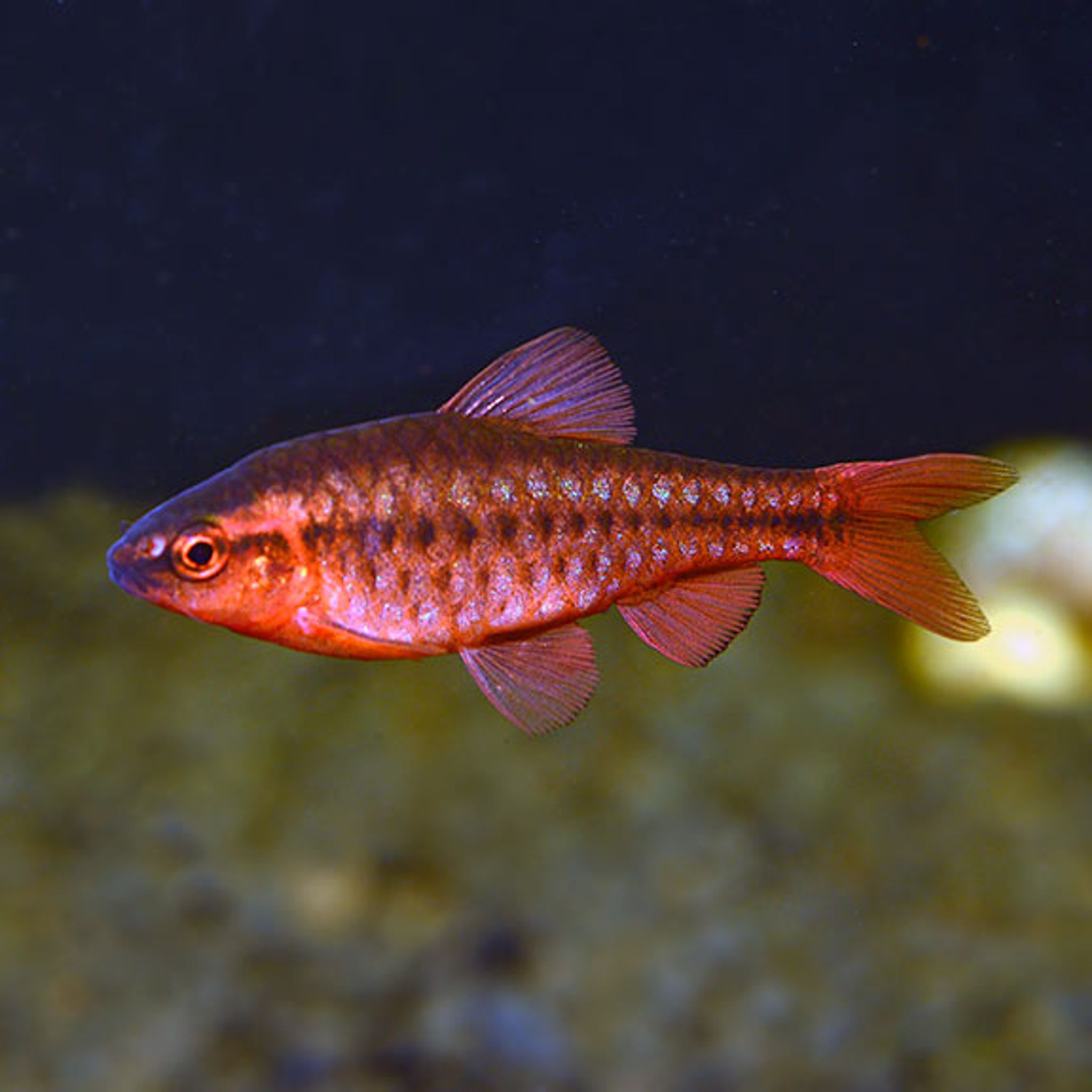

How Big Do Cherry Barb Get? Growth Rate, Adult Size and Tank Planning
A full-grown cherry barb reaches roughly 1.5 to 2 inches (3.8–5 cm), with most individuals settling around 1.6–1.8 inches (4–4.5 cm). That small footprint is exactly why they're so easy to get wrong: undersized tanks, thin schools, and rushed cycling all look "fine" for a fish this size, right up until growth stalls and behavior turns sour. Here's the real growth curve, the size differences between males and females, and a stocking plan that actually works.
Adult Cherry Barb Size at a Glance
| Measure | Size |
|---|---|
| Fry at birth | ~0.25 in (0.6 cm) |
| Juvenile at 1 month | ~0.5 in (1.3 cm) |
| Near-adult length | ~3–4 months |
| Full maturity (length + bulk/color) | 6–12 months |
| Adult total length (males) | ~1.5–1.7 in (3.8–4.3 cm) |
| Adult total length (females) | ~1.7–2 in (4.3–5 cm) |
| Typical lifespan | 4–6 years with good care |
Treat 1.5–2 inches as the honest range rather than a hard number — genetics, diet, and water quality all shift where an individual fish lands within it.
Males vs. Females: Why Size Varies
Cherry barbs show clear sexual dimorphism, and size is part of it:
- Females run slightly larger and noticeably deeper-bodied, especially once mature and carrying eggs. Coloring stays olive to brownish with a muted stripe.
- Males are usually a touch smaller but make up for it with the species' signature trait: an intense cherry-red body that deepens further during breeding displays.
If you're trying to sex a group, color is the fastest tell — but body depth and overall bulk are the more reliable size cue, since a stressed or newly colored-up male can look deceptively red before he's actually mature.
The Growth Timeline, Month by Month
Cherry barb growth isn't linear — it front-loads fast, then tapers into a long finishing phase:
- Birth: Fry hatch around 0.25 in (0.6 cm), nearly transparent and vulnerable.
- Month 1: Length roughly doubles to about 0.5 in (1.3 cm) as fry start free-swimming and eating fine foods.
- Months 2–4: This is the real growth spurt — cherry barbs pack on the bulk of their remaining length here, often reaching near-adult size by around month 3.
- Months 6–12: Length gains slow dramatically. What continues is filling out — deeper bodies, thicker shoulders, and full adult color — rather than more length. A fish is generally considered fully mature by this window, not at the 3-month mark, even though it already looks "grown."
That reconciles the two claims you'll see floating around: "full size by 3 months" is true for length, but full maturity (body depth, color intensity, breeding readiness) takes another 3–9 months on top of that.
What Affects How Big Your Cherry Barb Gets
Genetics sets the ceiling, but several factors decide whether a fish actually reaches it:
- Diet quality. A protein-rich flake or pellet as a staple, supplemented with occasional live or frozen foods, supports steady growth. Fry and juveniles especially need this protein to build tissue during the months 2–4 growth spurt.
- Water quality and oxygenation. Clean, well-oxygenated water keeps metabolism and appetite normal. Poor water quality is one of the most common — and most overlooked — causes of undersized adults.
- Available space. Crowding a young school into too little swimming room is a documented cause of stunted growth in schooling fish. Cherry barbs are active mid- and lower-water swimmers; cramped quarters suppress growth even when water tests look acceptable.
- Temperature and pH stability. Within the species' comfortable range, warmer and more stable conditions tend to speed metabolism and growth up to a point. Cold or fluctuating temperature and pH slow growth and add stress — so the goal is stability within range, not pushing toward the warm extreme.
- Genetics and breeding status. Some individuals are simply built smaller or larger, and breeding females can look temporarily larger or rounder due to eggs rather than overall size.
- Stress. Constant chasing, poor tankmate matches, or an overcrowded school all divert energy away from growth.
Sizing a Tank Around This Species
Because cherry barbs top out under 2 inches, it's tempting to under-buy the tank. Resist that. They're active schoolers that need horizontal swimming room, not just water volume.
- 20 gallons is the workable floor for a school of six.
- 25–29 gallon long tanks are the better real-world choice — the extra footprint gives a school room to spread out and reduces the stress that can suppress growth, especially in a community setup with other fish.
A simple rule of thumb for planning beyond the base tank: budget roughly 1 gallon per additional adult cherry barb past your starting school size. So a school of 6 fits the 20–25 gallon range, a school of 10 is comfortable in 25–29 gallons, and a school of 12+ is better served by 29 gallons or more, particularly once you add tankmates.
You can browse freshwater community fish and barbs specifically to compare species before finalizing your stocking plan, and check glass tanks sized for a proper long-footprint school.
Stocking Math That Actually Works
- Keep cherry barbs in groups of 6 or more — smaller groups lead to fin-nipping, hiding, and washed-out color from schooling stress.
- Aim for more females than males — a ratio like 2–3 females per male reduces the constant chasing that stressed, single-female groups experience.
- Water parameters: 74–79°F, pH 6.0–7.5 (slightly soft and acidic is preferred), with regular partial water changes to keep growth on track.
Recognizing Stunted or Poor Growth
A cherry barb that's noticeably behind schedule is worth investigating rather than shrugging off as "just small." Watch for:
- A fish plateauing well under an inch past 4–5 months of age.
- Clamped fins or persistent lethargy alongside slow growth.
- One or two individuals visibly smaller than the rest of an otherwise even school.
In nearly every case, the cause traces back to water quality, tank crowding, or diet — not genetics. Before assuming a fish is just "runty," rule out being outcompeted for food, a too-small tank, or inconsistent water changes.
A practical way to check: measure objectively instead of eyeballing it. Once a month for the first four months, hold a fish gently against the outside of the glass next to a ruler, or photograph the tank against a background grid and compare the same fish over time. This catches a stalling growth curve early, while there's still time to fix the underlying cause.
Long-Fin and Variant Cherry Barbs
Selectively bred variants — including long-fin ("veiltail" style) cherry barbs — are increasingly common in the trade. Their overall body length tends to fall in the same 1.5–2 inch range as wild-type fish, but the extended fins can make them look noticeably larger and change how they carry themselves in the water. If you're buying a variant expecting standard proportions, size the tank for the fin spread, not just the body length.
Aquarium Habits That Support Healthy Growth
A cherry barb's growth is only as good as the tank around it. A few standing habits make a measurable difference:
- Don't buy fish the same day as the tank. Cycle first — a healthy bacteria colony typically needs 4–6 weeks to establish, and ammonia and nitrite should read 0 ppm before stocking.
- Don't overfeed. Offer only what a school clears in about two minutes, once or twice a day for adults; overfeeding fouls water faster than it helps fish grow.
- Don't tear down the tank to clean it. A gravel vacuum plus routine partial water changes removes waste without destroying the beneficial bacteria that keep the system stable.
- Do buy the largest tank you can reasonably afford and maintain. Bigger volumes are more forgiving of small mistakes and swing less in temperature and chemistry.
- Keep the tank out of direct sun and drafts to limit algae blooms and temperature swings that stress fish and slow growth.
Beginner Mistakes That Kill Fish in the First 30 Days
- Skipping the nitrogen cycle and adding fish to unprocessed water.
- Overstocking a young biofilter all at once instead of adding fish gradually.
- Mixing species by looks rather than compatibility — matching temperament and water-chemistry needs matters more than appearance.
- Overfeeding in month one. Feed sparingly, roughly every other day, in a portion about the size of the fish's eye.
- Improper acclimation. Drip-acclimate for 45–60 minutes rather than just floating the bag, to avoid a pH shock that stresses new arrivals right when they're most vulnerable.
Feeding Cadence as Fish Grow
- Fry and juveniles benefit from more frequent, smaller feedings to fuel the months 2–4 growth spurt.
- Adults do best on one to two feedings a day, sized to what the school finishes in about two minutes.
15 Common Tank Problems to Avoid
A handful of setup and maintenance mistakes cause most of the growth and health issues hobbyists see:
- Undersized starter tank — aim for a 20–55 gallon range as a beginner; bigger tanks are more forgiving and stable.
- Skipping the nitrogen cycle before stocking.
- Topping off evaporated water instead of doing real water changes — this lets nitrate, phosphate, and pH drift; change roughly 10% weekly or 25% biweekly instead.
- Over-cleaning or over-scrubbing surfaces, which strips out the beneficial bacteria a tank depends on.
- Needing to clean again within 2–3 weeks of setup — a sign of an undersized filter, overstocking, or overfeeding, not bad luck.
Pairing a properly cycled tank with a right-sized filter goes a long way toward avoiding this list entirely.
Frequently Asked Questions
How big does a cherry barb get in a 10-gallon tank?
Physically, it will reach roughly the same 1.5–2 inch size regardless of tank — size doesn't shrink to fit the tank. The problem is that a 10-gallon tank is too small for a proper school of six or more, leading to more stress, hiding, and potentially stunted growth or a shorter lifespan. Upgrading to at least 20 gallons is strongly recommended.
How can I tell a male cherry barb from a female?
Males are usually smaller and show the species' signature deep cherry-red color, which intensifies during breeding displays. Females are larger and rounder-bodied, with more muted brown or olive tones.
How long do cherry barbs live?
Typically 4–6 years with stable water quality and a good diet. That lifespan is worth keeping in mind when planning tank size, since you're committing to years of a school, not just a few months.
Do cherry barbs stop growing after a certain age?
Growth in length slows sharply after 3–4 months and mostly plateaus by 6–12 months. Anything that looks like continued "growth" after that point is really the fish filling out in body depth and color rather than getting longer.
Can cherry barbs be kept with bettas or other small fish?
Generally yes — cherry barbs are peaceful and community-safe with similarly sized, non-aggressive tankmates. Avoid pairing them with notorious fin-nippers or with fish large enough to view a young cherry barb as food, since they're on the small end of the community-fish spectrum themselves.
Why is my cherry barb not growing or looks smaller than others?
Usually the cause is diet, water quality, tank crowding, or being outcompeted for food by faster or more aggressive tankmates. Rule these out with a water test, a look at feeding habits, and a check on tank size before assuming it's simply genetics.
What size tank do I need for a school of 6 cherry barbs?
Treat 20 gallons as the absolute floor. A 25–29 gallon long tank is strongly preferred, especially once you plan to add other community fish alongside the school.
How fast do cherry barb fry grow?
Fry start around 0.25 inches (0.6 cm) at birth and roughly double to 0.5 inches (1.3 cm) within the first month. The fastest length gains happen between months 2 and 4, after which growth shifts from length to filling out.
Ready to plan your school? Browse freshwater livestock on FishyHub to find healthy cherry barbs and compatible community tankmates sized right for your setup.


