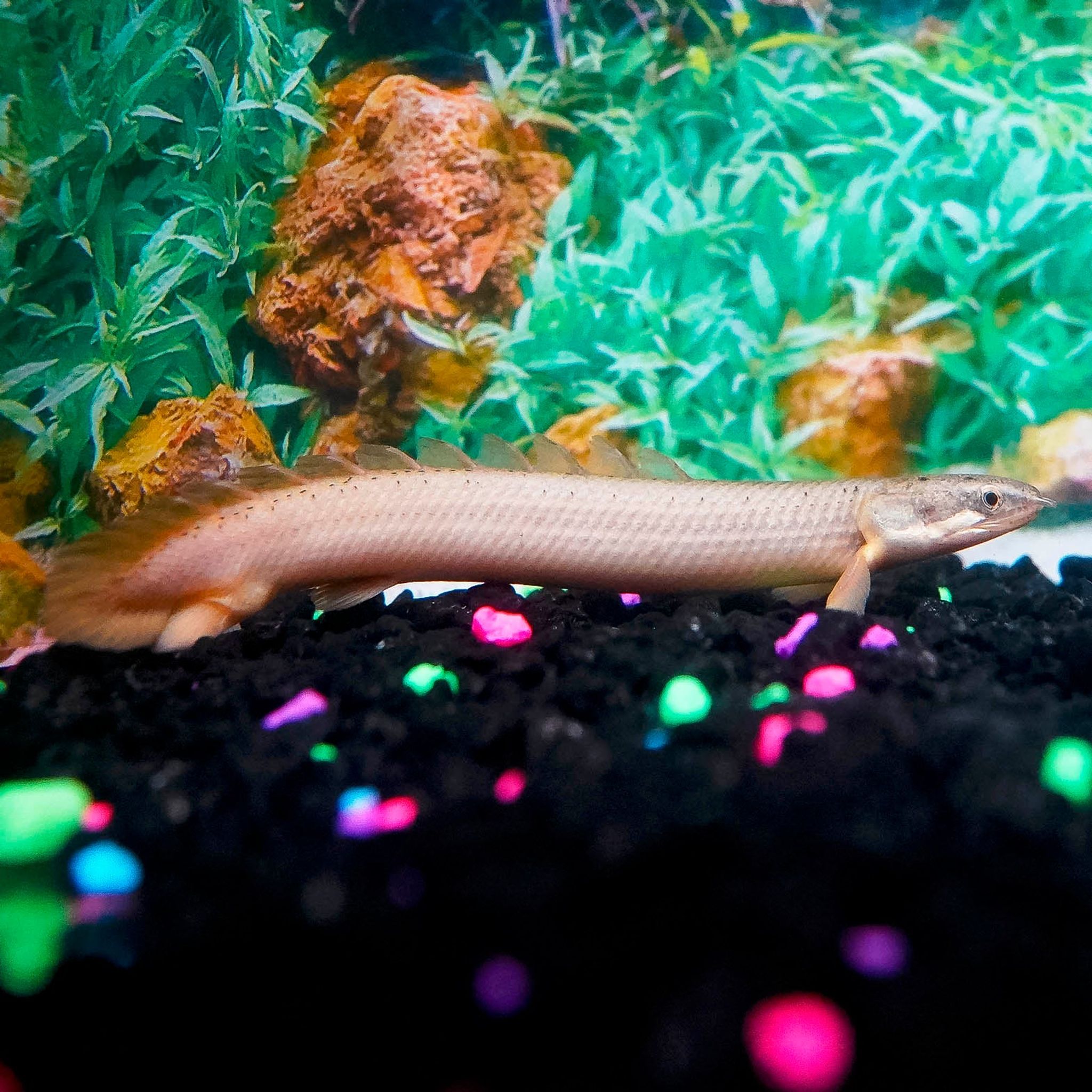
How Big Do Bichir Get? Growth Rate, Adult Size and Tank Planning
Most bichirs are sold as 3-4 inch "dinosaur eels" that fit comfortably in a small tank, which is exactly why so many owners get blindsided a year later. Depending on species, that little tube of a fish can end up anywhere from 12 inches to 30 inches long and live for decades. This guide walks through adult sizes by species, a realistic growth timeline, and the tank math you need before you commit.
What Is a Bichir, Exactly?
Bichirs (Polypterus spp.) are ancient, air-breathing freshwater fish native to African rivers and floodplains. Their elongated, eel-like bodies, armored scales, and rayed dorsal finlets give them a prehistoric look, which is where the "dinosaur eel" nickname comes from. Juveniles have feathery external gill fringes behind the head that let them breathe in low-oxygen water; these fringes shrink and eventually disappear as the fish matures and relies more on its lung-like swim bladder to gulp air at the surface.
That juvenile look is deceptive. A bichir's body plan barely changes as it grows — it just gets a lot longer and considerably thicker through the body, which is why size at purchase tells you almost nothing about size at maturity.
Adult Size by Species
Adult length varies enormously across the common pet-trade species, generally landing somewhere between 10 and 30+ inches. Buying for the adult size — not the size in the store tank — is the single most important planning decision.
| Species | Typical Adult Length | Minimum Adult Tank Size |
|---|---|---|
| Senegal bichir (P. senegalus) — "dinosaur bichir" | 12-14 in (30-36 cm), occasionally to 16 in | 75-90 gal (280-340 L) |
| Albino bichir (color morph of Senegal) | 12-14 in (30-36 cm) | 75-90 gal (280-340 L) |
| Delhezi bichir | 14-16 in (36-41 cm) | 75-90 gal (280-340 L) |
| Ornate bichir (P. ornatipinnis) | 20-24 in (51-61 cm) | 125+ gal (475+ L) |
| Endlicheri/Saddled bichir (P. endlicherii) | Up to 24-30 in (61-76 cm) | 125+ gal (475+ L) |
A couple of caveats worth flagging. Reported maximums for the largest species range from "up to 30 inches" to "about 2.5 feet," which is really the same figure stated two ways — treat 24-30 inches as the realistic aquarium ceiling, with wild-caught specimens occasionally running larger than tank-raised fish. The albino bichir is simply a color form of the Senegal bichir, not a separate species, so it follows the same size and care guidelines as its parent.
How Fast Do Bichirs Grow?
Growth is front-loaded: bichirs put on the most length in their first year, then slow down considerably as they approach maturity. Well-fed juveniles in adequate space can add several inches within a few months, but that pace tapers off — it does not continue in a straight line to adult size.
As a rough guide for a well-cared-for Senegal-type bichir starting from a 3-4 inch juvenile:
| Age | Approximate Length |
|---|---|
| 3 months | 5-7 in (13-18 cm) |
| 6 months | 7-9 in (18-23 cm) |
| 12 months | 9-11 in (23-28 cm) |
| 24 months | 11-13 in (28-33 cm) |
Most bichirs reach roughly half to two-thirds of their adult length by 12-18 months, then take another 2-4 years total to fill out to full adult size and body thickness. Larger species like the Ornate or Endlicheri follow the same overall pattern but scale up proportionally, ending up longer at every stage.
Growth rate is directly tied to diet and available space. A bichir kept in cramped quarters with sparse feeding will grow slower — but that's not a shortcut to a permanently small, healthy pet. It's a warning sign, covered below.
Stunting Is Not the Same as Slow Growth
It's tempting to assume that a small tank will simply keep a bichir small. It won't — not safely. Stunting from undersized housing and poor nutrition doesn't stop growth cleanly; it forces the fish's skeleton and organs to develop abnormally while soft tissue growth is suppressed. The practical consequences include:
- Spinal curvature and deformed body shape
- Compressed internal organs, which stresses the liver and kidneys
- Weakened immune response and higher disease susceptibility
- A shortened lifespan overall, sometimes cut dramatically short
A bichir kept long-term in a tank that's too small isn't a "manageable small pet" — it's a fish in chronic distress. If growth seems to have stalled well before the age benchmarks above, that's a cue to reassess tank size and diet, not a convenient outcome.
Tank Size Planning
Because bichirs are long-lived — commonly 10 to 20+ years with good care — tank planning should be built around decades, not just the fish's eventual length.
Minimum adult tank sizes, single fish:
- Smaller species (Senegal, Albino, Delhezi): 75-90 gallons (280-340 L)
- Larger species (Ornate, Endlicheri/Saddled): 125+ gallons (475+ L)
You'll sometimes see 40-gallon tanks mentioned for bichirs online. Treat that as a juvenile-only, short-term arrangement — not adult housing. It gets cited because it's what some keepers use temporarily while a young fish is still small, not because it's adequate long term.
Footprint matters more than height. Bichirs are bottom-oriented, sedentary swimmers that cruise along the substrate rather than the water column. A long, low, wide tank gives far more usable space for a bichir than a tall tank holding the same number of gallons — prioritize floor area when comparing tank dimensions.
Keeping more than one: Add roughly 20-30+ gallons per additional bichir, and step up a size class if you're combining bichirs with other large bottom-dwelling fish. Multiple bichirs can coexist in adequately sized setups with plenty of hiding spots to reduce competition, though some size- and shape-based aggression toward similar tankmates is normal.
You can browse adult-appropriate tank sizes and stands under Tanks & Stands when you're ready to size up.
Planning an Upgrade Path
Two realistic approaches:
- Buy the adult tank up front. More expensive at the start, but you avoid multiple cycling cycles, moving stress, and buying (then reselling) an interim tank.
- Stage the upgrade. Start in a smaller juvenile setup, but commit to a firm upgrade timeline — around the 12-18 month mark, when growth is still fast — rather than waiting until the fish is visibly cramped. Budget for the final tank early so the upgrade isn't a scramble.
Either way, the adult tank size should be decided before you buy the fish, not discovered after it outgrows the first one.
Water Parameters and Substrate
Bichirs are fairly adaptable but do best within these ranges:
- Temperature: 72-82°F (22-28°C)
- pH: 6.2-7.8 (soft to neutral; treat this wider range as the safe working window since bichirs tolerate some variation)
- Flow: Moderate to low is fine; well-oxygenated water is still worth maintaining even though bichirs can breathe atmospheric air as a backup
Substrate: Use fine sand rather than gravel. Bichirs root and scoot along the bottom constantly, and coarse gravel can scrape their barbels and skin over time. A soft sand bed lets them move naturally without abrasion — see options under Substrate.
Filtration: Bichirs are large carnivores and heavy waste producers. Run filtration rated above the gallon-for-gallon norm for the tank size rather than matching it exactly. Check Filters for units sized generously for large, messy fish.
Furnishings and lid: A tight, secure lid is non-negotiable. Bichirs are notorious escape artists and can squeeze through surprisingly small gaps within days of a new setup. Add driftwood and rock caves for cover, and keep lighting on the dim side — bichirs are nocturnal and shy away from bright light during the day.
Diet as They Grow
Juveniles do well on small live or frozen foods; as they mature, shift toward:
- Sinking pellets or a gel food as the daily staple
- Occasional frozen or live meaty foods — bloodworms, shrimp, earthworms, silversides
Avoid making feeder fish a primary diet component; it carries a real disease and parasite risk. Also watch portion sizes on fatty foods long-term — obesity is a common problem in older, well-fed bichirs kept in tanks without much room to move.
Sexing and Size
Size alone is not a reliable way to sex a bichir — males and females of the same species reach similar adult lengths. The more consistent visual cue is the anal fin: mature males typically develop a noticeably thicker, broader anal fin compared to the slimmer fin on females. This becomes easier to judge once a fish approaches adult size, not as a juvenile.
Choosing Tankmates
Pick tankmates too large to be swallowed and not prone to nipping fins. Reasonable pairings include Oscars and other large cichlids, sizable barbs, plecos and other large catfish, and knifefish. Avoid small fish, shrimp, and slow-moving bottom dwellers small enough to fit in a bichir's mouth — a fish that looked safely oversized at purchase can become a meal once the bichir grows. Explore large tankmate options under Monster Fishes or bottom-dwelling species compatible with bichirs in Plecos, Corys & Bottom Dwellers.
Common Mistakes to Avoid
- Buying a small juvenile on impulse without researching adult size or species identity
- Assuming slow growth means the tank is adequate, rather than a stunting warning sign
- Using gravel substrate instead of sand
- Leaving a tank uncovered or with gaps in the hood
- Housing bichirs with tankmates that are small now but will fit in their mouth later
- Feeding a diet based mainly on live feeder fish
- Underestimating filtration needs relative to the fish's bioload
Frequently Asked Questions
How big does a dinosaur bichir/eel get?
It depends heavily on species. Common pet-trade Senegal and Albino bichirs typically top out around 12-14 inches, while larger species like the Ornate or Endlicheri/Saddled bichir can reach 20-30 inches. Most beginner-sold "dinosaur bichirs" are the smaller Senegal type.
How fast do bichirs grow?
Growth is fastest in the first year with good food and adequate space, then slows noticeably. Reaching full adult size typically takes 2-4 years, even though the fish may already look close to full-grown after 12-18 months.
What size tank does an adult bichir need?
At least 75-90 gallons for smaller species like Senegal or Delhezi, and 125+ gallons for larger species like Ornate or Endlicheri. Floor space matters more than tank height since bichirs are bottom-dwelling swimmers.
Can bichirs live in a 40-gallon tank?
Only as a short-term home for a juvenile of a smaller species. A 40-gallon tank is not adequate long-term housing for an adult bichir of any common species.
Do bichirs stop growing if kept in a small tank?
They may appear to grow more slowly, but this is stunting, not a safe size limit. Stunted growth is linked to spinal deformities, organ stress, and a shortened lifespan rather than a harmless smaller adult.
What do bichirs eat as they grow?
Juveniles do well on small live or frozen foods, while adults should transition to sinking pellets or a gel food as a staple, supplemented with occasional meaty treats like bloodworms or shrimp. Avoid relying mainly on feeder fish due to disease risk.
Can you keep more than one bichir together?
Yes, in a tank upsized by roughly 20-30+ gallons per additional bichir with plenty of hiding spots. Some aggression toward similarly sized or shaped tankmates is normal and worth planning around with enough cover.
How long do bichirs live?
Commonly 10-20+ years with proper care, which is why tank planning should be based on a long-term commitment rather than the fish's current small size.
If you're ready to start planning a bichir setup, browse available bichirs and compatible bottom-dwelling species in Plecos, Corys & Bottom Dwellers on FishyHub.


