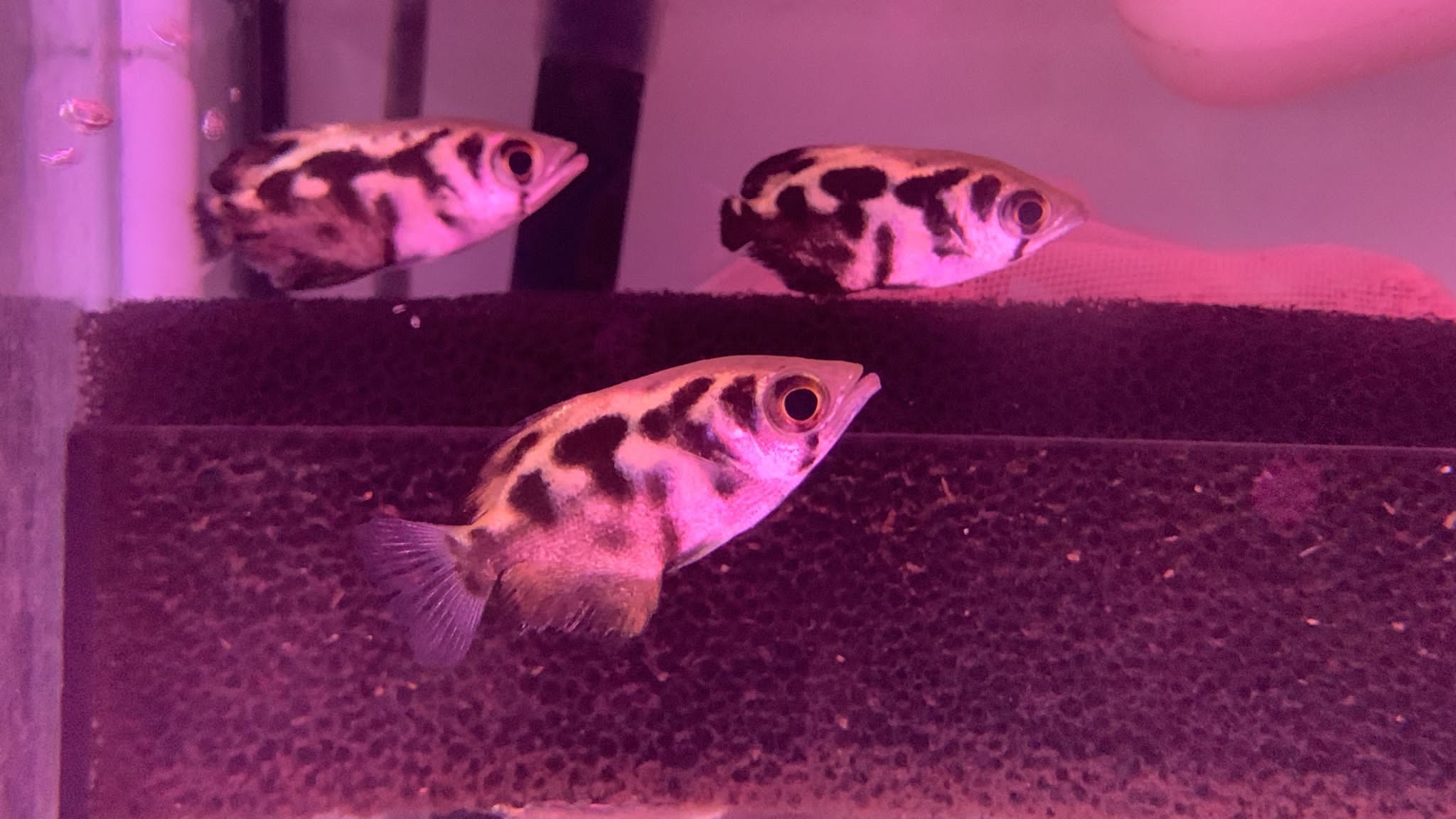
How Big Do Archerfish Get? Growth Rate, Adult Size and Tank Planning
Most archerfish sold in stores are 1.5 to 2 inches long, which makes them look like a nano-tank candidate. They aren't. A healthy archerfish typically reaches 8 to 12 inches as an adult, hits that size within one to two years, and needs a brackish, surface-oriented tank far larger than its juvenile size suggests. Here's the actual growth curve and the tank numbers to plan around before you buy.
Adult Size: What to Actually Expect
The two archerfish species most commonly sold in the US hobby are the banded archerfish (Toxotes jaculatrix) and the largescale archerfish (Toxotes chatareus). Both get sold under the generic label "archerfish," so buyers rarely know which one they're bringing home.
Size claims for this genus vary enormously depending on the source, because wild and captive numbers get mixed together:
- Realistic captive planning number: 8–10 inches, with larger individuals reaching close to 12 inches.
- Wild/record sizes: some references cite 14–16 inches for the largest species in native brackish and estuarine habitats.
- Species difference: banded archerfish generally top out a bit smaller in home aquariums than largescale archerfish, though the gap isn't dramatic enough to change your tank math.
The takeaway: plan your tank around 8–12 inches, not the 2-inch fish in the bag, and don't assume you'll get the smaller wild-max number just because a source quotes it.
Species Identification: Banded vs. Largescale Archerfish
Because store labeling is often just "archerfish," it helps to know what you're looking at:
| Feature | Banded archerfish | Largescale archerfish |
|---|---|---|
| Body tone | Silvery, cleaner contrast | Slightly sootier/duskier overall |
| Banding pattern | More regular, evenly spaced dark bands | Bands often less uniform |
| Dorsal fin spines | Typically fewer | Typically more |
| Adult size trend | Slightly smaller on average | Slightly larger on average |
Neither trait is foolproof at juvenile size, so treat both species as needing the same large, long tank rather than trying to bet on the smaller outcome.
Growth Rate: A Realistic Timeline
Archerfish growth front-loads hard. A juvenile fed well in good water can put on size fast, then growth tapers as the fish matures.
| Age / stage | Approximate length | Notes |
|---|---|---|
| At purchase | 1.5–2 in (4–5 cm) | Typical juvenile size sold in stores |
| ~6 months | 3–4 in (7.5–10 cm) | Rapid early growth with good food and stable water |
| ~1 year | 5–7 in (13–18 cm) | Growth continues but begins slowing |
| 1.5–2 years | 8–12 in (20–30 cm) | Adult length and sexual maturity reached |
Two caveats worth planning around:
- Growth slows considerably after year one — don't assume the fast juvenile pace continues in a straight line.
- Undersized tanks can stunt growth. Stunting isn't unique to archerfish, but it's rarely discussed for this species specifically. A cramped tank or inconsistent water quality can suppress growth rate and long-term health even if the fish technically "survives," so a small enclosure isn't a shortcut to a permanently small fish — it's a welfare problem.
Tank Size: Matching Gallons to Growth Stage
Tank size recommendations for archerfish range from 55 to 125+ gallons across different sources, and the disagreement comes down to what stage of life is being discussed. Framed as a progression:
- 55 gallons: workable only as temporary housing for a single small juvenile — not a long-term home.
- 75–100 gallons: the realistic minimum for one adult archerfish long-term.
- 100–125+ gallons: recommended for adults kept in a group, which is how archerfish should generally be kept (more on that below).
Why Length and Footprint Matter More Than Depth
Archerfish are surface-oriented hunters, not deep divers — in the wild they cruise just under the water's surface, hunting insects that land on it or overhanging vegetation above it. That behavior changes what "big enough" means:
- A long, low, wide tank gives more usable surface-swimming territory than a tall tank with the same gallon count.
- Depth mostly adds water volume without adding room the fish actually uses day to day.
- When comparing two tanks of similar gallons, favor the one with more floor footprint and surface area over the taller option.
The Air Gap Requirement
Archerfish shoot jets of water at insects above the surface to knock them down, and they're also strong jumpers. Any tank needs:
- A secure, well-fitted lid or canopy — no gaps large enough for a fish to launch through.
- An air gap of roughly 4–8 inches between the water surface and the lid, giving the fish room to shoot and giving you room to feed from above without flooding the hood.
A loose-fitting lid is one of the most common ways archerfish end up on the floor, especially when startled or aiming at food.
Groups and Compatibility
Keeping Archerfish in Groups
Archerfish are naturally social to semi-schooling and generally do best in groups of 4–6 or more, not singles or pairs. Housing them alone or in twos tends to increase aggression and skittishness and can dull their coloration. A group of 5–6 fits the 100–125+ gallon range described above — groups need proportionally more space, not just more fish crammed into a minimum-size adult tank.
Tankmates and Predation Risk
Archerfish pair reasonably well with other robust, brackish-tolerant species such as monos, scats, gobies, mollies, and certain puffers. You can browse a range of compatible community stock, including freshwater livestock suited to larger or brackish setups, when planning a stocking list.
The critical warning: an adult archerfish will eat any tankmate small enough to fit in its mouth. A fish that was a safe dither species at 2 inches can become prey once the archerfish reaches its adult length, so stock with the adult archerfish size in mind from day one, not the size it is at purchase.
Brackish Water: The Non-Negotiable Part
Archerfish are not a permanent freshwater fish. Long-term health depends on dedicated brackish conditions:
- Specific gravity: roughly 1.005–1.015, checked with a hydrometer or refractometer — not test strips, which aren't built to measure salinity accurately and can let dangerous swings go unnoticed.
- pH: 7.0–8.5
- Temperature: 74–82°F (23–28°C)
- Hardness: moderately hard water
Should Salinity Start Low or High?
Sources disagree on timing. In the wild, very young archerfish tolerate lower salinity as they move between freshwater and brackish habitats, and some hobbyists cite this to justify starting juveniles in near-freshwater conditions. The more defensible long-term approach: don't keep a juvenile in freshwater indefinitely just because it can briefly tolerate it. Instead, raise salinity gradually as the fish grows, working toward full adult-level brackish parameters (specific gravity in the 1.010–1.015 range) rather than a fixed number applied on day one or skipped altogether.
Keeping archerfish in freshwater long-term is a known cause of fin and skin issues and reduced immunity — it's a slow decline, not an immediate crisis, which is exactly why it gets missed until the fish is already struggling.
Brackish Tank Setup Basics
A few setup choices support both water quality and natural behavior:
- Hardscape: driftwood and mangrove roots tolerate brackish conditions and suit the biotope.
- Floating plants or overhanging branches: mimic the natural hunting setup where insects are more likely to be near or above the surface, encouraging natural spitting behavior.
- Filtration: a system sized for the adult bioload from the start, since retrofitting filtration after a fish outgrows its setup is harder than planning for it up front. You can compare options for filters suited to larger brackish and freshwater setups when building out the system.
Feeding and Hunting Behavior
Archerfish are carnivorous/insectivorous and hunt by spitting a jet of water from a groove in the roof of the mouth to knock insects off overhanging leaves or branches into the water, where they're eaten. This isn't a party trick — it's how the species feeds in the wild, and it's a behavior worth preserving in captivity.
Diet through growth stages:
- Live foods: crickets, flies, and mealworms dropped near the surface, plus bloodworms in the water column.
- Training onto frozen and pellet foods: many archerfish can be transitioned to frozen foods and some pellets over time, which is more practical long-term than sourcing live insects indefinitely.
- Variety matters: a diet of pellets alone, without live or frozen insects/prey mixed in, can affect natural behavior and growth. A rotation that includes a gel food or freeze-dried options alongside live and frozen items supports both nutrition and the hunting instinct. FishyHub carries a range of freeze-dried foods that work well as part of that rotation.
Transitioning to non-live foods doesn't eliminate the spitting behavior on its own — fish that are never given anything to spit at (floating insects, food dropped from above) can lose the habit of hunting at the surface, so it's worth occasionally offering food in a way that still triggers it.
Estimating Adult Size Before You Buy
Most buyers have no way to gauge a juvenile's eventual size at the point of sale, since the two common species are usually mislabeled or sold under one generic name. Useful cues:
- Ask (or check) which species is being sold, if the retailer distinguishes between banded and largescale.
- Look at banding regularity and body tone using the identification table above — a rough guide, not a guarantee.
- Default to planning for the larger end of the captive range (10–12 inches) rather than assuming you got the smaller species, since the cost of over-preparing a tank is much lower than the cost of a forced rehoming later.
Common Mistakes to Avoid
- Buying a 2-inch juvenile without a plan for 100+ gallons. This is the single most common path to a rehoming situation, since the fish outgrows a small setup well within its first year.
- Long-term freshwater housing. Tolerable briefly for very young fish, harmful over time.
- Loose-fitting lids or gaps. Archerfish jump, especially when startled or lining up a shot at food.
- Keeping singles or pairs. Leads to more aggression, more hiding, and duller color than a proper group.
- Stocking small tankmates. Anything that fits in an adult archerfish's mouth is eventually at risk.
- Using test strips for salinity. They're imprecise for specific gravity; a hydrometer or refractometer gives the accuracy this species needs.
- Feeding only pellets. Skips the variety that supports healthy growth and natural hunting behavior.
If you're setting up a dedicated system, browsing glass tanks in the 75-gallon-and-up range is a practical starting point for sizing an enclosure that will still fit the fish in a year.
Lifespan: The Other Long-Term Commitment
Beyond size, archerfish commonly live 5–10 years in captivity, longer with excellent care. Combined with their adult footprint, that makes them a genuine long-term stocking decision rather than an impulse buy — the tank commitment and the time commitment arrive together.
Frequently Asked Questions
How big does an archerfish get in a home aquarium?
Typically 8–12 inches, depending on species and care, which is noticeably smaller than the wild maximums (up to 14–16 inches) sometimes quoted online. Plan your tank around the captive range, not the wild record.
How fast do archerfish grow?
Growth is fastest in the first six months, often reaching 3–4 inches from a 1.5–2 inch juvenile with good food and stable water. Growth continues but slows considerably after the first year, with full adult size and sexual maturity reached around 1–2 years.
What size tank does an archerfish need?
Plan for 75–100 gallons minimum for one adult, and 100–125+ gallons for a small group of 4–6. A 55-gallon tank only works temporarily for a single small juvenile. Favor a long, wide footprint over a tall tank of the same volume.
Can archerfish live in freshwater?
Not long-term. They need brackish water to stay healthy, with specific gravity around 1.005–1.015. Very young fish show some natural tolerance for lower salinity, but extended freshwater housing leads to fin, skin, and immune problems over time.
How many archerfish should be kept together?
Groups of 4–6 or more are recommended over singles or pairs. Archerfish are semi-schooling, and small groups tend to show more aggression, more hiding, and duller coloration than a properly sized group.
Do archerfish need a lid?
Yes. They're strong jumpers that shoot at prey above the water, so a secure, well-fitted lid or canopy is essential, along with an air gap of roughly 4–8 inches for natural hunting behavior.
How long do archerfish live?
Roughly 5–10 years in captivity with good care, sometimes longer. That lifespan should factor into the tank-size decision as much as the fish's adult length does.
What do archerfish eat as they grow?
Juveniles and adults are carnivorous/insectivorous, eating live crickets, flies, mealworms, and bloodworms. Many can be trained onto frozen foods and some pellets over time, though a varied diet that still includes live or frozen prey supports healthier growth and preserves natural hunting behavior.
Planning a brackish setup for archerfish or another surface-hunting species? Browse FishyHub's Freshwater Livestock selection to compare stock and compatible tankmates before you commit to a tank size.


