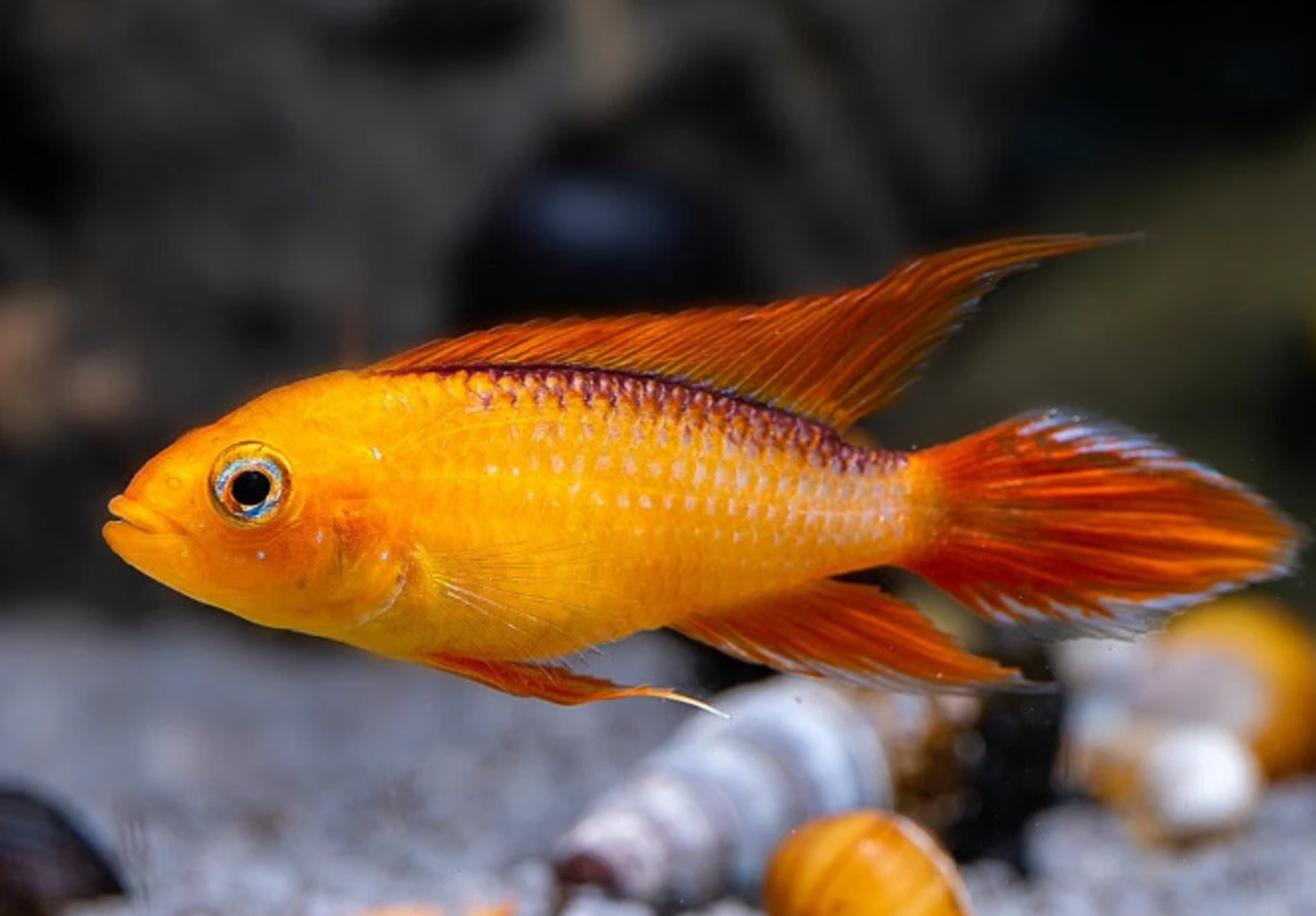

How Big Do Apistogramma Get? Growth Rate, Adult Size and Tank Planning
Most Apistogramma stay small, but "small" covers a wide range: adults run from about 1 to 3.5 inches (2–9 cm), and the number depends heavily on species and sex. This guide breaks down realistic adult sizes, how fast these dwarf cichlids grow, and exactly how many gallons to plan for so your fish reach their full potential instead of stalling out.
Genus-Wide Size Range
Across the roughly 90+ described Apistogramma species, standard length at maturity spans 1 to 3.5 inches (2–9 cm). That's a big range for one genus, so a single "Apistogramma get this big" answer is misleading. In practice, the species sold in the US aquarium trade cluster much tighter: most common pet-trade Apistogramma settle around 2.5 to 3 inches (6–7.5 cm) as adults.
A few named species and most males of larger species push past that cluster toward the 3–3.5 inch ceiling, while some of the smallest species stay under 2 inches their whole lives. Treat any single number you see online as an average, not a guarantee — sex, genetics, and rearing conditions all shift where an individual fish lands within its species' range.
Males vs. Females: The Size Gap Is the Rule, Not the Exception
Sexual dimorphism in Apistogramma is pronounced and consistent across almost every species:
- Males run noticeably larger, reaching 3 to 3.5 inches in bigger species, with elongated, elaborate dorsal and caudal fin extensions.
- Females stay smaller, typically 1.5 to 2.5 inches, with rounder bodies and less exaggerated finnage.
- Females often shift to brighter, more uniform coloration — frequently yellow — especially while guarding eggs or fry, which is a useful sexing cue separate from size alone.
This gap matters at purchase time. A juvenile that looks like a small, compact adult female can turn out to be a young male that grows a third larger with long trailing fins within a few months — a common surprise for new keepers who sized their tank around the fish's appearance at the store.
Species-by-Species Size Anchors
Adult size varies enough between species that it's worth checking the specific one you're buying rather than assuming a genus average. Here's how popular and notable species compare.
| Species | Male Size | Female Size | Notes |
|---|---|---|---|
| A. cacatuoides (cockatoo dwarf cichlid) | ~3 in (7.5 cm) | ~2 in (5 cm) | Hardy, popular beginner pick |
| A. agassizii | up to ~3.5 in (9 cm) | ~2 in (5 cm) | One of the larger common species |
| A. borellii | ~3 in (7.5 cm) | ~2 in (5 cm) | Calmer temperament |
| A. macmasteri | ~3 in (7.5 cm) | ~2 in (5 cm) | Similar profile to cacatuoides |
| A. hongsloi | ~3 in (7.5 cm) | ~2 in (5 cm) | Reddish fin edging |
| A. viejita | ~3 in (7.5 cm) | ~2 in (5 cm) | Sometimes confused with hongsloi |
| A. elizabethae | ~3 in (7.5 cm) | ~2 in (5 cm) | Blackwater-associated |
| A. trifasciata | ~2 in (5 cm) | ~1.5–2 in (4–5 cm) | Three dark stripes, blue fin edging |
| A. panduro | ~2 in (5 cm) | ~1.5–2 in (4–5 cm) | Compact, peaceful |
| A. nijsseni | ~3 in (7.5 cm) | ~2 in (5 cm) | Females turn deep yellow when brooding |
| A. baenschi | larger than most | proportionally larger | Runs above the typical dwarf-cichlid cluster |
| A. kullanderi | ~3.1 in / 79.7 mm SL | slightly smaller | Largest known Apistogramma species |
The Outlier: A. kullanderi
A. kullanderi is the genus's size record-holder, with males reaching about 3.1 inches (79.7 mm standard length). It comes from an isolated upper-watershed system in the Rio Xingu basin in Brazil. Taxonomic literature has flagged it as a challenge to the whole "dwarf cichlid" label, since it's noticeably larger than the vast majority of its relatives. The leading explanation is ecological: isolation in a limited watershed with reduced competition likely allowed the species to evolve unusually large body size for the genus — a small window into why size varies so much across Apistogramma more broadly (habitat isolation and competition pressure shape maximum size, not just genetics alone).
Two More Blackwater Species Worth Knowing
A. sororcula is a polychromatic species from the Rio Guaporé drainage spanning Bolivia and Brazil. It was sold under informal trade names before being formally described, and it illustrates how much color variation exists within a single species — females turn bright yellow during brood care, similar to many other Apistogramma. A. bitaeniata is another blackwater-river species from the Amazon Basin (Brazil and Peru), sized typically for the genus and commonly available for anyone building a South American blackwater setup.
Growth Timeline: From Fry to Full Size
Apistogramma grow quickly relative to many other freshwater fish, but full size and full color don't arrive on the same schedule.
- Hatching: Eggs laid in a cave hatch in roughly 2 to 5 days.
- Free-swimming fry: Fry become free-swimming within days of hatching and immediately need very small live foods.
- Juvenile growth spurt: The first few months are the fastest growth period, especially when fry are raised on live and frozen protein foods like baby brine shrimp.
- Adult size: Most Apistogramma reach full adult length by around 5 months old.
- Color and fin maturity: Full adult coloration and the long fin extensions on males typically continue developing for some time after body length has already maxed out — a fish can be full-grown in length but still "filling in" its finnage and color weeks later.
Why Tank Size and Water Quality Actually Change Growth
It's tempting to think of adult size as fixed by genetics, but crowding and poor water quality directly suppress growth, not just stress or health in the abstract. In a cramped or contested tank, subordinate fish spend energy on stress hormones and territorial vigilance instead of growth, and inconsistent water parameters slow metabolic processes tied to development. That's the mechanism behind a common observation: apistos kept in undersized or hard, alkaline tanks often end up smaller, duller, and slower to mature than genetically identical fish raised in soft, stable, spacious conditions.
This is also where wild-caught versus tank-raised stock diverges. Line-bred, tank-raised Apistogramma are typically adapted to a wider range of water parameters and often reach a consistent adult size and coloration under standard care. Wild-caught individuals can be pickier about needing genuinely soft, acidic water to reach their full size and color potential, and may show more size variation batch to batch. Buyers should ask about origin if reaching top-end size and color intensity matters to them.
Tank Size Guidance Tied to Real Numbers
| Setup | Recommended Tank Size |
|---|---|
| Single pair, minimum | 20 gallons long (76 L) |
| Single pair, recommended | 30 gallons (114 L) |
| Harem (1 male, 2–3 females) | 30–40 gallons (114–151 L) |
| Each additional pair beyond the first | add ~10 gallons (38 L) |
The old "an inch of fish per gallon" heuristic is too simplistic for Apistogramma. These are territorial cichlids that need floor space and sightline breaks, not just water volume — a long, low tank with plenty of horizontal territory outperforms a tall tank of the same gallon count. Nano tanks in the 5–10 gallon range aren't recommended for adult pairs; they don't offer enough territory or parameter stability, though some breeders use them short-term for isolating and rearing fry before moving them to a bigger system. Browse freshwater cichlids sized appropriately for the tank you're planning before you buy.
Water Parameters That Support Full Growth
Soft, slightly acidic water is the consistent thread across every reputable source on this genus:
- Temperature: 75–82°F (24–28°C), with some species tolerating up to 86°F (30°C)
- pH: 6.0–7.0 is the safe, easy range for most keepers; some wild forms and dedicated blackwater biotopes are pushed down to 4.5–5.0, but that's an advanced setup, not a beginner default
- GH: roughly 3–12 dGH
- KH: roughly 2–6 dKH
Keeping apistos in hard, alkaline tap water without adjustment is a common mistake. The fish may survive, but poor coloration, chronic stress, and stunted or slow growth are the typical result even without outright illness.
Diet for Proper Development
Apistogramma are omnivorous and grow best on a varied diet:
- Quality micro-pellets or small pellets as a base
- Live or frozen protein: baby brine shrimp for fry, then bloodworms, daphnia, and brine shrimp for juveniles and adults
- Occasional blanched vegetable matter
- Small feedings 2–3 times a day rather than one large meal
Overfeeding or relying only on dry food is a frequent mistake — protein-poor diets slow growth and dull color, while varied live and frozen foods support both size and vibrancy.
Housing Structure: Caves, Substrate, and Leaf Litter
Caves and Cover
Apistogramma are cave spawners by nature. Coconut shells, small clay pots, and short lengths of PVC give pairs a defensible breeding site and reduce stress-driven aggression toward tankmates. Soft substrate and dense planting round out a layout that lets subordinate fish retreat out of a dominant male's sightline — critical in any tank housing more than one male.
Leaf Litter and Botanicals
Dried leaves — Indian almond (catappa), oak, beech, or magnolia — replicate the leaf-litter streambeds many Apistogramma evolved in. As they break down, they release tannins that soften and acidify water naturally, and they grow a biofilm layer that fry graze on for extra nutrition. Shy fish also use the leaf layer as cover, which lowers stress and, per the growth mechanism above, supports healthier development rather than just improving the tank's look. Always boil leaves briefly before adding them — this sterilizes them and helps them sink instead of floating, since unboiled leaves and other botanicals can introduce contaminants.
Blackwater Biotope Tanks
For keepers who want to go further, a full blackwater biotope setup mimics a flooded South American forest stream: soft, tannin-stained water with low KH/GH, driftwood such as Malaysian or spiderwood for structure, and botanicals like catappa leaves and alder cones (boiled before use) scattered across the substrate. Apistogramma are a classic centerpiece fish for this style of tank, and a well-matched biotope tends to support better growth and richer coloration than a generic community setup with standard tap-water parameters.
Lifespan and Long-Term Planning
Apistogramma typically live 3 to 10 years, depending on species and care quality. That range is worth factoring into tank planning up front — a tank sized only for the fish's appearance at purchase, rather than its adult territory needs over a multi-year lifespan, is a common and avoidable mistake.
Good Community Picks and Territorial Behavior
Most Apistogramma are peaceful community fish day to day, but territorial and aggressive behavior spikes sharply once spawning starts or fry are present — a normally calm pair can injure tankmates in an undersized tank during this period. Good species for planted community setups, kept in pairs or harems (one male with multiple females) in a long, well-planted tank with plenty of hiding spots, include:
- A. cacatuoides
- A. borellii
- A. trifasciata-type species
- A. macmasteri
- A. hongsloi
Always plan around the space needs of a breeding pair, not just the peaceful behavior you see before spawning begins.
Apistogramma vs. Kribensis: A Size Comparison
Kribensis (Pelvicachromis pulcher) is a popular West African dwarf cichlid often mentioned alongside Apistogramma, but it runs noticeably larger — about 4 inches (10 cm) versus the roughly 2.5–3 inch cluster typical of common Apistogramma species. Kribensis needs a similarly sized or slightly larger tank: 20 gallons minimum for a pair, 40–50 gallons for a group or community setup. If you're comparing South American dwarf cichlids against their African counterparts for a stocking plan, size is the main differentiator to keep in mind — check African cichlids if a kribensis-style setup fits your tank better than an Apistogramma pair.
Stocking a Community Tank With Apistogramma
If you're adding an Apistogramma pair to an existing community tank rather than a dedicated species tank, treat the pair as needing roughly the same 20–30 gallon floor space allotment as they would alone, on top of whatever your tetras, corydoras, or other tankmates already require. Territorial disputes are about floor space and sightlines more than raw volume, so a wider footprint matters more than tank height when adding a pair to a mixed setup.
Common Mistakes to Avoid
- Undersizing the tank because the fish looks small at the store — plan for the adult male's full size and territorial needs, not the juvenile size at purchase.
- Ignoring sex differences when estimating size — a compact "female" can be a young male that grows a third larger with elaborate fins.
- Skipping soft, acidic water parameters — hard, alkaline tap water leads to poor color and stunted growth even without outright illness.
- Adding leaves or botanicals without boiling first — risks contaminants and leaves that float instead of sink.
- Underestimating spawning aggression — a peaceful pair can turn highly territorial once eggs or fry appear.
- Overfeeding or feeding only dry food — a protein-poor diet slows growth and dulls color.
Frequently Asked Questions
How big does an Apistogramma get in inches/cm?
The genus range is about 1 to 3.5 inches (2–9 cm), but most common pet-trade species settle around 2.5 to 3 inches (6–7.5 cm). Males consistently run larger than females within the same species.
Do male or female Apistogramma get bigger?
Males, consistently. They also develop longer, more elaborate fin extensions, while females stay smaller, rounder-bodied, and often take on brighter, more uniform coloration during brood care.
How long does it take an Apistogramma to reach full size?
Most reach full adult body length by around 5 months old. Full color intensity and complete fin development in males can continue for a bit longer after length has already maxed out.
What is the largest Apistogramma species?
A. kullanderi holds the record, with males reaching about 3.1 inches (79.7 mm standard length). It comes from an isolated watershed in Brazil's upper Rio Xingu basin, where reduced competition likely allowed it to evolve larger than its relatives.
What size tank does a pair of Apistogramma need?
Plan for 20 gallons long as an absolute minimum, with 30 gallons recommended for more stable conditions. Add roughly 10 gallons for each additional pair or for a harem setup.
Can Apistogramma live in a nano tank (5–10 gallons)?
Not for adults or breeding pairs — a nano tank doesn't offer enough territory or stable parameters long-term. Some breeders use small tanks temporarily for rearing fry before moving them to a larger system.
Are Apistogramma bigger or smaller than kribensis?
Smaller on average. Most Apistogramma top out near 3 inches, while kribensis reaches about 4 inches (10 cm) and needs a correspondingly larger tank for a group.
What water conditions help Apistogramma reach full size and color?
Warm water (75–82°F), soft and slightly acidic parameters (pH 6.0–7.0, low GH/KH), a varied protein-rich diet, and low-stress housing with caves and leaf litter all support healthy growth and vibrant coloration.
Ready to plan your setup? Browse freshwater livestock on FishyHub to find Apistogramma and tankmates sized right for the tank you're building.


