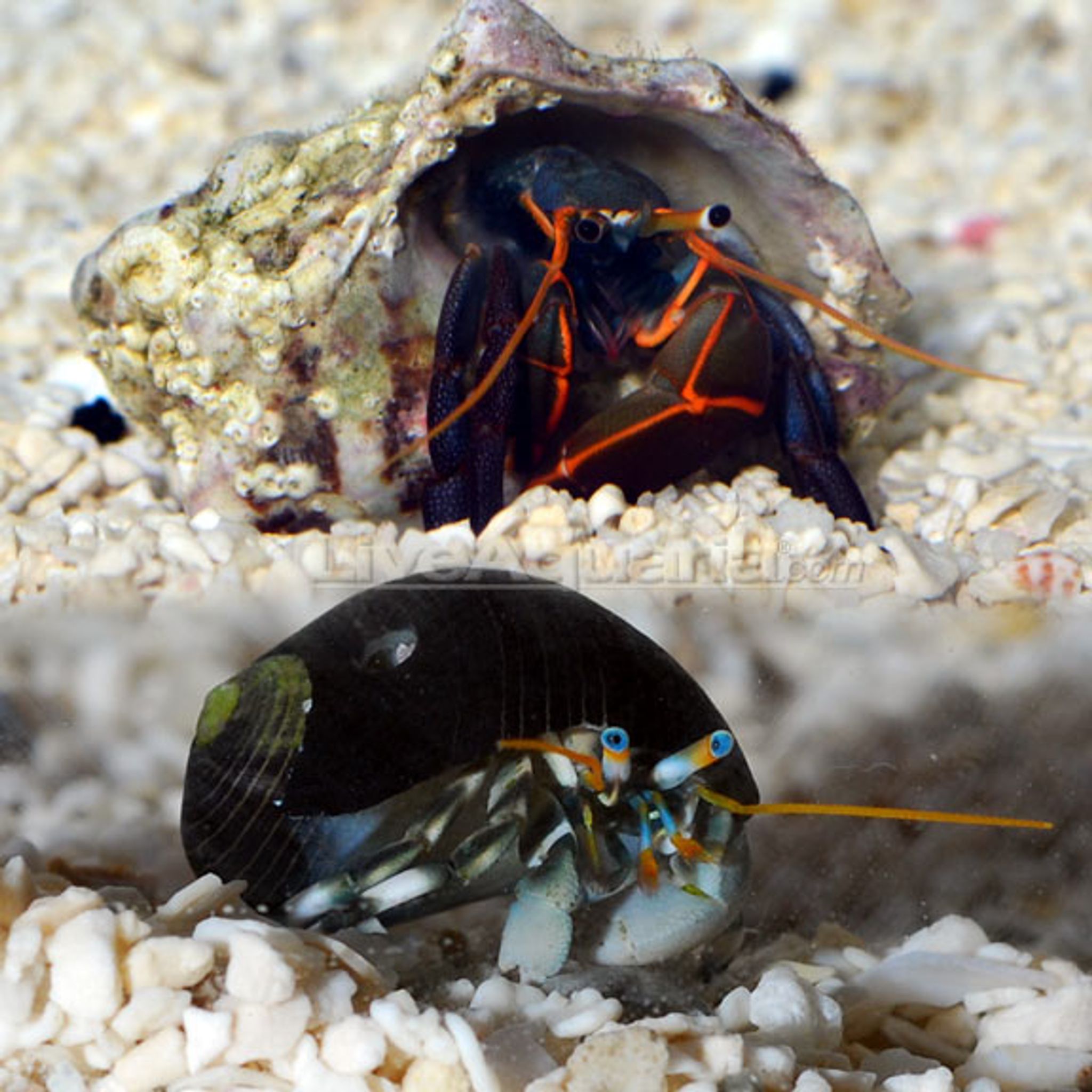

Hermit Crab Care Guide: Tank Requirements, Feeding and Compatibility
Marine hermit crabs are one of the most popular clean-up crew additions to a saltwater aquarium, but most online searches for "hermit crab care" mix in results for terrestrial pet crabs kept in dry terrariums. This guide covers only aquarium (marine/reef) hermit crabs—tank setup, stocking math, feeding, shell needs and compatibility—so you can stock them correctly and avoid the most common complaint: crabs attacking snails.
Marine Hermit Crabs vs. Land Hermit Crabs
Marine hermit crabs are scavenging and algae-grazing crustaceans that live fully submerged in saltwater. Because they lack a hardened abdomen shell of their own, they occupy empty gastropod (snail) shells for protection and swap into larger ones as they grow.
Terrestrial hermit crabs (genus Coenobita), by contrast, are land pets kept in humid terrariums with shallow water dishes, not full saltwater tanks. They are a completely different care system—different humidity needs, different substrate, different food—and should never be confused with the reef-tank species covered here.
Popular Reef-Safe Hermit Crab Species
| Species | Common Name | Adult Size | Notes |
|---|---|---|---|
| Clibanarius tricolor | Blue-leg hermit crab | ~1 in (2.5 cm) | Hardy, strong algae/cyanobacteria grazer, most common clean-up crew pick |
| Clibanarius digueti | Red-leg hermit crab | ~1 in (2.5 cm) | Similar role to blue-leg, active grazer |
| Paguristes cadenati | Scarlet reef hermit | ~1 in (2.5 cm) | Bright red-orange, peaceful algae eater |
| Calcinus elegans | Electric blue hermit | ~1–1.5 in (2.5–4 cm) | Striking coloration, moderate hardiness |
| Ciliopagurus strigatus | Halloween hermit | 2–3 in (5–7.5 cm) | Larger, striped legs, needs more space |
| Petrochirus diogenes | Giant hermit crab | Up to 6 in (15 cm) | Predatory tendencies, best for large/specialty setups only |
Smaller species (blue-leg, red-leg, scarlet, electric blue) are the best fit for a standard reef community tank. Larger genera—Halloween, giant hermits, and related Dardanus/Aniculus species—need more room per animal and carry a higher risk to corals and slower tankmates. You can browse live specimens in FishyHub's marine invertebrates crabs category when selecting species for your setup.
Tank Size and Stocking
A commonly used starting guideline is roughly 1 small hermit crab per 1–2 gallons (4–7.5 L) of tank water. Rather than stocking to that number all at once, add crabs gradually—start with a handful in a new tank and increase over several weeks.
Two factors matter more than the raw gallon count:
- Shell availability. Even a lightly stocked tank will see problems if there aren't enough spare shells.
- Food supply. A young tank without established algae and detritus can't support as many crabs as a mature one.
Larger species need considerably more space per individual, and a giant or Halloween hermit crab can outcompete or threaten smaller tankmates and corals regardless of how much "room" the gallon math suggests.
Water Parameters
Marine hermit crabs need stable, reef-standard saltwater conditions:
| Parameter | Acceptable Range | Sweet Spot |
|---|---|---|
| Temperature | 72–83°F (22–28°C) | 75–82°F (24–28°C) |
| pH | 8.0–8.4 | 8.1–8.4 |
| Specific gravity | 1.020–1.026 | 1.023–1.025 |
| Calcium | ~380–430 ppm | mid-range |
| Alkalinity | ~2.5 meq/L | stable, not exact |
Stability matters more than hitting an exact number—crustaceans are sensitive to sudden swings during acclimation more than to minor day-to-day variance. Never use copper-based medications in a tank housing hermit crabs or any other invertebrates. Copper is lethal to crustaceans; treat sick fish in a separate quarantine tank instead.
Habitat Setup
- Substrate: Sand works best—crabs bury in it, especially before molting.
- Live rock: Provides grazing surfaces for algae and biofilm, plus hiding spots.
- Secure aquascaping: Hermit crabs climb constantly and can dislodge loose rock or knock corals loose, so secure your rockwork before adding crabs.
- Filtration and flow: Good water movement and filtration support the same stable parameters crabs need long-term.
- Acclimation: Like other invertebrates, hermit crabs are sensitive to abrupt salinity and temperature shifts. Use a slow drip acclimation over 30–60 minutes rather than a quick bag-float-and-dump, matching the bag water to tank parameters gradually before release.
Feeding Hermit Crabs
Hermit crabs are omnivorous scavengers and opportunistic feeders. In an established tank they'll graze on:
- Nuisance algae, including hair algae and cyanobacteria
- Detritus and leftover food
- Dead or dying tankmates (they rarely hunt healthy fish)
That natural grazing isn't enough on its own in most tanks. Supplement directly 2–3 times per week with:
- Sinking algae wafers or pellets
- Dried seaweed or nori
- Occasional meaty protein—mysis shrimp, chopped seafood, or clam/mussel
Direct feeding measurably reduces snail predation, since a well-fed crab has little incentive to attack a living snail for its shell or body. A cuttlebone or crushed coral placed in the tank adds extra calcium to support molting. You can find suitable dried and freeze-dried options in FishyHub's freeze-dried food category.
Shells: The Single Most Important Supply
Shells are arguably more important than any water parameter for hermit crab welfare. Always keep a generous surplus—3 to 5 or more empty, unpainted, appropriately sized shells per crab—available at all times.
Buying and Prepping Shells
- Use natural, unpainted gastropod shells (whelk, periwinkle, turbo) with a smooth, wide aperture.
- Boil new shells briefly and let them cool, or otherwise quarantine them, before adding to the tank.
- Avoid painted, artificial, resin-coated, or decorative shells—they can trap the crab, injure it, or leach chemicals.
Sizing the Next Shell
A rough rule: look at the diameter of your crab's current shell opening and offer spares roughly 25–50% larger in opening diameter. Crabs test-fit shells with their claws before committing, so having a range of sizes—not just one "bigger" option—gives them room to grow into the right one as they molt.
Why Crabs Seem to "Fight" Over Shells
Even with several spares present, you may see what looks like a shell-swapping frenzy. This is often housing-chain behavior: one crab finds a marginally better shell, moves in, and abandons its old shell—which triggers the next crab to move up, and so on down the line. It looks chaotic but is a normal, non-aggressive process as long as enough shells of varying sizes are actually available.
Molting
Hermit crabs periodically shed their entire exoskeleton to grow. Frequency varies widely: juveniles may molt roughly once a month, while larger adults can go well over a year between molts.
During a molt, a crab typically buries itself in the substrate and goes still for days. Do not disturb a molting crab—it's at its most vulnerable with a soft new exoskeleton. Many crabs eat their shed exoskeleton afterward to reclaim calcium, which is normal and beneficial.
Is My Hermit Crab Dead or Just Molting?
This is one of the most common points of confusion for new keepers:
- Molting: An empty, translucent exoskeleton casing with no body inside and no odor. The crab itself is elsewhere, buried or hidden.
- Dead: The body remains inside the shell and typically develops a strong, foul odor within a day or two.
If you're unsure, leave the tank undisturbed and check again in 24–48 hours rather than pulling the shell out to inspect it.
Compatibility
Marine hermit crabs are generally reef-safe with caution when it comes to the common small species. Good tankmates include:
- Peaceful community and reef fish: clownfish, gobies, blennies, and wrasses (in moderation)
- Other peaceful clean-up crew members: snails and cleaner shrimp
Avoid pairing hermit crabs with large, aggressive, or predatory fish—triggerfish, larger wrasses, and puffers can and will eat small crabs. Also avoid keeping very large hermit species alongside corals or slow-moving snails, since size mismatch increases predation risk. If you're building out a mixed clean-up crew, FishyHub's marine invertebrates snails category is a useful complement to hermit crabs, since a healthy snail population also helps keep algae in check.
Do Hermit Crabs Actually Kill Snails?
Both framings you'll see online have some truth. Species temperament plays a role—some hermit crabs are simply more opportunistic than others—but the majority of predation incidents trace back to two fixable causes: too few spare shells and too little direct feeding. Address both and most snail-killing behavior stops.
A Note on Fiddler Crabs
Fiddler crabs (genus Uca) are often lumped in with marine hermit crabs in general crab-keeping content, but they're a different, largely brackish and semi-terrestrial group. Fiddlers need a paludarium-style setup with land access and brackish water—not a standard reef tank—so they shouldn't be mixed into a marine hermit crab setup.
A Note on Spiny Lobsters
Spiny lobsters occasionally show up in "clean-up crew" discussions alongside hermit crabs, but they grow much larger and become increasingly predatory as they mature. They're generally unsuitable for a reef community tank and shouldn't be treated as a hermit crab substitute.
Lifespan
In a well-run aquarium, marine hermit crabs commonly live roughly 1–3 years, sometimes longer with stable water quality and adequate food and shells. Short lifespans are usually a sign of poor husbandry—starvation, shell shortages, or unstable parameters—rather than a fixed biological limit.
Stress Signals to Watch For
- Increased aggression toward snails or other tankmates
- A sudden shell-swapping frenzy
- Reduced activity or hiding more than usual
- Refusal to eat offered food
These signs generally point to insufficient shells, insufficient food, or unstable water parameters—check those three things first before assuming illness.
Common Mistakes
- Not enough spare shells. The single biggest cause of crabs killing snails or fighting each other. Keep 3–5+ appropriately sized shells per crab at all times.
- Underfeeding or relying only on tank algae. Leads directly to scavenging on live snails and other invertebrates.
- Overstocking a young, immature tank before enough natural algae and micro-organisms have developed.
- Copper exposure from fish medications—always fatal to crabs and other invertebrates. Treat fish separately.
- Disturbing a molting crab, mistaking it for dead or stuck, which can kill it during its most vulnerable phase.
- Buying painted or artificial shells that trap, injure, or leach chemicals into the crab.
- Ignoring parameter stability—sudden swings in specific gravity or temperature are harder on crustaceans than being slightly outside the ideal range.
Buying Checklist
Before adding a crab to your cart, check for:
- Active legs and antennae with visible movement
- A tight, confident grip on its shell
- No missing or regenerating limbs (minor regeneration is normal, but avoid crabs with multiple missing legs)
- A shell that fits properly—not oversized or cracked
Frequently Asked Questions
Are hermit crabs reef safe?
Generally yes for the common small species—blue-leg, red-leg, scarlet, and electric blue—when well fed and given enough shells. Larger genera like Dardanus, Aniculus, and Petrochirus carry more risk to corals and tankmates.
How many hermit crabs can I put in my tank?
Roughly 1 small hermit crab per 1–2 gallons is a reasonable starting guideline, added gradually rather than all at once. The real number should be based on available algae/food and shell supply, not tank volume alone.
Do hermit crabs need a special shell, or can I use any shell?
They need an empty, unpainted gastropod shell with a smooth, appropriately sized opening. Decorative, painted, or coated shells can trap or injure the crab and should be avoided.
Why is my hermit crab attacking my snails?
Almost always a sign of too few spare shells or too little supplemental feeding, not innate aggression. Add more shells and increase direct feeding before assuming the crab is simply hostile.
How can I tell if my hermit crab is dead or just molting?
A molt leaves an empty, odorless exoskeleton casing while the crab hides elsewhere. A dead crab's body stays inside the shell and typically develops a strong odor within a day or two.
How long do hermit crabs live in a saltwater aquarium?
Typically 1–3 years with good husbandry. Shorter lifespans usually trace back to poor water quality, inadequate shells, or insufficient food rather than a fixed biological ceiling.
Can hermit crabs live with fiddler crabs or land hermit crabs in the same setup?
No. Fiddler crabs and terrestrial hermit crabs need brackish or humid land-based setups and shouldn't be mixed with marine hermit crabs in a standard saltwater aquarium.
Ready to build out your clean-up crew? Browse marine hermit crabs and other reef invertebrates in FishyHub's marine invertebrates category.


