

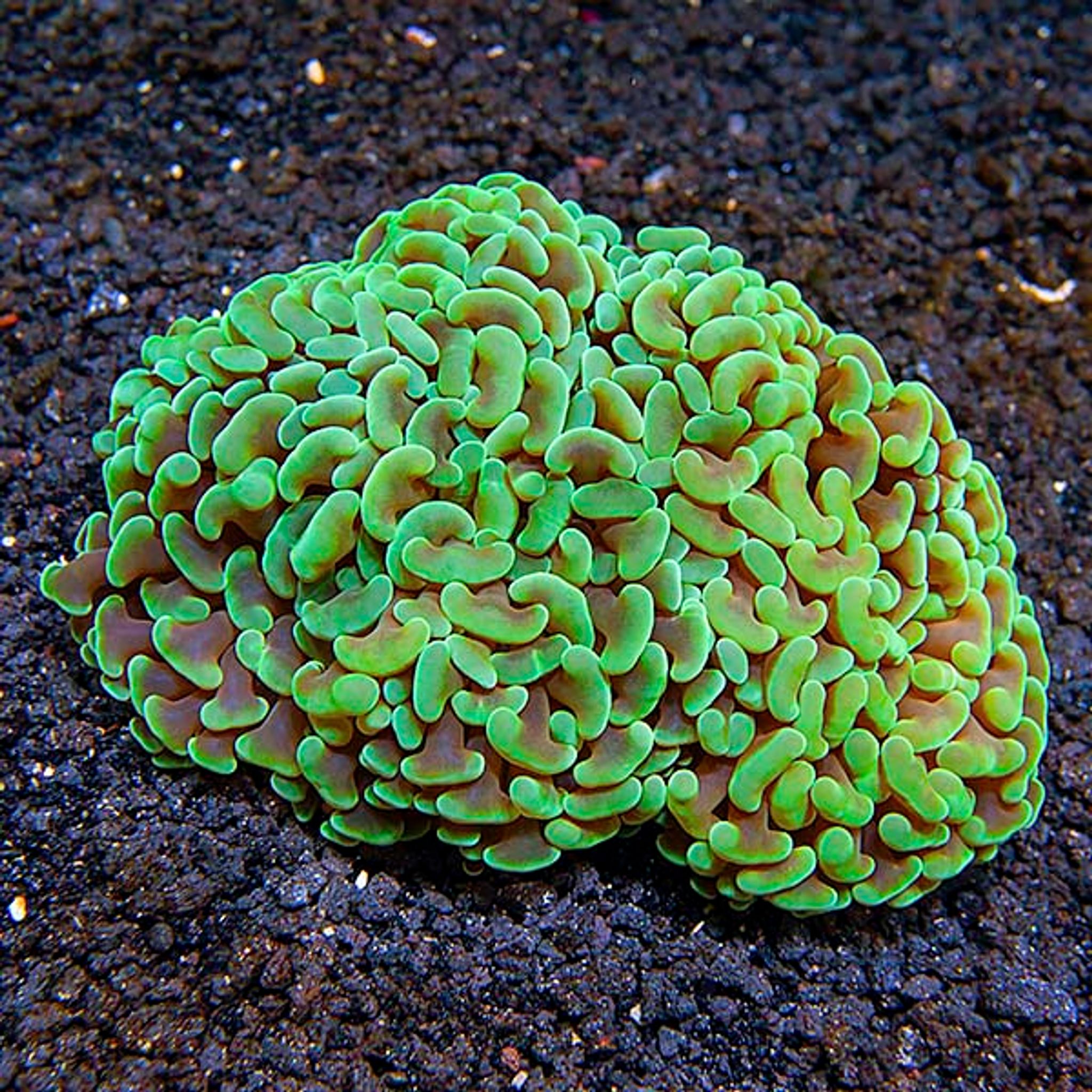

Hammer Coral Care Guide: Lighting, Flow, Feeding and Placement
Hammer coral is one of the most popular large-polyp stony (LPS) corals for reef tanks because it forgives small water-quality slips but punishes bad spacing decisions fast. This guide gives you the actual PAR, flow, and distance numbers keepers converge on, plus the placement rules that prevent it from stinging its neighbors to death.
What Is a Hammer Coral?
Hammer coral belongs to the genus Euphyllia, most commonly the species ancora or paraancora. It's named for its tentacle tips, which fan out into anchor- or hammer-shaped bulbs, and it's a close relative of torch and frogspawn coral — the three are often grouped together as "the Euphyllia family."
Hammer corals grow in two forms:
- Wall (encrusting) form: heads are tightly packed together on a single fused base, colony spreads as a mat.
- Branching form: individual heads sit on their own branches that grow outward from the base, giving more visible separation between polyps.
Both forms photosynthesize through symbiotic algae (zooxanthellae) and fluoresce green or gold under blue actinic light, which is part of why they're a display favorite.
Tank Size
Recommendations across the hobby range from 20 to 50 gallons (76-189 L) as a bare minimum, which is a wide spread. The practical answer: 30 gallons (114 L) or larger is the sensible starting point. A 20-gallon tank can technically hold one small frag, but adult hammer colonies can spread 1-3 feet (30-90 cm) across, and you need room around that footprint for sweeper tentacles and spacing from other corals — something a small tank simply doesn't have.
Lighting
Hammer coral wants moderate, diffused light, not the intense output SPS corals demand.
| Parameter | Range | Notes |
|---|---|---|
| PAR at the polyp | 75-150 | Most keepers start frags at 75-100 PAR |
| Acclimated range | Up to 150-400 PAR | Only after gradual acclimation over weeks |
| Color temperature | ~10,000-20,000K plus actinic/blue | Pure actinic alone lacks intensity for full photosynthesis |
Sources disagree on the ceiling — some say 75-100 PAR is plenty for life, others report healthy colonies under 150-400 PAR. The sensible middle ground: start a new frag at 75-125 PAR and only push higher gradually while watching for bleaching, tissue recession, or polyp retraction. There's no real payoff to maxing out light on an LPS coral, and the downside (stress, color loss) is real. Direct, intense lighting or a metal-halide hot spot will cause polyps to curl inward and colors to wash out.
A Simple Light Acclimation Protocol
Because sudden light increases are a leading cause of bleaching, ramp new corals in gradually:
- Days 1-3: Place at the lowest shelf/rock position in your tank, or under dimmed output equivalent to roughly 50-75 PAR.
- Days 4-10: Increase intensity or move up the rockwork in small steps, checking daily that polyps stay extended and colors hold.
- Weeks 2-4: If the coral is doing well, continue stepping toward your target PAR (up to 150+ if desired), watching for any sign of stress after each change.
- Ongoing: Once settled at a stable position, avoid moving it again — Euphyllia corals dislike repeated relocation as much as light swings.
Water Flow
Flow needs to be low to moderate and indirect — gentle enough that tentacles sway without folding over or deflating, but present enough to prevent detritus and mucus from settling on the skeleton (mucus-shedding is a normal, necessary function that adequate flow supports).
- Too much flow: polyps stay retracted, the coral looks permanently "closed," and it struggles to capture food.
- Too little flow: detritus and mucus accumulate on the skeleton, raising disease risk.
If a coral looks closed but light and water parameters check out, relocating it out of a direct pump or wavemaker path, or dialing back pump output, is usually the fix.
Placement
Placement is where most hammer coral problems start, and it's really two separate decisions.
Vertical/horizontal position:
- Place low to mid-tank on solid rock, never directly on sand (which traps waste against the base and invites recession).
- Leave vertical clearance so extended polyps can't touch the light fixture, glass lid, or powerheads.
Spacing from neighbors:
- Keep at least 6-10 inches (15-25 cm) from any other coral species; give large, mature colonies even more.
- Sweeper tentacle length estimates range from 6 to 20+ inches depending on colony size and source — when in doubt, size your spacing to the larger estimate and reassess as the colony grows, since these tentacles extend mainly at night and are easy to underestimate during a daytime store visit.
- Hammer coral generally tolerates contact with other Euphyllia species (torch, frogspawn) reasonably well at normal spacing, but will sting and damage most soft corals and SPS within reach — and can even damage its own kind if colonies are packed too tightly.
Placing a hammer coral too close to neighbors is the single most common beginner mistake in a mixed reef tank, and the damage — stung tissue, recession, sometimes death of the neighboring coral — can show up within days. When in doubt, err on the side of more distance, not less.
You can browse frags and colonies in LPS hard corals sized appropriately for the space you actually have.
Water Parameters
Hammer coral is more forgiving of parameter swings than SPS corals, but stability still matters more than hitting an exact number.
| Parameter | Target range |
|---|---|
| Temperature | 75-82°F (24-28°C) |
| Salinity (SG) | 1.023-1.025 |
| pH | 8.1-8.4 |
| Alkalinity | 8-12 dKH |
| Calcium | 400-450 ppm |
| Magnesium | 1,250-1,350 ppm |
| Nitrate | 1-10 ppm (up to 20 ppm is survivable) |
| Ammonia | 0 |
Sources split on nitrate tolerance — some cap it at 10 ppm, others say up to 20 ppm is fine. The practical take: low single-digit nitrate supports better color and lower disease risk even though the coral can technically survive higher levels, so treat 20 ppm as a ceiling to avoid, not a target.
Feeding
Hammer coral gets most of its energy from photosynthesis, but supplemental feeding measurably improves growth and color. It's an enthusiastic eater that rarely refuses food — which means overfeeding, not underfeeding, is the real risk.
What to feed: mysis shrimp, brine shrimp, krill, chopped fish or shrimp, LPS-formulated pellets, or plankton preparations. You'll find a range of suitable options under freeze-dried food.
How often: roughly 1-3 times per week. Some keepers feed twice or three times weekly for faster growth; others feed once a week and see the coral do fine. Feeding isn't mandatory for survival under adequate light, but it does noticeably help.
How to feed:
- Dim or turn off tank lights, or wait until lights-off, when polyps are naturally more extended.
- Use a pipette, turkey baster, or dedicated feeding tool to place small amounts of food directly onto open polyps.
- Briefly reduce flow in that area if possible so food doesn't blow away before the coral can capture it.
- Remove uneaten food afterward with a turkey baster or net to protect water quality.
General Coral Feeding Technique
This target-feeding approach applies broadly across LPS corals, not just hammer: feed individual corals directly rather than broadcast-feeding the whole tank whenever you can, since it lets you control exactly which corals get fed and how much. Rotating food types — phytoplankton, zooplankton, mysis, krill, LPS pellets — gives more balanced nutrition than repeating one product.
Feeding a Mixed Reef Tank
If you're running SPS, LPS, and soft corals together, their feeding needs differ: SPS corals often do fine with less direct feeding, while LPS corals like hammer benefit more from regular target feeding. The tradeoff is nutrient export — extra feeding adds organic load, so make sure skimmer capacity and water-change schedule can keep pace, or you'll see nitrate and phosphate creep upward along with algae.
Aggression and Compatibility
Hammer coral is one of the more aggressive LPS corals because of its long, potent sweeper tentacles and its chemical (allelopathic) warfare with neighboring corals. Recap of the compatibility rules:
- Safe with other Euphyllia (torch, frogspawn) at proper spacing.
- Unsafe near SPS or soft corals within tentacle reach.
- Can sting its own kind if colonies aren't given room to grow.
Fish Tankmates
Hammer coral pairs well with most reef-safe fish, but a few groups are known to nip at LPS polyps and are worth watching closely or avoiding in a hammer-heavy tank: some butterflyfish and some larger angelfish species have a reputation for picking at Euphyllia flesh. Smaller reef-safe fish like clownfish, gobies, and blennies are generally considered safe around hammer coral.
Difficulty and Who Should Keep One
Hammer coral is widely rated easy-to-moderate — a good "first LPS" pick, but not a true beginner coral for a brand-new tank. It needs mature, cycled, stable water more than it needs precision dosing, so it's better suited to someone who has already run a stable reef tank for a few months than to someone setting one up for the first time.
Where Hammer Fits Among LPS Corals
LPS corals as a category — hammer, torch, frogspawn, plus others like Acanthastrea, Favia, Blastomussa, Duncan, and Fungia — generally want moderate-to-higher light and moderate flow. They're more forgiving of parameter swings than SPS corals but pickier than most soft corals, which makes the category a natural "next step" after keeping softies successfully.
Beginner-Friendly LPS Options
Hammer, frogspawn, torch, and Duncan corals are commonly recommended as approachable first LPS choices. For hammer specifically, the main beginner risk isn't water chemistry — it's spacing and aggression, which is why placement gets its own section above rather than being an afterthought.
Normal Night Behavior vs. Stress
New keepers often panic when a hammer coral "looks different" between morning and night — this is usually normal, not a problem:
- At night or in dim light, tentacles and sweepers extend further to feed; the coral can look bigger or stringier than during the day.
- During the day, especially under bright light, polyps may partially retract — this is normal photosynthetic behavior, not distress.
- True stress signs are polyps staying closed for multiple days regardless of light cycle, tissue that looks thin or receding, or a brown, stringy discharge.
If you're unsure which you're seeing, check the coral at the same time of day for a few days running before assuming something is wrong.
Common Mistakes and Troubleshooting
A simple way to work through a hammer coral that "doesn't look right":
- Check spacing first. Is anything within 6-10+ inches? A stinging neighbor is the most common cause of retraction or tissue loss.
- Check flow. Too strong keeps polyps closed; too weak lets waste build up on the skeleton.
- Check light. Recent increase or a bright, direct fixture can cause retraction or bleaching.
- Test water parameters. Confirm ammonia is zero and nitrate, alkalinity, calcium, and magnesium are in range.
- Inspect for pests or damage. Look for flatworms, physical injury, or early signs of tissue liquefaction.
Other frequent errors worth calling out directly:
- Overfeeding: uneaten food fouls water and is linked to a higher risk of brown jelly disease. Feed modest amounts and remove leftovers.
- Sudden light changes: moving a coral to much higher PAR too quickly causes bleaching or tissue recession — always ramp up gradually.
- Skipping quarantine: introduces flatworms, Aiptasia, vermetid snails, bubble algae, or disease straight into the display.
Brown Jelly Disease
Brown jelly disease is a fast-moving tissue-liquefaction condition, often triggered by physical damage, stress, or overfeeding. It can spread across a skeleton within a day, so speed matters:
- Isolate the affected coral in a separate container or quarantine tank immediately.
- Physically siphon or remove the jelly-like tissue with a turkey baster or similar tool.
- Dip the coral in iodine or a coral-safe antiseptic solution.
- Address the underlying cause (poor flow, overfeeding, injury, water quality) so it doesn't recur.
Fragging and Propagation
A frag is simply a cut fragment of a parent coral that regrows into its own independent colony — it's the standard way hobbyists and sellers propagate stony corals, and it's how most hammer coral for sale started out.
Branching form frags relatively easily:
- Cut 2-3 inches (5-7.5 cm) below the heads using a bandsaw, rotary tool, or coral shears.
- Attach the cut piece to a frag plug or disk using cyanoacrylate (superglue) gel or two-part epoxy.
- Wear gloves during the process — the sting and mucus can irritate skin.
Wall form is much harder to frag without damaging tissue and carries a high failure rate, so it's often left as an intact colony rather than cut.
Quarantine
Quarantine and inspect (with a dip) any new hammer coral for several weeks before adding it to your display tank. This screens for pests like flatworms, Aiptasia, vermetid snails, and bubble algae, as well as early disease signs, before they have a chance to spread into an established reef.
Frequently Asked Questions
How much light does a hammer coral need?
Moderate, diffused light in the range of roughly 75-150 PAR at the polyp is enough for a healthy hammer coral. Avoid harsh, direct lighting or metal-halide hot spots, and acclimate any increase in intensity gradually over one to two weeks or more.
How often should I feed my hammer coral?
Roughly 1-3 times a week with meaty foods like mysis or brine shrimp is plenty. It's photosynthetic and won't starve without feeding, but regular target feeding noticeably improves growth and color over time.
How far apart should hammer corals be from other corals?
Keep at least 6-10 inches (15-25 cm) between a hammer coral and any neighboring coral species to account for sweeper-tentacle reach. Give large, mature colonies even more room, since tentacle length grows along with the colony.
Can hammer coral touch other corals?
It tolerates contact with other Euphyllia species, like torch and frogspawn, reasonably well at normal spacing. It will sting and damage most other corals, including SPS and soft corals, and can even harm its own kind if colonies are overcrowded.
Why are my hammer coral's polyps not opening?
The usual causes are too much flow, too much light, a stinging neighbor within reach, or a water-quality problem. Check spacing and run a full parameter test before assuming disease, since flow and light issues are far more common than infection.
What is brown jelly disease and how do I treat it?
It's a fast-moving tissue-liquefaction infection, often triggered by physical injury, stress, or overfeeding, that can spread across a skeleton within a day. Isolate the coral, physically remove the affected tissue, dip it in iodine or a coral-safe antiseptic, and correct whatever stressor caused it.
What size tank do I need for a hammer coral?
A mature, cycled tank of at least 30 gallons (114 L) is a practical minimum. It allows room for the colony to grow to its adult spread of 1-3 feet and still keep proper spacing from other corals.
How do I frag a hammer coral?
Branching-form hammer corals can be cut 2-3 inches below the heads with a rotary tool, bandsaw, or coral shears, then glued to a frag plug with cyanoacrylate gel or epoxy. Wall-form colonies are difficult to frag without damaging tissue and are usually better left uncut.
Ready to add one to your reef? Browse current frags and colonies in FishyHub's corals category and size your next hammer coral to the space you actually have available.