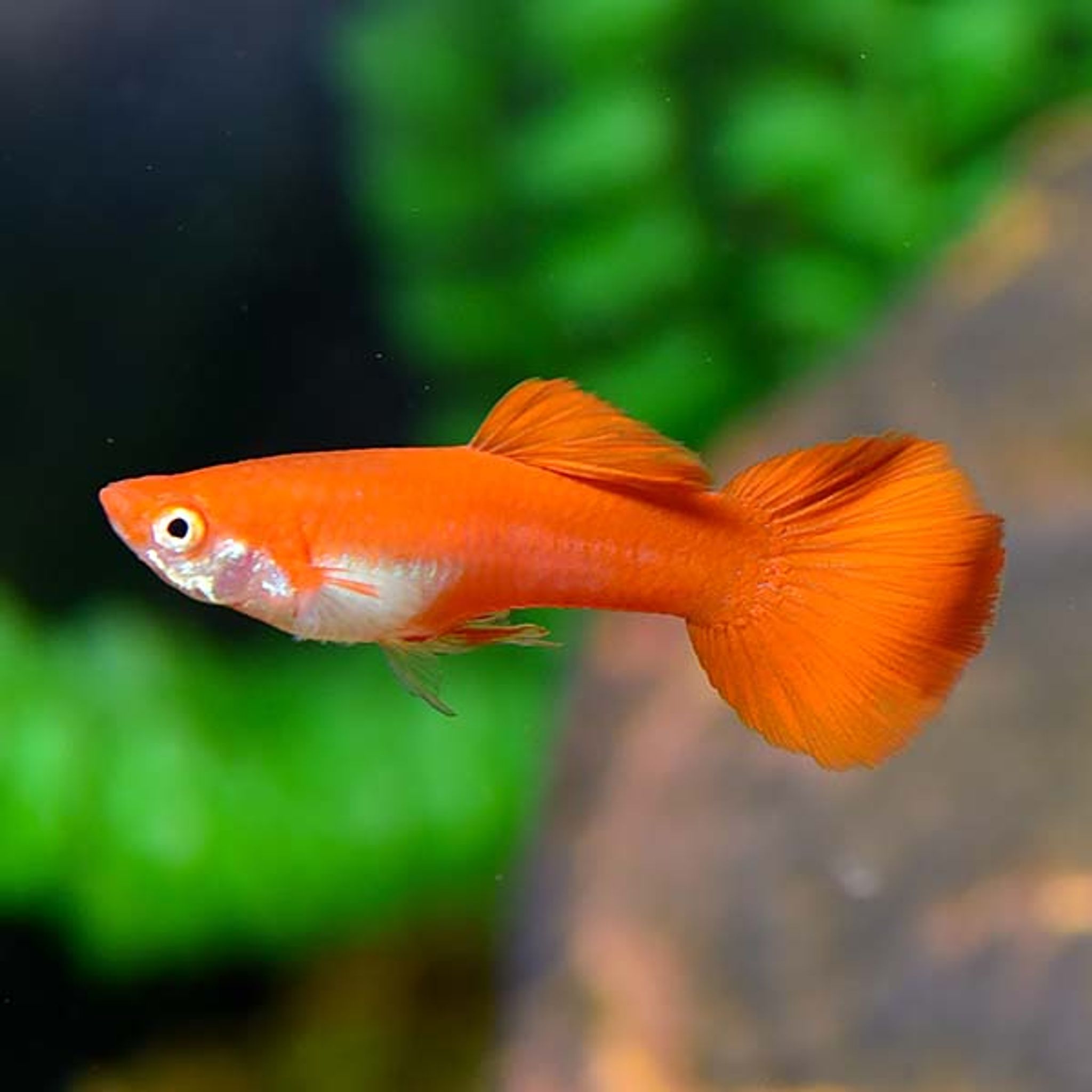

Guppy Care Guide: Tank Size, Diet, Water Parameters and Temperament
Guppies do best in a cycled, heated tank of at least 10 gallons (38 L), kept at 75–78°F (24–26°C) with hard, slightly alkaline water, a varied omnivore diet and a ratio of one male to two or more females. They are peaceful, busy fish that breed constantly, so the smartest thing a new owner can do is plan for babies before the first brood arrives. This guide covers the numbers first, then fry, lifespan and health.
Guppy Basics at a Glance
The guppy (Poecilia reticulata) is a livebearer native to northeastern South America and the Caribbean. Wild-caught guppies are rarely sold; nearly every fish in the trade is a farm-bred fancy strain.
| Trait | Male | Female |
|---|---|---|
| Adult size | About 1–1.5 in (2.5–4 cm) | About 1.5–2.5 in (4–6 cm) |
| Color and tail | Bright, large, flowing tail | Plainer, smaller tail |
| Anal fin | Rod-shaped gonopodium | Fan-shaped |
| Body | Slim | Rounded belly, dark gravid spot near the vent |
Juveniles can usually be sexed at about 3–6 weeks, when the male's anal fin starts to lengthen into a rod.
Tank Size and Setup
How big a tank do guppies need?
Recommendations range from 5 to 10 gallons. A 5-gallon (19 L) tank can hold a trio at the absolute minimum, but it only really works for three males. For most people, 10 gallons (38 L) is the practical starting point for a small group, and 20 gallons (76 L) or more is wise if you keep females, because fry fill a tank fast. A rough guide is about 1 gallon per adult guppy, plus spare room for growth.
Filtration and lid
- Use a gentle filter, such as a sponge filter, or cover the intake of a hang-on filter with a pre-filter sponge so fry and long fins are not pulled in. You can compare options in FishyHub's filters category.
- Guppies spend their time in the middle and top of the tank and can jump, so fit a tight lid.
Plants and decor
Dense live plants such as guppy grass, hornwort, java moss and floating plants give fry places to hide and soak up nitrate. Pick smooth decor so long tails do not tear on sharp edges.
Botanicals like leaf litter and alder cones add extra cover and a film of microorganisms for grazing. They lower pH slightly, so watch your readings if your water is already soft.
Water Parameters
| Parameter | Target | Notes |
|---|---|---|
| Temperature | 75–78°F (24–26°C) | Safe range 74–80°F (23–27°C); brief tolerance of about 64–84°F (18–29°C) |
| pH | 7.0–8.2 | Stability matters more than an exact number |
| GH | About 8–18 dGH | Guppies prefer hard water |
| KH | 4–10 dKH | Helps keep pH steady |
| Ammonia / nitrite | 0 ppm | Any reading means a problem |
| Nitrate | Under 20–40 ppm | Lower is better |
Temperature and the lifespan tradeoff
Published ranges run anywhere from 72–77°F to 74–82°F. Aim for 75–78°F. Warmer water speeds up growth and breeding but tends to shorten life, while the low-to-mid 70s tend to lengthen it. Most US homes drop below that range, especially overnight or in winter, so plan on a heater.
Hard water and US tap water
Some care sheets list a pH as low as 5.8–6.8, but guppies do best at 7.0 or higher in hard water. Soft, low-GH water is linked to poor health and shimmying. The good news: tap water in many US areas is already hard and alkaline, which suits guppies well. Soft-water regions, including the Pacific Northwest and parts of the Southeast and New England, usually need remineralizing. Test GH and KH, then raise minerals with crushed coral, aragonite or a mineral additive. Aquarium salt does not replace GH.
Cycling and maintenance
- Cycle the tank before adding any fish so bacteria can process waste.
- Change about 25% of the water weekly and vacuum the gravel.
- Keep testing for ammonia, nitrite and nitrate, especially after adding fish.
Diet and Feeding
Guppies are omnivores that graze algae in the wild, so they need both protein and plant matter.
- Staple: quality micro pellets or flakes containing protein and plant ingredients.
- A few times a week: frozen, live or freeze-dried foods such as baby brine shrimp, daphnia and bloodworms.
- Vegetables: blanched peas or a spirulina-based food.
Feed adults 1–2 small meals a day, offering only what they finish in about 1–2 minutes. One fasting day a week is fine for adults. Fry need 3–5 tiny meals a day. FishyHub's food and supplements section includes freeze-dried options for variety.
Temperament and Tank Mates
Guppies are peaceful, active and social, and should be kept in groups. Males chase females constantly, which is why the ratio matters.
Sex ratio
Keep one male to two or three females. Some keepers suggest one to three–five; either works, and more females simply spreads the harassment thinner. An all-male tank is a great choice if you want no babies and maximum color. Males squabble a little but rarely do real damage.
Compatible and incompatible tank mates
| Good choices | Avoid |
|---|---|
| Corydoras, otocinclus, kuhli loaches, bristlenose pleco | Fin-nippers such as tiger barbs and serpae tetras |
| Harlequin rasboras, tolerant small peaceful tetras | Cichlids, large gouramis, adult angelfish |
| Platies, mollies | Bettas (fin confusion and aggression) |
| Nerite and mystery snails; adult cherry shrimp (shrimp babies get eaten) | Any large or predatory fish |
Guppies and other livebearers
Guppies share needs with platies, mollies and swordtails: hard water and a plant-rich tank, which makes a livebearer community easy to plan. If you want pure lines, keep guppies apart from Endlers. The two hybridize readily, and the offspring blur both strains.
Buying Guppies and Quarantine
Store fish are often inbred and stressed from shipping. Mass farming, heavy inbreeding and routine drug use have made many livebearers noticeably weaker than they once were. Fish from breeders or local aquarium clubs are usually hardier.
What to look for: active swimming, open fins that are not clamped, no white spots, and no thin or pinched bodies.
A simple quarantine protocol:
- Set up a small, cycled, heated tank with a sponge filter.
- Keep new guppies there for 2–4 weeks.
- Feed lightly, change water often, and watch daily for white spots, frayed fins, thinning, stringy white feces or red threads at the vent.
- Treat anything you find before the fish join your main tank.
Breeding, Pregnancy and Fry
How guppies mate
Fertilization is internal. The male uses his gonopodium in a quick thrust. Females store sperm for months and can drop several broods from one mating, so a "virgin" female bought from a mixed tank may already be pregnant.
Signs of a pregnant guppy
- A darker, enlarged gravid spot
- A boxy or squared-off belly
- Hiding, refusing food and heavy breathing close to birth
Gestation is about 21–31 days, occasionally up to 35, and shorter in warmer water. Birth takes a few hours and produces 5–50+ fry; young mothers have smaller broods. Adults eat fry.
Breeding boxes vs. plants
Opinions split here. Some keepers rely on breeding boxes, while others find they stress mothers. The gentler approach is heavy planting or a separate fry tank. If you use a box, move the female in late and only for a short time.
Raising healthy fry
- Keep fry at 76–80°F (24–27°C).
- Offer small meals often, and keep water very clean with small daily changes.
- Use gentle filtration and sort fry by size so big ones do not outcompete small ones.
- Switch to crushed flakes at about 2 weeks. Fry are usually safe with adults at 6–8 weeks and mature at about 2–4 months.
Live fry foods
| Food | Best use |
|---|---|
| Infusoria | First days, weakest fry |
| Rotifers | First days |
| Microworms | Easy home culture |
| Vinegar eels | Easy home culture, long-lived in water |
| Baby brine shrimp | Best growth |
| Powdered food | Convenient backup |
Selective breeding and what to avoid
For better strain quality, separate the sexes early and choose your best fish as breeders. Common mistakes include endless sibling inbreeding, overcrowding, and relying only on breeding boxes.
Plan for the population boom
A mixed group can outgrow a tank within a few months. Decide in advance: trade surplus fish to a local store for credit, sell or swap at club auctions, or choose humane options. Never release guppies outdoors. To stop breeding, keep only males, or remove the males, knowing stored sperm will still produce some broods.
Guppies in an Outdoor Pond
In US zones where water stays above about 65–68°F (18–20°C), guppies can spend summer in a patio pond or tub. They eat mosquito larvae and breed quickly. Bring them indoors before fall, and never let them escape into local waterways, where they are invasive.
Lifespan and Health
How long do guppies live?
Guppies typically live 1–3 years, with most reaching 1.5–3. Claims range from two to five years. Store fish often land at the lower end, while well-kept breeder stock in cooler water tends to live longer.
Do guppies have teeth?
Yes. They have tiny jaw teeth for scraping algae and grabbing small prey. They are harmless to people.
Common diseases
- Ich: white salt-like spots.
- Fin rot: ragged, fraying fins.
- Columnaris: a bacterial infection that often shows as pale patches.
- Internal parasites: guppy wasting and camallanus worms, which appear as red threads at the vent.
- Shimmying: a side-to-side wobble often linked to soft water or poor water quality.
Common Mistakes and Troubleshooting
- Uncycled tank: leads to ammonia spikes.
- Mixed sexes with no plan: ends in an overcrowded tank.
- Too many males: stressed or dying females.
- Overfeeding: cloudy water and nitrate buildup.
- Soft or acidic water: shimmying and fin problems. Test GH and KH.
- Skipping quarantine: parasites can wipe out a tank.
| Symptom | Check first |
|---|---|
| Clamped fins or shimmying | Water quality, GH, temperature |
| Frayed tails | Fin rot or nippy tank mates |
| Sudden deaths after purchase | Shipping stress or parasites |
Frequently Asked Questions
How many guppies can go in a 10-gallon tank?
Roughly 5–6 adults. Keep fewer if you have females, since their fry will quickly add to the count. An all-male group lets you stock closer to the upper end.
Do guppies need a heater?
Usually, yes. Most US homes run cooler than guppies prefer, especially at night and in winter. Aim for a steady 76–78°F (24–26°C).
Can guppies live without a filter?
It is not recommended. Waste builds quickly and fry are sensitive to poor water. A sponge filter is the minimum and is also the safest choice for fry.
Why is my guppy hiding at the bottom?
Common causes are stress, a pregnant female close to giving birth, poor water quality or disease. Test ammonia, nitrite, nitrate and GH first, then look for spots, clamped fins or thinning.
Will guppies eat their babies?
Yes, adults eat fry. Dense plants such as guppy grass and java moss save many of them, and a separate fry tank saves the most.
How often do guppies give birth?
About every 4–5 weeks. Stored sperm means a female can keep producing broods for months after a single mating.
Start Your Guppy Tank
A 10-gallon or larger cycled tank, hard water at 75–78°F, a mixed diet, a sensible sex ratio and a plan for fry cover almost everything guppies need. When you are ready, browse guppies on FishyHub and quarantine your new fish before they join the main tank.


