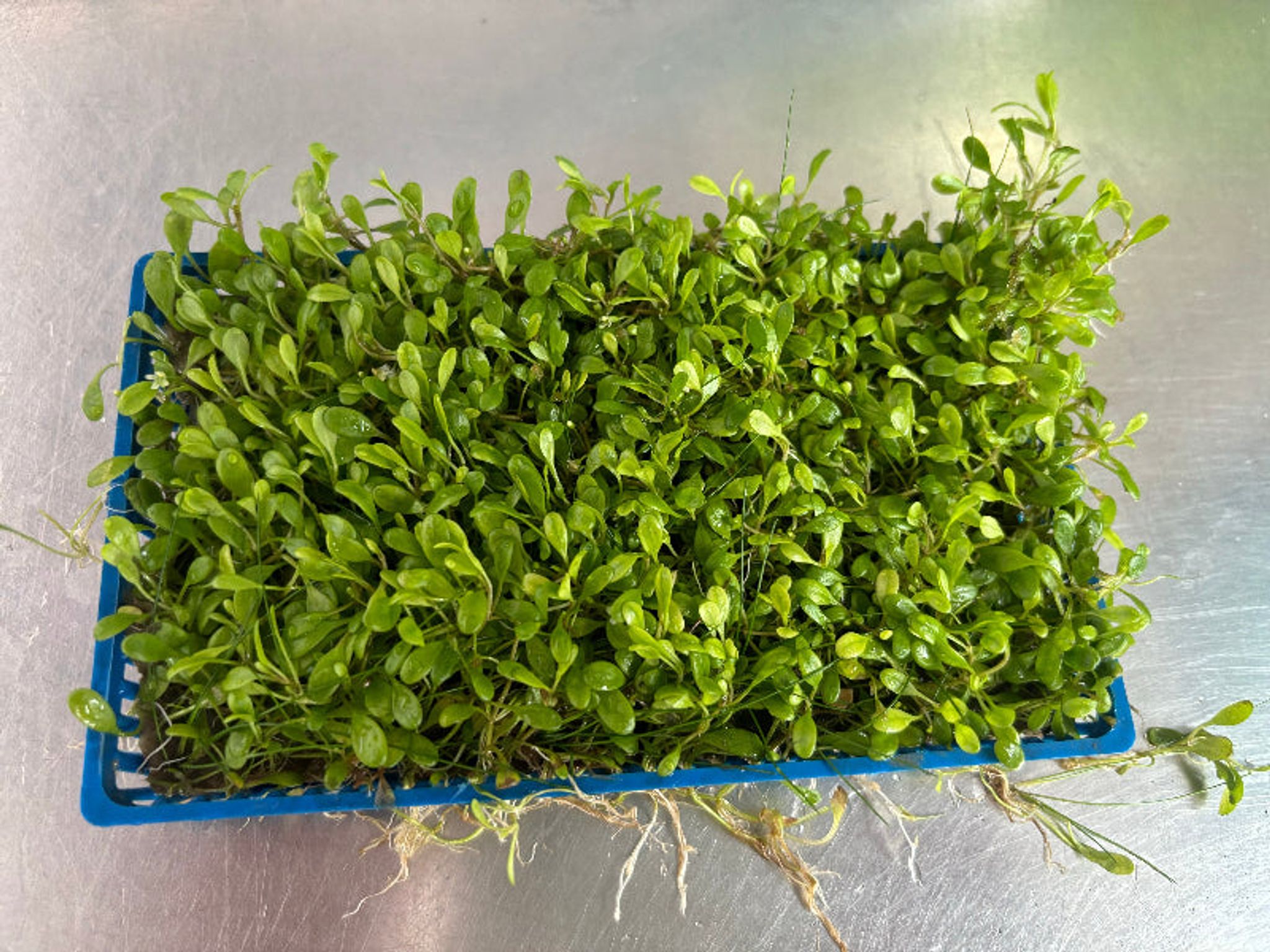

Glossostigma Care Guide: Light, CO2, Substrate and Growth Tips
Glossostigma elatinoides is one of the most photographed foreground plants in the hobby, and also one of the most misunderstood — plenty of people plant it expecting an easy lawn and end up with a scraggly, floating mess. This guide sets realistic expectations up front and walks through the light, CO2, substrate, and trimming routine that actually produces a flat, dense carpet.
What Glossostigma Is (and Why It's Tricky)
Glossostigma elatinoides is a tiny creeping plant native to Australia, New Zealand, and parts of Asia. It spreads by runners (stolons) that root at each node, which is exactly the growth habit that makes it a favorite in Nature-style and Iwagumi aquascapes. Kept trimmed, a mature carpet stays under about 1 inch (2.5 cm) tall and reads as a solid green mat rather than individual plants.
Here's the part most retail descriptions skip: Glossostigma is an intermediate-to-advanced plant, not a beginner one. It will survive in a wide range of setups, but it only forms that famous flat carpet when light and CO2 are both dialed in. Skip one of those, and it doesn't die — it just grows upward and sparse instead of spreading horizontally.
If you're not ready for CO2 injection yet, two easier carpeting plants are worth considering instead: dwarf sagittaria and Monte Carlo, both of which tolerate lower light and no-CO2 setups far more gracefully.
Lighting Requirements
Glossostigma wants medium-high to high light intensity, measured as roughly 30–50 PAR at the substrate. That's a meaningful amount of light reaching the bottom of the tank, not just at the water surface.
- Photoperiod: 8 hours minimum, 10 hours is a more reliable target for steady carpeting.
- More light = flatter growth. Under strong light, the plant spreads laterally to capture more surface area. Under weak light, it stretches upward toward the source instead.
- Depth matters more than footprint. A fixture that's plenty strong for a shallow 10-gallon (38 L) tank may not push enough PAR to the substrate in a taller tank. A nano tank often carpets fine under a basic clip-on LED, while a deeper aquascape typically needs a stronger single fixture or two units to hit the same PAR at the bottom.
You can browse suitable LED lighting fixtures on FishyHub when sizing a light to your tank's depth rather than just its footprint.
CO2: The Real Deciding Factor
This is where most Glossostigma attempts succeed or fail. Ambient CO2 in aquarium water sits around 2–4 ppm, which is far below what a demanding carpet plant wants. To photosynthesize fast enough to spread flat, Glossostigma needs supplemental CO2 pushing toward 20–30 ppm.
Does it need CO2 to survive? No. Does it need CO2 to carpet? Effectively yes. That distinction matters: the plant can live for months in a low-tech tank without ever forming the mat most people picture when they buy it.
Pressurized vs. DIY CO2
| Option | Best for | Pros | Cons |
|---|---|---|---|
| Pressurized CO2 system | Tanks above ~15–20 gal, anyone wanting a reliable carpet | Stable, precise, low maintenance once dialed in | Higher upfront cost |
| DIY yeast reactor | Small/nano tanks under ~15–20 gal, budget starts | Cheap, easy to build | Output fluctuates, needs recharging every 1–3 weeks |
| Liquid carbon (glutaraldehyde-based) | Supplementing light-CO2 setups | Simple to dose, no equipment | Generally not strong or consistent enough alone for a true carpet |
Pressurized setups typically cost noticeably more than a DIY yeast bottle but hold a steady ppm day after day, which is what a dense carpet actually needs. DIY yeast reactors are a legitimate starter option on a nano tank, but expect the output to drift as fermentation slows over its cycle — plan on recharging the mixture roughly every one to three weeks.
CO2 Timing and Safety
- Start injection 1–2 hours before lights turn on.
- Stop injection 1 hour before lights turn off. Plants consume oxygen (not CO2) overnight, so continuing injection into darkness offers no benefit and adds risk.
- Run a sponge filter, air stone, or otherwise maintain surface agitation overnight to keep oxygen levels up for fish.
- Watch for fish gasping at the surface, clamped fins, or gathering near the outflow — these are signs of CO2 overdose, and injection should be reduced immediately.
Reading a Drop Checker
A drop checker gives a coarse, delayed read on dissolved CO2: green generally indicates a reasonable range, while lime-green or yellow signals levels high enough to stress fish. Don't chase an exact number on the checker alone, though — it lags real-time conditions. Pearling (fine oxygen bubbles streaming off healthy leaves) and vigorous new growth are better real-time signals that light and CO2 are actually balanced for the plant.
Substrate and Water Parameters
Glossostigma has a shallow, thin root system, so substrate texture matters as much as nutrient content.
- Best choice: a fine-grained, nutrient-rich aquasoil, roughly 2–3 inches (5–7.5 cm) deep, soft enough for the fine roots to penetrate easily.
- Alternative: inert sand or fine gravel works if paired with root tabs buried near the plant's base, since inert substrates carry no nutrient reserve on their own.
Water parameters are otherwise forgiving and overlap with standard tropical community setups. You can browse substrate options on FishyHub sized for foreground carpet plants.
| Parameter | Range |
|---|---|
| Temperature | 72–82°F (22–28°C) |
| pH | 6.0–7.5 (tolerant down to ~5.0) |
| GH | 2–15 (soft to moderately hard) |
| Tank size | 5–10 gal (19–38 L) nano up to large aquascapes; most common in 10–40 gal (38–151 L) foreground layouts |
Planting Method
- Remove the plant from its pot and gently separate the mat into small plantlets — a single pot typically yields roughly 10–15 individual tufts.
- Using tweezers, bury just the base and roots of each plantlet, leaving the leaves exposed above the substrate.
- Space plantlets about 1 inch (2.5 cm) apart in a grid pattern for even, faster-filling coverage.
- Press the substrate firmly around each piece so it doesn't float free during the first water changes or filter flow.
The Dry Start Method
Many growers plant Glossostigma into damp (not flooded) substrate, then cover the tank with plastic wrap or a humidity dome for 3–6 weeks before adding water. This lets roots establish and runners spread across the substrate surface without the risk of early melt or plantlets lifting off before they've anchored. It's not mandatory, but it meaningfully reduces early failures — especially in taller tanks where light and CO2 struggle to reach a fully submerged substrate from day one.
Fertilizing a Carpet Plant
A dense, fast-growing mat is a heavy feeder. Plan on two fertilization channels working together:
- Root feeding: root tabs pushed into the substrate near the root zone, replenished on the schedule the product recommends.
- Liquid fertilizer: a complete formula supplying macronutrients (nitrogen, phosphorus, potassium) and micronutrients (chelated iron, magnesium, manganese, boron), dosed into the water column.
Skipping either one tends to show up as stalled growth or pale, yellowing new leaves even when light and CO2 look correct.
Growth Rate and Trimming
Once established, Glossostigma spreads quickly via lateral runners. Trim every 1–2 weeks, keeping the mat under roughly 1 inch (2.5 cm). Left thicker, the lower leaf layer loses light and gas exchange, starts to rot, and can cause entire patches of the carpet to detach and float to the surface — one of the most common complaints from first-time growers.
Trimmed clippings aren't waste: replant them into any bare or thin patches to speed up full coverage, since each clipping roots at its nodes just like the original plantlets.
Tankmate Compatibility
Glossostigma is compatible with most peaceful community setups:
- Good matches: tetras, small livebearers, dwarf shrimp, and most snails.
- Avoid: goldfish, large cichlids, crayfish, and crabs — all of which dig, graze, or uproot low carpet plants.
If you're stocking a shrimp-focused carpet tank, you can browse dwarf shrimp on FishyHub — Glossostigma is a popular shrimp-tank plant, with the one real caution being copper-based medications and fertilizers, which harm shrimp regardless of the plant.
Glossostigma vs. Other Carpet Plants
Not every carpet plant demands the same setup. Here's roughly where Glossostigma sits:
| Plant | Difficulty | CO2 needed for a true carpet? |
|---|---|---|
| Dwarf sagittaria | Easy | No |
| Monte Carlo | Easy–moderate | No, but helps |
| Dwarf hairgrass | Moderate | Helpful, not strictly required |
| Micro sword | Moderate | Helpful, not strictly required |
| Glossostigma | Demanding | Yes, for a flat mat |
| Dwarf baby tears | Demanding | Yes, and less tolerant of unstable water than Glosso |
Dwarf baby tears is the closest comparison plant — similarly tiny leaves and carpeting habit, but generally less forgiving of parameter swings and nutrient gaps than Glossostigma.
Weekly Maintenance Checklist
- Trim the carpet back to about 1 inch if it's approaching that height.
- Dose liquid fertilizer on schedule; check root tabs haven't run out.
- Glance at the drop checker color and look for pearling during the light period.
- Confirm the CO2 system is still timed correctly and check gas supply or DIY reactor output.
- Scan for any lifting patches, yellowing leaves, or algae starting on the substrate surface.
Troubleshooting Common Mistakes
- Growing up, not out: light or CO2 is too low for a carpet — check PAR at the substrate and confirm CO2 is actually reaching 20–30 ppm.
- Melting shortly after planting: usually a normal transition as the plant adjusts to submersed conditions; give it time before assuming failure.
- Yellowing leaves: check iron and macronutrient dosing before assuming a light problem.
- Carpet floating up in patches: almost always overgrowth — the mat went too long without trimming and the lower leaves rotted.
- Algae after starting CO2: usually inconsistent dosing or unbalanced light-to-fertilizer ratio, not the CO2 itself — stability matters more than the exact amount.
- Planted too sparsely or too deep: plantlets float free or take too long to fill in; keep spacing to about 1 inch and bury roots only, not leaves.
Frequently Asked Questions
Can Glosso grow without CO2?
Yes, it survives without CO2, but it will grow upward and sparse rather than forming a flat carpet. CO2 is specifically what pushes the plant into dense, horizontal growth.
How long does it take Glosso to carpet a tank?
Typically several weeks to a few months, depending on light intensity, CO2 consistency, nutrient dosing, and how densely it was planted initially. Tanks started with the dry start method often establish a fuller mat faster, since roots and runners spread before flooding.
Why is my Glosso floating up?
Usually the mat grew too thick before being trimmed, and the bottom leaf layer rotted and detached from lack of light and gas exchange. It can also happen if plantlets were placed too shallowly or loosely at planting time.
Is Glosso shrimp-safe?
Yes, it's a popular choice for shrimp tanks. The real caution is CO2 levels and copper-containing fertilizers or medications, which can harm shrimp if overdosed — the plant itself poses no risk.
Do I need a CO2 diffuser, or can I just use liquid carbon?
Liquid carbon can supplement growth but generally isn't strong or consistent enough on its own to produce a true carpet. A real CO2 injection system, pressurized or DIY, is the reliable route to flat, dense coverage.
What substrate is best for Glosso?
A soft, nutrient-rich aquasoil is ideal for its shallow, fine root system. Inert sand or gravel can work too, as long as it's paired with root tabs to make up for the lack of built-in nutrients.
Can I keep Glosso in a low-tech, no-CO2 tank at all?
Yes, as a low groundcover or filler rather than a full carpet — it will stay green and compact without matting down completely. That's a reasonable compromise for hobbyists not ready to invest in CO2 injection yet.
How often should I trim Glosso?
Roughly every 1–2 weeks once the carpet is established, keeping it under about 1 inch tall. Regular trimming prevents the lower leaves from losing light and rotting, which is the main cause of patches lifting off the substrate.
Ready to put together the light, CO2, and substrate setup a Glossostigma carpet actually needs? Start with the substrate category on FishyHub and build the rest of your gear list around it.


