
German Blue Ram Care Guide: Tank Size, Diet, Water Parameters and Temperament
The German blue ram is one of the most colorful small cichlids in the hobby, but it is also one of the least forgiving of a cold, unstable, or brand-new tank. This guide lays out the exact tank size, temperature, pH, diet, and tankmate choices that keep rams alive, plus the mistakes that actually kill them. Follow the numbers below in a mature tank, and this fish is well within reach of a patient beginner.
What Is a German Blue Ram?
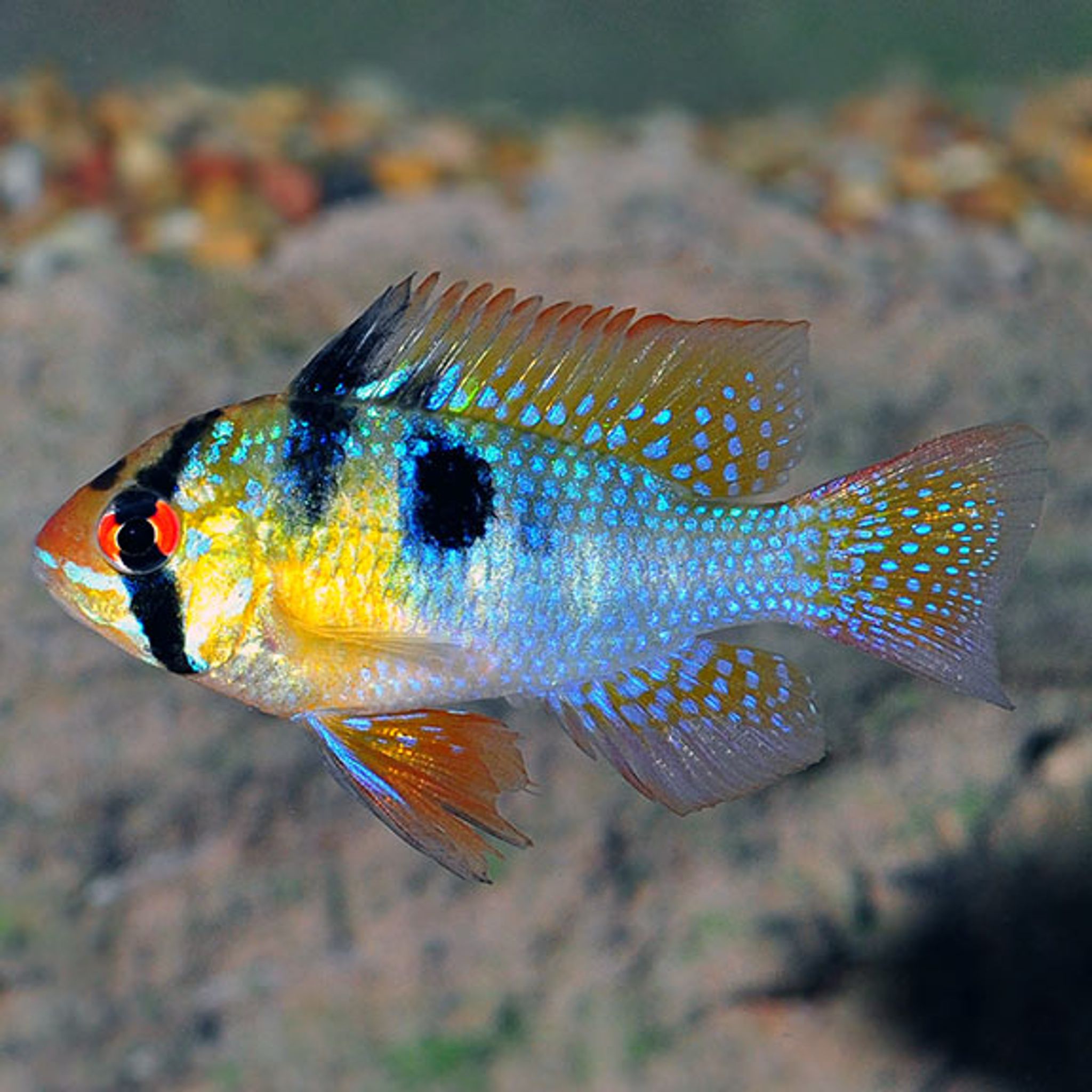
The German blue ram, Mikrogeophagus ramirezi, is a dwarf South American cichlid native to the Orinoco basin savanna (the llanos) of Venezuela and Colombia. In the wild it lives in warm, soft, acidic, slow-moving, weedy water often stained brown by decaying leaf litter. The "German" in the name has nothing to do with origin — it refers to the European, largely German, breeders who bred the fish in numbers and made it widely available decades ago. It is not a separate species from any other blue ram you'll see for sale.
Size and lifespan: adults reach 2–3 inches (5–7.5 cm), with males slightly larger. Most rams live 2–4 years in captivity, with a few reaching around 5 under excellent care. Some commercial stock is short-lived because of aggressive line-breeding; buying healthier stock improves your odds.
Is the German Blue Ram Right for You? A Readiness Checklist
Sources disagree on difficulty — a few call rams easy, most call them intermediate. The honest label is "beginner-plus, mature tank only." Before buying, confirm:
- Your tank has run fully cycled for 3 months or more, not just cycled with a bottled bacterial product.
- You can hold a steady 80–84°F (27–29°C), not just reach it briefly.
- Your test kit shows 0 ppm ammonia, 0 ppm nitrite, nitrate under ~20 ppm.
- You have at least a 20-gallon (76 L) footprint, ideally long-style.
- You've checked your tap water report, or can test GH and KH.
- You can commit to weekly water changes and skip pH-adjusting chemicals.
If any of these are missing, wait — rams punish an unfinished setup faster than tetras or livebearers do.
Tank Size and Setup
A single pair needs a minimum of 20 gallons (76 L), with a long footprint preferred over a tall one — rams are bottom-oriented fish, so floor area matters more than height. A 10-gallon (38 L) tank is only acceptable as a dedicated species or breeding tank, never a community setup. For two males or two pairs, plan for roughly 40 gallons (150 L) or more with plenty of broken sightlines.
Substrate and decor: fine sand, since rams naturally sift for food; driftwood, caves, and rocks, plus a couple of flat stones or slate pieces as potential spawning sites. Planting should be dense but not wall-to-wall — leave open sand at the front for foraging. Floating plants and dim, diffused lighting help rams feel secure and show better color, and a little leaf litter adding tannins is a plus.
Good low-light, warm-water plants include anubias, java fern, Amazon sword, vallisneria, cryptocoryne, floaters, and java moss.
Water Parameters
This is where most ram deaths actually originate — not disease, but drift and mismatch. Sources online range wildly (72–79°F on the low end, up to 80–86°F on the high end), but the consensus that keeps rams healthy long-term is warmer and stable.
| Parameter | Target Range | Notes |
|---|---|---|
| Temperature | 80–84°F (27–29°C) | 82°F is a solid single target; below ~78°F, rams weaken and get sick more often |
| pH | 6.0–6.8 practical, down to 5.0 for wild-type keeping | Captive-bred stock often tolerates up to ~7.5 if stable |
| General hardness (GH) | 3–8 dGH (~50–140 ppm) | Adaptable stock copes up to ~12 dGH |
| Carbonate hardness (KH) | Low, but not zero | Zero KH invites pH crashes |
| Ammonia / Nitrite | 0 ppm | Rams react to spikes faster than tetras or livebearers |
| Nitrate | Under ~20 ppm | Weekly water changes keep this in check |
Stability beats a perfect number. Don't chase a specific pH with acid-based products — a stable 7.0 is safer than an unstable 6.2 that swings overnight.
Lowering pH the Safe Way
pH, KH, and GH are linked: KH buffers pH, so softening the water is usually the real fix. Blend RO or distilled water with tap water to bring GH and KH down together; driftwood and catappa leaves (about one per 10 gallons) acidify gradually; peat in the filter works too, but avoid it in tanks under 10 gallons where it can crash pH too fast. Avoid bottled "pH-down" chemicals — they cause crashes and rebound swings that stress rams more than a slightly higher, stable pH ever would.
Your Tap Water Reality
Most US municipal water is harder and more alkaline than a ram's ideal range, and it's often treated with chloramine rather than plain chlorine. Check your utility's annual water quality report for hardness (ppm) and disinfectant type before deciding whether straight tap water will work, or whether you need a partial RO mix and a chloramine-rated dechlorinator.
Maintenance and Acclimation
Change 20–30% of the water weekly, matching the new water's temperature and chemistry so the change doesn't shock the fish. Use gentle filtration with low flow — a sponge filter works well. For new arrivals and large water changes alike, a slow drip acclimation over an hour or more is safer than a quick temperature-matched dump, since it lets pH and hardness equalize gradually.
If your home stays cool (68–72°F/20–22°C), size your heater generously — roughly 3–5 watts per gallon — and pair it with a separate thermometer to verify actual tank temperature rather than trusting the heater's dial.
Diet
German blue rams are omnivores that feed mainly from the bottom. Build the diet around a quality sinking pellet or granule as the staple, frozen foods (bloodworms, brine shrimp, mysis, daphnia or cyclops) for variety, and live foods when available.
Newly purchased rams are often picky and may ignore dry pellets at first — start with frozen food and gradually wean them onto pellets once settled. Feed adults once or twice a day in small portions, juveniles 2–3 times a day, and remove uneaten food within a few minutes to protect water quality.
Temperament and Tankmates
Rams are peaceful for a cichlid and generally shy. A pair will claim a small territory around a rock or cave and defend it, but real aggression is limited — males spar with each other, and pairs get genuinely feisty only while guarding eggs or fry. The bigger risk runs the other way: boisterous or oversized tankmates bullying the rams.
Good tankmates (small, calm, and warm-water tolerant): cardinal and rummynose tetras, heat-tolerant corydoras such as sterbai, otocinclus, small plecos, hatchetfish, pencilfish, and small peaceful gouramis. In a large tank, discus and angelfish can also work.
Avoid: fin-nippers, fast food-hogs, large or aggressive cichlids, and any cool-water species that can't handle 80°F+ — many standard "community fish" picks assume water under 80°F, so double-check tolerance before adding one. You can browse compatible options in FishyHub's Angelfish, Discus, Rams & Cichlids category.
Sexing Males and Females
- Males have taller, more pointed front dorsal rays and are typically larger overall.
- Females are rounder-bodied with a pink or red-tinted belly, and the black spot on the dorsal fin usually shows blue speckling inside it — a detail males lack.
Ram Color Morphs and Related Species
Electric Blue Ram vs. German Blue Ram
The electric blue ram is the same species, not a separate one — despite occasional claims that it's a wild-discovered variant, it is a line-bred color morph that's almost entirely metallic blue. Because of the inbreeding involved, electric blues run a little smaller and more delicate. Care requirements are identical, but water stability matters even more.
Gold Ram and Other Types
The gold ram is a yellow-orange xanthic color morph, usually a bit hardier than the electric blue. Other forms include longfin, black, and balloon rams. Balloon-bodied rams are a deformed body shape from selective breeding and carry real welfare concerns — spinal compression can affect swimming and organ function, so weigh that before buying.
The Bolivian ram (Mikrogeophagus altispinosus) is a genuinely different, hardier species tolerating cooler and harder water — a reasonable alternative for a less demanding setup, along with certain apistogramma species, kribensis, and keyhole cichlids if the German blue ram's requirements feel like too much of a stretch.
"Angel Ram"
"Angel ram" is a trade name, not a separate species — typically applied to long-finned or balloon-bodied line-bred rams. Care is identical to a standard German blue ram.
Breeding Basics
To breed rams, raise six or more juveniles together and let a compatible pair form naturally rather than forcing a match. Set up a dedicated 10–20 gallon tank at about 82–85°F with soft, acidic water around pH 6.
Rams are open spawners that lay eggs on a flat stone, typically 150–300 eggs (some reports up to 500). Eggs hatch in about 60 hours, and fry become free-swimming 3–5 days later. First foods should be infusoria or vinegar eels, moving to baby brine shrimp once the fry are larger. New pairs frequently eat their first one or two spawns — this is common, not a sign of a bad pair. Reduce disturbance, or be prepared to hatch eggs artificially if it keeps happening.
Health and Buying Tips
Most ram health problems trace back to poor water quality, low temperature, or weak stock — not anything exotic. Common issues include ich, bacterial infections, flukes, and internal parasites. Mycobacteriosis (fish TB) is also a risk; it generally can't be cured and can infect people through open cuts, so wear gloves handling affected fish or tank water. Quarantine new rams 2–4 weeks before adding them to an established tank.
When buying: choose healthy juveniles from a shop or breeder with a good reputation, avoid fish that look thin, clamped-finned, dull-colored, or hollow-bellied, and ask how long the shop has had them and whether they're already eating — a fish feeding well is a much safer bet.
Once your tank is ready, you can browse live stock in FishyHub's Freshwater Livestock category to compare available rams and tankmates.
Common Mistakes and Troubleshooting
| Problem | Likely Cause | Fix |
|---|---|---|
| Sudden death shortly after purchase | Weak stock or a big parameter jump | Drip-acclimate slowly, buy from a reputable source |
| Hiding and refusing food | Poor water, low temperature, or bullying tankmates | Test water, raise temperature toward 82°F, offer frozen food, check for aggressors |
| Faded color | Stress, poor water, low temperature (mild fading after shipping or at night is normal) | Verify parameters and temperature before assuming illness |
| Pair eating their eggs | Common with first spawns | Reduce disturbance, be patient, or hatch artificially |
| Gasping, red gills, clamped fins | Ammonia or nitrite poisoning | Large water change, an ammonia-binding dechlorinator, reduce feeding, check the cycle |
Rams show ammonia and nitrite symptoms earlier than many community fish, and ammonia is more toxic at higher pH and temperature — exactly the conditions rams live in. A small dose of aquarium salt (chloride) offers short-term nitrite protection while you fix the cause. Other mistakes to avoid: adding rams to a tank cycled only with a bottled product rather than time, keeping them at typical community temperatures around 76°F, mixing with tiger barbs or large aggressive cichlids, and big mismatched water changes.
Frequently Asked Questions
Can I keep a single German blue ram?
Yes. A lone ram or a single pair is fine, and for a community tank a pair or one male is generally the safer choice over a group.
Are German blue rams good for beginners?
Only for a patient beginner with a mature, warm, stable tank — not a brand-new setup or someone unwilling to test water regularly.
Can I keep two male rams together?
Only in 40 gallons (150 L) or more, with plenty of decor to break sightlines so each male can hold his own territory.
Can German blue rams live with neon tetras?
Not ideally — the 80–84°F range rams need is often too warm for neon tetras long-term. Cardinal tetras tolerate the heat better and are a closer match.
Can rams live with shrimp?
They can share a tank with adult shrimp, but rams eat shrimplets and will harass adult cherry shrimp, so don't count on a shrimp colony holding steady alongside them.
Why did my ram die within a week of purchase?
Usually weak commercial stock, an immature or uncycled tank, or acclimation shock from a fast parameter change. Slow drip acclimation and buying well-kept stock both reduce this risk.
Do rams need hard or soft water?
Soft, slightly acidic water is ideal, but stability matters more than hitting an exact number — a steady moderate hardness beats an unstable "perfect" one.
How can you tell a male ram from a female?
Check the dorsal fin (males have taller, pointed front rays), body shape (females are rounder), and belly color (females often show pink or red), plus blue speckling inside the female's dorsal spot.


