
Freshwater Pom-Pom Crab Care Guide: Setup, Feeding, Water Parameters and Breeding
The freshwater pom-pom crab is a tiny, fuzzy-clawed scavenger that has become a popular oddball addition to community tanks, but it's easy to confuse with lookalike species that need very different conditions. This guide covers realistic tank setup, feeding, water parameters, molting behavior, and why breeding this crab at home almost never succeeds.
What Exactly Is a Freshwater Pom-Pom Crab?
The name "freshwater pom-pom crab" gets applied fairly loosely in the trade, and the honest answer is that the exact species identity is murky. Most hobbyists are keeping a small, likely undescribed or misidentified species, not a scientifically confirmed one — which is part of why care advice varies so much across sources.
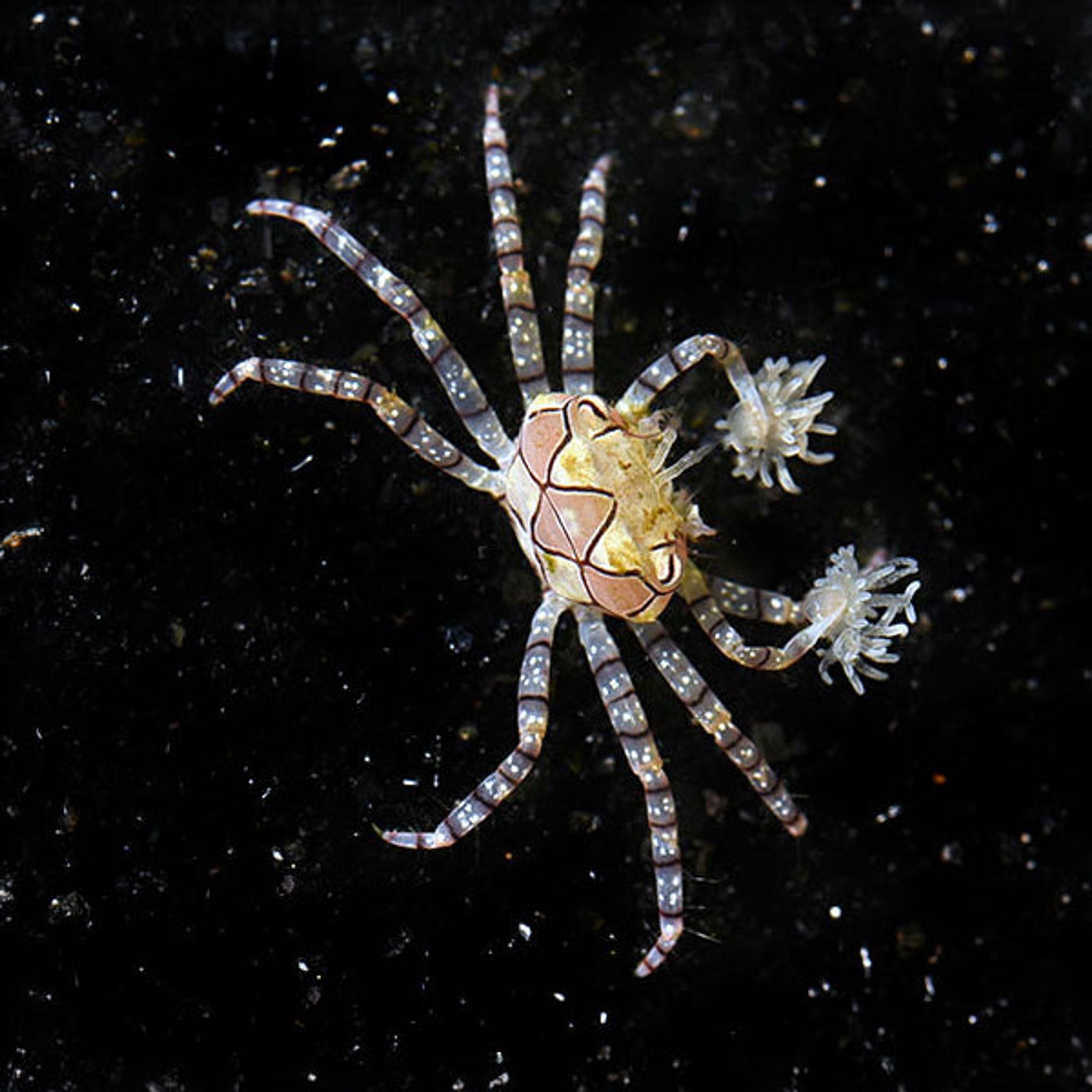
This is a completely different animal from the marine pom-pom (boxer) crab in the genus Lybia, a true saltwater species famous for holding stinging anemones in its claws like tiny pom-poms. The freshwater version has hairy, fuzzy-looking chelipeds for a different reason: it uses them to trap and scoop up food particles and algae, not to filter plankton from open water or wield anemones. If a listing doesn't specify which crab you're getting, ask before buying.
Tank Setup
Size and Group Dynamics
A 5-gallon (19 L) tank is the minimum for a small group of 3–5 crabs, but 10 gallons (38 L) is noticeably more comfortable, especially if you want to keep a small colony or add tankmates. These crabs are social scavengers and tend to do better in numbers than alone.
Substrate and Décor
- Substrate: fine sand, at least 2 inches (5 cm) deep — these crabs are active, persistent burrowers and need enough depth to dig proper retreats.
- Décor: driftwood, rock caves, and dense low plantings or floating plants give cover and climbing surfaces. Leave open sandy patches uncluttered so the crabs have room to forage and dig.
- Lid: a tight-fitting, secure lid is mandatory. These are strong, persistent climbers and determined escape artists — a loose lid or gap around cords is often how a crab ends up dried out on the floor.
Filtration and Flow
A standard filtered, heated freshwater setup works fine. Favor gentle flow over strong current, since pom-pom crabs are not capable swimmers and can struggle against a powerful outflow.
Water Parameters
Sources disagree slightly on the ideal ranges, so the table below presents the safe outer tolerance alongside the tighter comfort zone most keepers should aim for.
| Parameter | Outer tolerance | Ideal / comfort zone |
|---|---|---|
| Temperature | 72–82°F (22–28°C) | 75–80°F (24–27°C) for activity and breeding attempts |
| pH | 6.2–7.6 | 6.8–7.2 |
| General hardness (GH) | — | 6–8 dGH (moderately soft to medium) |
| Carbonate hardness (KH) | — | 2–6 dKH |
| TDS | — | ~150–200 ppm |
| Nitrate | Under 20 ppm | As low as practical |
Hardness is less critical than temperature and pH for this species — the GH and KH figures above are roughly analogous to easy community or shrimp-tank water, not a parameter you need to chase precisely. Adults are fully freshwater and need no salt or brackish conditions for everyday care; that requirement only shows up at the larval stage, which is a separate issue covered in the breeding section below.
Diet and Feeding
Despite the "pom-pom" name and fuzzy claws, these crabs are not filter feeders. They're omnivorous scavengers and detritivores that use their claws to trap food particles and biofilm rather than filter the water column.
A reasonable feeding routine includes:
- Algae wafers and sinking pellets
- Blanched vegetables such as zucchini or spinach
- Occasional protein: frozen or live bloodworms, brine shrimp
- A calcium source for shell health — cuttlebone, crushed coral in a media bag, or a mineral (GH+) supplement dosed per the product's directions
Feed 2–3 times a week in small amounts, and remove uneaten food promptly to keep nitrate down. Overfeeding protein while skimping on calcium is a common cause of weak or deformed shells after molting.
Tankmates and Bioload
Good tankmates stay in the mid-to-upper water column and won't harass a slow-moving bottom crab: small tetras, danios, and dwarf gourami all work well. Cherry, amano, and bamboo shrimp are generally tolerated too, though very small shrimp or shrimp fry carry some predation risk from an opportunistic crab. Multiple pom-pom crabs are mostly peaceful together, with occasional minor sparring between males.
Avoid tiny snails, fry, and anything that will nip fins or act boisterously toward a slow crustacean — fin-nippers, aggressive cichlids, and crayfish are all poor matches.
As a simple stocking guideline for a mixed tank, keep the crab group modest relative to tank size — for example, 3–5 crabs in a 5-gallon setup — and layer in only a light fish load on top, since the bioload from crabs, fish waste, and uneaten food adds up faster in a small footprint. You can browse suitable options among FishyHub's small community fish and shrimp selections.
Behavior and Molting
Pom-pom crabs are notably active compared to other small freshwater crabs — constantly foraging, digging, and climbing. They're mostly peaceful but will retreat into burrows and can vanish from view for a day or two, most often around molting.
Molting is how the crab sheds its old exoskeleton to grow. During this process it's soft and vulnerable, so it hides in its burrow. Leave it completely undisturbed. Don't remove the shed shell right away — it's a calcium source the crab may re-consume — but do remove it after a day or two if it goes uneaten, to avoid fouling the water.
A Quick Note on Anatomy
Understanding basic crab anatomy explains why molting and calcium matter so much: the carapace is the hard outer shell, gills need to stay moist even in a fully aquatic species, pereiopods are the walking legs, and chelipeds are the claws. Crabs have no internal skeleton — the exoskeleton is their only structural support, which is why periodic molting is the only way they can grow, and why a calcium deficiency shows up directly as shell problems.
Lifespan
Expect a short lifespan of roughly one year on average in captivity. Some keepers report longer with very stable conditions, but wild lifespan isn't well documented, and there's no confirmed way to reliably extend it much beyond that window.
Breeding
This is the section where expectations need to be set honestly: captive breeding is not reliably achieved in home aquariums. The larvae are believed to require brackish or marine conditions to develop — a marine larval phase similar to many other "freshwater" crab species — which a standard freshwater tank simply cannot provide.
Sexing adults is possible by looking at the abdominal flap on the underside:
- Males have a narrower, V-shaped flap and often larger claws.
- Females have a broader, rounded flap used for carrying eggs.
You may come across an occasional hobbyist anecdote claiming a home breeding success. Treat these as unverified rather than a reproducible method. Larval rearing in freshwater setups remains an open, experimental frontier rather than something with an established how-to — if you're curious, treat any attempt as research, not a guaranteed outcome.
Health Issues and Quarantine
Common problems include shell or molting complications from calcium or mineral deficiency, fungal or bacterial infections tied to poor water quality, and general stress from unstable parameters. Copper-based medications are toxic to crabs and most invertebrates — avoid them entirely, including copper-containing fertilizers.
Always quarantine new or wild-caught crabs before adding them to an established tank. A practical acclimation routine:
- Float the sealed bag for 15–20 minutes to match temperature.
- Use drip acclimation over 30–60 minutes rather than dumping bag water in — this matters more than usual if the store held the crab in slightly brackish water, since a sudden salinity or hardness shift can shock it.
- Net the crab into a separate quarantine container with sand and cover for 2–3 weeks, watching for stress signs or infection before introducing it to the display tank.
Other "Freshwater" Crabs to Know Before You Buy
Most crabs sold as "freshwater" in the US trade are actually brackish or semi-terrestrial, and only a handful — the pom-pom crab and the Thai micro crab among them — are truly fully aquatic. Confirming the exact species before buying prevents a slow decline from being kept in the wrong water.
| Species | Habitat needs | Key notes |
|---|---|---|
| Freshwater pom-pom crab | Fully aquatic | No land needed; covered above |
| Vampire crab | Semi-terrestrial (paludarium) | Needs land + water, dense cover, nocturnal, territorial; tolerates 70–82°F; best kept alone or raised together from juveniles |
| Red claw crab | Brackish | Needs added aquarium salt for low specific gravity, land area (roughly 3 parts water to 1 part land), 70–88°F; will shred live plants |
| Fiddler crab | Brackish/semi-terrestrial | Males have one oversized claw; needs land access and salt |
A broader roundup of novelty and collector species — Tanganyika crabs, Chinese mitten crab, panther crab, red devil crab, Thai devil crab, red apple crab, marble crab, Halloween moon crab, tangerine head crab, Matano crab, and rainbow crab — mostly need brackish or semi-terrestrial setups rather than a standard freshwater tank. A responsible-hobbyist caution: several of these, including the Chinese mitten crab, are invasive species that are illegal to keep or release in parts of the US. Never release any aquarium crab into local waterways, regardless of species.
Common Mistakes
- Buying a "freshwater crab" without confirming the species, then watching it decline slowly in pure fresh water when it actually needed brackish or land access.
- Skipping the secure lid and later finding an escaped, dried-out crab.
- Overfeeding protein and underfeeding calcium, leading to weak or deformed post-molt shells.
- Disturbing a crab during or right after molting, risking fatal complications like limb loss or incomplete shedding.
- Using copper-based medications or fertilizers anywhere near the tank.
- Assuming the "pom-pom" claws mean filter-feeding behavior, then wondering why the crab isn't grazing the water column.
- Housing pom-pom crabs with fin-nippers, aggressive cichlids, or crayfish.
- Expecting easy captive breeding despite the larval saltwater requirement.
Frequently Asked Questions
Can freshwater pom-pom crabs live fully submerged, or do they need land?
They're fully aquatic as adults and don't need a land area, though they do enjoy climbing on driftwood or rockwork near the surface.
Do they need salt or brackish water?
No — adults thrive in plain fresh water. Only the larvae are believed to need brackish or marine conditions, which is the main reason captive breeding fails.
How long do pom-pom crabs live?
Roughly one year on average in captivity. Stable, well-maintained conditions may extend this somewhat, but a multi-year lifespan isn't typical.
Can I breed pom-pom crabs at home?
Not reliably. The larvae need a saltwater phase that a standard freshwater tank can't replicate, so most breeding attempts fail regardless of adult water quality.
Will they eat my shrimp or fish?
They're generally peaceful scavengers, but may opportunistically prey on very small shrimp, fry, or already weak or sleeping tankmates. Stick to mid-to-upper-column fish and larger shrimp species.
Why did my crab disappear for days?
It's most likely molting and hiding in a burrow while its new shell hardens. Leave it alone, avoid disturbing the substrate, and just keep water quality stable in the meantime.
Are freshwater pom-pom crabs the same as marine pom-pom (boxer) crabs?
No. The marine boxer crab is a true saltwater species that carries anemones in its claws, while the freshwater trade crab is a small, separate species with fuzzy claws used for scavenging.
If you're setting up a tank for one of these crabs, start by browsing FishyHub's freshwater livestock selection alongside fine sand substrate and calcium-rich foods and supplements to round out the setup.


