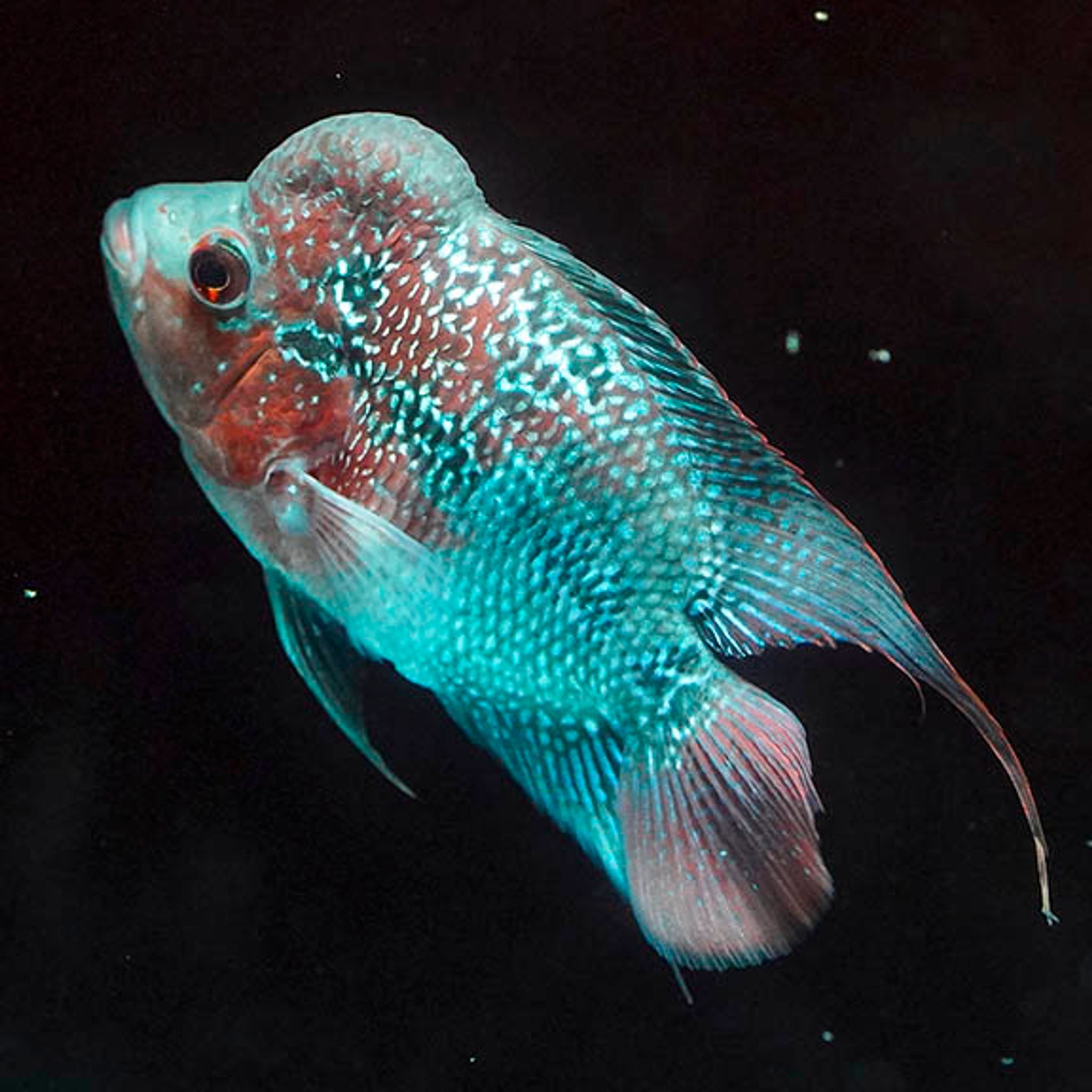

Flowerhorn Care Guide: Tank Size, Diet, Water Parameters and Temperament
A flowerhorn is a bold, personable cichlid that also happens to be one of the most space-hungry, waste-producing, and temperamental fish sold in the freshwater hobby. This guide covers the exact tank size, water parameters, diet, and equipment redundancy a flowerhorn needs, plus the temperament realities most buyers underestimate before bringing one home.
What Exactly Is a Flowerhorn?
A flowerhorn is not a wild species — it's a man-made hybrid cichlid, developed mainly in Malaysia and Taiwan starting in the 1990s by crossing several Central American cichlid species, including the Trimac cichlid, redhead cichlid, and Midas cichlid.
Because it's a hybrid/strain complex rather than a fixed species, there's no single "true" flowerhorn. This matters practically:
- Body shape, adult size, hump development, and color can vary widely between lines, even from similar-looking parents.
- A juvenile gives few visual clues about its adult outcome — hump size, coloration, and even final body length are not guaranteed.
- Fertility varies too; some heavily hybridized ornamental lines breed poorly even when paired successfully.
The Midas Cichlid Connection
The Midas cichlid, a robust Central American species, is one of the wild fish used in the original flowerhorn crosses. It's a large part of why flowerhorns inherited a deep, muscular body, a strong territorial streak, and a genetic tendency toward head growth — traits that later breeders selected for and exaggerated into today's ornamental strains.
Common Flowerhorn Types
Strain names describe head shape, scale pattern, and color rather than a formal taxonomy:
| Strain | Notable traits |
|---|---|
| Kamfa | Blocky, rounded head; heavy pearling on the body |
| Zhen Zhu / Pearl types | Dense pearl-like scale spangling |
| Golden Monkey | Golden-yellow base with bold black markings |
| Red Dragon / Red Texas lines | Deep red base color layered with pearling |
Tank Size: The Number One Thing to Get Right
Adult flowerhorns typically reach 12–16 inches (30–41 cm), with some strains and individuals pushing past 16 inches; males generally grow larger than females.
For a single adult, plan on:
- 75 gallons (284 L) as the safer minimum
- 70 gallons (265 L) as an absolute floor, not a target
- A long, wide footprint over height — aim for roughly 48+ inches (122 cm) of length and 18+ inches (46 cm) of width, since flowerhorns are deep-bodied cruisers, not jumpers
If you're set on keeping a pair (an advanced project, covered below), add another 70–100+ gallons of volume on top of the single-fish minimum. Bigger is always better given how large and heavy-bodied this fish gets.
Buy the adult-size tank from day one. Flowerhorns grow fast, and "it's small right now" is the single most common setup mistake — undersizing early forces stressful, expensive upgrades later instead of one correctly sized tank from the start.
Water Parameters
Consistency matters more than hitting an exact number, but stay within these ranges:
| Parameter | Target range |
|---|---|
| Temperature | 80–86°F (27–30°C); treat 86°F as the safe ceiling for daily keeping |
| pH | 7.0–7.8 as the sweet spot (tolerated range roughly 6.5–8.0) |
| General hardness | 8–20 dGH |
| Ammonia | 0 ppm |
| Nitrite | 0 ppm |
| Nitrate | Under 20 ppm |
A note on temperature: a few sources push the ceiling to 89°F, but that's better reserved for short-term disease treatment rather than everyday operation. Keeping the tank steadily in the low-to-mid 80s°F is the safer long-term approach.
Filtration and Water Changes
Flowerhorns are heavy waste producers relative to their size, so filtration needs to be oversized well beyond a filter's advertised tank-size rating. Canister filters are generally favored for the turnover and media capacity a 75+ gallon, single-large-fish tank demands.
For water changes:
- 20–30% weekly is the common baseline.
- Given the bioload, twice-weekly partial changes are worth considering, especially in smaller setups or heavily stocked tanks.
- Don't skip changes just because the fish "looks fine" — hole-in-the-head disease and fin or tail deterioration usually trace back to accumulated nitrates and inconsistent maintenance, not a sudden event.
You can browse canister and other filtration options in FishyHub's external filters category.
Diet
Flowerhorns are omnivorous with a strong carnivore lean. The most reliable approach is a quality pelleted staple as the base of the diet, layered with meaty foods and occasional vegetable matter — not an all-live or all-meat feeding routine.
- Base: a high-quality, protein-rich cichlid pellet with strong fish-meal content; color-enhancing formulas are commonly used to support hump and color development.
- Meaty supplements: bloodworms, shrimp, krill, earthworms, and crickets.
- Plant matter: roughly 20–30% of the diet in blanched vegetables, which several keepers credit for better digestion and color.
- Frequency: 2–3 feedings per day, portioned to whatever clears in a couple of minutes. Juveniles and breeding adults need smaller, more frequent feedings.
Overfeeding — especially protein-heavy feeding without variety — is a common contributor to poor water quality and digestive problems, so portion control matters as much as ingredient quality.
Temperament and Tank Mates
Flowerhorns are highly territorial and aggressive, and that aggression intensifies with maturity and around breeding condition. At the same time, they're widely regarded as intelligent and interactive; many recognize their keeper and approach the glass, earning a "wet pet" reputation that softens the case for solo housing rather than undermining it.
Best practice: keep one flowerhorn per tank. If tankmates are attempted at all:
- Only large, robust, fast-swimming fish of comparable size stand any real chance — think large plecos, giant gourami, or other big Central American cichlids.
- Compatibility is never guaranteed, even with the "right" species.
- Always have a backup tank ready to separate fish at the first sign of serious aggression.
Assuming personality alone will make a mixed tank work is a frequent and costly mistake — it tends to end in injury or death for one fish or the other.
Robust Central American and other large cichlids suited to a similar bioload and footprint can be found in FishyHub's American cichlids category, and flowerhorns themselves are listed under monster fishes.
The Nuchal Hump: A "Fish With a Big Forehead"
The forehead hump — called the nuchal hump or "kok" — is the flowerhorn's signature trait and the reason it's often searched as "the fish with the big forehead." It's:
- More pronounced in mature males than females
- Influenced by genetics, age, hormones, and diet
- Small or absent in juveniles, which is why hump potential can't be judged from a young fish
- Prized in show and breeding lines, but never guaranteed even from strong parentage
Growth, Lifespan, and Sexual Maturity
- Lifespan: roughly 10–12 years with good, consistent care.
- Sexual maturity: around 8–14 months.
- Common health issues: ich (white spot), hole-in-the-head disease, and fungal or bacterial infections — nearly all of which trace back to water-quality lapses or nutritional gaps rather than being random events.
Flowerhorn Breeding Basics
Breeding is best framed as an advanced, breeder-only project, not a beginner goal:
- Pairing is difficult because the same aggression that makes flowerhorns unsuitable for community tanks also makes courtship risky — an unreceptive pair can injure or kill each other.
- Many heavily hybridized ornamental lines have reduced fertility, so even a formed pair may not produce viable spawns.
- When pairs do form, parents guard eggs and fry closely.
- Fry are relatively easy to raise once hatched but need frequent small feedings multiple times a day.
- A dedicated spawning setup with the ability to separate fish quickly is essential in case pairing turns aggressive instead of reproductive.
Choosing the Right Aquarium Heater
Given the bioload and size of a flowerhorn tank, heating deserves more thought than a single generic heater:
- Rule of thumb: about 5 watts per gallon, enough to raise tank temperature roughly 10°F above room temperature.
- For larger tanks (75–125+ gallons), split the total wattage across two smaller heaters instead of one large unit — if one fails, the other prevents a full temperature crash.
- Position heaters near water flow (such as a filter outlet) for even heat distribution.
- Use a separate thermometer to verify actual tank temperature, since heater dials are frequently inaccurate.
- Never run a heater outside of water, even briefly.
An underpowered or single heater in a large, heavily stocked tank is a common setup gap — the temperature swings that follow are a real source of stress, and running two smaller heaters is a low-cost way to add redundancy.
Electrical Safety Around Aquariums
A large, always-running tank setup means more cords and more risk near water:
- Use GFCI-protected outlets for anything near the tank.
- Add drip loops to every cord so water can't travel down the cord into an outlet or power strip.
- Use surge protectors or power strips rated for damp locations.
- Inspect cords regularly for corrosion or wear.
- Keep all electrical connections above and well away from splash zones.
Power Outage Planning
Because flowerhorns are single-fish, high-bioload occupants of large tanks, losing heat and oxygen for even a few hours carries real risk — a gap most general fishkeeping advice doesn't connect specifically to this fish. A basic plan:
- Keep a battery- or gas-powered air pump on hand as backup aeration.
- Insulate the tank with blankets or towels to slow heat loss.
- Avoid opening the lid unnecessarily, which lets warmth escape.
- Hold off on feeding during an extended outage — reduced metabolism at lower temperatures means uneaten food just degrades water quality.
- For longer outages, manually re-oxygenate the water by gently stirring the surface.
A Buyer's Checklist Before You Purchase
Because juveniles reveal so little about their adult outcome, ask before buying:
- What strain or lineage is this fish, and what's the expected adult size range?
- Is there any indication of hump potential in the parents?
- Has the tank this juvenile came from shown any signs of disease?
- Do you have the 75-gallon-plus tank, oversized filtration, and heater redundancy ready before bringing it home?
It's also worth a quick check of your local and state regulations — some jurisdictions place restrictions on non-native or hybrid cichlids, and it's better to confirm this before purchase than after.
Frequently Asked Questions
Can flowerhorns live with other fish?
Generally, no — as a rule of thumb, flowerhorns do best housed alone. If tankmates are attempted, stick to large, fast, robust species of similar size, and be prepared to separate them immediately if aggression escalates.
How big of a tank does a flowerhorn need?
Plan for at least 75 gallons (284 L) for one adult, with more required for a pair or an especially large specimen. A long, wide footprint matters more than tank height.
What is the hump on a flowerhorn's head?
It's the nuchal hump, or "kok" — a genetic, hormonal, and diet-influenced trait that's more pronounced in mature males and especially prized in certain show and breeding strains.
What do flowerhorns eat?
A protein-rich cichlid pellet forms the base of the diet, supplemented with meaty foods like shrimp, bloodworms, and krill, plus some vegetable matter, fed 2–3 times daily.
What temperature and pH do flowerhorns need?
Aim for 80–86°F (27–30°C) and a pH around 7.0–7.8, with moderate general hardness. Stability over time matters more than hitting an exact figure.
How long do flowerhorns live?
With consistent care, typically 10–12 years.
Are flowerhorns hard to breed?
Yes — pairing is difficult due to their aggression, and many ornamental lines have reduced fertility even when a pair forms successfully. Parents that do spawn guard their eggs and fry closely.
What size heater does a flowerhorn tank need?
A baseline of about 5 watts per gallon works well; for tanks over roughly 100 gallons, split that wattage across two heaters rather than relying on a single large unit.
If you've weighed the space and maintenance commitment and are ready to move forward, you can browse available flowerhorns in FishyHub's flowerhorn category.


