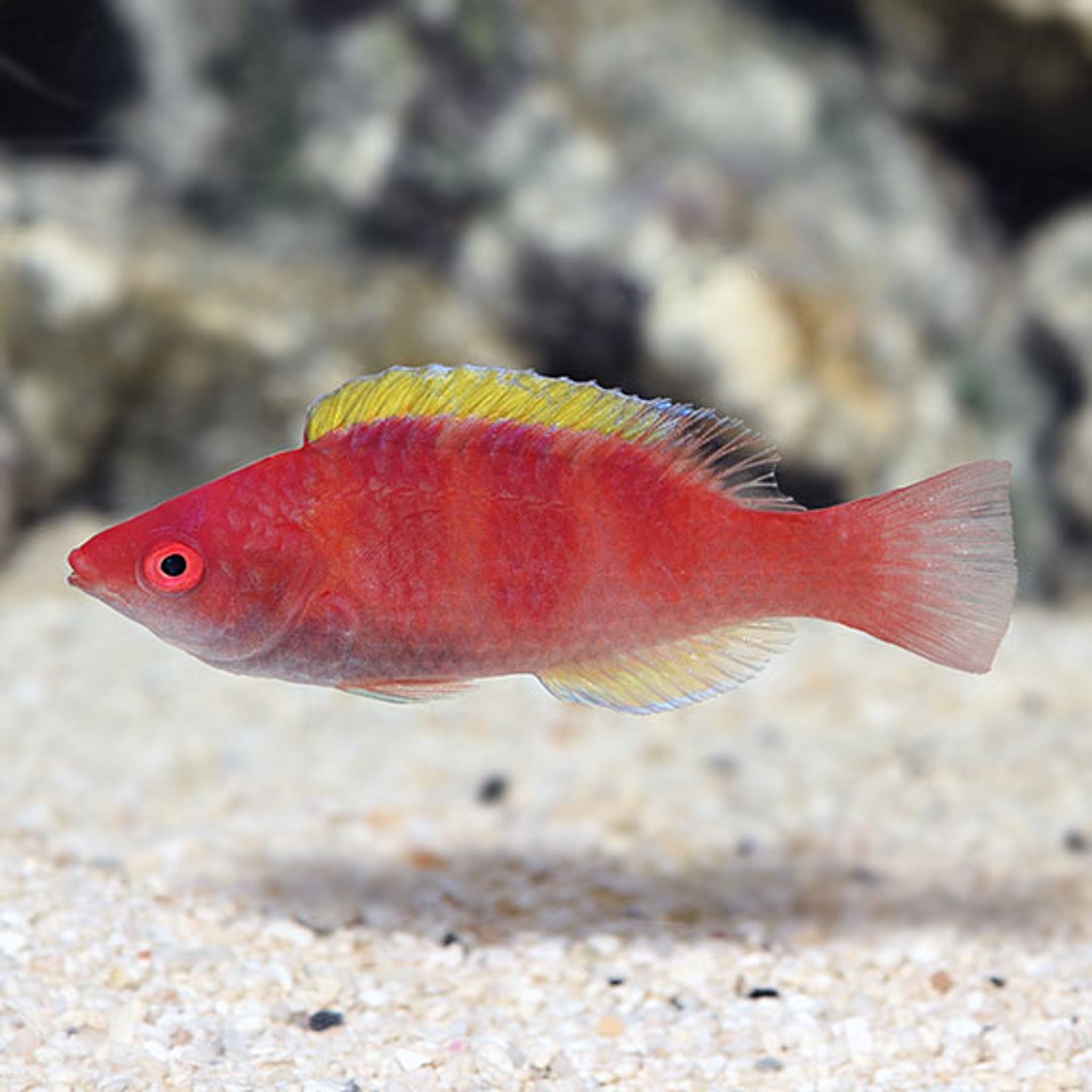
Fairy Wrasse Care Guide: Tank Size, Diet, Compatibility and Reef Safety
Fairy wrasses are among the most colorful, genuinely reef-safe fish available for a saltwater tank, but they have two non-negotiable needs: open swimming room and a lid that actually seals. This guide covers tank size by scenario, feeding schedules, water parameters, compatibility, and the most common mistakes that lead to a missing fish or a starving one.
What Is a Fairy Wrasse?
"Fairy wrasse" refers to the genus Cirrhilabrus, part of the wrasse family Labridae. Taxonomists currently recognize somewhere between 45 and 60 valid species, and the count keeps climbing — more than a dozen new species have been formally described since 2000. They're found across a huge range: the Red Sea, the Indian Ocean, and throughout the Pacific as far as the Pitcairn Islands, with northern populations reaching Hawaii and southern Japan.
Most adult fairy wrasses run 2.5 to 6 inches (6-15 cm), with males consistently larger and more vividly colored than females of the same species.
Tank Size: A Scenario-Based Approach
Rather than one blanket number, the right tank size depends on how many fish you're keeping and how large the species gets. Use this as a quick decision framework:
| Scenario | Minimum tank size | Notes |
|---|---|---|
| Single small-to-medium fairy wrasse | 40-55 gal (150-210 L) | Floor for most commonly sold species |
| Single larger-bodied species (5-6 in) | 55-90 gal (210-340 L) | More active swimmers need more length |
| One male + harem of females | 90-135+ gal (340-510+ L) | Space reduces territorial friction |
| Two males in the same tank | 135+ gal (510+ L) | Even then, fighting risk is high |
Across every scenario, footprint matters more than height. Fairy wrasses are mid-water cruisers that patrol horizontally, so a long tank — ideally 48 inches or more — serves them far better than a tall, narrow one with the same total volume. None of the roughly four dozen commonly kept species should be considered truly nano-safe.
Water Parameters
Fairy wrasses are undemanding once acclimated, as long as basic reef parameters stay stable:
- Temperature: 72-82°F (22-28°C), with most kept comfortably at 75-78°F (24-26°C)
- pH: 8.0-8.4
- Specific gravity: 1.020-1.025
- Alkalinity (dKH): roughly 8-12
They aren't fussy about micro-swings the way some invertebrates are — the priority is consistency, not perfection.
Diet and Feeding Schedule
In the wild, fairy wrasses are carnivorous zooplanktivores that graze continuously on drifting plankton. Some sources call them "omnivorous" because they'll eventually take flake or pellet, but that's more about adaptability than natural diet — they are not fish that need plant matter to thrive.
A practical captive diet includes:
- Enriched mysis and brine shrimp as the staple
- Live copepods, especially important during the first weeks after introduction
- Chopped seafood or krill for larger species
- High-quality marine pellets or flake, once the fish is settled and feeding confidently
Feeding frequency is where sources disagree most: some say twice a day is fine, while others — particularly those focused on live pods — insist on near-continuous grazing. The practical middle ground is to feed at least 2-3 small meals daily and, where possible, maintain a standing copepod population via a refugium or regular live-pod dosing, rather than relying on scheduled feedings alone. This matters most in the first few weeks, when a newly introduced fish may be too shy to compete for food at a single big feeding.
If you don't run a refugium, dosing live copepods a few times a week directly into the display, timed for lights-out or right after the main lights dim, is a workable low-cost alternative to a dedicated pod culture setup. You can browse feeding options for zooplanktivores in FishyHub's food and supplements category.
Reef Safety
Fairy wrasses are excellent reef citizens. They ignore stony and soft corals entirely, coexist safely with clams and the vast majority of sessile invertebrates, and many actively hunt and eat pest flatworms (such as Convolutriloba) and pyramidellid snails — a genuine pest-control bonus rather than just a "won't bother anything" fish.
The caveats are narrow:
- Tiny ornamental shrimp (sexy shrimp, anemone shrimp) can occasionally be picked at by a fairy wrasse, particularly very small individuals
- Aggressive host anemones (Heteractis, Stichodactyla) can catch and hold a wrasse that swims too close, so weigh that risk if your tank centers on one
If you're stocking delicate ornamental shrimp alongside a wrasse, it's worth browsing FishyHub's marine shrimp selection with an eye toward hardier, larger-bodied species rather than the smallest ornamentals.
Compatibility and Social Structure
Temperament is genuinely species- and setup-dependent, which is why you'll see fairy wrasses described anywhere from "peaceful" to "semi-aggressive." The realistic summary: generally peaceful toward unrelated fish, but territorial toward similarly shaped or similarly sized wrasses — especially their own species — in tight quarters.
Good tankmates typically include damsels, gobies, blennies, cardinalfish, pygmy angels, and anthias.
Fish to avoid include large predators and aggressors — lionfish, triggerfish, groupers, puffers, frogfish — as well as established boisterous wrasses like six-line wrasses (Pseudocheilinus) and some Halichoeres species, which will readily bully a shyer fairy or flasher wrasse. You can browse compatible options in FishyHub's wrasse category alongside other peaceful reef fish.
Keeping More Than One
Fairy wrasses are protogynous hermaphrodites — every individual starts life as a female, and the largest, most dominant female in a group converts to male if the resident male is lost or removed. Males display noticeably richer, more intense coloration, particularly during courtship and territorial disputes, and can dull back down if repeatedly dominated by a rival.
Practical stocking rules:
- Single specimen works in any tank meeting the minimum size above
- One male with multiple females (a harem) is the standard way to keep a small group, and needs 90+ gallons
- Two males together risks ongoing fighting unless the tank is very large (100-135+ gallons)
- Mixing different Cirrhilabrus species in one tank is genuinely difficult — look-alike species often trigger aggression that wouldn't happen with a single species. If you do combine species, add all the females at once and the male last, and provide plenty of rockwork and open space.
Notable Species and Color Morphs
The genus is large, but a handful of species and morphs dominate the US aquarium trade:
| Species / morph | Approx. size | Standout feature | Min. tank size |
|---|---|---|---|
| Lubbock's / multicolor Lubbock's | 3-4 in | Affordable, vivid multi-color body | 40-55 gal |
| Exquisite fairy wrasse | 3 in | Purple-and-red gradient, budget-friendly | 40-55 gal |
| Splendid pintail | 4-5 in | Elongated tail filament; limited Philippine collection | 55-90 gal |
| Blue throat | 3-4 in | Deepwater origin; often pricier and less frequently available | 55-90 gal |
| Blue-sided fairy wrasse | 3-4 in | Bold blue flank stripe | 40-55 gal |
| Lineatus fairy wrasse | 4 in | Fine longitudinal lines over a pastel body | 40-55 gal |
| Johnson's fairy wrasse | 4 in | Deep red-violet coloration | 55-90 gal |
| Pink margin fairy wrasse | 4 in | Subtle pink-edged fins | 40-55 gal |
| Mystery wrasse | 4-5 in | White-line pattern on lavender body; strong pest-eater | 55-90 gal |
| McCosker's flasher wrasse | 2.5-3 in | Not a true fairy wrasse (see below); flashy fin display | 40-55 gal |
| Line-spot flasher wrasse | 2.5-3 in | Not a true fairy wrasse; active mid-water swimmer | 40-55 gal |
Prices vary enormously by rarity: common Lubbock's and exquisite types are inexpensive and widely available, while rarer deepwater or newly described species — the splendid pintail and certain Philippine endemics among them — can run into the hundreds of dollars and show up on a seasonal, collection-limited basis.
Flasher Wrasses and Other Close Relatives
Flasher wrasses (genus Paracheilinus) are close cousins often shopped alongside true fairy wrasses. They share similar reef safety and jumping risk but tend to be more outgoing and active, frequently flaring their fins in display. The two groups can bicker with each other, so if you combine fairy and flasher wrasses in the same tank, keep an eye on ratios and give each enough territory.
A few other reef wrasses are worth knowing when planning compatibility:
- Mystery wrasse — peaceful, reef safe, an enthusiastic pest-eater, and just as jump-prone as true fairy wrasses
- Pencil wrasses (Pseudojuloides) — deepwater, sand-diving planktivores that are less commonly available but behave similarly
- Halichoeres and torpedo wrasses (Pseudocoris) — generally not good tankmates for fairy wrasses. These are bolder, substrate-diving wrasses, and even though some Halichoeres are themselves reef safe, their pushier temperament clashes with the more timid fairy and flasher wrasses
As an aside, purple tilefish are unrelated to fairy wrasses but share the same deep-sand-diving habit and jumping risk, and are sometimes cross-shopped by the same buyers — worth the same lid precautions if you're considering one.
Tank Lid and Escape Prevention
Jumping is the single defining care issue with this genus. Fairy and flasher wrasses startle easily — a sudden shadow, lights switching on or off abruptly, or being chased by a tankmate — and a startled wrasse will launch itself out of any opening it can find.
A tight-fitting lid is mandatory, not optional. Options include:
- A DIY screen top: an aluminum frame with fine mesh netting, cut to fit the tank's rim
- Ready-made screen or mesh lid kits sized for standard tank dimensions
- Commercial acrylic canopies with sealed cutouts for cords and equipment
Whichever you choose, check every gap — cord pass-throughs, overflow box slots, and the seams between panels are the most common places a determined fish escapes through, even on a tank that looks fully covered.
Acclimation and Common Mistakes
New fairy wrasses are often shy to the point of alarm: expect a fish that dives into the sand or hides in rockwork for days and refuses food. This is normal acclimation stress in most cases, not illness, and a deep sand bed genuinely helps by giving a stressed fish somewhere to retreat. Add fairy wrasses later in your stocking order, once the tank is established with mature rockwork and hiding spots — not as an early addition to a bare, unsettled system.
Common mistakes to avoid:
- No lid or an incomplete one — the fish jumps and is later found dried out; fix with a full mesh or screen top that also covers overflow slots
- Adding too early to an immature tank — leads to prolonged hiding and starvation; wait until the tank is established
- One large daily feeding — a species built for constant grazing loses weight on this schedule; switch to several small feedings plus live pods
- Two males in a small tank — chronic fighting, torn fins, and stress-related disease; keep one male per tank unless it exceeds roughly 100-135 gallons
- Mixing several Cirrhilabrus species — often triggers unexpected aggression between look-alikes; stick to one species per tank
- Assuming a hiding, food-refusing new fish is sick — usually just stress; minimize disturbance and offer live or frozen mysis before assuming illness
- Pairing with boisterous wrasses like six-lines or aggressive Halichoeres — leads to bullying; add the fairy wrasse first, or skip the combination entirely
Fairy wrasses are generally hardy and disease-resistant. When problems do occur — ich, fin rot, pop-eye — they're usually stress-triggered by poor acclimation or incompatible tankmates rather than inherent fragility. With stable parameters and good nutrition, a well-kept fairy wrasse typically lives 4-8 years in a home reef tank.
Frequently Asked Questions
What is the minimum tank size for a fairy wrasse?
Generally 40-55 gallons for a single small-to-medium species. Larger-bodied species or a male-plus-harem setup need more — 90 gallons or above.
Are fairy wrasses reef safe?
Yes. They ignore stony and soft corals, are safe with clams and most sessile invertebrates, and many actively eat flatworms and pest snails. The only real caution is around very small ornamental shrimp, which a wrasse may occasionally pick at.
Can you keep two fairy wrasses together?
Yes, if it's one male with several females in a tank of 90 gallons or more. Two males housed together will usually fight unless the tank is very large — 100-135+ gallons.
What do fairy wrasses eat?
Enriched mysis and brine shrimp, live copepods, chopped meaty seafood for larger species, and marine pellets or flake once the fish is acclimated. Feed several small meals across the day rather than one large one.
Why does my fairy wrasse keep jumping or hiding?
Jumping is a startle response to sudden movement or lighting changes, so a tight, gap-free lid is essential. Hiding after introduction is typically normal acclimation stress rather than illness, and usually resolves with patience and minimal disturbance.
Do fairy wrasses change sex?
Yes. They're protogynous hermaphrodites — every fish starts as female, and the dominant female in a group converts to male if the resident male dies or is removed.
What's the difference between a fairy wrasse and a flasher wrasse?
They're different genera — Cirrhilabrus versus Paracheilinus — with similar size, reef safety, and jumping risk. Flasher wrasses tend to be more active and outgoing, and the two groups can squabble if kept together.
How long do fairy wrasses live in a home aquarium?
Typically 4-8 years, assuming stable reef parameters and consistent, frequent feeding.
Ready to add one to your reef? Browse FishyHub's full wrasse selection to compare available species and color morphs.

