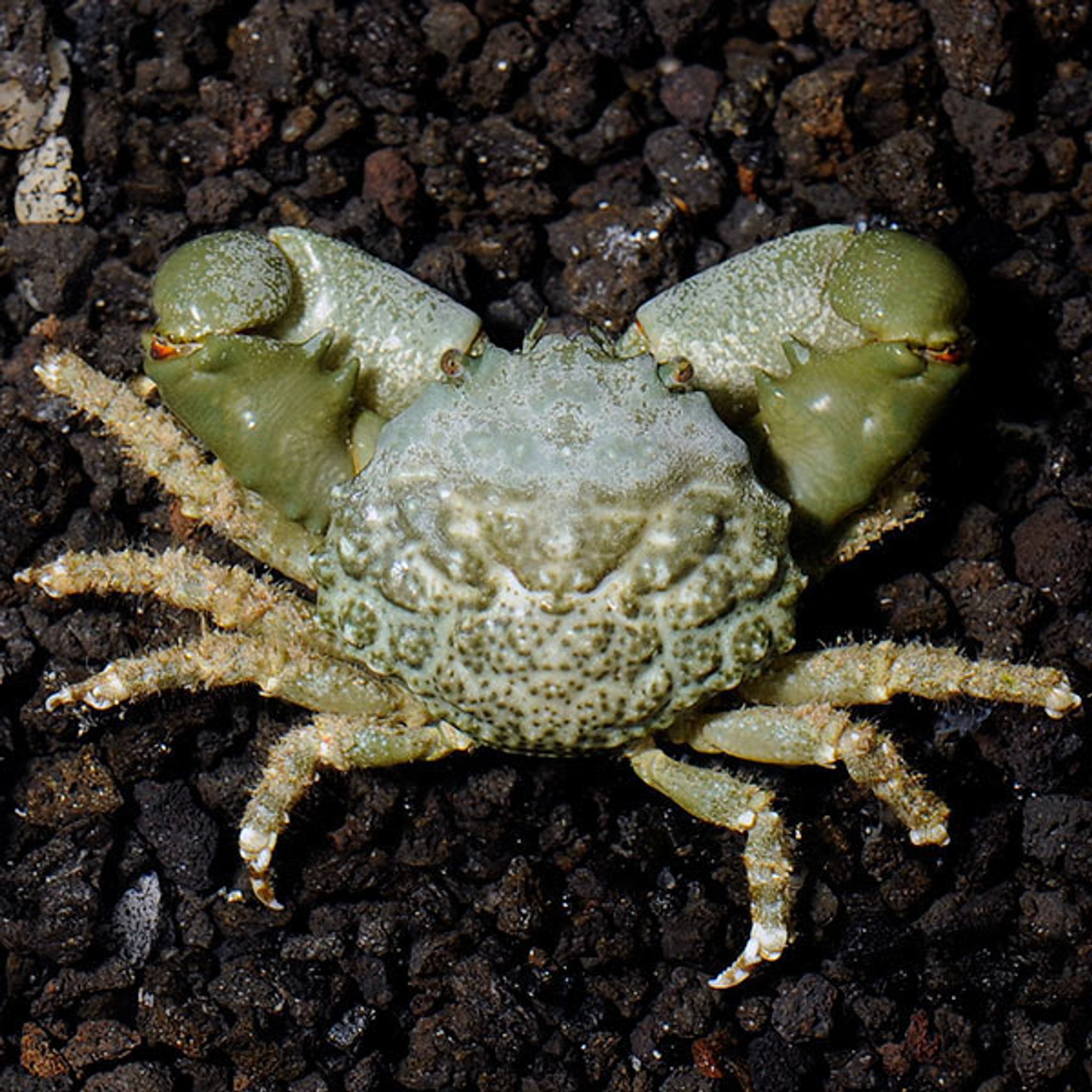

Emerald Crab Care Guide: Tank Requirements, Feeding and Compatibility
The emerald crab (Mithraculus sculptus) is one of the most popular clean-up crew crabs in the saltwater hobby, prized for tackling bubble algae in reef tanks. Before you add one, it pays to confirm you actually have the real species, dial in the right tank size and parameters, and understand that this is an omnivore, not a lawnmower — get any of those wrong and you risk fights, predation on corals, or a crab that starves quietly in a corner.
Identification First: Emerald Crab or Gorilla Crab?
This is the single most important check before you buy or before you decide a hitchhiker on your live rock is safe to keep. Emerald crabs and their lookalike, the gorilla crab (a xanthid, sometimes loosely called a "mithrax" or "rubble crab"), are both green and both arrive on live rock, which causes constant misidentification.
| Feature | True Emerald Crab | Gorilla Crab (pest) |
|---|---|---|
| Shell texture | Smooth | Fuzzy or hairy |
| Claw tips | Cream or pale green | Dark-tipped |
| Temperament | Docile scavenger | Aggressive predator |
| Diet risk | Occasional polyp nibbling if underfed | Eats coral polyps, feather duster crowns, anemone tentacles, small fish |
| Toxicity | None known | Can carry tetrodotoxin, dangerous if eaten by a fish |
| Rock behavior | Hides in existing crevices | Enlarges crevices by scraping away live rock, destabilizing aquascapes |
If a "green crab" at checkout or on your rock has any hair or fuzz, or dark claw tips, treat it as a gorilla crab, not an emerald crab. The most effective removal method is a smooth-walled trap — a shot glass or similar container baited with a piece of meaty food and set on the substrate overnight works well, since the crab can climb in but not climb back out. Manual extraction with tweezers is possible but often means pulling apart rockwork. Avoid chemical treatments; they stress or kill other tank life without reliably solving the problem.
Species Snapshot and Lifespan
True emerald crabs are native to Caribbean and western Atlantic reefs. Adults typically reach 1.5–2.5 inches (about 4–6 cm) across the carapace, averaging around 2 inches. With stable water quality and consistent feeding, expect a lifespan of roughly 2–4 years in captivity.
Sexing is straightforward once you know what to look for: males have a narrow, triangular abdominal flap (apron), while females have a wider, rounded flap and are generally reported as calmer and less prone to aggression. If you're choosing a single crab for a mixed-species tank, a female is often the safer pick.
Tank Requirements
Tank Size
Recommendations across the hobby range from as little as 10 gallons up to 30 gallons per crab, which is a wide spread. A sensible, conservative approach:
- 20 gallons (76 L) minimum for one crab.
- 30+ gallons (114 L) preferred, especially in a reef system with corals you want to protect.
- Add roughly 20–30 more gallons of volume per additional crab — emerald crabs are territorial, and cramped quarters lead to fights and lost claws or legs.
Water Parameters
| Parameter | Target Range |
|---|---|
| Temperature | 72–82°F (22–28°C), mid-to-high 70s ideal |
| pH | 8.0–8.4 |
| Specific gravity (salinity) | 1.023–1.025 |
| Alkalinity (KH) | 8–12 dKH |
| Nitrate | Under 20 ppm |
A reliable heater is required, and parameters should be stable rather than drifting — crabs are more sensitive to swings than many reef fish. One critical caveat: emerald crabs cannot tolerate copper-based medications. If you ever need to treat fish for disease, remove the crab first or treat in a separate hospital tank; dosing copper in a display tank that houses a crab will kill it.
Aquascape and Hiding Spots
Provide plenty of live rock with crevices and small caves. Emerald crabs are mostly nocturnal, especially in the first few weeks after introduction, and need daytime hiding spots to feel secure. Some individuals become bolder and more visible during the day once fully settled, but don't be alarmed if yours stays tucked away — that's normal behavior, not a sign of stress by itself. Pair the rockwork with a sandy or fine substrate to mimic a natural Caribbean reef bottom.
One easy habit: leave discarded molted shells in the tank rather than removing them. The crab will often eat its own old shell to recover calcium for the next molt.
Feeding: Omnivore, Not Lawnmower
Emerald crabs are marketed heavily as algae eaters, and bubble algae control is genuinely their signature job. But treating them as pure herbivores is a common mistake. In practice, they're omnivorous scavengers that eat:
- Bubble algae, hair algae, and film algae
- Detritus and leftover fish food
- Meaty foods: mysis shrimp, brine shrimp, krill, chopped shrimp or squid
If algae supply runs low and no supplemental feeding is offered, a hungry emerald crab is far more likely to pick at coral polyps, feather dusters, sponges, or slow-moving snails. Feed meaty food roughly 2–3 times a week, even when bubble algae is visibly present in the tank. Underfeeding, not temperament, is the single biggest driver of predation complaints in reef tanks. A rotation of frozen or freeze-dried marine foods works well for this — you can browse a range of freeze-dried foods to keep on hand for target feeding.
Reef Safety: A Real But Manageable Risk
Emerald crabs are best described as "reef safe with caution," not an unconditional yes. Individual temperament varies considerably: some keepers run them in coral tanks for years without a single incident, while others report polyp predation almost immediately. Frame it as an individual- and feeding-dependent risk rather than a flat verdict.
Rough risk tiers to watch, from most to least vulnerable:
- Higher risk: zoanthids, mushroom corals, and other small-polyp species with exposed, fleshy tissue.
- Moderate risk: feather dusters, small-polyp SPS, small or slow snails.
- Lower risk: large-polyp LPS corals, which tend to retract tissue more effectively.
Two practical safeguards reduce risk substantially: keep the crab well fed on meaty food regardless of algae levels, and observe closely for the first few weeks after adding it to a coral tank. It's also worth waiting until a reef tank is reasonably mature — with an established supply of algae and detritus — before adding a crab, since a brand-new tank with little natural food increases the odds of early predation.
Molting: What's Normal
Like all crustaceans, emerald crabs periodically shed their exoskeleton to grow. After a molt, what's left behind looks like a complete, intact "ghost" crab — legs, claws, even eye stalks in place, but hollow. This regularly gets mistaken for a dead crab. The real animal, meanwhile, hides for several days while its new shell hardens, during which it's highly vulnerable to attack from tankmates.
To tell a molt from a genuine death: check the shell for intact leg joints and eye stalks, and note whether there's any foul odor — a molt has no smell, while a dead crab typically does within a day. Do not disturb the tank or remove the shell during this period; leave the crab alone until it re-emerges, and let it consume the old shell if it chooses to.
Health and Quarantine
Emerald crabs are susceptible to shell disease, a bacterial or viral condition that shows up as pitting or pockmarks on the carapace, along with occasional mite or parasite issues. More importantly for a mixed tank, emerald crabs can act as symptomless carriers of marine ich — they can pass the parasite to fish without showing any signs of illness themselves. This is a strong argument for quarantining new crabs before adding them to an established display, rather than skipping quarantine because "it's just a crab."
Compatibility With Other Tankmates
Emerald crabs generally coexist well with shrimp, snails, and hermit crabs when the tank is large enough and feeding is consistent, though slow-moving snails and small shrimp carry some ongoing risk and should be monitored after introduction. If you're stocking a cleanup crew, review compatible options in the marine invertebrates category before adding new tankmates.
Related Reef Crabs and Crustaceans Worth Knowing
Crabs and lobsters form a broad category of aquarium crustaceans, and emerald crabs are just one entry point. Lobsters generally need far larger, predator-only setups and aren't compatible with a typical reef community. A few other commonly searched options worth comparing:
Arrow Crab
A long-legged, spider-like decapod (Stenorhynchus seariegus) needing at least 20 gallons per animal. Arrow crabs are semi-aggressive, especially as males mature, and while they help control bristleworms, they will also take small fish and shrimp. A full-grown emerald crab isn't usually threatened by an arrow crab, but the arrow crab itself is a bigger risk to most other tankmates.
Sally Lightfoot Crab
A different genus (Percnon) with a 15-gallon minimum, similar reef parameters to emerald crabs, and an omnivorous diet of algae plus small invertebrates and carrion. It becomes more predatory and semi-aggressive with age, so it's worth researching before adding it to a peaceful reef.
Decorator Crab
From a different family entirely, decorator crabs camouflage themselves by attaching debris, algae, or sponge to their shells. They're generally considered reef-safe and passive — a gentler alternative to emerald or gorilla crabs if camouflage behavior interests you.
Spider Crab
Another reef-tank hitchhiker or decorative purchase, spider crabs are slow-moving, camouflage-oriented, and mostly peaceful scavengers, distinct from both arrow and gorilla crabs.
Bubble Algae Removal: Setting Realistic Expectations
Since bubble algae control is the main reason most keepers buy an emerald crab, it helps to know the full toolkit. The gold-standard method is manual removal: pop or pull the entire bladder including its base, ideally with the return pump off first, since disturbing an intact bladder can spread spores throughout the tank. Emerald crabs are a popular biological control but not a guarantee — they may lose interest in algae entirely if not also given meaty food. Other biological helpers include certain snails such as turbo or trochus species, algae-grazing tangs or rabbitfish, and simply reducing nutrient levels. Chemical or peroxide-based treatments exist for severe infestations but should be treated as a last resort, not a first step.
Drip Acclimation for a New Crab
Crabs are notably sensitive to sudden salinity swings during shipping, so a slow drip acclimation is worth the extra time:
- Float the sealed bag in the tank for 15–20 minutes to match temperature.
- Empty the bag into a clean container and run an airline with a valve from the display tank into the container, dripping slowly.
- Let the volume roughly double over 45–60 minutes, adjusting drip speed as needed.
- Net the crab out (avoid adding the shipping water to the tank) and release it near the rockwork so it can find shelter immediately.
Buying Tips
Emerald crabs sold in the US trade are a mix of wild-caught Caribbean imports and tank-raised specimens; either can make a healthy addition, but tank-raised individuals tend to acclimate a little faster. Prices vary by supplier and season, so treat any single figure as a rough guide rather than a fixed expectation, and always inspect the crab (or ask for a photo) for the smooth-shell, cream-clawed traits described above before purchase.
Frequently Asked Questions
Is my green crab an emerald crab or a gorilla crab?
Check for a smooth, non-hairy shell and cream or pale green claw tips — that's a true emerald crab. A hairy or fuzzy shell with dark-tipped claws signals a gorilla crab, which should be removed rather than kept in a reef tank.
Are emerald crabs reef safe?
Mostly yes, when well fed and given adequate space, but they're not risk-free. They can eat coral polyps, feather dusters, and slow-moving snails, and that risk rises sharply with hunger and overcrowding.
What do emerald crabs eat?
They eat algae, especially bubble algae, but they're omnivorous scavengers, not strict herbivores. Supplement their diet with mysis shrimp, krill, or pellets roughly 2–3 times a week regardless of how much algae is present.
Will an emerald crab actually get rid of bubble algae?
Often, but it's not guaranteed. Pairing a crab with manual popping and removal, plus keeping nutrient levels low, gives the best results.
How many emerald crabs can I keep together?
A safe rule of thumb is one crab per roughly 20–30 gallons. Keeping more crabs in tight quarters leads to fighting, particularly between males.
Why is my emerald crab hiding all the time?
This is typically normal nocturnal behavior, especially in the first few weeks after introduction. Make sure there's enough rockwork for cover, and check whether the crab might be mid-molt rather than stressed.
Can emerald crabs live with shrimp, snails, or hermit crabs?
Generally yes, as long as the crab is well fed and the tank has enough space. Slow snails and small shrimp carry some ongoing risk, so it's worth monitoring the tank closely after any new introduction.
How long do emerald crabs live?
With stable water quality and proper feeding, emerald crabs typically live around 2–4 years in captivity.
Ready to add an emerald crab or round out your cleanup crew? Browse the current selection in the crabs category to compare available specimens before you buy.


