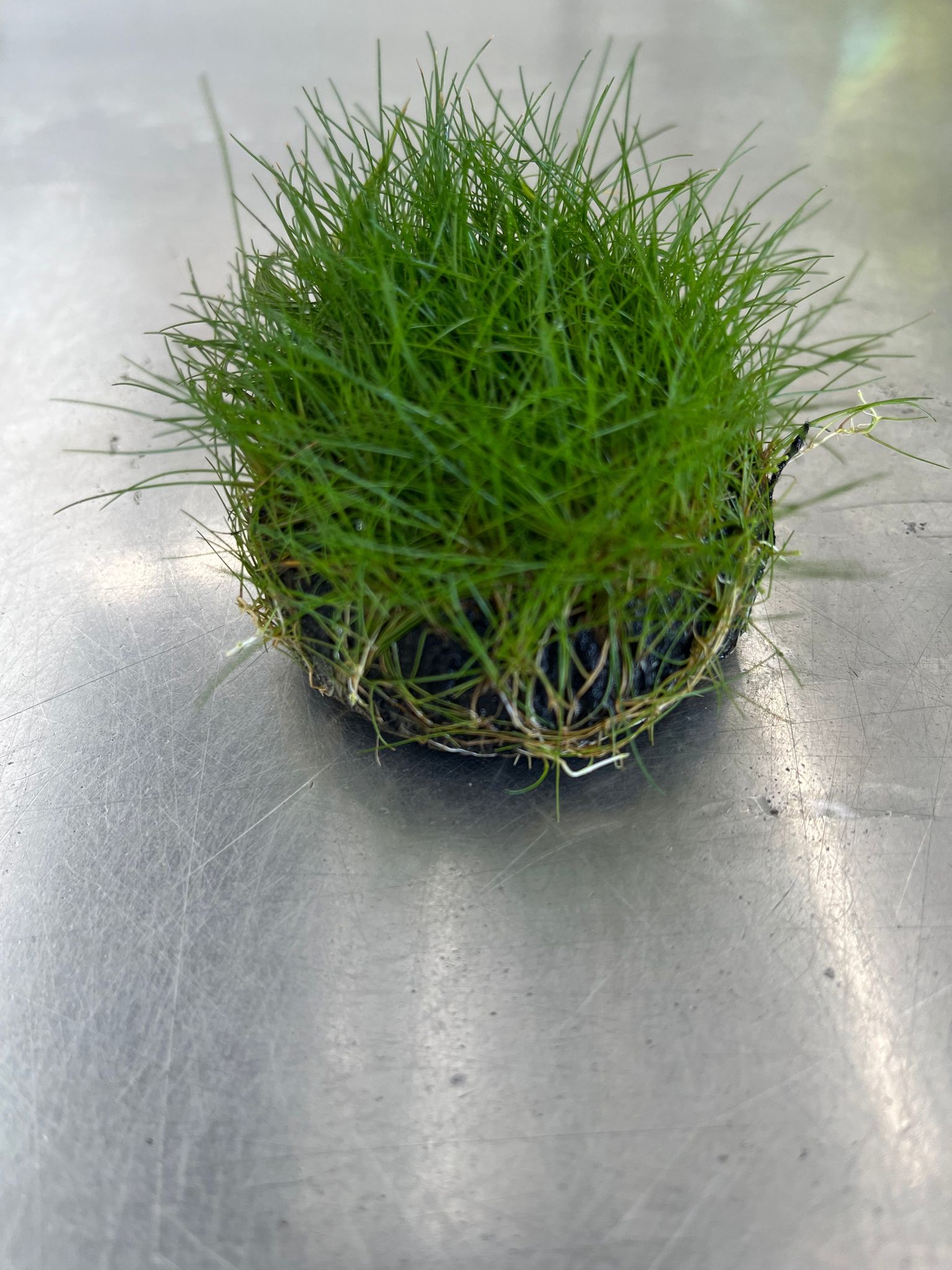

Dwarf Hairgrass Care Guide: Light, CO2, Substrate and Growth Tips
Dwarf hairgrass can carpet an aquarium floor in thin, grass-like blades, but getting a dense lawn instead of scattered tufts takes more than dropping in a few pots. This guide breaks down the exact light, CO2, substrate, and trimming targets that separate a patchy planting from a true carpet, plus a tiered path so you can pick a setup that matches your budget and patience.
What Is Dwarf Hairgrass, Exactly?
"Dwarf hairgrass" is a common name applied to a few look-alike species in the sedge family, not a true grass:
- Eleocharis acicularis – the most widely sold form, very thin blades.
- Eleocharis parvula – a shorter, more compact species often marketed for nano tanks.
- Eleocharis pusilla ("mini" cultivars) – sometimes sold under this name for an even smaller profile.
All three grow as thin, upright blades from creeping rhizomes and are found worldwide in marshy, wet habitats across North America, Europe, and parts of Asia and South America. In nature they grow both emersed (above water) and submersed, which is why aquarium stock often ships as emersed-grown tissue-culture cups.
Telling It Apart From Look-Alikes
Because these plants are frequently mislabeled at retail, it helps to know what you're actually buying:
| Plant | Leaf shape | Height | Light/CO2 needs | Notes |
|---|---|---|---|---|
| Dwarf hairgrass (Eleocharis spp.) | Thin, round, hair-like blades | 2–6 in | Moderate–high, CO2 for dense carpet | True grass-like sedge |
| Lilaeopsis | Flat, slightly wider blades | 1–3 in | Medium–high, usually CO2 | More delicate to establish |
| Brazilian micro sword (Lilaeopsis brasiliensis) | Flat, grass-like | 2–3 in | Bright light, CO2 for best growth | Tolerates a wide temp range, even slight brackish |
| Juncus repens | Tufted, needle-like, taller | 4–10 in | Low–moderate | Grows fast, needs frequent trimming |
| Mondo grass (not aquatic) | Thick, dark, strap-like | 4–8 in | N/A | A terrestrial garden plant — will rot underwater |
Mondo grass in particular gets sold or mistaken for an aquatic plant on occasion; it's actually a lily relative meant for garden borders, and it will slowly rot if kept submerged long-term. Steer toward true aquatic carpet plants instead.
Tank Size and Setup
Dwarf hairgrass works in nano tanks as small as 5–10 gallons (19–38 L) all the way up to large aquascapes — there's no real upper size limit. As a rough planting guide for common US tank footprints:
| Tank footprint | Approx. clumps needed for a full grid |
|---|---|
| 10-gallon (20 x 10 in) | 40–60 small clumps |
| 20-gallon long (30 x 12 in) | 80–120 small clumps |
| 40-gallon breeder (36 x 18 in) | 150–220 small clumps |
Tighter spacing gives a faster-looking carpet but costs more plant material up front; wider spacing is cheaper but takes longer to fill in.
Lighting
To grow a genuine dense carpet, light needs to be moderate to high in intensity and it must actually reach the substrate — not just the water surface. Target roughly 35–50+ PAR at the substrate with an 8–10 hour photoperiod. Fixtures and full-spectrum LED options for planted setups are worth comparing in Lighting if you're upgrading from a low-output stock hood.
Watch for shading: taller plants, hardscape, or an aging bulb can block enough light that hairgrass stretches upward toward the surface instead of spreading sideways. If your carpet is growing tall and thin rather than low and dense, check PAR at substrate level, not just the fixture's wattage.
CO2: Optional, But the Biggest Lever
Dwarf hairgrass will survive without injected CO2, but carpeting is a different question. Here's the honest tradeoff:
- Without CO2: growth is thin and patchy, and a full carpet can take many months (sometimes 6+) to fill in, if it fills in at all.
- With CO2: a dense carpet can form in roughly 4–8 weeks under adequate light.
- Liquid carbon supplements: a lower-cost, lower-effect middle ground between the two.
Some guides call CO2 mandatory; it isn't, strictly speaking — the plant can live without it. But it is the single biggest lever for carpet speed and density, so treat it as strongly recommended rather than optional if a fast, thick lawn is the goal.
Substrate
Roots are delicate and need to push through material easily, so substrate choice matters more here than with many other plants:
- Nutrient-rich aquasoil — the top pick for density and long-term growth; it supports root uptake and beneficial bacteria better than plain sand.
- Fine sand or fine gravel plus root tabs — a workable, budget-friendly alternative since roots move through fine grains without resistance.
- Coarse gravel — avoid it; it blocks runner spread and prevents roots from penetrating.
Browse root-feeding-friendly options such as soil-type mixes and fine gravel/sand blends under Substrate, including dedicated aquasoil in the Soil range and finer blends in Gravel & Sand. Keep depth modest — about 1–1.5 in is plenty for a carpet plant; it doesn't need deep substrate to root well.
Sand alone works fine for plants that don't feed heavily through their roots (anubias, java fern), but as the sole substrate for a root-feeding carpet plant like hairgrass, it's less ideal than a nutrient-rich soil-type layer, or soil capped with a thin layer of sand.
Planting Method
- Separate purchased pots, mats, or tissue-culture cups into small clumps of just a few blades each.
- Trim the roots slightly — this encourages new growth rather than just re-anchoring the old root mass.
- Plant clumps in a grid roughly 0.5–2 in apart using tweezers.
- Bury only the roots; keep all blades above the substrate surface.
Tissue-cultured, in-vitro cups (a common US retail format) are grown emersed in a sterile gel medium. They typically melt back less than potted or bare-root bunches during the transition to submersed growth, but they still need an adjustment period — see the troubleshooting section below.
Water Parameters
| Parameter | Range |
|---|---|
| Temperature | 50–85°F (10–29°C); comfortable long-term range 72–79°F (22–26°C) for tropical community tanks |
| pH | 6.5–7.5 |
| General hardness | Roughly 2–10 GH |
| Carbonate hardness | 0–14 KH |
Notably, dwarf hairgrass is cold-tolerant down to about 50°F, which makes it usable in unheated tanks or seasonal outdoor setups, not just heated tropical aquariums.
Fertilization and Flow
Because hairgrass feeds through both roots and leaves, combining root and water-column fertilization gives the best density:
- Root tabs for sand or gravel setups.
- Liquid all-in-one or macro/micro fertilizers for soil-based or CO2-injected tanks, dosed on a regular schedule rather than sporadically.
Moderate water flow across the carpet helps distribute CO2 and nutrients evenly and discourages debris and algae from settling into the blades. Too little flow leaves dead zones where growth lags; too much can flatten new plantings before roots anchor.
Trimming and Propagation
Once established, trim hairgrass regularly with scissors or curved carpet scissors down to roughly 1 in or shorter. Trimming is not just tidying — it's what triggers lateral, runner-driven growth that thickens the carpet, rather than letting individual blades just grow tall. After trimming, a gentle substrate vacuum removes floating clippings and debris trapped low in the lawn.
Propagation happens via runners (stolons) that shoot out new plantlets sideways, not through leaf cuttings. Once a patch is established, runners can be divided and replanted elsewhere to expand coverage.
Choose Your Tier: Low-Tech vs. CO2-Injected
| Low-tech budget carpet | CO2-injected showcase carpet | |
|---|---|---|
| Light | Moderate, ~8 hrs/day | 35–50+ PAR, 8–10 hrs/day |
| CO2 | None or liquid carbon | Pressurized injection |
| Substrate | Fine sand/gravel + root tabs | Nutrient-rich aquasoil |
| Timeline to carpet | Several months, sometimes 6+ | Roughly 4–8 weeks |
| Relative cost | Lower upfront | Higher (CO2 system, stronger light) |
| Best for | Patient, budget-conscious tanks | Aquascaping showcases, faster results |
Neither path is wrong — pick based on how quickly you want results and how much equipment you're willing to run.
Aquascaping Uses and Alternatives
Dwarf hairgrass is a signature plant for Iwagumi and other minimalist, nature-style layouts because it forms an even, low, natural-looking green field around stone hardscape without competing visually with the rocks. It's also common as a general foreground carpet or midground "meadow" in Dutch-style and other nature aquascapes.
If hairgrass isn't the right fit, several alternatives are worth considering:
- Lilaeopsis — similar in appearance, slightly more delicate; needs medium-high light, nutrient-rich substrate, and often CO2; plant in a diagonal grid roughly 0.5 in apart. Can be trickier to establish than hairgrass.
- Brazilian micro sword (Lilaeopsis brasiliensis) — grass-like leaves 2–3 in tall, bright light and CO2 for best growth, but beginner-friendly and tolerant of a wide temperature range and even slight brackish water. Slower to fill in than hairgrass.
- Juncus repens — taller and tufted, easy and adaptable, often used as a companion texture plant; grows fast under strong light and needs frequent trimming to avoid looking overgrown.
- Marsilea hirsuta — a four-leaf-clover-shaped low carpet plant that tolerates low light and no CO2, making it an easier low-tech alternative, though it grows more slowly.
- Vallisneria — not a carpet plant, but a common grass-like background option if you want height rather than a lawn.
Common Mistakes and Troubleshooting
- Planting too sparsely or too shallow — leads to floating clumps and a patchy look for months. Push roots in fully and keep only blades above the substrate.
- Using coarse gravel — blocks the fine root and runner network from spreading. Switch to sand, fine gravel, or soil.
- Not enough light at the substrate — taller plants, decorations, or a weak or aging light cause hairgrass to stretch upward instead of spreading sideways.
- Skipping CO2/fertilizer in a "want it fast" tank — causes slow, uneven growth. Either accept a slower low-tech timeline or add CO2/liquid carbon and root tabs.
- Never trimming — uncut hairgrass grows tall and thin instead of dense. Regular trims force it to send runners sideways.
- Mistaking initial melting or yellowing for failure — newly planted hairgrass, especially emersed-grown or tissue-cultured stock, often melts back or yellows during the first 1–3 weeks of adjustment. Trim off dying blades and be patient rather than replanting or overdosing fertilizer.
- Algae taking over a struggling carpet — usually signals a light/nutrient/CO2 imbalance (too much light relative to available CO2 or nutrients). Rebalance the inputs rather than just cutting light, and consider adding algae-grazing shrimp or snails.
- Digging or foraging tank mates uprooting fresh plantings — give new plantings a few weeks to anchor before introducing vigorous diggers.
Tank Mates and Ecological Role
A hairgrass carpet gives shelter and grazing ground for shrimp, small fry, and light bottom-dwellers, while also oxygenating the water and helping absorb nitrate. Peaceful community fish and shrimp such as those found in Shrimps do well grazing biofilm off the blades. Avoid large substrate-digging fish — big cichlids, goldfish, and heavy-foraging or burrowing bottom dwellers can uproot new plantings before roots take hold, so hold off on adding them until the carpet is established.
Frequently Asked Questions
Do I need CO2 for dwarf hairgrass?
Not to keep it alive — it will survive without injected CO2. But if you want a true dense carpet within a reasonable timeframe, CO2 is essentially the deciding factor; without it, expect thin, slow growth.
How long does it take dwarf hairgrass to carpet?
Roughly 1–2 months with CO2 and strong light reaching the substrate. Without CO2 in a low-tech setup, expect several months, sometimes 6 or more, for a full carpet to form.
Can I grow dwarf hairgrass in sand?
Yes — fine sand or fine gravel works well paired with root tabs, since the delicate roots move through fine grains easily. That said, nutrient-rich aquasoil generally produces denser, faster growth than sand alone.
Why is my dwarf hairgrass turning brown or melting?
This is usually normal transition stress after planting, especially with emersed-grown stock adjusting to life underwater. Trim off the dying blades and keep water parameters stable; if melting persists beyond a few weeks, check for a nutrient deficiency instead.
How often should I trim dwarf hairgrass?
Trim whenever it looks noticeably shaggy or starts shading its own base, typically cutting back to about 1 in. Regular trimming is what drives runner growth and a fuller, denser carpet over time.
Is dwarf hairgrass good for beginners?
Yes for basic upkeep — it's genuinely easy to keep alive. Achieving a true dense carpet, though, is a moderate-difficulty project that requires coordinating light, substrate, and often CO2 rather than a single fix.
Ready to start your carpet? Browse substrate options built for root-feeding plants like dwarf hairgrass in Substrate on FishyHub.


