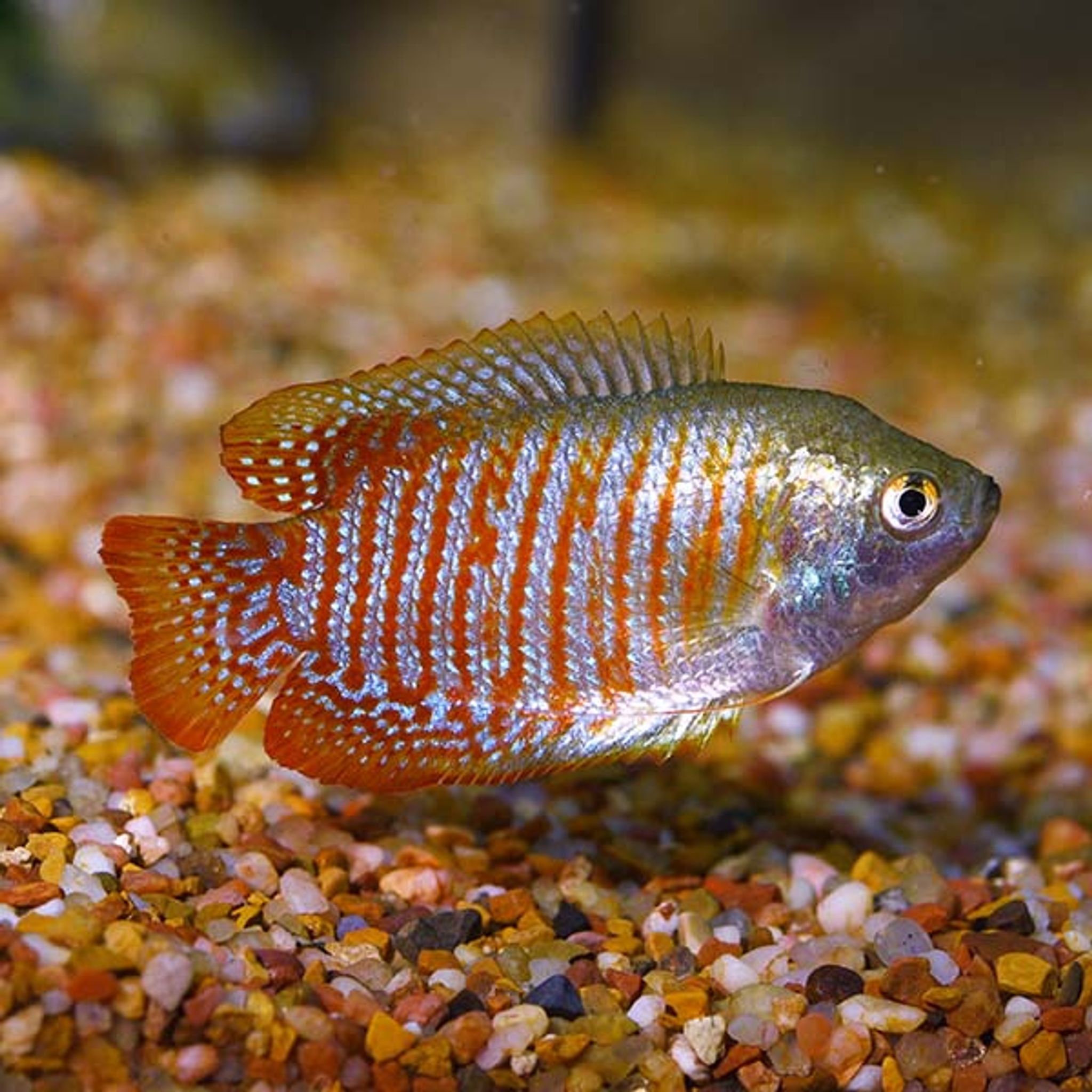

Dwarf Gourami Care Guide: Tank Size, Diet, Water Parameters and Temperament
The dwarf gourami is one of the most colorful fish sold at US pet stores, but it also carries a well-documented disease risk that most impulse buyers never hear about. This guide covers the tank size, diet, water parameters and temperament you actually need to know, plus how to buy a healthy fish in the first place.
Species Snapshot
The dwarf gourami (Trichogaster lalius, formerly classified as Colisa lalia) is a labyrinth fish in the family Osphronemidae, the same family that includes bettas and paradise fish. In the wild, it lives in slow, weedy, warm, often low-oxygen waters across India, Bangladesh and Pakistan — drainage ditches, rice paddies and shallow ponds.
| Trait | Detail |
|---|---|
| Adult size (male) | About 3 in (7.6 cm), occasionally to 3.5 in |
| Adult size (female) | About 2–2.5 in (5–6.4 cm) |
| Store size | Often under 2 in (5 cm) |
| Minimum tank | 10 gal (38 L) for one male |
| Recommended tank for pairs/community | 20 gal (76 L) or more |
| Temperature | 72–82°F (22–28°C); target 76–80°F (24–27°C) |
| pH | 6.0–7.5, tolerates up to about 8 |
| Lifespan | 2–4 years typical; 4–6 years possible with clean genetics and top care |
Tank Size and Setup
A single male does fine in a 10-gallon (38 L) tank as a long-term minimum. If you want a male with females, or a small peaceful community, step up to 20 gallons (76 L) or larger. Dwarf gouramis are surface-oriented labyrinth fish, so a long, shallow footprint beats a tall, narrow one — more surface area matters more than depth.
Stocking by tank size:
| Tank size | Reasonable stocking |
|---|---|
| 10 gal (38 L) | One male only, as a centerpiece |
| 20 gal (76 L) | One male with 2–3 females, or one male plus a light school of small tetras |
| 29 gal (110 L) | One male with females plus corydoras or kuhli loaches and a small schooling species |
Always run a lid on the tank. Labyrinth fish breathe atmospheric air through an organ above the gills, so they surface regularly to gulp air. Leave a small air gap between the water and the lid, and try to keep the room air close to the water temperature — cold air pulled in with each breath can chill the fish and irritate the labyrinth organ.
Aquascape
Dwarf gouramis are naturally shy and color up best in a densely planted tank:
- Floating plants such as red root floaters, frogbit or water sprite covering part of the surface — this calms skittish fish and gives the male nest-building material.
- Driftwood and a dark substrate to set off their color.
- Dim to moderate lighting rather than bright, open water.
- Gentle flow only — a sponge filter or a baffled hang-on-back filter. A strong current stresses these fish, which evolved in still, weedy water.
Aquarists sourcing plants and gentle-flow filtration for this kind of setup can browse Freshwater Livestock and Filters on FishyHub.
Water Parameters
| Parameter | Target range |
|---|---|
| Temperature | 76–80°F (24–27°C) for general keeping; 80–82°F (27–28°C) for spawning |
| pH | 6.5–7.5 is a safe target; tolerates 6.0–8.0 |
| GH | Roughly 4–15 dGH |
| KH | Roughly 3–8 dKH |
| Ammonia | 0 ppm |
| Nitrite | 0 ppm |
| Nitrate | Under 20 ppm, ideally 10 ppm or less |
Stability matters more than hitting an exact number. Sources vary on pH (some say a narrow 6.5–7.0, others 6–8) and temperature (some quote 68–79°F, breeding guides run up to 86°F). Splitting the difference: keep them at 76–80°F day to day, and only push toward 80–82°F when deliberately conditioning a pair to spawn. A steady heater is required in nearly every US home — even a warm-climate house sees enough overnight swing to stress the fish.
Maintenance: change 20–30% of the water weekly, vacuum the substrate, and test water regularly. Because dwarf gourami disease is widespread in farmed stock, clean and stable water is one of the few things you actually control to reduce outbreak risk.
Seasonal note for US keepers: winter heating can dry out a room and let tank temperature drift down when a heater underperforms, while summer heat waves can push an unheated tank above 86°F. Check the thermometer more often at both extremes.
Diet and Feeding
Dwarf gouramis are omnivores that feed mid-water and at the surface. Build the diet around:
- A quality flake or small floating pellet as the base (betta pellets work well given the similar mouth size).
- Frozen or live bloodworms, brine shrimp and daphnia 2–3 times a week for protein.
- Plant matter such as spirulina flake or blanched vegetables for fiber.
Feed small portions once or twice a day, only what the fish clean up in about 2 minutes — shorter than the 3–5 minutes sometimes quoted, because these fish are greedy and will keep eating past fullness, and slower tankmates get outcompeted if you overfeed. Fast the fish one day a week to prevent bloat, which is a common and preventable problem in this species.
Temperament and Aggression
Temperament is genuinely inconsistent across the species — some individuals are timid pushovers, others are territorial bullies, and both descriptions are accurate depending on the fish, its sex, and its tank. In general:
- They're usually peaceful toward unrelated species.
- Males are territorial toward other males and toward any fish that looks similar or shares bright coloring.
- Keep one male per tank unless the tank is large (20+ gal) and heavily planted with visual breaks.
What triggers aggression:
- Two males in a small tank
- Cramped quarters with no cover
- Look-alike or brightly colored tankmates
- Active spawning (a nesting male gets territorial)
Fixes: add more plants and hardscape as visual barriers, upsize the tank, rehome the aggressor, or use a tank divider if you must house two males temporarily.
Sexing
| Trait | Male | Female |
|---|---|---|
| Color | Bright, red-and-blue barring or solid color | Silvery-gray with faint bars |
| Dorsal fin | Pointed | Rounded |
Most stock at chain stores skews heavily male since females are less commercially attractive, so finding a true pair can take some searching.
Tank Mates
Good matches: small peaceful schooling fish such as neon, ember or cardinal tetras and harlequin rasboras, plus corydoras, kuhli loaches, cherry barbs, platies, otocinclus and nerite snails.
Avoid: bettas and other gourami species (same labyrinth-fish conflict), fin nippers like tiger barbs, large cichlids, and angelfish (risky). Adult amano shrimp are about the only shrimp with decent odds — dwarf gouramis hunt shrimplets and fry, and small snails aren't fully safe either.
Labyrinth Fish Basics
Dwarf gouramis belong to the anabantid group, fish with a labyrinth organ that lets them breathe air directly from the surface. This is why they tolerate the low-oxygen water of their native habitat and why they need that air gap under the aquarium lid. It's also why they clash with bettas — both are anabantids with the same territorial instincts and the same need for surface access, so housing them together almost always ends in fighting.
Gourami Family Comparison
"Gourami" covers a wide size and temperament range. Before buying, it helps to see the dwarf gourami next to its relatives:
| Species | Adult size | Minimum tank | Temperament |
|---|---|---|---|
| Dwarf gourami | ~3 in (7.6 cm) | 10 gal (38 L) | Variable; male territorial |
| Honey gourami | ~2 in (5 cm) | 10 gal (38 L) | Most peaceful of the group |
| Pearl / moonlight gourami | ~5 in (12.7 cm) | 30 gal (114 L) | Generally calm |
| Blue / three-spot gourami | ~5–6 in (12.7–15 cm) | 30+ gal (114+ L) | Can be mean |
| Kissing gourami | 8–12 in (20–30 cm) | 55+ gal (208+ L) | Variable, can bully |
| Paradise fish | ~3–4 in (7.6–10 cm) | 10–20 gal (38–76 L) | Aggressive; cold-tolerant |
| Giant gourami | 18–24 in (46–61 cm) | 200+ gal (757+ L) | Large-tank species only |
If disease risk is a major worry (see below), the honey gourami is worth a look — it's smaller, generally hardier in trade, and considered the most peaceful of this whole family, making it a reasonable low-risk alternative for the same care level.
A Note on Powder Blue Gourami
The powder blue (or neon blue) gourami isn't a separate species — it's a color morph of the same Trichogaster lalius. Care requirements are identical to any other dwarf gourami, but heavily line-bred color morphs, powder blue included, are widely considered more disease-prone than wild-type coloring.
Health: Dwarf Gourami Iridovirus (DGIV)
This is the issue every buyer should understand before purchasing. Dwarf gourami iridovirus is widespread in farmed stock, highly contagious, and currently incurable. Studies looking at imported fish have found it in a substantial share of the animals tested.
Signs to watch for:
- Loss of color
- Lethargy
- Refusing food
- Bloating
- Lesions or sores
- Hiding more than usual
If a fish is confirmed to have DGIV, the responsible course is humane euthanasia (clove oil overdose is a commonly used method) rather than treatment, since there is no cure. Never share nets, siphons or other equipment between an infected tank and any other tank.
Other Common Diseases
Ich, fin rot, columnaris (a cottony-looking growth, sometimes confused with fungus), true fungal infections, swim bladder disorders and general bacterial infections all show up in this species — and, as with bettas, nearly all of them trace back to poor water quality or chronic stress rather than bad luck. A basic hospital tank (bare-bottom, sponge filter, its own heater) makes it far easier to treat any of these without risking the main display.
If your gourami is lying at the bottom or acting lethargic: test the water first. The likely causes, in rough order, are poor water quality, a temperature that's too low, DGIV, swim bladder trouble, or general stress — ruling out water quality first saves time.
If color is fading: check for bullying, stress or a water quality problem before anything else. If fading comes with weight loss or visible sores, treat it as a possible DGIV case and isolate the fish.
Buying and Quarantine Checklist
Because DGIV is a trade-wide issue rather than a one-store problem, how you buy matters as much as how you keep the fish.
At the store:
- Choose a fish that is alert, actively swimming, and colorful — not hiding in a corner.
- Check that the fish is actively eating if food is offered.
- Look for no dead or visibly sick fish in the same system.
- Ask staff how long the fish has been in stock and, if possible, where it was sourced from — a longer observed stay in-store is a mild reassurance, though not a guarantee.
After purchase:
- Quarantine every new fish for 3–4 weeks in a separate tank before adding it to your display.
- Watch closely for the DGIV signs above during this window.
- Keep separate equipment (net, siphon) for the quarantine tank.
Breeding and Bubble Nests
Seeing a male build a floating cluster of bubbles is normal — it's a bubble nest, and it's a sign of a healthy, comfortable male, not a problem to fix.
Breeding setup: a separate tank with 6–8 in (15–20 cm) of water, held at 80–82°F (27–28°C), with floating plants and a tight-fitting lid to keep the air humid.
Spawning: condition the pair on live or frozen foods beforehand. The male builds the bubble nest from air bubbles and bits of plant material, then the pair embraces beneath it as eggs are released.
After spawning: remove the female — the male tends the nest alone and can turn aggressive toward her. Eggs hatch in about 24 hours, and fry become free-swimming in 2–3 days, at which point remove the male too.
Fry food: start with infusoria or vinegar eels, then move up to baby brine shrimp once the fry are large enough.
Common Mistakes to Avoid
- Putting two males in a 10-gallon tank
- Housing a dwarf gourami with a betta
- Buying a pale or hiding fish straight from the store tank
- Skipping quarantine
- Running a filter with strong output/flow
- Leaving the tank bare, so the fish hides or loses color
- Overfeeding, which leads to bloat
- Keeping the tank unheated
- Adding fish to a tank that hasn't finished cycling
- Adding a dwarf gourami to an established shrimp colony
Frequently Asked Questions
Can a dwarf gourami live in a 5-gallon tank?
Not recommended. A 10-gallon (38 L) tank is the minimum for a single male, and anything smaller doesn't give it enough stable water volume or surface area.
Can I keep two dwarf gouramis?
Keep only one male in a small tank, since two males will fight. A male with females, or a small group, needs 20 gallons (76 L) or more and heavy planting to break up sightlines.
Can they live with bettas?
No. Both are territorial labyrinth fish with overlapping needs and near-identical aggression triggers, so housing them together almost always leads to fighting.
Are dwarf gouramis good for beginners?
The water-parameter side is genuinely easy — they tolerate a wide range. The real challenge is disease risk from farmed store stock, which makes careful selection and quarantine more important than for most beginner fish.
How can you tell male from female?
Males are brighter, often with red-and-blue barring or solid color, and have a pointed dorsal fin. Females are silvery-gray with faint barring and a rounded dorsal fin.
Why is my gourami building bubbles at the surface?
That's a bubble nest, built by a male preparing to spawn. It's a normal behavior and generally a sign the fish is healthy and comfortable in its environment.
Do dwarf gouramis eat shrimp or snails?
They will take shrimplets and small snails, so a breeding shrimp colony isn't a safe tankmate setup. Adult amano shrimp are usually large enough to be left alone.
How long do dwarf gouramis live?
Typically 2–4 years, though fish from clean bloodlines with excellent care can reach 4–6 years.
Is dwarf gourami disease curable?
No, DGIV has no cure once a fish is infected. The only real defenses are careful buying, a full quarantine period, and prevention rather than treatment.
Ready to start a setup of your own? Browse available gourami stock in the Gourami category on FishyHub, along with community-friendly species suited to a planted dwarf gourami tank.


