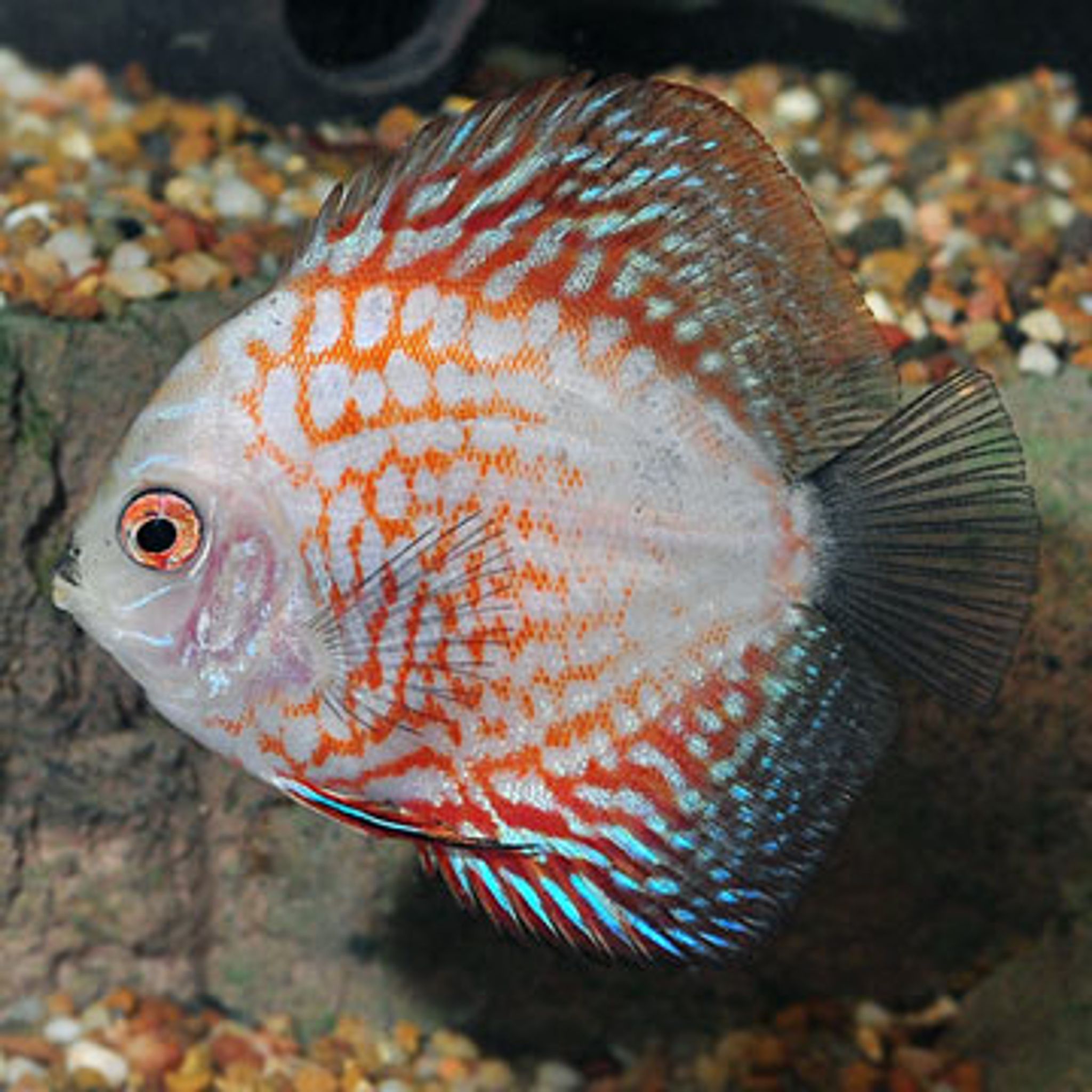

Discus Care Guide: Tank Size, Diet, Water Parameters and Temperament
Discus have a reputation for being fragile, but the reality is simpler: they're demanding, not mysterious. Give them a big enough tank, steady warm water, and a disciplined feeding and water-change routine, and they're a manageable intermediate project rather than an unsolvable puzzle. This guide covers the real numbers — gallons, degrees, and pH — along with diet, tankmates, and the mistakes that sink most first attempts.
What Is a Discus?
Discus belong to the genus Symphysodon, South American cichlids native to slow-moving, warm, soft, acidic tributaries of the Amazon basin, often thick with fallen wood and submerged roots. Wild populations are sometimes split into three or four species, but nearly everything sold to hobbyists in the US is captive-bred and selectively colored.
Their body shape is the giveaway: flat, round, and disc-like (hence the name), which is also why they need taller tanks than most fish their length. In home aquariums, discus commonly reach 5–6 inches (13–15 cm), with well-grown adults hitting 7–8 inches (18–20 cm) across and nearly as tall. With good care, they typically live 10–15 years.
Tank Size and Setup
Because discus are tall-bodied and social, tank height and floor space both matter more than they do for typical community fish.
- Tank height: aim for at least 18–24 inches (46–61 cm) tall so adults have room to turn and display naturally.
- Minimum size: 55 gallons (208 L) is a reasonable floor for a small group of adults. It is not a comfortable long-term home for six full-grown fish.
- Recommended size: 75 gallons (284 L) or larger is the common recommendation for 5–6 adult discus.
- Rough stocking rule: budget about 10 gallons per adult discus. A 125-gallon (473 L) tank comfortably holds around 12.
| Tank size | Suggested adult discus | Notes |
|---|---|---|
| 55 gal (208 L) | 4–5 | Workable floor, not ideal for a full group |
| 75 gal (284 L) | 5–6 | Common sweet spot for a starter group |
| 125 gal (473 L) | ~12 | Good for growing out juveniles or a larger community |
Sources vary widely on the true minimum — some cite 25 gallons, others 50–55, and others 75. Very small figures only make sense for a single fish or an established breeding pair, not a group. For anyone starting out, treat 55 gallons as the absolute floor and plan for 75-plus if you want the full social benefit of a group.
Bare Bottom vs. Planted
Bare-bottom tanks are the standard in breeding and grow-out setups because waste is easy to see and siphon, and the tank is simple to keep spotless. A planted setup is entirely doable with mature, healthy fish and heat-tolerant species — it just adds another layer of maintenance on top of an already demanding routine. Neither approach is required; it's a matter of priorities.
Water Parameters
Temperature
Discus need consistently warm water: 82–86°F (28–30°C), with many experienced keepers holding steady at 84–86°F. Stability matters more than hitting an exact number — a swing of more than about 2°F can stress the group. Use two heaters sized so that neither one alone could overheat the tank if it fails on, plus a separate thermometer or controller to catch drift early. This also protects you during a heater failure or power outage, since a backup unit keeps temperature from crashing while you sort out the problem.
pH and Hardness
This is where discus keeping gets oversimplified. Captive-bred discus, which make up the vast majority of what's sold in the US, do fine across a pH range of 6.0–7.5. The goal is stability, not chasing a "perfect" number — swinging pH with chemical additives causes far more stress than a steady pH that's slightly off the textbook ideal.
Wild-caught fish and dedicated breeding stock are a different story: they need genuinely soft, acidic water, typically pH 5.0–6.5 with general hardness of 1–4 °dGH and carbonate hardness of 1–4 °dKH. If you're keeping standard captive-bred discus for a display tank, don't try to replicate these breeding-tank conditions — it adds risk without benefit.
Nitrogen and Water Changes
Keep ammonia and nitrite at 0 ppm at all times. Nitrate should stay under 20 ppm in a bare tank and under 40 ppm in a planted one — lower is always better for discus.
Water changes are the backbone of discus keeping, more so than for most freshwater fish:
- 30–50% once or twice a week, or
- Smaller daily changes (around 10%) for those who prefer a steadier routine.
Both approaches work — what matters is consistency and matching the new water's temperature and chemistry closely to what's already in the tank. A sudden shift in either can shock the fish. Many keepers age or pre-treat water in a barrel ahead of time, blending in RO water if their tap supply runs hard, so a change is just pumping in water that's already the right temperature and chemistry.
Filtration
Discus want gentle water flow with strong biological filtration — canister filters are the common choice for display tanks, while sponge filters are standard in bare-bottom grow-out and breeding tanks. Because warm water holds less dissolved oxygen than cooler water, add extra surface agitation or an air stone regardless of which filter you run.
Feeding Discus
Discus are best treated as mostly carnivorous with some plant matter in the mix, not strict omnivores. Their gut is short, so smaller, more frequent meals digest better than one or two large feedings:
- Adults: 2–3 small meals a day, only what they clear in a few minutes.
- Juveniles: 3–5 meals a day to support steady growth and prevent stunting.
Good staples include discus-specific granules or pellets, frozen bloodworms, brine shrimp, blackworms, and beef-heart-based mixes. Beef heart and similar rich foods should be fed sparingly — they foul water quickly if overfed, and leftover food should always be siphoned out promptly. You can browse discus-appropriate foods and frozen options through FishyHub's Food & Supplements category.
Temperament and Tankmates
Discus are peaceful, shy, and slow eaters — they're easily outcompeted for food by faster fish. Within their own group, expect some pecking-order squabbling as a hierarchy forms; this is normal and usually settles once the group is established. Keep the tank away from heavy foot traffic and avoid tapping the glass, since both spook them.
How Many Discus to Keep
Group size has a real effect on stress levels:
- One fish can do fine kept alone, though it misses the social dynamic.
- Two or three fish is the worst arrangement — small numbers tend to bully and stress each other.
- Five to six or more is the recommendation, since a larger group spreads out aggression instead of concentrating it on one or two individuals.
Good and Bad Tankmates
Suitable companions are calm, heat-tolerant fish that won't outcompete discus at feeding time:
- Cardinal tetras and rummynose tetras
- Sterbai corydoras (heat-tolerant among corydoras)
- Bristlenose plecos
- Some dwarf cichlids, such as rams
Cardinal tetras handle the warmer end of the discus range better than neon tetras, which are only marginal at 84–86°F. You'll find both in FishyHub's tetra selection and heat-tolerant corydoras.
Avoid barbs, fin-nippers, and fast, competitive feeders that outrace discus to food. Angelfish are frequently listed as compatible tankmates, but they compete aggressively at feeding time and can carry diseases that affect discus — most experienced keepers advise against the combination.
Discus vs. Oscars
Discus and oscars are not compatible tankmates. Oscars grow large, feed aggressively, produce heavy waste, and prefer noticeably cooler water than discus need. A tank sized for roughly a dozen discus would instead suit a single oscar — the choice comes down to how much daily maintenance you want versus which fish's personality you'd rather keep.
A Planted or Blackwater Amazon Biotope
For a more natural-looking setup, heat-tolerant plants that handle discus temperatures include anubias, java fern, Amazon swords, crypts (especially wendtii), vallisneria, dwarf sagittaria, water sprite, and bacopa. Tall driftwood placed toward the back breaks up sightlines and gives shy fish visual cover, while leaving roughly 40% of the substrate open keeps the layout from feeling cramped. Watch for leaf litter rotting faster than usual in the heat, and remove it before it fouls the water.
Some keepers add tannins with plain, unflavored rooibos tea (roughly one bag per 10–20 gallons, steeped and added gradually) or botanicals like catappa leaves for a blackwater look. This is a cosmetic and comfort add-on that softens the water's appearance slightly and can have a mild acidifying effect — it is not a substitute for actual pH management.
Buying Discus
Look for alert, round-bodied fish with a full forehead, clear eyes, and no dark blotching, sourced from a reputable breeder. Juveniles in the 2–4 inch (5–10 cm) range tend to settle into a new tank better than very young or very large fish. Skip the cheapest, visibly stunted stock — undersized discus often carry lasting health issues. Quarantine every new discus for 4–6 weeks before introducing it to an established tank, since even healthy-looking fish can carry parasites or bacterial issues that surface under stress.
A popular bred color strain worth knowing is the pigeon blood (or "blood pigeon") type — a red-orange fish with black "peppering" across the body. Fish with less peppering typically cost more. Because pale pigeon-strain parents are harder for fry to recognize as caregivers, breeders often foster their fry under a different pair.
Common Mistakes to Avoid
- Adding discus to an uncycled or brand-new tank.
- Keeping the tank too cool (under 82°F) to accommodate community fish.
- Chasing a specific pH with chemical additives, which causes damaging swings.
- Overfeeding beef heart or rich foods and skipping siphoning afterward.
- Keeping only two or three discus, or mixing very different sizes together.
- Skipping quarantine on new arrivals.
- Letting water changes bring in water that's noticeably different in temperature or chemistry from the tank.
Reading Stress Signals
Dark body color, clamped fins, hiding, refusing food, or white stringy feces are all signs something is wrong. Start by testing water parameters and confirming temperature is at target; add cover and space if a dominant tankmate is the likely cause; and isolate and treat if illness seems more likely than an environmental issue.
Health Issues to Watch For
- Hole-in-the-head disease (HITH): linked to Hexamita along with nutrition and water-quality problems; shows as pits on the head. Treat with metronidazole alongside improved water quality and diet.
- Gill flukes: treated with praziquantel or formalin.
- Ich and velvet: respond to a combination of raised heat and appropriate medication.
- Internal flagellates: often show up as white, stringy feces.
- Bacterial infections: vary in presentation; water quality is usually a contributing factor.
- "Discus plague": a general term for fish that darken, clamp their fins, and hide in a corner — treat it as a signal to test water immediately and isolate the affected fish.
Swimming sideways or lying flat on the substrate is usually related to swim-bladder trouble from constipation or overfeeding, though severe stress or poor water quality can also cause it. Try fasting the fish for 1–2 days, double-check parameters, and consider an Epsom salt bath for suspected constipation; treat internally if bloating is present.
Breeding Basics
Discus form pairs naturally within a group — buy a batch of juveniles and let two fish split off to feed and shelter together as they mature. Eggs are laid on a vertical surface, often a breeding cone, and both parents fan them. Eggs hatch in about 2–3 days, with fry becoming free-swimming a few days after that.
The standout fact of discus breeding: fry feed on mucus secreted from the parents' flanks for roughly 2–3 weeks before moving on to other foods. A dedicated breeding tank of 30–40 gallons (114–151 L) with soft, acidic water suits pairs best. Watch for egg-eating, two females mistakenly pairing up, and one partner becoming aggressive toward the other — all are common hiccups in a breeding setup.
Are Discus Good for Beginners?
Discus sit at an intermediate-to-advanced difficulty level, but a disciplined beginner can succeed. The prerequisites are non-negotiable: a fully cycled, oversized tank; a strict water-change schedule you'll actually stick to; stable heating with backup; and starting with captive-bred, already-grown stock rather than fragile juveniles. Skip any one of these and the odds shift sharply against you.
If you're ready to start building the system, FishyHub's Discus category is a good place to see what's currently available, and the Filters category covers canister and sponge options suited to the gentle, high-capacity filtration discus need.
Frequently Asked Questions
How many discus can I keep in a 55 or 75 gallon tank?
A 55-gallon tank comfortably supports around 5 adult discus, while a 75-gallon tank can support 6–8, depending on tankmates and how heavily planted or decorated the tank is.
Can discus live in regular tap water?
Yes, in most cases, as long as the water is properly dechlorinated, kept stable, and moderately soft for captive-bred fish. Wild-caught or breeding stock need much softer, more acidic conditions than typical tap water provides.
Can discus live with angelfish or neon tetras?
Neon tetras are only marginal tankmates at discus temperatures, so cardinal tetras are a better choice. Angelfish are generally not recommended, since they compete aggressively for food and can carry diseases that affect discus.
How often should I feed discus?
Adults do best on 2–3 small meals a day, feeding only what they finish within a few minutes. Juveniles need more frequent feeding, around 3–5 times a day, to support steady growth.
Why is my discus turning dark?
Dark coloring is a stress signal that can point to bullying, poor water quality, incorrect temperature, or illness. Test your water parameters and temperature first, then look at tankmate dynamics if the water checks out fine.
How long do discus live?
With good care — stable warm water, a consistent water-change schedule, and a varied diet — discus typically live 10 to 15 years.


