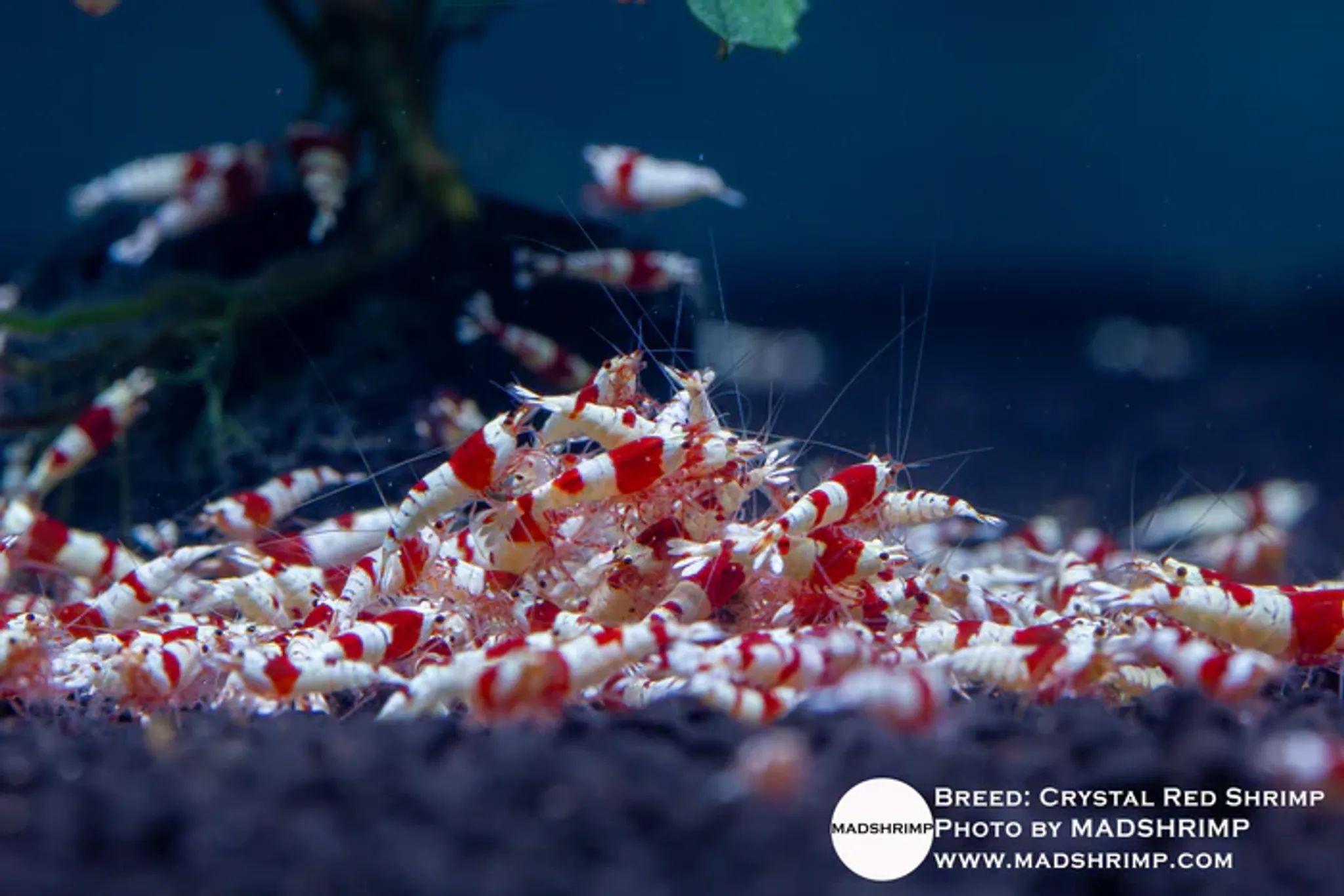

Crystal Red Shrimp Problems: Common Causes of Stress, Death and Poor Growth
Crystal Red Shrimp (CRS) dying one at a time, stalling at a certain size, or vanishing without a trace is rarely random — it almost always traces back to water chemistry instability, a hidden toxin, or a husbandry habit borrowed from a much hardier shrimp. This guide walks through the actual causes symptom by symptom so you can figure out what's going wrong tonight, not just what "good care" looks like in theory.
Why CRS Are More Fragile Than Other Shrimp
Crystal Red Shrimp are a selectively bred color form of Caridina cantonensis, developed from a very small number of original wild-caught individuals. That narrow genetic base means the strain carries less natural resilience than most aquarium shrimp, and it shows in how little room for error CRS give you compared to something like a cherry shrimp.
A few consequences worth understanding before troubleshooting anything else:
- Higher grades are often less hardy. Shrimp bred for a higher percentage of white coloration tend to be more inbred and more sensitive than lower-grade, more solid-red animals.
- "It worked for my cherry shrimp" is a trap. Neocaridina (cherry, blue dream, and similar shrimp) tolerate a wide swing in pH, hardness, and temperature. Caridina cantonensis strains like CRS do not, and advice built around Neocaridina's tolerance range will actively hurt a CRS colony.
- Stability is the priority, not a specific number. A tank sitting slightly outside the "ideal" range but holding steady day to day usually outperforms a tank that's technically closer to target but drifting or swinging.
Target Water Parameters for Crystal Red Shrimp
| Parameter | Target range | Notes |
|---|---|---|
| Temperature | 72–75°F (22–24°C) | Cooler end preferred; above ~76°F speeds metabolism, shortens lifespan, and lowers shrimplet survival |
| pH | 6.2–7.2 (optimal ~6.5–6.8) | Consistency matters more than hitting the exact number |
| GH | 4–6 dGH | Too low starves shell development; too high stresses the strain |
| KH | 0–2 dKH | Very low or near-zero carbonate hardness is normal and expected |
| TDS | 100–160 ppm | Many keepers target 140–160 ppm |
| Nitrate | Under 20 ppm | Keep as low as practical with regular water changes |
| Ammonia / Nitrite | 0 ppm, always | Any detectable reading is an emergency, not a "watch it" situation |
Sources disagree slightly on the exact ceiling for temperature — some allow up to 78–79°F, others insist on staying under 75°F. The safer approach is to treat 72–76°F as a workable range while recognizing that the cooler end extends lifespan and improves shrimplet survival, and that a stable 75°F beats a fluctuating 73–78°F swing.
Water Chemistry Mistakes That Cause Stress and Death
Substrate choice and cycling
A buffered, active soil substrate designed for shrimp is the standard for CRS because it holds pH low and stable and pulls KH toward zero on its own. New active substrate briefly leaches ammonia, so the tank needs to be cycled — and the substrate often rinsed or soaked beforehand — before any shrimp go in. Adding CRS to a freshly set-up, uncycled tank without established biofilm is one of the most common causes of mass die-offs in beginner setups; CRS belong in a mature tank, not a new one.
Tap water versus RO water
Tap water's pH, hardness, and treatment chemicals vary too much, and are frequently too high in GH/KH, for Caridina shrimp. The reliable standard is RO, RO-DI, or distilled water, remineralized with a shrimp-specific mineral supplement back up to the target GH and TDS, with dechlorinator dosed or the water aged to clear chlorine and chloramine.
Don't stop at testing the tank — test the tap water itself when troubleshooting. Some municipal supplies already carry background ammonia (released when dechlorinator breaks down chloramine) or measurable nitrate straight out of the faucet, which can mislead you into blaming the filter or substrate for a problem that's actually coming in with every water change.
If you're setting up a home RO or RO-DI unit for a shrimp tank, size it to your typical water-change volume, budget for periodic pre-filter and membrane changes, and plan for the waste-water ratio these units produce — none of it is complicated, but it does need a bit of storage and workflow planning before shrimp go in.
Water change technique
Crystal Red Shrimp tolerate small, frequent water changes far better than large ones. A workable baseline is 10–20% weekly, or that same volume split into two smaller changes. A single large-volume change is a common trigger for unwanted molting and molting-related deaths because it shifts temperature and TDS too fast. Match new water to the tank's existing temperature and TDS before adding it, and if TDS needs correcting, move it gradually over several changes rather than fixing it in one step. Base your frequency on what your nitrate and TDS readings actually show rather than a fixed calendar — a tank running clean might need less than weekly changes, while one drifting upward needs more.
High pH and pH crashes
High pH in a CRS tank usually comes from alkaline tap water, a calcareous or crushed-coral substrate (wrong choice for CRS, which need an inert or buffering-low substrate), or overfeeding and waste buildup raising the bioload. Correct it with RO water, driftwood and tannins, and steady maintenance — avoid chemical pH-down products, which tend to swing pH rather than hold it.
The opposite failure — a sudden pH crash — is common in mature shrimp tanks once buffered active substrate exhausts its capacity after months or years of use. The warning sign is a slow decline in KH and pH over successive tests, not a sudden event. Regular testing that tracks trends, not just single readings, is what lets you catch this before the substrate's buffer runs out and pH collapses.
Copper Toxicity: A Uniquely Lethal Threat
Shrimp use hemocyanin, a copper-based pigment, to carry oxygen in their blood — fish use iron-based hemoglobin instead. That biological difference is exactly why copper is so dangerous to shrimp: free copper ions disrupt the very molecule they depend on to breathe, and shrimp and other invertebrates lack the tolerance mechanism fish have for it. Even trace amounts that are safe in a fish medication or fertilizer dose can be lethal.
Common copper sources:
- Copper plumbing or copper in the tap water supply
- Copper-based fertilizers, dosed as if for a fish-only planted tank
- Copper-based medications, including many general "ich" or parasite treatments
- Plants treated with copper-based pesticides or snail killers before sale
Symptoms of copper poisoning: increased erratic movement, visible mucus on the gills, gill discoloration, lethargy, and — in a serious exposure — a mass die-off across the colony rather than a single shrimp.
Prevention: quarantine and rinse new plants before they go into a shrimp tank, use fertilizers labeled invert-safe and dose conservatively, avoid copper-based medications entirely in a shrimp tank, test tap water if copper is suspected, and use a metal-absorbing filter media as a safeguard if copper exposure is a concern.
Poor Growth and Stalled Molting
When shrimp stop growing or seem stuck at a size, it's rarely a disease. The usual suspects are:
- Insufficient calcium or GH for building new shell material
- Not enough food — biofilm, leaf litter that generates biofilm, algae wafers, or a quality shrimp-specific pellet
- Overcrowding or competition for food and space
- Chronic low-grade stress from parameters that drift or swing even within an "acceptable" range
Feeding cadence matters here directly: shrimp graze almost constantly on biofilm, so a bare tank with only occasional pellet feeding under-supplies growing shrimp even if water parameters look fine. Supplementing calcium and feeding a rotation of a gel food, blanched vegetables, and a mineral-rich shrimp pellet supports both shell development and reproduction. You can browse shrimp-specific foods and mineral supplements to build that rotation.
The white ring of death
A pale or white ring forming around a shrimp's body near the head is commonly linked to molting stress and often precedes death after a failed molt. It's tied to unstable water, low GH or calcium, or a temperature swing rather than a single specific disease. Molting is the single most vulnerable period in a shrimp's life — the exoskeleton must be fully shed and re-hardened, and any stress during that window (a sudden TDS shift, a chemical dose, low calcium) can leave the shrimp unable to finish molting. Seeing a white ring is a signal to check every parameter immediately, not to wait and see.
Vorticella and Other Stalked-Ciliate Infections
Vorticella is a stalked ciliate protozoan that attaches to a shrimp's shell, gills, or antennae, showing up as a fuzzy white or cottony coating. It's opportunistic — it flourishes when organic waste builds up in the substrate or filter and general water quality declines. Affected shrimp may swim erratically or upside-down, stop eating, and show generally elevated stress.
Vorticella itself is not usually the direct killer; it signals that tank hygiene has already slipped, and it adds one more stressor on top of whatever caused the outbreak. Treatment should escalate rather than jump straight to chemicals, since shrimp are highly sensitive to medication:
- First line: improve substrate and filter cleanliness, reduce organic waste, and add tannin-rich leaf litter or other botanicals with mild antimicrobial properties.
- Moderate cases: a brief, mild aquarium-salt dip on affected individuals.
- Severe or entrenched infestations: targeted anti-parasitic or anti-fungal treatment in a separate quarantine setup, kept away from the main colony.
Fixing the underlying water-quality problem resolves most mild cases on its own, which is why it belongs first regardless of how bad an individual infestation looks.
Shrimp Anatomy: What to Check When Diagnosing a Sick Shrimp
A few anatomy basics make troubleshooting faster:
- Gills, tucked under the carapace, are where you can spot early stress — discoloration or visible mucus there often shows up before other symptoms.
- The exoskeleton must be shed periodically for the shrimp to grow, and that molt is the single most vulnerable point in its life cycle for illness or death.
- Hemocyanin, the copper-based blood pigment, is why copper poisoning hits shrimp so much harder and faster than it hits fish.
When something looks off, check gill color and clarity first, note whether the shrimp is mid-molt or has a fresh shell, and treat any erratic or inverted swimming as a signal to test water immediately rather than waiting.
Dwarf Shrimp Biology: Caridina vs. Neocaridina
Most generic "shrimp care" advice online is written around Neocaridina — cherry shrimp and their color variants — which tolerate a wide pH, hardness, and temperature range and breed readily across a broad set of conditions. Caridina cantonensis strains, including CRS, need a narrower, more stable window and are noticeably less forgiving of swings. Mixing up the two care sheets is one of the most common reasons a new keeper's first CRS colony struggles even though "the same setup worked fine" for cherry shrimp previously. If you're building a mixed invertebrate tank, you can find shrimp livestock that spans both types, but treat their care requirements as genuinely different animals.
Other invertebrate tankmates
Snails and other freshwater invertebrates share the same core sensitivities as CRS — copper toxicity and a need for stable parameters — so a mixed-invert tank doesn't get a pass on any of the precautions above. Quarantine new invertebrates the same way you'd quarantine new plants, since parasites like vorticella can hitchhike in on snails or other shrimp just as easily as on decor.
Tankmates and Physical Hazards
Unexplained shrimp disappearances are often physical, not chemical:
- Predatory or overly active fish — even species marketed as "shrimp-safe" will pick off shrimplets or molting adults given the chance.
- Unguarded filter intakes — a sponge guard or pre-filter sponge is inexpensive insurance against a shrimp being pulled in.
- Overly strong flow — CRS are weak swimmers relative to the current in many filters, and constant strong flow is a chronic stressor even when it isn't directly lethal.
Water Testing Fundamentals for Shrimp Keepers
Test ammonia, nitrite, nitrate, GH, KH, pH, and TDS — every one of these, not just the two or three that seem most relevant when trouble appears. Options include liquid test kits (generally the most accurate for the shrimp-relevant range), test strips (fast but less precise, especially for GH/KH), and electronic meters for pH and TDS (convenient for frequent checks but need upkeep).
Test on a routine schedule — at least weekly for a new or unstable tank — rather than only when shrimp already look stressed. The value of routine testing is catching a slow trend, like KH declining month over month, before it becomes a crash. By the time visible symptoms appear, the underlying drift has often been building for weeks. You can browse water conditioners and test supplies alongside a buffered substrate suited to shrimp when setting up or restocking a tank.
Calibrating electronic testers
TDS and pH pens drift over time and will quietly give you a false reading that masks a real problem. Calibrate them periodically with a calibration solution, and replace a pH probe once its readings become inconsistent or slow to settle — a "fine" reading from a drifting meter is worse than no reading at all, because it delays you noticing an actual parameter shift.
Troubleshooting Checklist
Run through this the next time something looks wrong:
- Test ammonia and nitrite first — either above zero is an emergency.
- Test the tap water source itself, not just the tank, for ammonia and nitrate.
- Check GH, KH, pH, and TDS against target ranges and compare to your last few readings for a trend, not just a single number.
- Confirm temperature is in the 72–75°F range and hasn't spiked.
- Rule out copper: any new plants, fertilizers, or medications added recently?
- Inspect gills and shell for discoloration, mucus, or a white ring near the head.
- Look for fuzzy white growth (vorticella) on shell, gills, or antennae.
- Review recent water changes — was any single change unusually large or mismatched in temperature/TDS?
- Check substrate age against expected buffering lifespan if pH has been declining slowly.
- Confirm feeding is adequate (biofilm, gel food, mineral-rich pellets) if growth has stalled rather than shrimp dying outright.
Frequently Asked Questions
Why do my crystal red shrimp keep dying for no visible reason?
It's usually accumulated stress from unstable parameters, a hidden toxin like copper, or a failed molt rather than one dramatic cause. Start by testing ammonia, nitrite, GH, KH, pH, and TDS — including the tap water itself — before assuming disease.
What is the ideal pH and temperature for crystal red shrimp?
Target pH around 6.5–6.8, acceptable between 6.2 and 7.2, with temperature at 72–75°F (22–24°C). Stability day to day matters more than hitting an exact number.
Can I use tap water for crystal red shrimp?
Generally not recommended without treatment and testing. RO or RO-DI water remineralized with a shrimp-specific mineral supplement is the reliable standard, especially where tap water GH/KH runs high or chloramine and nitrate levels are unknown.
What does a white ring around my shrimp mean?
It's associated with molting stress or failure, often tied to unstable water or insufficient calcium, and frequently precedes death. Treat it as a signal to check every parameter immediately rather than waiting to see if the shrimp recovers.
How do I get rid of vorticella on my shrimp?
Improve substrate and filter cleanliness and overall water quality first — this resolves most mild cases on its own — and add tannin-rich botanicals to help. Reserve targeted quarantine treatments for severe or entrenched infestations, since shrimp are highly sensitive to medication.
Why is my shrimp population not growing or breeding?
Check calcium and GH levels, confirm temperature is on the cooler end of the range (which favors reproduction), and make sure food and biofilm are adequate. Also confirm the tank is mature enough — a young tank without established biofilm rarely supports strong shrimplet survival.
Is copper dangerous even in trace amounts?
Yes. Shrimp rely on a copper-based blood pigment but are extremely sensitive to free copper ions, so doses considered safe in fish medications or fertilizers can still be lethal to an entire colony.
How often should I test my shrimp tank's water?
Test regularly — at least weekly for a new or unstable tank — for ammonia, nitrite, nitrate, GH, KH, pH, and TDS, not only when shrimp look stressed. Catching a slow trend, like declining KH, is what lets you prevent a crash instead of reacting to one.
Getting Crystal Red Shrimp stable comes down to consistent water chemistry, a suitable substrate, and ruling out copper before anything else. You can browse Crystal Red Shrimp and other Caridina livestock on FishyHub to find animals suited to a properly cycled, stable setup.


