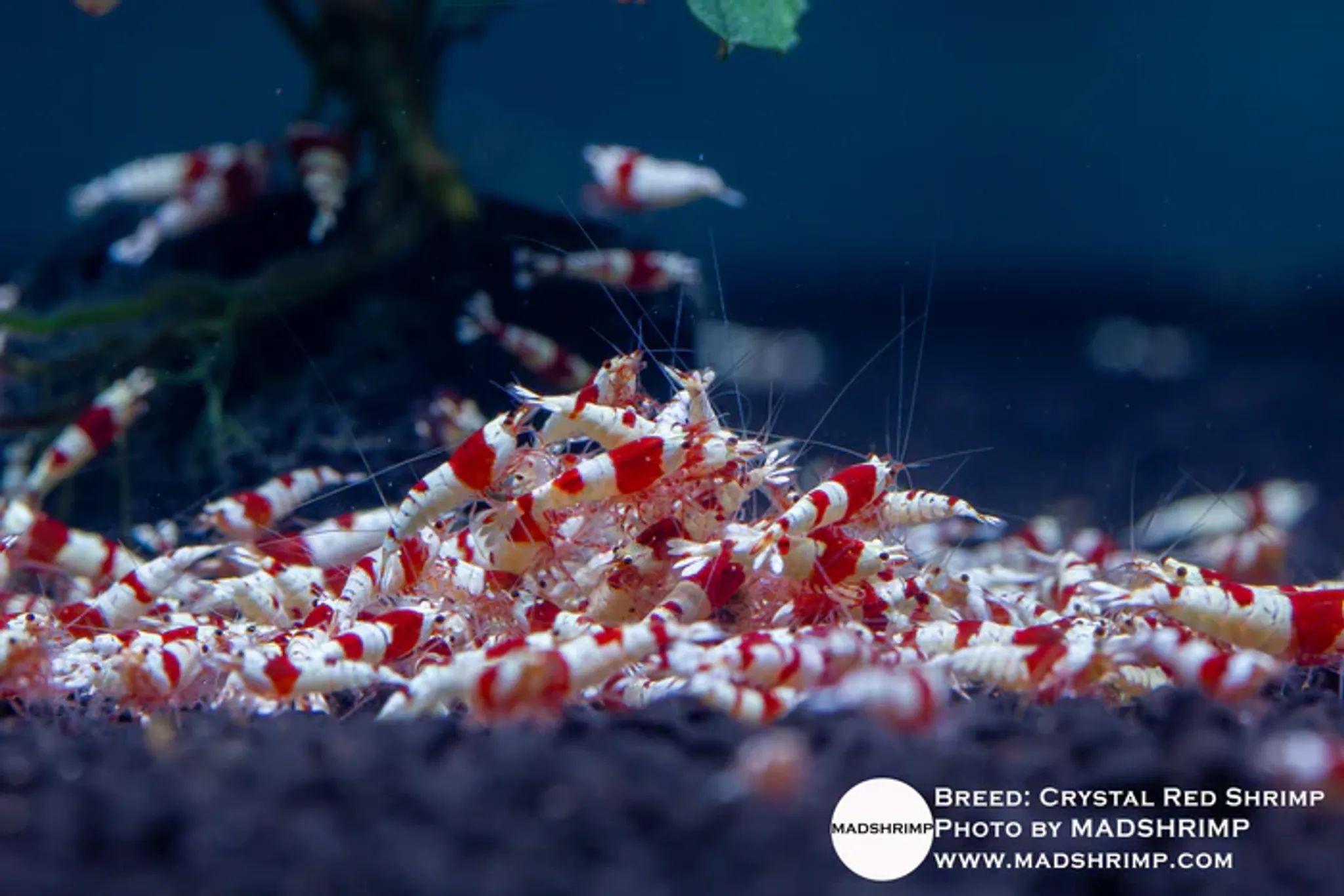

Crystal Red Shrimp Care Guide: Setup, Feeding, Water Parameters and Breeding
Crystal Red Shrimp (CRS) are rewarding to keep but genuinely more sensitive to water chemistry than most freshwater fish, which is why so much conflicting advice circulates about temperature and hardness. This guide gives you one confident set of numbers for setup, feeding, and breeding, written specifically for hobbyists working from typical US municipal tap water.
What Are Crystal Red Shrimp?
Crystal Red Shrimp are a selectively bred color morph of Bee Shrimp (Caridina cantonensis), first isolated from a batch of black Bee Shrimp in Japan in the early-to-mid 1990s. Breeders selected for the striking red-and-white banding that gives the variety its name, and that same lineage later produced Crystal Black Shrimp and higher-grade lines like Mosura and Panda.
Because they're a Caridina species rather than the hardier Neocaridina (cherry shrimp) group, CRS need more stable, lower-hardness water. That single fact drives almost every setup decision below.
Tank Setup
Tank Size
A 5-gallon (19 L) tank is technically workable, but 10 gallons (38 L) is the realistic minimum for a stable, forgiving colony. Larger water volumes buffer swings in temperature and chemistry far better than small tanks, which matters more for CRS than for most community fish.
Substrate
An active, buffering substrate (a shrimp-specific soil-type substrate) is the beginner-safe default. It naturally lowers pH and KH over time and adds biofilm surface area. Inert sand or fine gravel can work, but only if you're precisely remineralizing your water and testing regularly — it's less forgiving of mistakes.
| Substrate type | Best for | Trade-off |
|---|---|---|
| Active/buffering soil substrate | Beginners, most home setups | Needs replacing every 1–2 years as buffering capacity exhausts |
| Inert sand or gravel | Experienced keepers with a TDS/GH/KH meter | No margin for error on remineralization |
Filtration
A sponge filter is the standard recommendation: gentle flow, no intake risk to tiny shrimplets, and a huge surface area for beneficial bacteria and biofilm. Avoid power filters with exposed intakes — they can pull in shrimplets.
Planting and Decor
A heavily planted tank is strongly recommended. Java moss and other fine-leaved plants, driftwood, and leaf litter (such as almond leaves) all grow biofilm and give shrimp cover during molting and while carrying eggs. You can browse suitable plants and the shrimp themselves in FishyHub's shrimp category.
Cycling
The tank must complete a full nitrogen cycle — 0 ppm ammonia, 0 ppm nitrite — before any shrimp go in. CRS tolerate ammonia and nitrite spikes far worse than most fish, so patience here isn't optional.
Water Parameters
Numbers matter more for CRS than almost any other aquarium animal. Here's a single, consolidated target range instead of the scattered figures found across different sources.
| Parameter | Recommended target | Outer survivable range |
|---|---|---|
| Temperature | 70–76°F (21–24°C) | 62–78°F (17–26°C) |
| pH | 5.8–7.0 | — |
| GH (general hardness) | 4–6 dGH | — |
| KH (carbonate hardness) | 0–2 dKH | up to 4 dKH tolerable, higher risk |
| TDS | 140–160 ppm | — |
Temperature: Stability matters more than hitting an exact number. Warmer water in the mid-to-high 70s°F speeds up breeding but shortens lifespan; cooler, stable temperatures in the low-to-mid 70s favor longevity. Treat 62–78°F as outer survivable extremes, not a target range to aim for.
KH is the most contested number. Some sources say 0–1 dKH, others allow up to 4 dKH. Since CRS is a genuinely more KH-sensitive Caridina species (unlike Neocaridina, which tolerates higher KH), aim low — 0–2 dKH — and treat 3–4 dKH as tolerable but riskier, especially for a breeding colony.
Why RO/DI Water Matters
Most US municipal tap water is too hard or alkaline, and inconsistent batch-to-batch (chloramine levels, trace heavy metals, and mineral content all vary), for the precision CRS need. Reverse osmosis (RO) water has had nearly all dissolved minerals and contaminants stripped out. Adding a deionization (DI) stage polishes out the small amount of dissolved solids the RO membrane alone misses, giving you an essentially blank-slate water source. You then remineralize it with a shrimp-specific mineral supplement to hit your exact GH/KH/TDS targets — repeatably, every water change.
RO/DI isn't strictly mandatory, but it's strongly recommended in most US areas, because it turns water chemistry from a guessing game into a controlled, repeatable process.
Replacing RO/DI Filters
RO/DI systems use several stages, each with its own service life:
- Sediment and carbon pre-filters: typically swapped every 6–12 months, depending on tap water quality and usage.
- RO membrane: generally lasts 2–3 years.
- DI resin: replace based on performance, not the calendar — when a TDS meter reading after the DI stage starts creeping above 0–1 ppm, the resin is exhausted.
Test with a TDS meter rather than guessing on a fixed schedule; usage and local water quality both shift the real lifespan.
Tap Water Without RO/DI
If you don't have access to RO/DI equipment, blending in bottled spring water or leaning more heavily on an active buffering substrate can approximate suitable conditions as an entry point. It's a workable starting setup, but expect more variability and a harder time sustaining a large breeding colony long-term compared to a proper RO/DI setup.
Feeding
CRS are omnivorous scavengers and grazers. Their primary diet is biofilm — the microbial and algal film that naturally builds up on glass, hardscape, and plant surfaces — supplemented with:
- A small amount of shrimp-specific sinking pellets or powder food, once daily or every other day.
- Blanched vegetables (zucchini, spinach, broccoli) occasionally.
- Specialized powdered "first foods" for shrimplets, since juveniles can't tackle larger pellets.
Feed only what's fully cleared within 2–3 hours. Overfeeding, especially protein-heavy foods, fouls water quickly in a bioload this sensitive. You can find suitable foods in FishyHub's food and supplements category.
Biofilm and Powdered Biofilm Foods
Biofilm should be encouraged, not scrubbed away — it's the shrimp's staple food source. Leaf litter, mature hardscape, and patience during cycling all help it establish. Powdered biofilm-mimicking supplement foods are especially useful for shrimplets, since the fine powder disperses through the water column and reaches every juvenile instead of forcing them to compete over one pellet.
Molting
Regular molting is normal and a sign of healthy growth. Provide calcium and mineral supplementation and plenty of hiding spots, since shrimp are soft-shelled and vulnerable right after shedding. A pale, empty shrimp-shaped shell on the substrate is a discarded molt, not a dead shrimp — don't remove it in a panic; shrimp often eat their own molts for calcium.
Tankmates
CRS are best kept in a species-only tank. Other peaceful, similarly-sized dwarf shrimp can sometimes cohabit, but risk hybridizing and muddying color lines over generations. Avoid fish entirely if breeding is a goal — nearly all fish will eat shrimplets — and avoid any aggressive or large tankmates.
Breeding
No special trigger is needed beyond stable, correct parameters and good nutrition. Key facts:
- Sexing: females are larger and show a curved underside "saddle" or brood pouch when mature.
- Gestation: females carry fertilized eggs under the abdomen for about 30 days before releasing fully formed miniature shrimplets — there's no larval stage.
- Clutch size: up to roughly 20–30 shrimplets per clutch.
- Maturity: females typically reach breeding age around 4–5 months old.
- Temperature effect: upper-70s°F water speeds up the breeding cycle but reduces adult lifespan and can lower shrimplet survival; cooler, stable temperatures in the low-to-mid 70s favor gradual, sustainable population growth.
Once established, a healthy colony breeds continuously, with females able to carry a new clutch every several weeks.
Genetic Diversity
High-grade CRS lines are often heavily inbred for color and pattern. Occasionally introducing unrelated stock — even lower-grade — can improve colony vigor and hatch rates over time. It's also worth quarantining any new shrimp before adding them to an established colony, since CRS lines can be disease-prone and slow to recover from a setback.
Crystal Red Shrimp Grading
Grade is judged by the amount, clarity, and opacity of white banding relative to red, assessed once a shrimp is mature — juveniles can't be reliably graded until their pattern fills in. Common tiers run roughly:
| Grade | Appearance |
|---|---|
| C | Mostly translucent red, minimal white |
| B | Some white banding, uneven |
| A | Solid, clean red-and-white bands |
| S / SS / SSS | Increasing white coverage and clarity |
| Mosura-tier | Mostly solid white body with red patches |
Higher grades command higher prices because consistent, high-white pattern is harder to breed true and takes longer to select for.
Crystal Black Shrimp and Other Bee Shrimp Variants
Crystal Black Shrimp are the same species and genetics as CRS, just black-and-white instead of red-and-white. Care requirements are identical. Keepers sometimes cross or house them together, but mixing color lines over generations can muddy both.
Both varieties are cultivated forms of the wild Bee Shrimp. Selective breeding for solid, high-contrast banding created the "Crystal" lines, and further selection built the higher grades like Mosura and Panda. Tiger Shrimp are another popular Caridina dwarf shrimp worth considering alongside or instead of CRS — they share the same low-KH, stable-water requirements but display a distinct striped pattern instead of banding.
Interest in rare, high-grade bee shrimp color morphs has grown into something of a specialty niche within the freshwater hobby, with breeders continuing to refine pattern and opacity across new generations.
Understanding Aquarium KH
KH (carbonate hardness) measures a water's buffering capacity — essentially its concentration of bicarbonate and carbonate ions — and is distinct from GH (general hardness), which measures dissolved calcium and magnesium. KH matters because it resists pH swings: low KH means pH can drift more easily, which is exactly why CRS keepers deliberately keep KH low rather than treating that instability as a problem to fix. Test KH with a liquid or digital test kit, and adjust it through your RO/DI remineralization recipe rather than by dosing buffers directly into an established tank.
Common Mistakes to Avoid
- Using untreated or unremineralized tap water, causing hardness and pH swings that trigger mass die-offs.
- Adding shrimp to a newly cycled tank before a mature biofilm layer has developed.
- Overfeeding, especially protein-heavy foods, which crashes water quality fast.
- Using copper-based medications, fertilizers, or algae treatments — copper is highly toxic to shrimp even at trace levels safe for fish.
- Keeping CRS with fish that pick off shrimplets, so the colony never actually grows despite visible breeding activity.
- Skipping slow drip acclimation for new shrimp — sudden parameter shifts during transport are a leading cause of early losses.
- Relying only on a thermometer and skipping TDS/GH/KH testing, which defeats the purpose of a precision setup.
- Disturbing or removing a discarded molt, mistaking it for a dead shrimp.
Tools You Actually Need
At minimum: a TDS meter (checks total dissolved solids after remineralization and RO/DI filter performance), a liquid or digital GH/KH test kit, and a reliable aquarium thermometer. These three let you verify every parameter in the table above instead of guessing.
Frequently Asked Questions
What is the ideal water temperature for Crystal Red Shrimp?
Roughly 70–76°F (21–24°C). Staying cooler within that band favors longevity, while warmer temperatures toward the high end speed up breeding but shorten lifespan.
Do Crystal Red Shrimp need RO/DI water?
It's not strictly mandatory, but it's strongly recommended in most US tap-water areas because it lets you control GH, KH, and TDS precisely. Hard or alkaline tap water is one of the most common causes of failed CRS setups.
How often do Crystal Red Shrimp breed?
Continuously once mature and conditions are stable. Females can carry a new clutch every several weeks under good conditions, with each clutch taking about a month to hatch.
Can Crystal Red Shrimp live with fish?
Generally not recommended if breeding is the goal, since most fish will eat shrimplets. A dedicated species-only tank is the safest setup.
What's the difference between Crystal Red and Crystal Black Shrimp?
They're the same species with identical care requirements — the only difference is pigmentation, red-and-white versus black-and-white. Both descend from wild Bee Shrimp.
Why do my Crystal Red Shrimp keep dying?
Usually unstable or incorrect water chemistry — high KH, unstable pH, or ammonia/nitrite from an immature tank — or exposure to copper from medications or fertilizers.
What should I feed baby Crystal Red Shrimp?
Biofilm is their primary food source, supplemented with powdered "first foods" made for shrimplets, since they can't yet handle larger pellets.
How do I know what grade my Crystal Red Shrimp is?
Grade is based on the amount, clarity, and opacity of white banding relative to red, and it can only be judged reliably once a shrimp is mature — juvenile pattern hasn't filled in yet.
Ready to start or expand a colony? Browse live Crystal Red Shrimp and compatible dwarf shrimp species in FishyHub's shrimp shop.


