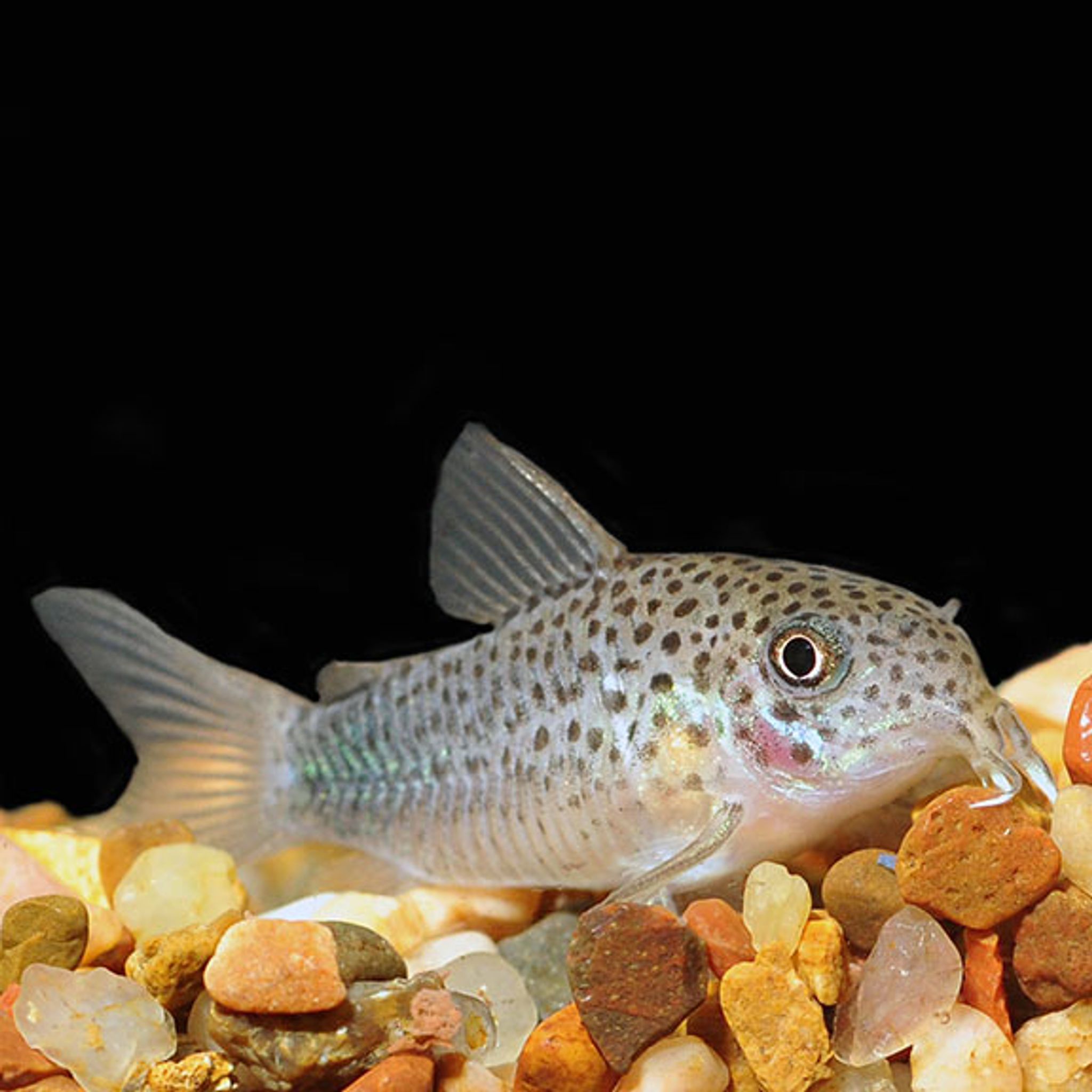

Corydoras Catfish Care Guide: Tank Size, Diet, Water Parameters and Temperament
Corydoras catfish are among the most popular bottom-dwelling fish in US freshwater tanks, prized for being peaceful, active by day, and genuinely easy to keep once the basics are right. This guide covers realistic tank sizes, water parameters, feeding, tankmates, and the mistakes that account for most cory losses.
What Are Corydoras Catfish?
Corydoras is a genus of small, armored catfish native to South America, east of the Andes. Instead of scales, they carry overlapping bony plates along the body, and each fish has three pairs of sensory barbels around the mouth plus sharp spines in the dorsal and pectoral fins used for defense. Scientists have formally described more than 160 species, and hobbyists track dozens more informally as "C-numbers" until they're classified.
Most corys sold in US stores are captive-bred, which matters for water chemistry (more on that below). Adult size varies by species:
- Standard species (bronze, peppered, panda, julii-type): about 1–3 inches (2.5–7.5 cm)
- Dwarf species (pygmy, habrosus, hastatus): about 1–1.5 inches (2.5–4 cm)
- Larger species (emerald and Brochis-type corys): 3–3.5 inches (7.5–9 cm)
Females run noticeably larger and rounder-bodied than males of the same species, which becomes the easiest way to sex a group.
Lifespan is often underestimated. Reports range from 3–5 years in neglected setups to 20+ years for a few long-lived individuals, but a well-maintained tank should realistically produce 5–10+ years, with many species doing fine well past that if water quality stays consistent.
Tank Size and Group Size by Species Type
Corys are shoaling fish. A single cory, or even a pair, will spend most of its time hiding and showing stress behavior. Keep at least six of the same species — dwarfs are happiest in groups of 8–12 or more. Mixed species will loosely shoal together but each still prefers its own kind, so don't count a mixed group toward the minimum for either species.
Floor area matters far more than tank height, since corys are bottom-oriented and need room to patrol in a group without constantly bumping into tankmates.
| Cory type | Examples | Group size | Minimum tank |
|---|---|---|---|
| Dwarf | Pygmy, habrosus, hastatus | 8–12+ | 10 gal (38 L) |
| Standard | Bronze, peppered, panda, julii/three-stripe | 6+ | 20 gal long (75 L) |
| Larger-bodied | Emerald, Brochis-type | 6+ | 30+ gal (114+ L) |
A 10-gallon tank works fine for a dwarf-only group, but standard-size corys need the footprint of a 20-gallon long, not a taller 20-gallon high — the extra length gives six fish enough patrol space and reduces territorial bumping at feeding time.
Water Parameters
Corys tolerate a workable range of parameters as captive-bred fish, but stability matters more than hitting an exact number.
- Temperature: 72–78°F (22–26°C) covers most species. Bronze and peppered corys tolerate cooler water, down to roughly 68–70°F (20–21°C), while sterbai corys handle warmer water up to about 82°F (28°C), which is why sterbai is the usual cory choice for discus and other warm-water community tanks. Most US homes will need a heater to hold a steady temperature year-round.
- pH: aim for 6.5–7.5. Wild-caught corys prefer soft, acidic water, but almost all US retail stock is captive-bred and adapts well to neutral or slightly alkaline tap water. Don't chase pH with chemical additives — swings caused by pH-down products are far more dangerous to corys than a stable pH of 7.4.
- General hardness: roughly 2–15 dGH is workable for captive-bred fish.
- Ammonia and nitrite: must read 0 ppm. Corys are among the first fish to suffer in an uncycled or newly set up tank.
- Nitrate: keep under about 20–40 ppm. Corys are notably sensitive to nitrate buildup and to waste accumulating in the substrate.
Many US municipal water supplies are hard and alkaline and treated with chloramine rather than plain chlorine. This isn't a problem for captive-bred corys as long as you use a conditioner rated for chloramine, not just chlorine, and avoid the temptation to soften or acidify tap water artificially.
Perform weekly water changes of 25–30%, always with a dechlorinator. Combine this with regular gravel vacuuming, since dirty substrate is the biggest driver of nitrate spikes and bacterial issues in cory tanks specifically.
Substrate and Tank Setup
Smooth sand is the ideal substrate for corys — about 2 inches (5 cm) is plenty of depth — because they spend much of the day sifting it with their barbels while foraging. Pool filter sand or aquarium-grade sand both work well; rinse thoroughly before adding it to avoid clouding the water. Smooth, rounded fine gravel is an acceptable substitute if sand isn't practical.
Avoid sharp or poorly maintained gravel. Barbel erosion — where the whisker-like barbels shorten or disappear — is often blamed on sharp substrate alone, but dirty substrate and elevated bacterial load are usually the bigger culprit; sharp grit just makes existing damage worse. Fix water quality and cleaning routine first, then reconsider the substrate itself if problems continue.
Round out the setup with:
- Live or silk plants, driftwood, leaf litter, and caves to provide shade and security
- Open sand patches left clear for foraging
- Gentle to moderate water flow — corys don't like being blasted by a powerhead
- A tight-fitting lid, since corys occasionally dart to the surface to gulp air through their gut, a normal adaptation, not a sign of trouble on its own
Diet and Feeding Technique
Corydoras are omnivores, not algae eaters, and they are not a "cleanup crew" that can live on other fish's leftovers. A cory fed only on scraps will slowly starve even while other fish in the tank look healthy.
Feed:
- Sinking pellets or wafers daily as a staple
- Frozen or live bloodworms, blackworms, brine shrimp, and daphnia a few times a week
- A gel food occasionally for variety
Because corys are slower feeders than most midwater fish, target-feed after lights-out or use a turkey baster to place food directly near the substrate so fast swimmers like tetras or barbs don't clear the bowl first. Food should disappear within a few minutes; anything left over should be siphoned out to protect water quality.
Temperament and Tankmates
Corydoras are fully peaceful and active during the day, and a healthy group shows genuinely fun behavior — synchronized foraging sweeps across the tank floor and an occasional "winking" eye-roll motion that many owners find distinctive.
Good tankmates: tetras, rasboras, livebearers, gouramis, peaceful dwarf cichlids, otocinclus, bristlenose plecos, shrimp, and snails.
Avoid: large or aggressive cichlids, oscars, goldfish (which prefer cooler water and will eat small corys), fin-nippers that harass bottom-dwellers, and crayfish. Bettas and shrimp are generally safe cory tankmates, though corys may eat very young shrimplets given the chance.
You can browse compatible options for a cory community setup in FishyHub's corydoras category, as well as the broader small community fishes selection for tankmate ideas.
Acclimation and Handling
New corys are especially prone to stress and sensitive to sudden parameter swings, so drip acclimation and a proper quarantine period matter more here than with many hardier fish. Only add corys to a fully cycled tank — an uncycled tank is one of the most common reasons new corys die within the first weeks.
One safety note worth knowing before you bring corys home: when stressed or netted, corys can release a mild toxin from their skin. Bag them individually or in small numbers with plenty of water, and never dump bag water directly into your display tank.
Cory Types and Notable Species
- Bronze cory: hardy, around 2.5 inches, broadly tolerant of parameter swings — often the entry point for new keepers.
- Albino cory: a color morph, usually of the bronze (occasionally peppered) species, with identical care needs but slightly more light-sensitive eyes.
- Peppered cory: cool-tolerant and hardy, good for unheated or lightly heated setups.
- Panda cory: popular for its black-and-white pattern; standard care applies.
- Julii vs. three-stripe (trilineatus): true julii corys are genuinely rare in the trade; most fish sold under the "julii" name in US stores are actually Corydoras trilineatus. The two look similar but are distinct species — worth knowing if you're trying to keep a specific bloodline.
- Sterbai cory: warm-tolerant up to about 82°F, making it the standard cory choice for discus and other warm-water tanks.
- Emerald and Brochis-type corys: larger-bodied, need the 30+ gallon end of the sizing chart above.
- Beyond these, the hobby includes long-nosed species, unclassified "C-number" forms, and a handful of rare species collectors chase as "holy grail" finds.
Dwarf Corys
Pygmy, habrosus, and hastatus corys top out around 1–1.5 inches and do fine in a 10-gallon tank, but only in groups of 8–12 or more — a small group of dwarfs hides just as much as a lone standard cory. They need very small sinking foods sized for their mouths. Pygmy and hastatus corys spend more time hovering in midwater than other corys, while habrosus stays closer to the bottom.
Corys Compared to Other Bottom Dwellers
Corys sit within the callichthyid, or armored catfish, family — distinct from suckermouth plecos (family Loricariidae) and from larger catfish species that quickly outgrow a community tank. Among common bottom dwellers, only some are true algae eaters:
| Bottom dweller | Eats algae? | Needs dedicated feeding? |
|---|---|---|
| Corydoras | No | Yes |
| Bristlenose pleco | Yes (plus other foods) | Yes |
| Kuhli loach | No | Yes |
| Otocinclus | Yes | Supplement with algae wafers |
| Shrimp/snails | Partially | Yes |
Every bottom dweller on this list, corys included, still needs food placed where they can reach it — none of them survive on tank scraps alone. Other oddball bottom feeders, such as banjo catfish, follow the same rule: sinking, meaty food offered after dark works best for them too.
Breeding Corydoras
Common species like bronze, peppered, and pygmy corys breed readily in a home aquarium; many rarer species are considerably harder. To condition a group, feed extra worms and frozen foods, and keep more males than females — roughly a 2:1 ratio encourages spawning behavior.
A classic breeding trigger is a large, cooler water change (a few degrees below tank temperature) paired with strong aeration, which mimics a natural rain event; a drop in barometric pressure can trigger spawning on its own. During spawning, the female carries fertilized eggs in a "basket" formed by her pelvic fins and sticks them individually to glass or plant leaves. Eggs hatch in roughly 3–6 days. Removing unfertile or fungused eggs improves survival, and adding alder cones or a trace of methylene blue helps control fungus.
Fry live off their yolk sac initially, then move on to microworms, baby brine shrimp, and powdered fry food. Raise them over a bare bottom or thin sand layer with frequent small water changes, since fry are far less tolerant of waste buildup than adults.
Sources disagree on whether to move eggs to a separate hatching container or leave them in place. Both approaches work; moving eggs out of a community tank generally improves survival by removing the risk of other fish eating them.
Common Mistakes and Troubleshooting
- Adding corys to an uncycled tank: they're frequently the earliest casualties of an unfinished nitrogen cycle.
- Buying only one or two: expect constant hiding and visible stress; buy the full group size from the start.
- Relying on leftovers for food: thin bodies or sunken bellies are a starvation sign, not a sign the fish is just small.
- Worn or missing barbels: address water quality and substrate cleanliness first; only replace sharp gravel afterward if issues persist.
- Constant surface dashing: occasional trips to gulp air are normal, but frequent dashing signals low oxygen or poor water quality — test parameters and add aeration.
- Rapid gilling, clamped fins, or lying on one side: check ammonia, nitrite, nitrate, and temperature immediately.
- Medication sensitivity: corys can react badly to copper-based treatments and heavy salt doses; use half-strength or scaleless-fish-safe medications when treating a tank that includes corys.
- Ich or red blotches (likely bacterial): quarantine affected fish, maintain clean water, and treat cautiously with scaleless-safe products.
Frequently Asked Questions
How many corys should I keep?
Keep at least six of the same species for standard corys, and 8–12 or more for dwarf species like pygmy or habrosus corys. Smaller groups tend to hide and show visible stress.
Can corys live in a 10-gallon tank?
Dwarf species (pygmy, habrosus, hastatus) do well in a 10-gallon tank in a full group. Standard-size species like bronze or panda corys need the floor space of a 20-gallon long instead.
Do corys clean the tank or eat algae?
No. Corys scavenge some leftover food but are not algae eaters and don't function as a cleanup crew. They need their own regular feedings of sinking pellets and meaty foods.
Why is my cory swimming to the surface?
Corys can breathe air through their gut and occasionally dash to the surface to gulp air, which is normal. Frequent or constant surface trips usually signal poor water quality or low dissolved oxygen and should prompt a water test.
Can corys live with bettas or shrimp?
Generally yes — corys are peaceful toward both. They coexist well with adult shrimp, though they may eat very small shrimplets if given the opportunity.
How can I tell male from female corys?
Females are larger and wider-bodied when viewed from above, especially when carrying eggs. Males are slimmer with more pointed pelvic fins.
Do corys need a heater?
Yes, in most US homes. Aim for a stable 72–78°F, adjusting slightly for species — cooler for bronze or peppered corys, warmer for sterbai.
Ready to start or expand a cory group? Browse available stock in FishyHub's Plecos, Corys & Bottom Dwellers category, along with suitable sand and gravel substrates to round out the setup.


