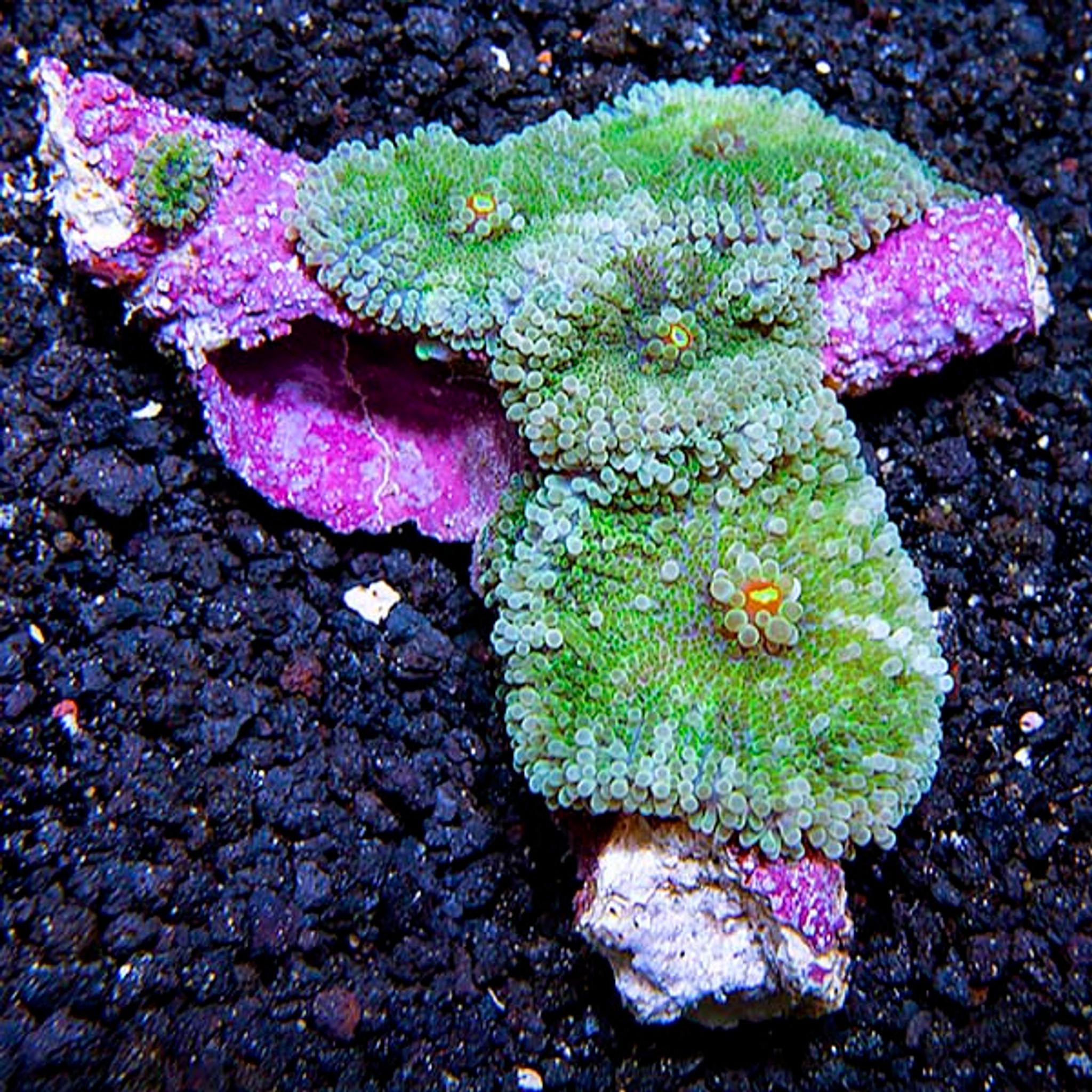

Common Ricordea Problems: Tissue Loss, Fading, Pests and Recovery
A Ricordea mushroom that suddenly shrinks, pales out, or grows odd white specks can send any reef keeper into panic mode. The good news is that these corallimorphs are among the hardiest animals in the hobby, and almost every symptom traces back to a handful of well-known causes rather than something mysterious. This guide is organized by symptom so you can match what you're seeing to a likely cause and a practical fix.
Know Your Ricordea First
Ricordea are corallimorphs, not true stony corals, which is part of why they tolerate more variation than SPS or LPS species. Two types show up in the trade:
- Ricordea florida — Caribbean/Atlantic origin, generally the more forgiving of the two and a solid choice for less-stable systems.
- Ricordea yuma — Indo-Pacific origin, prized for intense color, but noticeably pickier about clean, stable water chemistry.
Neither is difficult. Yuma just rewards consistency more, so treat it as the more parameter-sensitive of the pair rather than a genuinely hard coral.
Baseline Parameters
| Parameter | Target range |
|---|---|
| Salinity | 1.024–1.026 |
| Temperature | 76–80°F (24–27°C) |
| pH | 7.8–8.4 |
| Alkalinity | 8–11 dKH |
| Calcium | 380–450 ppm |
| Magnesium | 1250–1350 ppm |
| Light | Roughly 50–100 PAR |
| Flow | Low to medium, indirect |
Ricordea are more forgiving of small calcium, alkalinity, and magnesium swings than stony corals, but they still suffer when nutrients spike or parameters move abruptly rather than gradually.
Quick Symptom-to-Cause Reference
Before troubleshooting in depth, use this table to narrow down what's likely happening.
| Symptom | Most likely cause | First response |
|---|---|---|
| Pale/white + tank light recently increased | Bleaching from excess PAR | Lower intensity or move down/shaded |
| Pale/dull + very low nutrients | Zooxanthellae starving | Ease off carbon dosing/GFO, try direct feeding |
| Brown, dull color + weak lighting | Insufficient light | Move closer to the light source gradually |
| Balled up, won't extend | Flow too strong/direct | Redirect flow away from the disc |
| Closed for days, otherwise normal | New arrival adjusting, low pH, or light shock | Wait 5–7 days before further action |
| Torn in half, two mouths visible | Normal fission (splitting) | No action needed |
| Edges melting, mouth intact | Parameter swing, chemical burn, or physical injury | Isolate, stabilize water, reduce flow/light |
| Tiny bite marks, slime trail, worse at night | Ricordea nudibranch | Manual removal at night, dip and quarantine new frags |
| Flat tan/brown discs coating the mushroom | Waminoa flatworms | Manual removal, dips, or biological control |
Tissue Loss and Melting
Tissue loss is the most alarming symptom, but it usually traces to one of four sources:
- A sudden parameter swing — a large uncorrected water change, a dosing error, or a temperature spike.
- Chemical or physical burn from a neighbor. Ricordea wield their own sweeper and chemical defenses, but aggressive corals such as Euphyllia species or zoanthids placed too close can burn them right back — leave generous spacing before blaming the Ricordea itself.
- Physical injury from frag-cutting or rough handling during shipping.
- Old tank syndrome or a nutrient crash, where a long-neglected system suddenly loses its capacity to buffer stress.
Recovery: isolate the piece, keep water chemistry pristine and stable, and dim lighting and flow around it. Give it one to three weeks — as long as the mouth and central disc are intact, edge tissue loss usually regrows over that window.
Fading and Bleaching
A Ricordea that goes pale, white, or loses its pattern is almost always dealing with one of these:
- Excess light or a PAR increase that happened too fast. This is the single most common cause of true bleaching.
- An abrupt lighting schedule change, such as a new fixture or a photoperiod jump.
- Overly aggressive nutrient export — carbon dosing or GFO pulled nitrate and phosphate down so far that the zooxanthellae are effectively starving.
Reduce intensity or move the mushroom lower for light-driven fading; ease off nutrient export and consider direct feeding if it's pale from low nutrients instead. PAR guidance varies — some keep Ricordea low and shaded, others note yuma intensifies under brighter light — so start around 50–80 PAR and increase gradually while watching for bleaching.
Not Opening or Staying Closed
A closed, deflated mushroom for a few days is not automatically a crisis. Check, in order: flow (too strong keeps it balled up), light shock (recent fixture changes or relocation), low pH from CO2 buildup, or simple new-arrival adjustment — freshly added specimens often stay closed for days before extending normally. Give it time; persistent closure paired with pale color is the combination that warrants deeper troubleshooting.
Shrinking, "Walking," or Splitting
A Ricordea shrinking to a small disc or slowly relocating across the rock can simply mean it's seeking better flow or light — normal behavior, not disease. Persistent shrinking combined with pale coloration, though, points to a real light, flow, or parameter problem.
Splitting is another frequently misread behavior. Ricordea reproduce through longitudinal fission: the disc develops a second mouth and appears to tear itself in half before separating into two mushrooms. A shroom that looks like it's ripping apart is very likely propagating, not dying — overreacting to normal fission is one of the most common new-keeper mistakes.
Pests: Telling Them Apart
Not every spot or fleck is the same threat, and treatment priority differs by pest.
Tissue-Eating Pests
Ricordea nudibranchs are color-matched to their host and easy to miss. They feed at night, leaving small bite marks and slime trails, and can cause real tissue loss over time. Control relies on manual removal with a turkey baster or tweezers after dark, a coral-safe dip for new arrivals, and ongoing inspection since they camouflage so well.
Cosmetic (Smothering) Pests
Waminoa flatworms are tiny, flat, oval pests that coat the disc. They don't eat tissue directly, but they block light and cause stress, showing up as indirect fading. Removal is by manual siphoning, dips, or natural predators — a lower-urgency problem than nudibranchs since it's stress-driven, not tissue destruction. Bristleworms occasionally scavenge already-dead tissue and are typically a symptom of existing decline rather than its cause.
Look-Alikes Worth Knowing
Aiptasia and majano anemones sometimes share live rock with Ricordea and get mistaken for a mushroom colony. Aiptasia has long, translucent, glassy tentacles from a small base; majano has a stubbier, more anemone-like body — both lack the smooth, patterned disc that defines a Ricordea and can compete with it for space.
Quarantine and Dipping New Arrivals
Sources disagree here. Some recommend a routine iodine or coral-safe dip on every arrival; others caution that Ricordea tissue is more delicate than LPS or SPS and can be irritated by a strong or prolonged dip. A reasonable middle ground: a brief, properly diluted dip plus visual inspection and quarantine catches most hitchhikers without stressing the tissue. Skipping quarantine entirely is a common way nudibranchs or Waminoa end up in a display unnoticed.
Acclimation and Placement
Correct acclimation avoids a large share of "it melted right after I got it home" reports. Use a slow drip or float-and-mix method over 30 to 60-plus minutes so temperature and salinity shift gradually. Just as importantly, don't drop a new mushroom straight into full tank lighting — start it lower or shaded, then move it to its permanent spot over several days.
For placement, loose rock rubble or a frag plug in a low-current pocket beats gluing. A detached Ricordea reattaches on its own over days to weeks if left alone; gluing can damage tissue and interferes with the coral relocating to find better conditions. Browse mushroom corals for healthy specimens to start a frag rack.
Frags mounted with glue or putty right after cutting are also more prone to melting at the cut edge than pieces left loose on rubble to heal first — let a fresh cut callus for a few days before mounting.
Feeding for Color and Recovery
Feeding isn't required — Ricordea get most of their energy from light via zooxanthellae — but it measurably helps color and speeds recovery after stress. Offer meaty foods cut to roughly half the size of a mysis shrimp, or an amino-acid/coral-food supplement, delivered directly to the mouth a few times a week.
Riding Out the "Ugly Stage" in a New Tank
If your Ricordea is struggling in a tank that's only a few weeks old, the tank itself may be the issue. Roughly weeks three through ten of a new system commonly bring an "ugly stage" of diatom blooms, cyanobacteria, and algae as the biological filter establishes. It's temporary and resolves with patience and nutrient export — water changes, cleanup crew, adequate flow — rather than chemical treatments. Corals placed into a tank still cycling through this phase can show extra fading or stress until things settle.
Traveling With Live Coral
Bringing a frag home from a swap or distant purchase in a sealed bag of water through airport security is legal — screening is visual and x-ray only and doesn't harm the animal. The real risks are temperature swings and long transit times, so insulate the bag well and minimize time out of stable water.
Common Mistakes to Avoid
- Placing a new Ricordea straight into a high-light, high-flow "showcase" spot instead of a shaded, low-flow spot for the first one to two weeks.
- Assuming normal splitting/fission means the coral is dying.
- Blaming the Ricordea for tissue loss when an aggressive neighbor's chemical or sweeper-tentacle warfare is the real cause.
- Skipping quarantine and inspection, letting camouflaged nudibranchs or Waminoa into the display undetected.
- Making large, infrequent water changes or sudden parameter corrections — Ricordea prefer stability over chasing "perfect" numbers.
- Gluing a detached mushroom down instead of letting it settle naturally in a rubble pocket.
If you're setting up a dedicated corallimorph section, it's worth reviewing options across soft corals to plan compatible tankmates with similarly modest flow and light needs.
Frequently Asked Questions
Why is my Ricordea shrinking or deflating?
Often it's a response to flow or light adjustment, general stress, or the coral relocating — give it a few days before assuming decline. Persistent shrinking with pale color signals a real parameter, light, or flow issue.
Why did my Ricordea turn white or pale?
Usually bleaching from too much light or a sharp lighting-schedule change, or nutrients stripped too low by aggressive export methods. Dial back light intensity or ease off carbon dosing and GFO, depending on which fits your setup.
Is it normal for a Ricordea to split in two?
Yes. Longitudinal fission is a normal reproductive method where the disc develops a second mouth and gradually divides — it's propagation, not injury.
How do I get rid of Ricordea nudibranchs?
Manual removal at night with a turkey baster or tweezers works best since they're nocturnal and camouflaged. Dip new arrivals before adding them to the display, and keep inspecting regularly since these pests are easy to miss.
What are the tiny flat brown or tan specks on my mushroom?
Most likely Waminoa flatworms, which coat the disc and block light rather than eating tissue directly. Remove them through dips, manual siphoning, or natural predators to reduce the stress and fading they cause.
Can a Ricordea recover from major tissue loss?
Yes, as long as the mouth and central disc survive and water conditions stay stable. Regrowth over one to four weeks is common even after losing significant tissue around the edges.
Do I need to feed my Ricordea?
No, since they get most of their energy from light through zooxanthellae. Occasional meaty feeding or a supplement helps boost color and speeds recovery after a stress event, though.
Is R. yuma or R. florida better for beginners?
Both are easy, hardy corallimorphs suitable for beginner-to-intermediate reef keepers. Florida is generally more forgiving in less-stable systems, while yuma rewards consistent, clean water with more intense coloration.
Ready to add or expand your corallimorph collection? Browse the current selection of corals on FishyHub to find healthy Ricordea and compatible tankmates for your setup.


