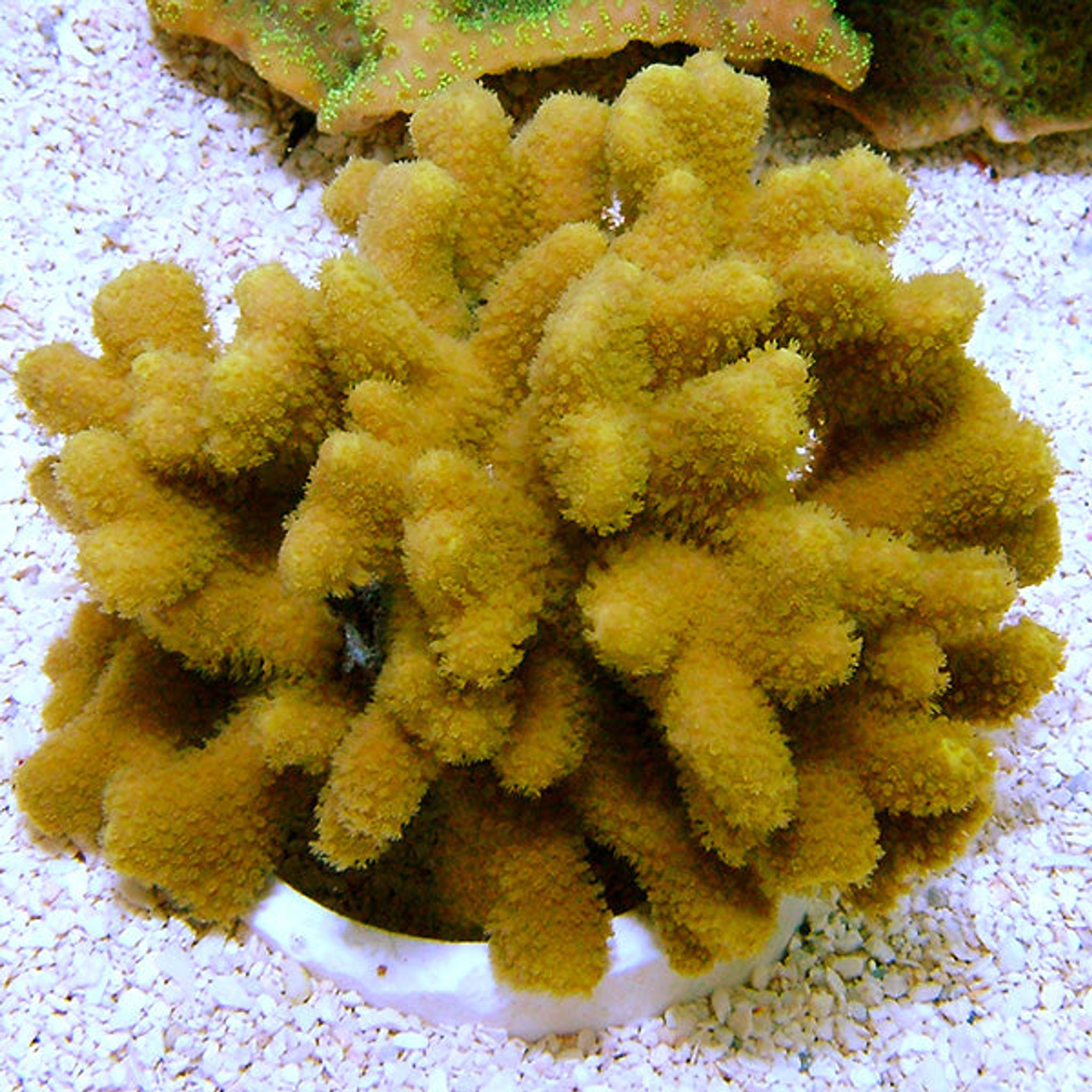

Common Porites Problems: Tissue Loss, Fading, Pests and Recovery
Porites corals have a reputation for being tough, fast-growing, and forgiving — right up until they aren't. When a colony starts losing tissue, fading out, or hosting mysterious pests, most of the usual causes trace back to water chemistry swings or one specific predator that many general coral-disease guides never mention. This guide walks through how to tell the problems apart and what to actually do about each one.
What Makes Porites Different From Other Stony Corals
Porites is an SPS-adjacent stony coral made up of masses of tiny polyps packed into a dense calcium carbonate skeleton, often growing as encrusting mounds, boulders, or branching "finger" colonies. It's generally hardy and grows quickly compared with many small-polyp stony corals, which is part of why it's popular as a host for symbiotic Christmas tree worms and for pink or orange coloration in a mixed reef display.
The trade-off: Porites tolerates a fairly wide range of water parameters but punishes sudden swings far more than it punishes a slightly-off but stable number. It's also notoriously vulnerable to a predatory nudibranch that specifically targets this genus, which is a detail many broad "coral pest" articles skip entirely because they focus on Acropora.
Tissue Loss: RTN vs. Slow Tissue Loss
Not all tissue loss looks — or behaves — the same way. Distinguishing the pattern is the fastest way to narrow down a cause.
| Symptom | Rapid Tissue Necrosis (RTN) | Slow Tissue Loss (STN) |
|---|---|---|
| Speed | Spreads visibly within hours, sometimes overnight | Gradual, over days to weeks |
| Margin appearance | Sharp, bright white bare-skeleton line | Ragged, less defined edge |
| Typical trigger | Sudden chemistry spike, physical shock, shipping stress | Ongoing low-grade stress: allelopathy, pest grazing, poor flow |
| Urgency | Act immediately — isolate and stabilize parameters | Investigate over a few days; still act promptly |
Common triggers for both patterns include:
- Chemical dosing spikes — sudden swings in calcium, alkalinity, or pH
- Pest predation — most notably the nudibranch covered below
- Physical damage — pinching or crushing during fragging or handling
- Allelopathy — chemical or sting-based irritation from aggressive neighbors like Goniopora, zoanthids, or sweeper-tentacle LPS
- Old or dirty transport water left in the bag too long, or general shipping stress
- Direct contact damage from a neighboring coral or debris settling on the tissue
Fading and Bleaching: Not the Same as Tissue Loss
A Porites colony that pales or turns white but keeps its tissue intact is going through a different process than tissue loss. The distinction matters because the fixes are different:
- Bleaching — the colony pales evenly across the whole surface while tissue remains present. This usually comes from a lighting change (new fixture, moved frag, increased PAR) or heat stress.
- Nutrient starvation fading — in a very "clean" tank with nitrate and phosphate pushed too low, zooxanthellae density drops and coloration fades even without any lighting change.
- Tissue loss — by contrast, exposes bare, often translucent skeleton where tissue is simply gone.
If tissue is still present and just pale, don't panic and don't overcorrect. A common mistake is treating a natural fading response to a lighting change as an emergency, when it's often just acclimation. True bleaching from heat or PAR overload looks similar but tends to follow directly after a specific change — check your equipment log first.
Reef Parameters That Matter Most for Porites
Consensus targets for a general reef tank, with Porites tolerating the wider end of these ranges as long as they stay stable:
| Parameter | Target Range |
|---|---|
| Temperature | 76–80°F (24–27°C) |
| Salinity | 1.024–1.026 SG |
| pH | 7.8–8.4 (ideally 8.1–8.3) |
| Alkalinity | 8–12 dKH, kept stable |
| Calcium | 380–450 ppm |
| Magnesium | 1250–1350 ppm |
| Nitrate | 2–10 ppm |
| Phosphate | 0.03–0.1 ppm |
Sources disagree on how tightly to chase pH — some push for a narrow 8.1–8.4 band, others say anywhere in 7.8–8.4 is fine if it's steady. The more useful rule: watch the swing size, not the absolute number. A daily pH swing under about 0.2–0.3 units is a better health indicator than hitting an exact target.
pH Swings and Why They Matter
Reef tank pH naturally dips overnight from respiration and CO2 buildup, then rises during lighted, photosynthetic hours. A swing beyond roughly 0.3–0.4 units in 24 hours is more stressful to coral tissue than a pH that's a bit low but consistent.
Chronically low pH is usually a gas-exchange problem, not a chemistry problem: closed equipment rooms, high indoor CO2, or a sealed canopy all trap CO2 near the water surface. Practical fixes include:
- Running fresh air intake to the skimmer or return pump area
- Adding a CO2 scrubber on the skimmer air intake
- Simply venting the equipment room more often
- Dosing kalkwasser at night specifically to counteract the nighttime dip (see below)
A protein skimmer or extra flow alone won't fix chronically low pH — skimmers help gas exchange only marginally. The bigger lever is fresh air supply or scrubbing CO2 from the intake air.
Kalkwasser: A Double-Edged Tool for Calcium and pH
Kalkwasser (calcium hydroxide, sometimes called limewater) is a low-cost way to dose calcium and alkalinity together while also raising pH. It's typically added through an auto top-off (ATO) drip that replaces evaporated water with kalkwasser-dosed fresh water instead of plain RO/DI.
Benefits:
- Pairs calcium and alkalinity dosing without the mismatch risk of separate two-part additives
- Precipitates excess phosphate, helping with nutrient control
- Raises pH, which is especially useful in tanks that run low from poor gas exchange
Precautions:
- Mix at a conservative strength — roughly 1–2 teaspoons per gallon of fresh RO/DI water, adjusted to how much your tank actually consumes through evaporation
- Dose only as fast as it's consumed via the ATO drip; never add it all at once
- A worked example: a tank evaporating 2 gallons per day should have kalkwasser metered in gradually across that same top-off volume, not dumped in as a single dose — dumping concentrated limewater in one shot is the single most common way this additive causes harm instead of help
- Overdosing spikes pH dangerously fast and can burn or shock coral tissue, triggering the same Porites-style tissue recession it's meant to prevent
- Only use fresh, properly mixed RO/DI water as the base — contaminants concentrate along with the calcium hydroxide
Kalkwasser alone is often sufficient for low-to-moderate demand tanks, but once a heavier SPS/Porites bioload outpaces the daily top-off volume, most reefers add a calcium reactor or two-part dosing alongside it rather than trying to push more kalkwasser through. You can run kalkwasser and a calcium reactor together, but total Ca/Alk input needs to be tracked as one combined number — reduce the kalkwasser dose or top-off rate if a reactor is already covering most of the demand.
Phestilla Nudibranchs: The Pest That Targets Porites Specifically
This is the pest most general "coral disease" content misses because it's written with Acropora in mind. Phestilla-type aeolid nudibranchs are cryptic predators, only a few millimeters long, that camouflage to match their host coral's color almost perfectly. They graze directly on Porites, Goniopora, Tubastrea, and Dendrophyllia tissue, feeding mostly at night.
How to spot them:
- Spreading tissue loss with no obvious algae bloom or chemistry cause
- Tiny slug-shaped bumps on close inspection
- Distinctive white spiral egg ribbons laid directly on the coral surface — this is the most reliable tell
Inspection technique: Check affected corals after lights-out using a dim red flashlight rather than white light — red light lets you spot nocturnal grazers and egg coils without disturbing fish and other nocturnal invertebrates that would otherwise scatter and hide the coral from view.
Removal and prevention:
- Hand-pick visible nudibranchs and egg ribbons with tweezers or a turkey baster
- Dip any new frag or colony in an iodine-based or other coral-safe dip solution before it ever touches the display
- Quarantine new corals and frags for a couple of weeks — this is the single biggest prevention step, since most infestations start with an unquarantined addition
- Since Porites, Goniopora, and Tubastrea are all in the same at-risk cluster, check all three if you keep more than one in the same system — an infestation on one often means it's worth inspecting the others
A UV sterilizer can help knock down free-swimming larvae in the water column, but it's not a substitute for physical inspection and dipping — it doesn't reach eggs or adults already on the coral.
Other Pests and Nuisances to Rule Out
- Red or orange flatworms — more commonly an Acropora pest, but can appear on other SPS-adjacent corals too
- Bristleworms — mostly harmless detritivores; opinions are split on whether they ever attack coral directly. The sensible take is that they aren't a primary cause of Porites decline, but they can opportunistically worsen an already-damaged colony, so thin out large populations if a coral is actively receding
- Predatory snails or gastropods — occasionally a problem in LPS-heavy tanks
- Film algae and cyanobacteria — can smother recovering, exposed tissue and slow re-encrustation even after the original cause is resolved
A Practical Recovery Protocol
Once a cause is identified, or while narrowing it down, follow this general sequence:
- Isolate the affected coral in a quarantine or frag tank if one is available.
- Inspect at night with a red flashlight for nudibranchs and egg ribbons.
- Remove pests by hand and dip the coral in an iodine-based or coral-safe dip.
- Test parameters first — calcium, alkalinity, pH, and salinity — before assuming disease or infection.
- Correct chemistry slowly, no more than about 0.5–1 dKH or 20–30 ppm calcium shift per day.
- Increase flow slightly to keep detritus from settling on damaged tissue — but don't crank up flow or light dramatically, since a stressed, receding coral generally recovers better with reduced stimulation and stability, not more of either.
- Hold off on fragging or handling until the tissue-loss margin has visibly stopped advancing for at least several days, ideally a week or two.
- Some hobbyists find gently brushing exposed skeleton to remove algae film helps tissue re-encrust the bare area once the underlying cause is resolved.
Livestock and coral-safe dip and medication products can be browsed on FishyHub if you need to restock quarantine supplies before adding new frags.
Common Mistakes to Avoid
- Chasing a "perfect" pH, calcium, or alkalinity number instead of stabilizing the swing — instability causes more damage than a number that's slightly off but steady
- Dosing kalkwasser too concentrated or too fast, which can itself trigger the same tissue recession it's meant to prevent
- Assuming tissue loss is "just chemistry" without ever doing a night inspection for nudibranchs
- Placing Porites too close to Goniopora, sweeper-tentacle LPS, or zoanthids and mistaking allelopathy damage for disease
- Treating natural fading from a lighting change as a health crisis instead of distinguishing it from true heat or PAR-overload bleaching
- Skipping quarantine on new frags or colonies, which is how most nudibranch eggs and juveniles get introduced
- Increasing flow or light on a stressed, receding coral to "help" it, when reduced stimulation and parameter stability usually aid recovery more
Frequently Asked Questions
Is Porites tissue loss always fatal?
No. If the cause is identified and removed early — a chemistry swing corrected or a pest removed — partial colonies commonly recover and re-encrust the exposed skeleton over the following weeks to months.
How do I know if it's RTN or normal slow recession?
RTN spreads visibly within hours or overnight and leaves a sharp, bright-white bare margin. Normal slow tissue loss progresses gradually over days with a ragged, less-defined edge.
What causes Porites to turn pale or white without losing tissue?
This is usually bleaching from a lighting or heat change, or fading from nutrient starvation in an overly "clean" tank — not RTN. Check whether tissue is still present and opaque, rather than gone and translucent skeleton showing through.
Do I need a UV sterilizer or coral dip to prevent nudibranchs?
A dip — iodine-based or similar — applied to any new frag or colony before it enters the display is the main prevention method. A UV sterilizer can help with free-swimming larvae in the water column but doesn't replace physical inspection and dipping.
Can I use kalkwasser in a tank with a calcium reactor?
Yes, many hobbyists run both together, but total calcium and alkalinity dosing needs to be tracked as one combined number to avoid overshooting. Reduce the kalkwasser dose or top-off rate if the reactor is already supplying most of the demand.
Why does my pH crash at night?
Once the lights go off, photosynthesis stops while respiration and background bacterial activity continue producing CO2, which lowers pH. This dip is normal, but it's exaggerated by poor room ventilation or a sealed canopy trapping CO2 near the water surface.
Browse Corals on FishyHub, including SPS Corals and LPS Hard Corals, to find healthy Porites and compatible tankmates, or check Water Condition & Additives for kalkwasser and dosing supplies before your next chemistry check.


