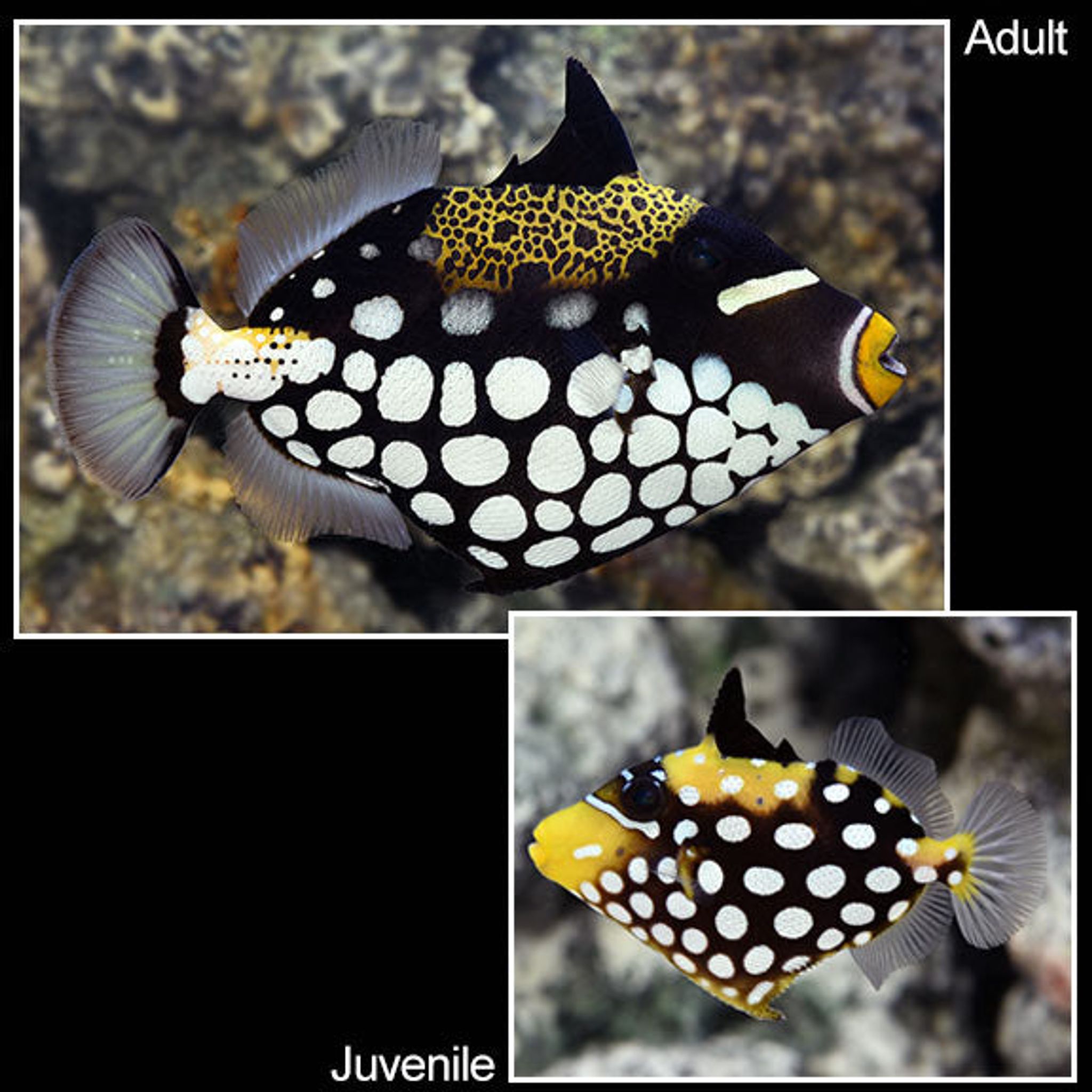
Clown Triggerfish Care Guide: Tank Size, Diet, Compatibility and Reef Safety
A clown triggerfish is not reef safe, and it needs far more space as an adult than most buyers plan for. If you're drawn in by the polka-dot pattern and bold personality, this guide lays out the real tank size progression, diet, tank mates, and long-term commitment before you commit a fishroom to one.
Species Snapshot
The clown triggerfish (Balistoides conspicillum) is also sold as the big-spotted, clown tiger, or yellow-blotched triggerfish. It's native to the Indo-Pacific, ranging from East Africa to Samoa and from southern Japan down to New Caledonia.
- Adult size: up to 20 in (50 cm) in the wild; captive fish commonly plateau around 10-15 in, though some approach full wild size with excellent care.
- Lifespan: 10-20 years in captivity is the commonly cited range with good husbandry. Wild lifespan is typically shorter, with one figure putting it around 8 years — a reminder that this is a genuine long-term, multi-decade household commitment.
- Temperament: among the most aggressive fish regularly kept in home marine aquariums.
Tank Size: A Realistic Upgrade Roadmap
Minimum tank size recommendations vary widely across sources — anywhere from 120 to 200 gallons — mostly because they're describing different life stages. The practical way to read this is as a staged plan, not a single number.
| Life stage | Fish size | Minimum tank | Notes |
|---|---|---|---|
| Juvenile | 2-5 in | 125-180 gal (473-681 L) | Absolute floor; plan the next upgrade before buying |
| Sub-adult | 6-10 in | 180-250 gal (681-946 L) | Aggression and territoriality ramp up sharply here |
| Adult | 10-15+ in | 250-300+ gal (946-1,136+ L) | Long-term home for the rest of its 10-20 year life |
Treat 125-180 gallons as the minimum to start a young trigger, not the tank it should live in forever. If you can't commit to a 250-300+ gallon system within a few years, this isn't the right species — undersizing leads to stunted growth, chronic stress, and worse aggression.
Aquascape and Rockwork
Clown triggerfish need two things that pull in opposite directions: wide open swimming space and dense, cave-riddled rockwork for retreat and nighttime security.
- Secure everything. These fish rearrange décor as a matter of habit, regardless of how it's stacked. Glue or epoxy rockwork into a stable structure rather than relying on gravity.
- Leave sand-to-glass clearance. A gap between the base of the rock structure and the aquarium glass keeps a shifted rock from cracking the pane.
- Build for the adult, not the juvenile. A scape sized for a 4-inch fish will get demolished by a 12-inch one.
Water Parameters
| Parameter | Target range |
|---|---|
| Temperature | 72-82°F (22-28°C), consensus band 74-78°F (23-26°C) |
| pH | 8.1-8.4 |
| Specific gravity | 1.020-1.025 |
| Alkalinity (dKH) | 8-12 |
These are standard FOWLR (fish-only-with-live-rock) parameters — nothing exotic, but stability matters more than chasing an exact number.
Filtration, Turnover and Bioload
A clown triggerfish is a large, messy, meaty-food predator, so filtration needs to be sized for bioload, not just tank volume.
- Return pump turnover: aim for 5-10x total tank volume per hour through the return pump. A 300-gallon tank benefits from roughly 1,500-3,000 GPH once head loss is accounted for.
- Protein skimmer: size the skimmer to the fish's actual bioload (a large, heavy-feeding predator), not just the display volume — undersized skimming is a common reason water quality lags in big FOWLR setups.
- Strong water movement also matters for oxygenation given how much this fish eats and excretes.
You can browse suitable filters sized for large systems when planning the mechanical and biological filtration for a tank this size.
New Tank Syndrome
Never add a clown triggerfish to an uncycled tank. Ammonia and nitrite spikes stress fish, suppress immune function, and damage gill tissue — and a fish this large produces enough waste to overwhelm immature biofiltration fast. Fully cycle the tank first, and test ammonia, nitrite, and nitrate both before and after introducing the fish.
Diet and Teeth Health
Clown triggerfish are strict carnivores with continuously growing, powerful teeth that need hard, resistant foods to wear down naturally.
Feed:
- Krill
- Clams (in the shell)
- Silversides
- Mysis shrimp
- Squid
- Whole shrimp
Feed small portions 1-3 times daily — juveniles can take several smaller feedings, while adults generally do better on 1-2 larger meals. Sources split on exact frequency, but the safer default is smaller and less often rather than more; remove uneaten food promptly to protect water quality.
Watch the teeth. A diet that skips hard-shelled foods (clams in shell, crab, snail) can let the beak-like teeth overgrow in captivity. Periodically check that the beak looks even and isn't curling — offering shelled foods regularly is the main preventive measure.
Temperament and Compatibility
Juveniles under about 5-8 inches are comparatively shy, hiding in rock crevices, especially at night. That changes fast: past roughly 6-8 inches, clown triggerfish become bold, fearless, and highly territorial. Many keepers report the fish learning to recognize its owner and take food from hand or tongs — a genuinely "dog-like" personality — but it remains one of the most aggressive species in the marine trade.
Choosing Tank Mates
Only pair a clown triggerfish with similarly large, tough, semi-aggressive fish:
- Large angelfish
- Tangs and surgeonfish
- Groupers
- Large puffers
- Other robust triggerfish
Introduction order matters more than the species list. Add the trigger while it's still small and let it grow up alongside its tankmates, rather than dropping an adult into an already-established tank — that's a near-guaranteed way to trigger serious aggression. If you're introducing a young trigger into an existing FOWLR system, consider a tank divider or acclimation box for the first stretch so fish can see each other without direct contact, and add it as one of the last, not the very first, additions once the rest of the community is settled.
Many keepers building this kind of large FOWLR community start with the trigger and stock around it — browse triggerfish, tangs and surgeonfish, large marine angelfish, and puffers on FishyHub to plan a size-matched stocking list.
Best kept singly, or as the largest/most dominant fish in the tank — never as a small addition to an aggressive community that's already established.
Is a Clown Triggerfish Reef Safe?
No. This is not a fish for a mixed reef tank. Clown triggerfish will:
- Eat or pick at ornamental shrimp, crabs, snails, and clams
- Physically knock coral frags around while foraging
- Bite at coral polyps
- Scratch aquarium glass in some large adults
This species belongs in a FOWLR system, not a reef. If you want trigger-family behavior and looks without wrecking a reef tank, the reef-friendly option in this family is narrow: only the aiptasia-eating filefish (Acreichthys tomentosus) carries a "reef-safe with caution" label, and even that fish can occasionally nip clams, zoanthids, and soft corals. Virtually no other filefish is broadly reef-safe.
Quarantine and Acclimation
- Drip-acclimate new arrivals over roughly an hour to adjust temperature and salinity gradually.
- Quarantine every new specimen, especially wild-caught imports, since hidden parasites and pathogens (including marine ich, Cryptocaryon irritans) are common in wild-collected triggers.
- Run a dedicated quarantine tank for several weeks, watching for spots, clamped fins, or labored breathing before moving the fish to the display.
- Once established and feeding well, clown triggerfish are considered a hardy species overall.
Related Species: Understanding the Triggerfish Family
All triggerfish share a few defining traits worth knowing before you commit to any species in the family:
- Powerful jaws and continuously growing teeth built for cracking hard-shelled prey
- A locking dorsal spine ("trigger" mechanism) used to wedge into rock crevices for defense
- Generally aggressive, territorial behavior as adults
- Mostly not reef-safe, with a few narrow exceptions in other genera
- A need for secure rockwork regardless of species
Queen Triggerfish (Atlantic Comparison)
The queen triggerfish is the Atlantic counterpart hobbyists often compare against the clown trigger. It runs smaller on average — 9-11 inches, occasionally up to about 24 inches — with a shorter typical captive lifespan (around 7 years, up to 13 in some cases). It's similarly aggressive, but the smaller footprint and shorter lifespan make it a somewhat different long-term commitment than a clown trigger.
Crosshatch Triggerfish (Collector Alternative)
The crosshatch triggerfish is a deepwater, high-value species that occasionally shows up in the trade. It's harder to source than a clown trigger and commands a much higher price, making it more of an advanced collector's fish than a beginner or mid-level purchase. It's worth knowing about as a "similar but different" option, not as a substitute recommendation for a first trigger.
Is a Clown Triggerfish a Beginner Fish?
Not really — despite being disease-resistant once established. Typical easy beginner saltwater picks are ocellaris clownfish, blue-green chromis, and various smaller angelfish, all of which fit modest tanks and peaceful communities. A clown triggerfish demands 200+ gallons at maturity, aggressive-compatible tank mates, and active management of a dominant predator. "Beginner-friendly" here only means hardy against disease — not appropriate for a first marine tank.
Common Mistakes to Avoid
- Buying for color without a plan. A striking juvenile in a store tank doesn't reveal the 200+ gallon adult it becomes.
- Housing juveniles with small or peaceful tank mates that get eaten or bullied once the trigger matures.
- Loose rockwork that shifts, crushes corals or equipment, or injures the fish itself.
- Overfeeding meaty foods and fouling the water — always remove uneaten portions and monitor nitrate.
- Skipping quarantine on wild-caught imports, risking a disease outbreak in the display tank.
- Undersized filtration or return flow for the bioload this fish produces, leading to poor water quality and worsened aggression.
- Adding an adult trigger last into an already-established community of smaller aggressive fish, expecting peace.
Breeding
Clown triggerfish are not practically bred in home aquariums. In the wild, they spawn in aggregations, with males building and guarding nest sites for roughly a week. Any captive-bred specimens in the trade come from commercial or large-scale facilities, not hobbyist setups.
Cost of Ownership
Before buying, weigh the full picture over a 10-20 year lifespan: a 250-300+ gallon tank and stand, a sump and appropriately sized skimmer, sufficient live rock for both filtration and secure aquascaping, ongoing meaty food costs for a large predator, and eventual equipment upgrades as the fish and its tank mates grow. This is a substantially bigger financial and spatial commitment than a standard reef or community tank.
Frequently Asked Questions
Is a clown triggerfish reef safe?
No. It eats invertebrates like shrimp, crabs, snails, and clams, and physically damages coral by knocking frags around or biting at polyps. It belongs in a FOWLR system, not a mixed reef.
What size tank does a clown triggerfish need?
Plan for 125-180 gallons as a minimum to start a juvenile, with a clear upgrade path to 250-300+ gallons for a full-grown adult. Don't buy one without a plan to reach that adult tank size.
What do clown triggerfish eat?
Meaty, hard-shelled foods including krill, clams in the shell, silversides, mysis, squid, and shrimp, fed in modest portions 1-3 times daily. Hard-shelled items help keep the continuously growing teeth worn down.
Can clown triggerfish live with other fish?
Yes, but only with large, tough tank mates such as tangs, large angelfish, groupers, other robust triggers, and large puffers. Avoid small, docile fish and all invertebrates, and introduce the trigger young rather than adding an adult to an established tank.
How big do clown triggerfish get and how long do they live?
They reach up to about 20 inches in the wild, though captive fish commonly plateau around 10-15 inches. Lifespan in captivity is commonly cited at 10-20 years with good care.
Are clown triggerfish aggressive?
Yes, they're among the most aggressive marine aquarium fish once mature, though juveniles are comparatively shy and reclusive. Many keepers also report distinct, dog-like personalities, including recognizing their owner at feeding time.
Can you breed clown triggerfish at home?
Not practically. Breeding occurs at commercial or large-scale facilities rather than in typical home aquarium setups.
What's the difference between a clown triggerfish and other triggers like the queen or crosshatch?
The clown triggerfish is larger and longer-lived and is the most common trigger species in the trade. The queen triggerfish is an Atlantic species that's typically smaller with a shorter captive lifespan, while the crosshatch triggerfish is a rare, expensive deepwater species aimed at advanced or collector-level keepers.
If you've weighed the space, the filtration, and the long-term commitment and you're ready to plan a build, browse marine fish on FishyHub to compare a clown triggerfish against size-matched tank mates before you buy.


