Cleaner Wrasse Care Guide: Tank Size, Diet, Compatibility and Reef Safety
The cleaner wrasse is one of the most misleadingly marketed fish in the marine hobby: charming, reef safe, and genuinely interesting to watch, but also one of the most common starvation deaths in home aquariums. This guide leads with that risk, then covers exactly what tank size, feeding routine, and tankmate mix give a cleaner wrasse a real shot at a full life.
What "Cleaner Wrasse" Actually Means
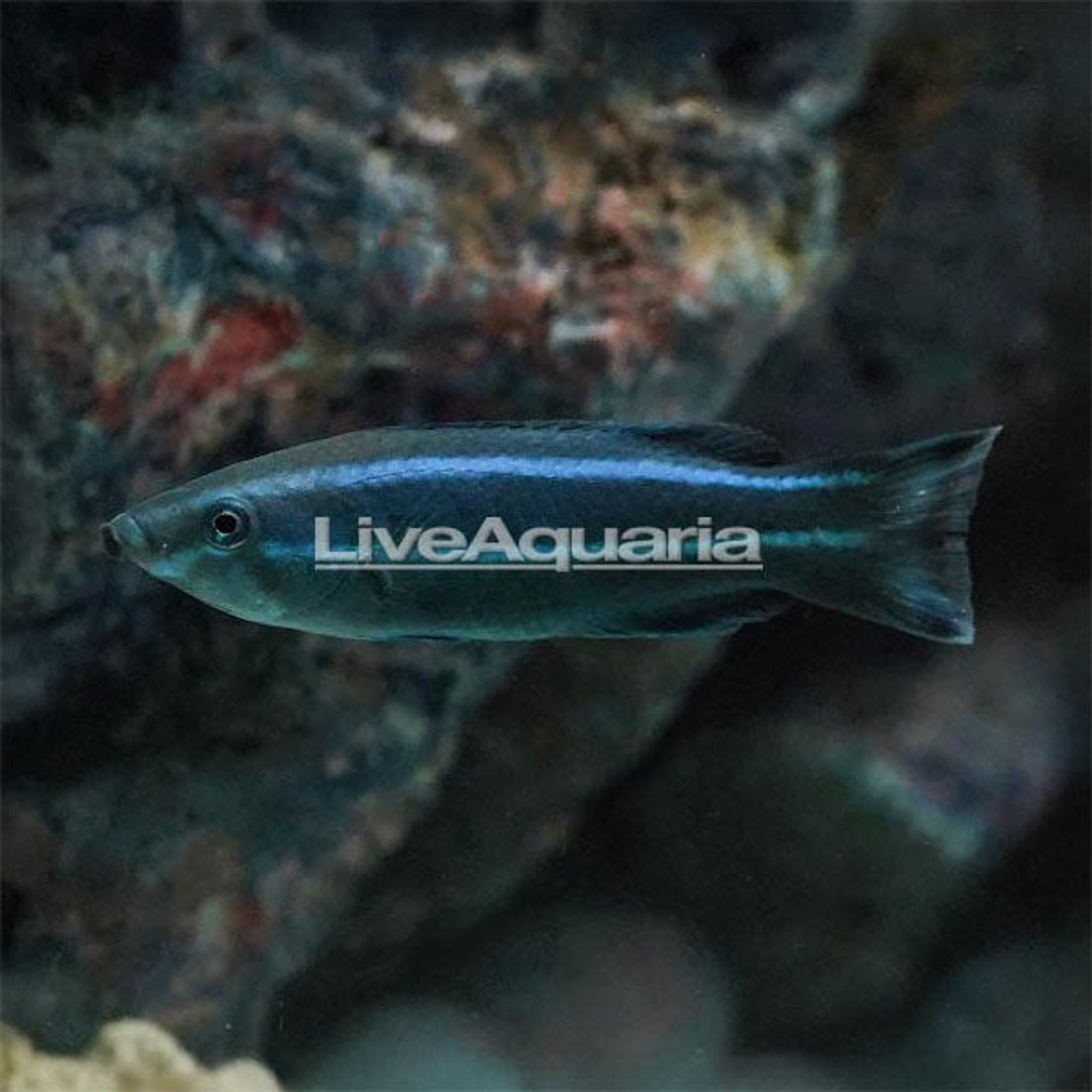
In the trade, "cleaner wrasse" almost always refers to Labroides dimidiatus, the bluestreak or common cleaner wrasse, recognizable by its dark lateral stripe and pale blue-white body. But the genus Labroides includes roughly five species, and a 2026 taxonomic revision split and renamed several of them. That matters for buyers because a listing labeled "cleaner wrasse" could now map to a slightly different species with its own range and care nuances.
Two look-alikes worth knowing:
- Labroides phthirophagus — the Hawaiian cleaner wrasse, a regional endemic.
- Labroides bicolor — the bicolor cleaner wrasse, larger-bodied with a two-tone color split rather than a single stripe.
If you're buying online, confirm the scientific name on the listing rather than relying on the common name alone — it's the only way to be sure which fish is actually shipping. You can browse current stock under marine wrasse.
Is a Cleaner Wrasse Hardy or Not? Resolving the Contradiction
Care guides disagree sharply here, and the disagreement comes from conflating two different things:
- Disease hardiness: genuinely strong. Cleaner wrasses tolerate a wide range of pathogens well and rarely succumb to the diseases they're constantly exposed to while cleaning other fish.
- Husbandry difficulty: genuinely hard. Getting one to eat enough, consistently, in a captive setting is one of the harder feeding challenges in the reef hobby.
Call it what it is: hardy against disease, but not beginner-friendly, and specifically because of feeding demands rather than fragility. Anyone marketing this fish as "easy" is skipping the part that actually kills most specimens.
Tank Size: Why the 20-vs-90-Gallon Debate Misses the Point
Sources range from a 20-gallon minimum to 90+ gallon recommendations, and both numbers are technically defensible — they're just answering different questions.
A cleaner wrasse can physically survive in a 20-gallon tank. The real limiting factor isn't swimming space; it's whether there's enough biomass and diversity of tankmates for the fish to actually clean and enough stability for water quality to hold steady. A cleaner wrasse in a small, sparsely stocked tank has nothing to "work," and that idle time correlates directly with starvation risk.
| Tank size | Verdict |
|---|---|
| Under 30 gal (114 L) | Not recommended — insufficient tankmate diversity and bioload stability |
| 30 gal (114 L) | Absolute floor, only in a mature, fully cycled system |
| 55–90+ gal (208–341 L) | Strongly preferred — supports a real fish community and more stable chemistry |
The practical takeaway: don't buy a cleaner wrasse to "finish" a small tank. Buy one after your tank already has an established, healthy population of other fish for it to service.
Water Parameters
Cleaner wrasses don't need anything exotic beyond standard, stable reef parameters:
- Temperature: 72–79°F (22–26°C)
- pH: 8.0–8.4
- Specific gravity: 1.020–1.025
- dKH: roughly 8–12
Stability matters more than hitting an exact number. Swings in any of these compound the stress that already comes with a difficult feeding routine, so test regularly rather than assuming a mature tank stays put on its own.
Diet: The Single Biggest Survival Factor
This is the point every buyer needs to internalize before purchase. In the wild, cleaner wrasses are obligate cleaners — parasites, dead tissue, and mucus scraped off other fish are not a snack, they're the primary nutritional driver of the species. That biology is exactly why so many die in captivity: a home aquarium rarely offers enough "clients" to replace that feeding style, and owners often treat cleaning behavior as if it were the whole diet.
It isn't. Every cleaner wrasse needs deliberate, frequent supplemental feeding:
- Enriched brine shrimp and mysis shrimp
- Copepods (live culture ideal)
- Fish roe
- Finely minced seafood
- Quality marine carnivore pellets or frozen blends
Feed small amounts multiple times per day rather than one or two larger feedings — this mimics the constant grazing pattern the fish evolved for. Garlic-soaked food can help entice a picky or newly acquired specimen to start eating.
A Simple Weekly Feeding Framework
| Time of day | What to offer |
|---|---|
| Morning | Enriched brine or mysis shrimp |
| Midday | Copepods or finely minced seafood |
| Evening | Marine carnivore pellet or frozen blend, garlic-soaked if reluctant |
Repeat daily, adjusting portion size to what disappears within a couple of minutes. A cleaner wrasse that isn't visibly interested in food within the first few days at home needs immediate troubleshooting — waiting it out is how most losses happen.
Troubleshooting a Wrasse That Won't Eat
- Offer live baby brine shrimp or a live copepod culture — movement often triggers a feeding response when prepared foods don't.
- Try garlic-soaked mysis shrimp to mask unfamiliar scents.
- Use target or turkey-baster feeding directly at the fish so it doesn't have to compete for food.
- Check whether faster or more aggressive tankmates are out-competing it at normal feeding time, and adjust where and when you feed accordingly.
Compatibility and Tankmates
Cleaner wrasses are generally peaceful and mix well with a broad range of community fish, including:
- Tangs
- Angelfish
- Clownfish
- Damselfish
- Dartfish
- Dottybacks
- Other wrasse species
Caution required with large predatory fish — moray eels, lionfish, groupers, and larger triggerfish can see a small wrasse as prey, and the reverse risk exists too: a cleaner wrasse habituated to approaching anything without fear can misjudge a genuine predator.
Never keep two cleaner wrasses in the same tank. They're commonly intraspecies aggressive and territorial, and pairing rarely works out in a home-sized system — this is one of the most repeated mistakes in the hobby.
A well-stocked, biologically diverse tank isn't just good practice generally — for this species specifically, tankmate diversity is what gives the wrasse something to do and someone to service, which directly supports its feeding drive.
Reef Safety
Cleaner wrasses are considered fully reef safe. Their natural diet is parasites, mucus, and plankton — not coral tissue, and not most invertebrates. The one caveat worth flagging: they may occasionally pick at small ornamental shrimp, so keep that in mind if delicate shrimp are a centerpiece of your invert stock.
Lifespan and Breeding
Captive lifespan is commonly cited around 4 years, notably shorter than what the species can achieve in the wild. That gap is almost entirely explained by feeding and husbandry difficulty, not any inherent fragility in the fish itself.
Biologically, cleaner wrasses are protogynous sequential hermaphrodites — every individual starts life female, and the dominant fish in a group transitions to male. In the wild they form haremic social groups, with courtship "dances" preceding pelagic spawning where eggs are scattered into open water. Captive breeding exists but remains a specialist-level undertaking, which is why the overwhelming majority of specimens sold in the US trade are wild-caught.
Sourcing, Sustainability, and Quarantine
Because nearly all cleaner wrasses are collected from the wild rather than captive-bred, two things follow. First, sourcing and shipping distance make acclimation and quarantine more important than for many captive-bred species — a specimen may already be carrying stress or disease before it reaches your tank. Second, there's a sustainability trade-off worth acknowledging: wild collection persists specifically because captive breeding is hard at scale. If tank-raised availability matters to you, it's worth asking a retailer directly whether tank-raised stock is on offer, as that segment of the market slowly grows.
A Quick Body-Condition Check Before You Buy
Before adding any cleaner wrasse to your cart, look for:
- A rounded, not concave, belly profile — a pinched stomach is an early starvation sign
- Active swimming and clear interest in food if a feeding demo is possible
- Clean, undamaged fins and skin, without cloudiness or excess mucus
- Behavior at a "cleaning station," if visible — an actively working fish is a good sign it has adjusted to captive conditions
Supporting Equipment
Cleaner wrasses are sensitive to poor water quality, so equipment choices matter more here than for hardier fish.
- RO/DI unit: a 5-stage RO/DI system is the standard way US reefers produce clean top-off and mixing water. Replace the membrane roughly every 9–12 months to keep output quality consistent.
- Protein skimmer: widely considered essential reef equipment. It pulls organic waste and proteins out of the water column before they break down into nitrate, which stressed reef fish and invertebrates — cleaner wrasse included — tolerate poorly. Treat a skimmer as standard equipment for any tank housing this species.
Disease Basics Every Cleaner Wrasse Owner Should Know
Because a cleaner wrasse's entire ecological role is removing parasites from other fish, a sick tank and a sick wrasse are closely linked. Know the basics:
- Marine ich (Cryptocaryon): white, salt-like spots on the body and fins, plus flashing or scratching against decor.
- Velvet: a fine, dust-like gold or gray coating, often with rapid breathing and lethargy — considered more aggressive than ich.
- Skin flukes: clamped fins, excess mucus production, lethargy, and cloudy eyes.
Newly acquired marine fish are the most common source of an outbreak. Combined with shipping stress and undetected pre-existing disease from holding facilities, this is the leading reason saltwater fish die shortly after purchase — reinforcing why quarantine before adding to a display is not optional, for a cleaner wrasse or any new arrival. A basic quarantine kit and reef-safe medication can be sourced from FishyHub's treatment and medication selection, and appropriate frozen or pellet feeds are available under food and supplements.
Common Mistakes to Avoid
- Buying for a small or lightly stocked tank and watching the fish slowly starve — the single most common cause of early death.
- Skipping quarantine on wild-caught stock that frequently carries parasites.
- Assuming cleaning behavior alone provides adequate nutrition.
- Housing with large predatory fish, or boisterous tankmates that outcompete it at feeding time.
- Using rough decor or coarse substrate that can damage its slime coat or fins.
- Attempting to keep two cleaner wrasses together.
- Neglecting regular water testing, letting chemistry fluctuations compound feeding-related decline.
Frequently Asked Questions
Is a cleaner wrasse reef safe?
Yes. Its natural diet is parasites, mucus, and plankton, not coral tissue or most invertebrates. The one caveat is that it may occasionally pick at small ornamental shrimp.
What's the minimum tank size for a cleaner wrasse?
Technically around 20–30 gallons (76–114 L), but 55+ gallons (208+ L) with an established, diverse fish community is far more reliable for long-term survival, since tank size matters less than having enough tankmates and stability.
What do cleaner wrasses eat if there's nothing to clean?
Enriched brine shrimp, mysis shrimp, copepods, fish roe, finely minced seafood, and quality marine carnivore pellets, offered multiple times daily rather than once or twice.
How long do cleaner wrasses live in captivity?
Commonly cited around 4 years, notably shorter than in the wild, mainly because of feeding and husbandry challenges rather than inherent fragility.
Can you keep more than one cleaner wrasse together?
Not recommended. Intraspecies aggression and territorial behavior are common even in larger tanks, making single-specimen keeping the safer default.
Are cleaner wrasses captive-bred?
Rarely. Most specimens available in the US trade are wild-caught, which is exactly why careful acclimation and a full quarantine period matter more for this species than for many captive-bred alternatives.
Why do cleaner wrasses die soon after purchase?
A combination of shipping stress, pre-existing parasites or disease picked up in the supply chain, and starvation from inadequate feeding once home. All three are reasons quarantine and a strict feeding routine matter from day one.
Do cleaner wrasses actually clean other fish in a home aquarium?
Yes — they'll establish "cleaning station" behavior and service tankmates directly. But this alone rarely supplies enough calories to sustain the fish, so supplemental feeding multiple times a day remains mandatory.
A cleaner wrasse can be a rewarding addition, but only in a tank that's already established, well-stocked, and ready to support its unusual feeding biology. Browse current stock and compatible tankmates under marine fish on FishyHub before you commit to bringing one home.

