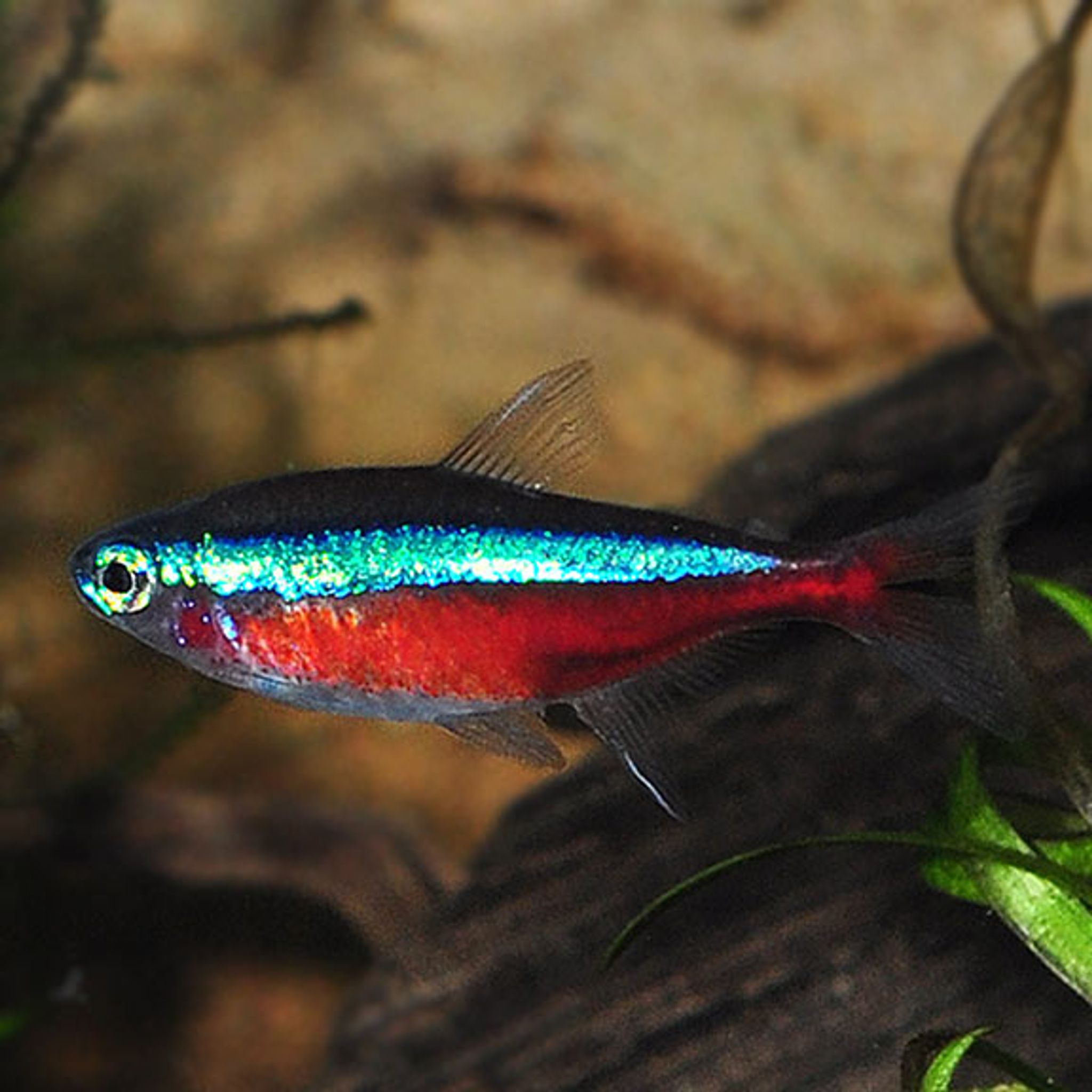

Cardinal Tetra Care Guide: Tank Size, Diet, Water Parameters and Temperament
Cardinal tetras need a 20-gallon (75 L) or larger tank, a group of at least 8, warm soft water around 76–82°F (24–28°C) with a pH of roughly 5.5–6.8, and small meals of micro foods once or twice a day. They are completely peaceful, but they are not the easy starter fish they look like: most are wild-caught and fragile for their first month. Put them in a mature, stable tank and they are easy to keep from then on.
Cardinal Tetra Quick Stats
| Trait | Details |
|---|---|
| Scientific name | Paracheirodon axelrodi (characin family) |
| Adult size | 1.5–2 in (4–5 cm) |
| Lifespan | Typically 4–5 years; longer possible |
| Temperament | Peaceful midwater schooling fish |
| Minimum group | 8+ (6 is the absolute floor) |
| Minimum tank | 20 gal (75 L) long |
| Temperature | 76–82°F (24–28°C) |
| pH | 5.5–6.8 ideal; up to ~7.2–7.5 if stable |
| Hardness | GH under ~6 dGH, KH 0–4 |
| Diet | Micropredator/omnivore |
| Difficulty | Easy once settled, fragile the first month |
Identification: What a Cardinal Tetra Looks Like
The cardinal has an electric blue stripe along the upper body and solid red covering the entire lower flank, from snout to tail. That full-length red band is the fastest way to tell it apart from a neon tetra. Adults reach about 1.5–2 inches (4–5 cm).
Sexing is subtle. Females are rounder and slightly larger, especially seen from above. Males are slimmer and have a tiny hook on the anal fin, which is very hard to see without magnification.
Cardinal Tetra vs Neon Tetra
| Cardinal tetra | Neon tetra | |
|---|---|---|
| Red stripe | Full length of body | Rear half only |
| Size | Slightly larger | Slightly smaller |
| Source | Mostly wild-caught | Captive-bred |
| Hardiness | More sensitive | Hardier |
| Preferred water | Soft, acidic, warm | Tolerates harder, more alkaline, cooler (70s °F) water |
| Cost | Usually higher | Usually lower |
The two can share a tank and will loosely school together, but each species prefers its own kind. If you mix them, settle on about 76–78°F and a pH below 7.
Albino Cardinal Tetra
The albino cardinal is a captive-bred color form with a pale, translucent body, the red stripe, red eyes, and little or no blue. Care is the same, but albinos tend to be more light-sensitive and slightly weaker, so give them dimmer lighting, a dark substrate and plenty of floating cover.
Where Cardinal Tetras Come From
Cardinals live in the upper Rio Negro and Orinoco drainages of Brazil, Colombia and Venezuela. Their home waters are shaded, slow-moving, tannin-stained streams and seasonally flooded forest. That water is very soft, very acidic and warm, often in the low to mid 80s °F. Similar shaded, soft, acidic habitats occur across the Amazon basin, including in Peru, which is why so many South American tropicals share these care needs.
The Rio Negro Fishery
The annual flood cycle drives mass spawning in the flooded forest. Most collecting happens as the water recedes, roughly August through February. The species reached the aquarium hobby in the 1950s, and today a community-based fishery around the town of Barcelos provides a major share of local income.
For buyers who care about ethics, research indicates this fishery is sustainable and gives local people a financial reason to protect the forest instead of clearing it. Buying wild cardinals, done responsibly, can support conservation.
Temperament and Group Size
Cardinals are fully peaceful and spend most of their time in the middle of the water column. They never bother tankmates, but they need company of their own kind. Kept in groups of 3–4, or in a bright, bare tank, they turn shy and pale and hide.
Advice on group size ranges from 5 up to 10. Aim for 8 or more; 10–12+ is better. Bigger groups school more tightly and show stronger color.
Tank Size and Setup
Recommendations run from 10 all the way to 40 gallons. A 20-gallon (75 L) long is the sensible minimum for a proper group of 8–10. After that, add roughly 2 gallons (7.5 L) per extra fish. A long, shallow footprint serves them better than a tall tank. A 10-gallon (38 L) can hold about six, but only for experienced keepers who can keep it very stable.
Only Add Them to a Mature Tank
This matters more than anything else in the guide. Add cardinals only to a fully cycled, established tank, ideally one that has been running for several months. A brand-new tank is the most common reason cardinals die suddenly in their first week.
Aquascape
- Dense planting with fine-leaved species along the back and sides
- Floating plants to shade the surface; cardinals color best under them
- Driftwood and leaf litter such as catappa or oak leaves
- Dark sand substrate
- An open swimming lane through the middle
- Dim to moderate light
Filtration and Gentle Flow
Cardinals come from slow water and tire in strong current. Good options include:
- A sponge filter, which is gentle and safe for tiny fish
- A hang-on-back or canister with a flow control knob, baffle or spray bar
- Pointing the outflow at the glass or surface to break it up
- A pre-filter sponge over intakes
Leave at least one calm zone where the fish can hover without fighting current. You can compare aquarium filters on FishyHub if your current unit pushes too much water.
Lighting
Modern LEDs do not harm fish eyes as long as the intensity is moderate and the fish have shade to retreat to. Run lights 8–10 hours a day on a timer. Do not leave lights on overnight; fish need real darkness. A brief dim blue "moonlight" setting for evening viewing is fine.
Water Parameters
| Parameter | Target | Notes |
|---|---|---|
| Temperature | 76–82°F (24–28°C) | Broad range quoted 73–84°F; avoid below 73°F |
| pH | 5.5–6.8 | Tolerates ~7.2–7.5 if stable |
| GH | Under ~6 dGH | Captive-acclimated fish tolerate moderate hardness |
| KH | 0–4 dKH | Low KH means pH can crash; monitor |
| Ammonia / nitrite | 0 ppm | Always |
| Nitrate | Under 20 ppm | Cardinals tolerate waste less well than neons |
Sources disagree on the ideal pH, from as low as 4.0 to strictly 5.5–6.5. What matters more is that pH stays stable. A steady tap-water pH is safer than chasing low numbers with acid or buffer products, because sudden swings kill more cardinals than a slightly high pH does.
Cardinals handle warmth well, which makes them good companions in discus and ram tanks.
Working With US Tap Water
Many US municipal water supplies are hard and alkaline. Test GH and KH first, before you buy fish. If your tap water is hard:
- Blend with RO water (or clean collected rainwater) to bring GH down gradually
- If you use pure RO, add a remineralizer so the water isn't completely empty of minerals
- Mix and match temperature and pH before every water change
- Use botanicals to soften and tint the water naturally
Blackwater and Tannins
Cardinals do not need blackwater, but they benefit from it. Leaves, alder cones and driftwood release tannins and humic substances that soften and acidify water and tint it amber. These may reduce stress and have mild antimicrobial effects.
Two cautions: in low-KH water, tannins can push pH into a sudden crash, and decaying botanicals can raise ammonia. Add them gradually and remove anything that turns to mush.
Diet and Feeding
Cardinals are micropredators/omnivores with very small mouths. Build the diet around:
- Staple: quality micro-pellets or crushed flake
- Frozen or live extras: baby brine shrimp, daphnia, cyclops, chopped bloodworm, mosquito larvae
Feed 1–2 small meals a day, offering only what disappears in about 2–3 minutes. Some keepers feed up to 3–4 tiny portions, and a small extra feed is reasonable in warm tanks where metabolism runs faster. Large flakes and overfeeding lead to bloating and nitrate spikes. Browse fish food and supplements on FishyHub for micro-sized staples and frozen or freeze-dried treats.
Tankmates
Good choices share the same calm, soft-water lifestyle:
- Other small tetras, rasboras, pencilfish and hatchetfish
- Corydoras, otocinclus and kuhli loaches
- Dwarf cichlids such as rams and apistogrammas
- Discus
- Shrimp and snails
Avoid anything that nips fins or can swallow a 1.5-inch (4 cm) fish. Adult angelfish are a known risk; add cardinals only at full size, and accept that losses can still happen.
Bettas: a calm betta can sometimes live with a cardinal group in a 20+ gallon (75+ L) tank, since both like warmth. But harassment happens, long-finned rosetail types are slow swimmers, and cardinals occasionally nip them. (The name is pronounced "BET-uh.")
Example Stocking Plans
| Tank | Cardinal group | Suggested companions |
|---|---|---|
| 20 gal (75 L) long | 8–12 cardinals | 5–6 small corydoras, 2–3 otocinclus, nerite snails |
| 29 gal (110 L) | 15–20 cardinals | 6 corydoras, a pair of apistogrammas or rams, a few otocinclus, shrimp |
Keep everything else lightly stocked so waste stays low.
Are They Good Schooling Fish for Beginners?
Cardinals often show up on beginner lists, but they work better as a second-step fish. Neon tetras, harlequin rasboras, rummynose tetras and similar species are easier starters. Whatever you choose, buy one species in a group of 6–10+.
Acclimation and the First 30 Days
Most cardinal losses happen in the first weeks and come from shipping stress, not old age.
First-30-days checklist:
- Ask the store how long the fish have been in; choose fish that have been there a week or more.
- Drip acclimate slowly over an hour or more with the lights dimmed.
- Quarantine for 2–4 weeks where possible, in a mature, planted or sponge-filtered tank.
- Feed lightly, just small amounts of micro food and baby brine shrimp.
- Watch daily for white spots, clamped fins, lagging or pale fish.
- Test ammonia, nitrite and nitrate several times a week.
- Make only small, matched water changes; no big parameter shifts.
- Move them to the display tank once they're eating well and showing full color.
Maintenance
Change 15–25% of the water weekly using dechlorinated water matched for temperature and pH. Small, regular changes are far safer than big, occasional ones. Vacuum lightly around plants and remove decaying leaves.
Lifespan
Cardinals typically live 4–5 years. Well-kept fish can go past 5, and there are rare reports close to 10.
Breeding Cardinal Tetras
Breeding is difficult but possible:
- A separate, dark 5–10 gallon (19–38 L) tank
- Very soft water (GH ~1–2), pH 5–6, about 80–82°F (27–28°C)
- RO water with peat or tannins
- Fine-leaved plants or a spawning mop
- Condition the pair with live foods
Cardinals are egg scatterers that spawn in dim light, laying 100–500 eggs. Remove the parents afterward. Eggs hatch in about a day and are light-sensitive, so keep the tank dark. Fry become free-swimming in 3–5 days and need infusoria first, then baby brine shrimp.
Health Problems
- Ich: white spots, often right after purchase. Raise the temperature gradually to about 84–86°F (29–30°C) and treat; cardinals tolerate the heat fairly well.
- Fin rot and columnaris: usually linked to poor water quality.
- Dropsy: swelling and raised scales.
- Neon tetra disease (Pleistophora): one fish discolored, with a curved spine or lagging behind. It cannot be treated, so isolate and remove affected fish.
Common Mistakes and Troubleshooting
- New tank: sudden deaths in week one. Wait until the tank is cycled and stable.
- Group of 3–4: hiding and faded color. Increase the group.
- Hard, alkaline tap water: poor color and shorter life. Blend with RO or remineralized soft water and add botanicals.
- Chasing pH with chemicals: swings kill. Adjust slowly.
- Pale at night: normal when resting or briefly stressed. Paleness that doesn't go away points to water quality or bullying.
- Big flakes, too much food: bloating and nitrate spikes.
Buying Cardinal Tetras in the US
Most cardinals sold in the US are wild-caught. They are usually inexpensive per fish and cheaper in bulk; albino and captive-bred fish cost more. Ask how long the batch has been in the store, and pass on tanks with dead or pale fish. You can browse tetras on FishyHub to compare what's available.
Frequently Asked Questions
How many cardinal tetras can go in a 10, 20 or 29 gallon tank?
About 6 in a 10-gallon (38 L), and only for experienced keepers with a very stable tank. A 20-gallon (75 L) suits 8–12, and a 29-gallon (110 L) can hold 15–20, with the rest of the tank lightly stocked.
Why are my cardinal tetras dying?
Usually it's shipping stress, an uncycled tank, or unstable or hard water. Buy fish that have been in the store for a week or more, acclimate slowly and add them only to a mature tank. If one fish has a curved spine and faded color, suspect neon tetra disease and isolate it.
Can cardinal tetras live with neon tetras or shrimp?
Yes to neons: their needs are similar, so aim for about 76–78°F and a pH below 7. Adult shrimp are safe with cardinals, but shrimplets may be eaten.
Will angelfish eat cardinal tetras?
Adult angelfish can eat small cardinals. If you want both, add cardinals at full adult size and accept some risk.
Do cardinal tetras lose color at night?
Yes. They pale while resting in the dark, and the color returns once the lights come on. Paleness that lasts through the day signals stress or water quality problems.
Are cardinal tetras good for beginners?
Yes, once the tank has matured. They are not a good first fish for a brand-new setup. Start with hardier species and add cardinals after the tank has been stable for a few months.
Build Your Cardinal Community
Cardinals repay a mature, softly lit, stable tank with tight schooling and some of the brightest color in freshwater. Once your water is dialed in, browse FishyHub's small community fishes to plan the cardinal group and their peaceful tankmates.


