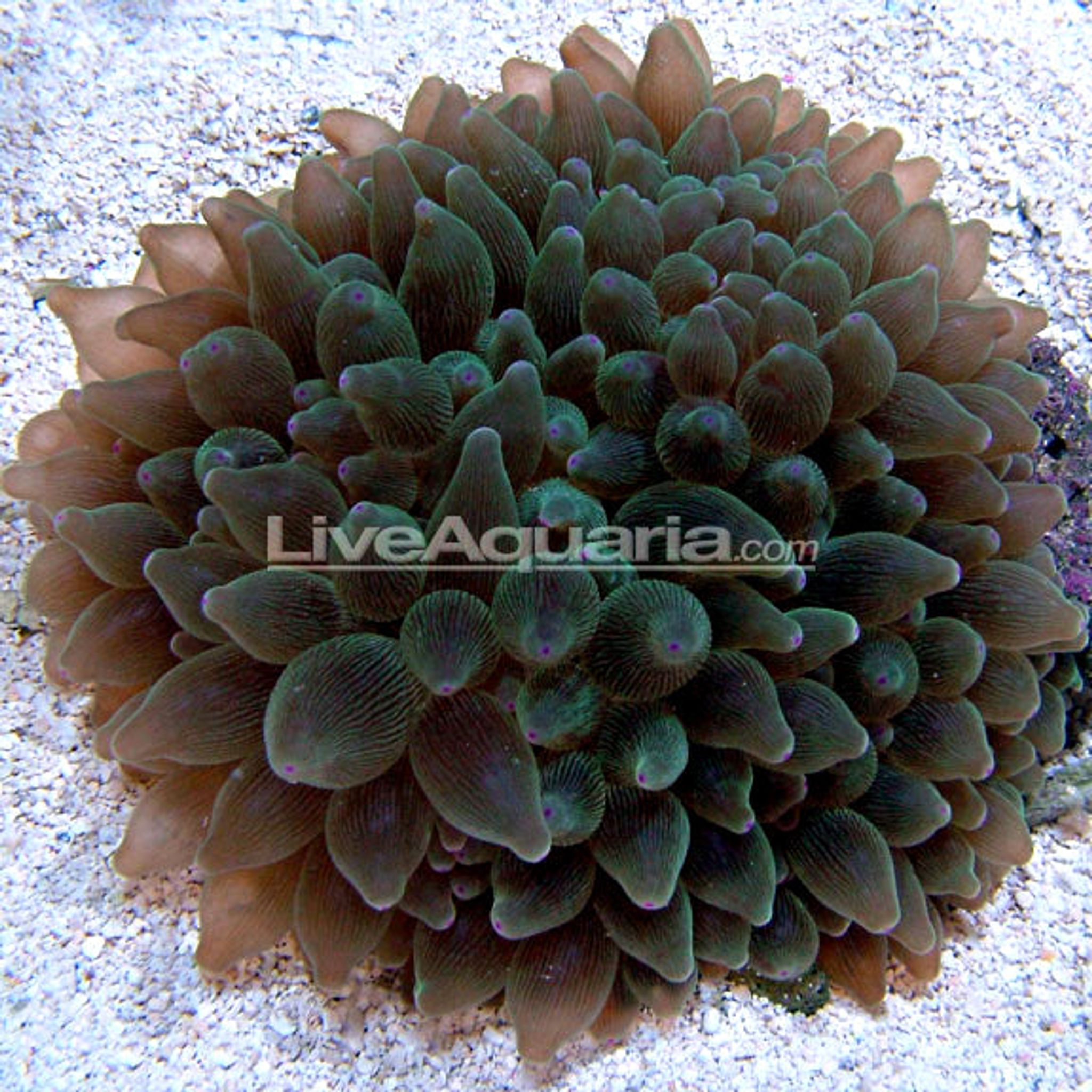

Bubble Tip Anemone Care Guide: Tank Requirements, Feeding and Compatibility
The bubble tip anemone (Entacmaea quadricolor) is often called the most approachable anemone for reef keepers, but "approachable" still means an established, stable tank rather than a true beginner setup. This guide walks through tank size, water parameters, lighting, feeding, placement and clownfish pairing so you can decide whether your system is ready and know what to do once the animal is in it.
What Is a Bubble Tip Anemone?
Entacmaea quadricolor, sold as the BTA or Rose BTA, gets its name from the bulb- or pear-shaped swelling at the tip of each tentacle. Those bulbous tips form under good light and flow; in weaker conditions the same anemone can go slender and stringy instead — one of the first visual clues something needs adjusting.
Common color morphs include:
- Brown or tan (the wild-type coloration)
- Green
- Red
- Rose or pink
- "Orange" and other aquacultured designer strains
A healthy adult can reach roughly 12 inches (30 cm) across the oral disc. In captivity, a well-run tank can keep one alive for 10+ years, and wild individuals are believed to live for decades — so this is a long-term commitment, not a short-lived showpiece.
Aquacultured, tank-raised specimens are increasingly available alongside wild-collected ones. Beyond the sustainability angle, they're often already adjusted to captive lighting and handling, which can make them a hardier starting point — though genetics and color morph both affect how forgiving an individual anemone turns out to be.
Is Your Tank Ready? Maturity and Size
The single biggest predictor of early anemone death is adding one to a tank that isn't ready. Most experienced keepers recommend a tank be fully cycled and running at least 6 months before an anemone goes in, giving biological filtration and rockwork time to stabilize.
Tank size guidelines:
| Setup | Minimum size | Notes |
|---|---|---|
| Single BTA | ~30 gallons (114 L) | Absolute floor; leaves little buffer for parameter swings |
| Single BTA, comfortable | 50+ gallons (190+ L) | More stable water chemistry, more room to roam |
| Multiple BTAs or BTA + corals | 75+ gallons (284 L) | Space to avoid stinging neighbors as anemones wander |
Larger volume matters because bigger water bodies resist the swings in temperature, salinity and nutrients that stress an anemone — stability matters more than hitting one perfect number.
Water Parameters
BTAs need reef-standard, stable water chemistry:
| Parameter | Target range |
|---|---|
| Temperature | 75–80°F (24–27°C) |
| Specific gravity | 1.023–1.026 |
| pH | 8.1–8.4 |
| Alkalinity | ~8–12 dKH |
| Ammonia / nitrite | 0 ppm |
| Nitrate | Under ~20 ppm (lower is better) |
| Phosphate | Under 0.03–0.1 ppm |
These numbers aren't arbitrary. The anemone hosts symbiotic algae called zooxanthellae in its tissue, and excess nitrate or phosphate can throw off that algae's growth and the anemone's coloration long before it shows up as an obvious "water quality problem." Keeping nutrients low and stable protects the symbiosis, not just the water test results.
Lighting: Feeding the Symbiosis
Zooxanthellae photosynthesize and pass sugars back to the anemone, which is why light is treated almost like a second food source. BTAs need moderate-to-high intensity, generally cited as roughly 150–350 PAR depending on where the anemone ends up in the tank — a specimen sitting higher on the rockwork needs less intensity than one settled near the sandbed.
Because the exact number shifts with placement depth, treat the range as a guide rather than a fixed target, and always acclimate slowly under strong reef LEDs:
- Reduce light intensity and/or photoperiod when the anemone first goes in
- Ramp both back up gradually over 1–2 weeks
- Watch for paling or retraction as a sign to slow down
A common, preventable cause of early bleaching is moving an anemone straight from a dim retail or transport tank into a bright home reef system without this step — the shock hits the zooxanthellae before the anemone visibly reacts.
Flow and Placement
BTAs want moderate, indirect, turbulent flow — enough to deliver food and oxygen and keep detritus off the tentacles, but not a direct laminar jet that constantly deflates it or tears tissue.
Rather than forcing an anemone into a spot you've picked, provide varied rockwork with crevices at different depths and flow zones, then let it choose. Expect relocation in the first days or weeks as it tests options — this is normal search behavior, not a warning sign on its own.
Proactive rockscaping matters here. A stressed, wandering anemone can settle into a worse spot than where it started — for example, drifting toward a dark overflow or a low-flow dead zone — creating a negative feedback loop. Screening equipment and offering good options elsewhere in the tank heads this off before it starts.
Protect Your Equipment
BTAs are mobile and can wander into unguarded intakes, where they're often shredded or killed — this is one of the most common causes of anemone death in home aquariums. Before adding one:
- Screen or guard powerhead intakes
- Screen overflow boxes
- Screen skimmer intakes
Feeding a Bubble Tip Anemone
Target-feed meaty marine proteins 1–3 times per week, with twice weekly a reasonable middle ground. Well-lit anemones getting strong zooxanthellae output typically need less supplemental feeding than those under lower light, so treat frequency as a range to adjust rather than a fixed rule.
Suitable foods:
- Mysis shrimp
- Chopped table shrimp, fish, or squid
- Silverside pieces
- Marine pellets formulated for anemones
Deliver food directly to the oral disc or tentacles with a turkey baster, pipette, or feeding tongs, and remove anything uneaten after 20–30 minutes so it doesn't foul the water. Avoid freshwater feeder foods, and don't drop in oversized chunks that go uneaten and rot. A hosting clownfish reduces — but doesn't eliminate — the need for supplemental feeding, since the fish brings in scraps and adds waste the anemone can use.
Handling and Acclimation
Drip-acclimate a new bubble tip anemone over 1–2+ hours rather than a quick float-and-dump. Handle it as little as possible:
- Wear gloves — nematocyst stings can irritate skin, especially near cuts
- Never force it off rockwork with bare hands; tearing the foot can be fatal
- If relocation is genuinely necessary, coax it gently with indirect flow, or simply wait — it will often move on its own
A note on quarantine: freshwater or iodine dips are debated even for corals, and there's little specific protocol published for anemones. A cautious approach is to skip aggressive dipping for anemones and instead rely on a careful visual inspection and a longer observation period before adding one to a display tank.
Compatibility With Clownfish
BTAs host a wide range of clownfish species in captivity, and ocellaris and percula clowns readily accept them even though the BTA isn't their most common host in the wild — that role tends to go to maroon clownfish. In nature, specific clownfish species often pair with specific anemone species; percula and ocellaris more frequently pair with other anemone species outside the aquarium trade. Captive breeding relaxes these preferences, and captive-bred clowns often accept whichever suitable anemone is offered.
Pairing is common but not guaranteed, and it isn't a requirement for the anemone's health — it gets most of its nutrition from zooxanthellae and target feeding regardless. Hosting can happen within hours or take weeks to months, and some captive-bred clowns with no anemone experience never host at all. That's a normal outcome, not a failure on your part.
Browsing options for pairing is easiest when you can compare species side by side, such as through FishyHub's clownfish selection alongside the anemone category.
The Two-Way Symbiosis
The clownfish relationship is a genuine mutualism: the clownfish gets a stinging shelter from predators, while the anemone benefits from the fish's waste nutrients, improved water movement around its tentacles from the fish's swimming, and some protection from anemone-eating fish. It's a separate relationship from the anemone's own symbiosis with zooxanthellae, which supplies sugars through photosynthesis in exchange for shelter, nutrients and carbon dioxide.
Clownfish aren't the only creatures that associate with anemones. Certain cleaner shrimp and anemone crabs also live commensally among the tentacles, giving reef keepers other compatible tankmate ideas if a clownfish pairing doesn't happen right away — worth checking FishyHub's broader marine invertebrates selection for candidates.
Sting Risk to Other Tankmates
A BTA's sting is generally mild to people but can injure or kill fish and corals that brush against it. Because the anemone will move over time, keep generous clear space — several inches up to a good portion of the tank's footprint depending on tank size — between it and any coral colonies, and reassess that spacing whenever it relocates.
Don't Confuse BTAs With Tube Anemones
Tube anemones (Ceriantharia) look superficially similar but belong to an entirely different, unrelated group. They're free-living animals in a mucus tube rather than attached to rock, they aren't considered reef-safe, and they sting aggressively enough to be a real risk to fish and corals. When shopping, confirm you're looking at a true anemone species rather than a tube anemone before adding one to a mixed reef tank.
How BTAs Compare to Other Anemones
BTAs have a reputation as one of the hardier, more adaptable anemones available in the hobby. A quick comparison against other common species:
| Anemone type | Relative size | Sting strength | Difficulty vs. BTA |
|---|---|---|---|
| Bubble tip (BTA) | Medium | Moderate | Baseline |
| Long-tentacle (LTA) | Medium-large | Moderate-strong | Somewhat harder |
| Sebae | Large | Moderate | Harder, less tolerant of swings |
| Carpet | Large | Strong | Notably harder |
| Magnificent/Ritteri | Large | Strong | Notably harder |
Carpet Anemones: A Step Up
Carpet anemones grow larger, sting more strongly, and tolerate parameter swings less well than BTAs, even though they can host multiple clownfish species at once. For that reason, most experienced keepers point beginners toward a BTA first and treat carpets as a species to work up to once a tank has a longer track record.
Common Mistakes to Avoid
- Adding a BTA too early. An immature or unstable tank is the leading cause of early death or bleaching.
- Unscreened intakes. Pumps, powerheads and overflows can pull in and destroy a wandering anemone.
- Placing it too close to corals. Stings can damage or kill neighboring colonies as the anemone moves.
- Forcing it off the rock. Bare-hand removal or pulling can tear the foot and be fatal.
- Overfeeding. Uneaten food rotting in the tank spikes ammonia and nitrate on an animal that's already parameter-sensitive.
- Insufficient light. Leads to shrinking, pale coloration and long stringy (rather than bulbous) tentacles.
- Mistaking wandering for distress. Early relocation is normal; true distress looks like deflation, bleaching, a gaping mouth, foul odor, or tentacles that won't retract to stimulus.
- Expecting instant clownfish hosting. Don't force fish into the anemone — let pairing happen on its own timeline.
- Splitting a stressed or poorly fed anemone. This sharply increases the odds both halves die instead of healing.
Propagation and Splitting
Bubble tip anemones reproduce asexually through longitudinal fission — the animal elongates and pulls itself apart into two genetically identical anemones. This happens naturally and opportunistically in healthy, well-fed specimens; it isn't something that occurs on a predictable schedule, and reports of how "easy" it is vary partly because natural splitting in home tanks is genuinely uncommon compared with how often it's discussed.
Manual fragging is a separate, more controllable option for a large, well-established, well-fed individual:
- Use a sharp, clean blade to cut through the foot and column.
- Make sure each half retains part of the mouth/oral disc and part of the foot.
- Move both halves to a recovery area with lower flow, dimmer light and minimal disturbance.
- Expect days to weeks for healing, with reduced feeding response during that time.
Splitting is stressful even under ideal conditions, so only attempt it on a healthy, mature specimen — not one that's already small, stressed, or underfed. There's also a subtler form of asexual reproduction called pedal laceration, where small tissue fragments left behind as the anemone moves can grow into new, tiny anemones — one reason BTAs sometimes seem to "multiply" without any deliberate fragging.
Frequently Asked Questions
Do I need a clownfish for a bubble tip anemone to survive?
No. The anemone gets most of its nutrition from zooxanthellae and target feeding, so a clownfish is a bonus companion rather than a requirement for survival.
How long before a bubble tip anemone hosts my clownfish?
It can happen within hours of introduction or take several weeks to months, and some captive-bred clownfish never host an anemone at all. Any of these outcomes is normal.
Why does my bubble tip anemone keep moving around the tank?
This is typically normal behavior while it searches for its preferred combination of light and flow, especially soon after introduction. Persistent wandering combined with shrinking or paling, though, suggests parameters, lighting, or flow need adjustment.
Can a bubble tip anemone sting me or my fish?
Yes. The sting is generally mild to people, though it can irritate sensitive skin or open cuts, and it can injure or kill fish and corals that brush against it — use gloves when handling and keep distance from corals.
What is the difference between a bubble tip anemone and a carpet anemone?
Carpet anemones grow larger, sting more strongly, and tolerate parameter swings less well than the hardier BTA, making them a step up in difficulty for most reef keepers.
How do you propagate or split a bubble tip anemone?
A healthy, well-fed anemone can split naturally through longitudinal fission on its own schedule, or a keeper can manually cut a large, well-fed specimen through the foot and column with a sharp blade so each half keeps part of the mouth and foot, then let both halves recover under low flow and dim light.
What size tank does a bubble tip anemone need?
A single BTA can go into roughly 30+ gallons as an absolute minimum, but 50+ gallons offers more stable parameters and enough room for it to roam without stinging tankmates.
What do bubble tip anemones eat?
Meaty marine foods — mysis shrimp, chopped fresh or frozen shrimp, fish, squid, and anemone-formulated pellets — target-fed roughly 1–3 times a week.
Ready to start planning your setup? Browse bubble tip anemones and other reef invertebrates in FishyHub's marine livestock selection.


