
Bolivian Ram Care Guide: Tank Size, Diet, Water Parameters and Temperament
The Bolivian ram (Mikrogeophagus altispinosus) is the dwarf cichlid to reach for if you've struggled with the pickier German blue ram or with soft, acidic water setups. This guide covers tank size, temperature, pH, diet, tank mates, and breeding in gallons, °F, and inches so you can set up with confidence on typical US tap water.
Quick Facts
| Trait | Range |
|---|---|
| Also called | Butterfly ram, Bolivian butterfly cichlid, ruby cichlid |
| Adult size | ~3 in; males to 3.5-4 in, females ~2.5 in |
| Lifespan | About 4 years, up to 5-6 with excellent care |
| Minimum tank | 20 gal long for one pair; 30 gal+ recommended |
| Temperature | 74-80°F day to day; 77-82°F for spawning |
| pH | 6.0-7.5 (6.5-7.0 ideal) |
| Hardness | GH under ~12 dGH (about 50-200 ppm); KH 0-10 dKH |
| Diet | Omnivore, bottom feeder |
| Temperament | Peaceful, shy, mildly territorial only when spawning |
| Difficulty | Beginner to intermediate |
Identification and Origin
Bolivian rams are also sold as butterfly rams, Bolivian butterfly cichlids, or ruby cichlids. The genus name Mikrogeophagus means "small earth-eater," a nod to how they sift mouthfuls of sand through their gills while foraging. In the wild, they live in the upper Rio Madeira basin spanning Bolivia and western Brazil, in shallow, sandy, slow-moving water — a habitat worth mimicking at home.
Adults reach about 3 inches, with males occasionally hitting 3.5-4 inches and females staying closer to 2.5 inches. Expect a lifespan around 4 years, stretching to 5-6 years under excellent care.
What They Look Like
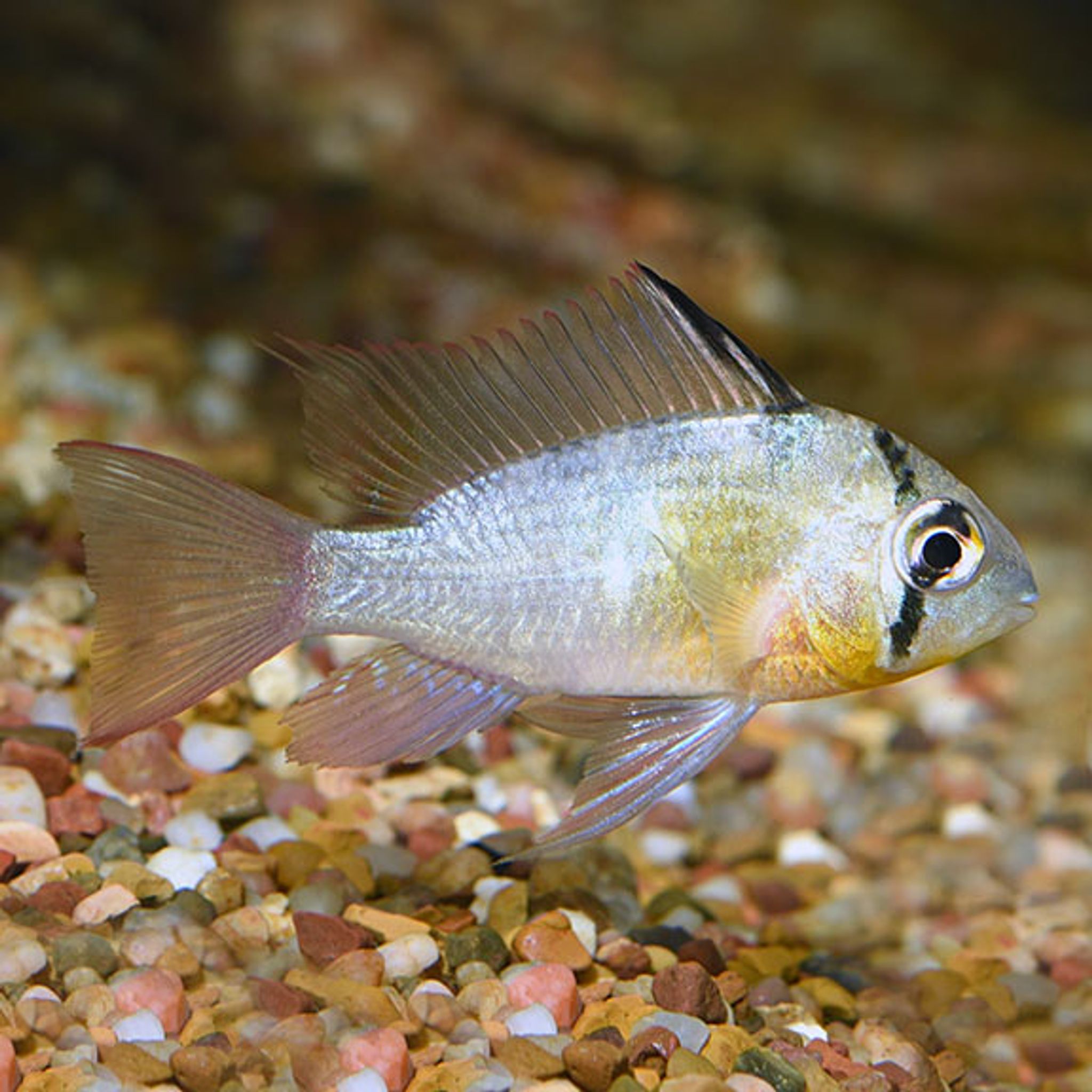
Bolivian rams show a tan-grey to bluish body with a gold or yellow belly, a black bar running through the eye, a dark spot at mid-body, red edging on the fins, and a tall spiny first dorsal ray. Their coloring is more muted than a German blue ram's — subtler, but no less attractive once settled in.
Tank Size and Setup
Floor area matters more than height, since Bolivian rams spend most of their time near the bottom. A 20-gallon long tank (30-inch footprint) works for a single pair, but a 30-gallon is the better minimum for long-term stability. Add roughly 5-10 gallons per additional fish, and for a group of six or more, aim for 40-55 gallons.
| Setup | Suggested tank |
|---|---|
| Single fish or bonded pair | 20 gal long (minimum) |
| Pair with a few tank mates | 30 gal |
| Group of 6+ in a community | 40-55 gal |
Substrate is non-negotiable: use fine, soft sand. Sharp or coarse gravel can damage their gills and mouths as they sift through it looking for food — this is one of the most common setup mistakes.
For decor, include driftwood, a couple of smooth flat stones or a slate piece for spawning, some caves, and plants around the tank edges — Java fern, anubias, and Amazon sword all work well, along with floating plants to soften the light. Leave an open sand patch at the front for foraging.
Filtration should be gentle to moderate: a sponge filter or a hang-on-back unit with the outflow baffled, aiming for roughly 4-5x tank volume per hour. Pair that with subdued lighting — Bolivian rams are shy under bright light with no cover to retreat to. You can browse gravel and sand substrate options suited to a soft-sand setup.
Water Parameters
Stability matters more than hitting an exact number. Keep these ranges as your target:
- Temperature: 74-80°F day to day; 77-82°F encourages spawning. Bolivian rams tolerate the low 70s noticeably better than most other rams.
- pH: 6.0-7.5, with 6.5-7.0 considered ideal.
- GH: under about 12 dGH (roughly 50-200 ppm).
- KH: 0-10 dKH.
- Ammonia and nitrite: 0 ppm, always.
- Nitrate: ideally under 20 ppm.
Change 25-30% of the water weekly. Bolivian rams are hardy, but cichlids still respond poorly to nitrate creep, so don't skip water changes just because the fish look fine.
pH, KH, and Working With US Tap Water
pH measures acidity; KH (carbonate hardness) is the buffering capacity that keeps pH from swinging. Much US tap water runs pH 7.5 or higher, and Bolivian rams tolerate that well — unlike German blue rams, they don't demand soft, acidic water to thrive.
If you want to nudge pH lower, driftwood, catappa (Indian almond) leaves, peat in the filter, or blending in some RO water with your tap water all work gradually. Whatever method you choose, change pH slowly — no more than about 0.2-0.3 per day — and resist chasing an exact number with chemical buffers. A stable, slightly high pH beats a "perfect" number that swings.
Ammonia, Nitrite, Nitrate, and Chlorine
Always cycle the tank fully before adding fish — Bolivian rams should never go into a new, uncycled setup. Ammonia and nitrite need to read 0 ppm, and nitrate should stay under 20-40 ppm. Dechlorinate every water change, since most US city water contains chloramine, which needs a dechlorinator formulated to break the chlorine-ammonia bond, not just remove chlorine.
If you see an ammonia spike, do a 30-50% water change immediately, cut back on feeding, and check for a dead fish or rotting food hidden in the substrate or decor.
Keeping Temperature Steady
Use a heater rated for roughly 3-5 watts per gallon — about 100W for a 20-30 gallon tank, or 150-200W for a 40-55 gallon tank — or run two smaller heaters for redundancy. A heater guard prevents fish from resting against the glass and getting burned. Never bury a standard heater under the sand; it can crack or overheat. Keep a separate thermometer to verify the heater's own display, and in cold US winters, consider a controller or backup heater since a single failed unit can chill a tank fast.
When doing water changes, keep the new water within about 2°F of the tank, and test weekly with a liquid test kit rather than relying on guesswork.
Diet and Feeding
Bolivian rams are omnivorous bottom feeders. Base their diet on quality sinking pellets or granules, and supplement with frozen or live bloodworms, brine shrimp, daphnia, mysis shrimp, and chopped earthworm. Floating flakes are often missed entirely, since these fish rarely feed at the surface.
Feed small amounts 2-3 times a day — only as much as they finish in about two minutes. A weekly fasting day is a good habit to prevent overfeeding and keep digestion healthy.
Temperament and Tank Mates
Bolivian rams are peaceful and somewhat shy, only turning territorial when spawning — and even then, they typically just chase intruders off a small patch rather than causing real harm. They rarely bother plants.
They do fine kept singly, as a pair, or in a group of six or more in a large enough tank, where a bigger group spreads out any minor squabbles. Pairs tend to form naturally out of a juvenile group over time.
Good tank mates include peaceful, similarly sized, mid-water fish:
- Rummynose, emperor, black neon, or lemon tetras
- Pencilfish, hatchetfish, rasboras
- Cherry barbs, dwarf gouramis
- Corydoras, otocinclus, bristlenose pleco, kuhli loaches
- Livebearers, as long as the water isn't kept too soft
Browse tetras or corydoras for solid, compatible additions.
Avoid large or aggressive cichlids, fin-nippers like tiger barbs and serpae tetras, tiny shrimp or fry (which will simply be eaten), and other dwarf cichlids in small tanks — Apistogramma can work, but only in 40+ gallon tanks with separated territories.
Bolivian Ram vs. German Blue Ram
| Bolivian ram | German blue ram | |
|---|---|---|
| Size | ~3 in | ~2 in |
| Temperature | 74-80°F | 80-86°F |
| Water needs | Tolerant, moderately hard OK | Soft, warm, very stable |
| Hardiness | Higher | Lower |
| Pairing | Easier | More finicky |
| Color | More muted | More vivid |
If you keep losing German blue rams to water swings, the Bolivian ram is usually the fix — it's built for exactly the kind of moderate, stable tap water most US homes already have.
Dwarf Cichlid Overview for Beginners
Dwarf cichlids are generally defined as species under about 4 inches, native to South America or West Africa. Among them, the forgiving beginner picks are the Bolivian ram, kribensis, Apistogramma cacatuoides, and keyhole cichlid. Harder options to save for later include German blue rams, most wild Apistogramma species, and checkerboard cichlids. You can explore other options in the Angelfish, Discus, Rams & Cichlids category or the American Cichlids subcategory.
Sexing and Breeding
Sexing: Males are larger and slimmer, with longer dorsal filaments and tail streamers. Females are rounder, with a pinkish or red belly. Venting (checking the small papilla near the vent) shows a pointed shape on males and a blunt one on females.
Breeding: Bonded pairs spawn in open water, laying 100-300 eggs on a flat stone. Eggs hatch in 2-3 days, and fry become free-swimming after another 5-8 days. Feed newly free-swimming fry baby brine shrimp or microworms. Both parents guard the brood for weeks, and fry typically reach about 1.5 inches by 6 months. A dedicated 20-30 gallon breeding tank improves fry survival significantly.
It's common for young, inexperienced pairs to eat their first few clutches — this usually resolves after a few spawning attempts. Reducing disturbance around the tank and adding a few dither fish can help pairs settle into successful spawning.
Health and Common Problems
- Ich: Raise the temperature gradually to 84-86°F and treat alongside a medication suited for the parasite.
- Bacterial infections: Usually linked to poor water quality — stay on top of water changes.
- Hole-in-the-head disease: Associated with poor water or nutrition; address both.
- Gill flukes: Signs include rapid gill movement, flared or reddened gills, flashing (rubbing against décor), and gasping at the surface. Treat with praziquantel in a quarantine tank or the main tank, and always quarantine new arrivals.
Quarantine any new fish for 2-4 weeks before adding them to an established tank.
Stress Checklist
Watch for hiding combined with faded color, clamped fins, rapid breathing, spitting out food, or glass surfing. If you spot these signs, check:
- Water parameters (ammonia, nitrite, nitrate, temperature)
- Bullying from tank mates
- Lighting that's too bright with too little cover
- Too few hiding spots
- Temperature swings
Common Mistakes to Avoid
- Using gravel instead of sand, leading to gill damage and frustrated foraging.
- Adding rams to an uncycled tank.
- Feeding only floating flakes, so mid-water fish snatch the food and the rams go thin.
- Housing them with fast, pushy eaters or fin-nippers.
- Keeping two males in a small tank, which causes persistent chasing — add hiding spots or rehome one.
- Bright, bare tanks that keep rams hiding and pale; add floating plants and driftwood.
- Buying skinny, pale fish, which often signals internal parasites — quarantine before adding to your main tank.
- Chasing an exact pH with chemicals instead of accepting a stable, slightly higher number.
Buying Tips
Look for active fish with full bellies and no pinched, sunken look to the head. Hobby-bred Bolivian rams generally adapt to tank life better than wild-caught specimens. Note that a "hop, then stop" swimming pattern near the substrate is completely normal for this species and isn't a sign of illness.
Handy Conversions
- dGH to ppm: multiply dGH by 17.9
- °C to °F: multiply by 1.8, then add 32
Frequently Asked Questions
Are Bolivian rams good for beginners?
Yes — they're widely considered the easiest ram species to keep, as long as they go into a fully cycled tank with stable parameters rather than a brand-new setup.
How many Bolivian rams should I keep?
One pair works well, and so does a single fish. For a group, aim for 5-6 or more in a 40-gallon or larger tank so any squabbling gets spread out.
Can Bolivian rams live with shrimp?
Adult Amano shrimp usually do fine alongside them, but cherry shrimp and any shrimplets are at real risk of being eaten.
Can they live with angelfish or German blue rams?
Angelfish can work in a large, tall tank. German blue rams are best avoided as tank mates since they need noticeably warmer, softer water than Bolivian rams prefer.
Will Bolivian rams eat or dig up my plants?
They rarely eat plants, but their sand-sifting habit can uproot them. Anchor plants with root tabs or pots, or attach them to driftwood instead of planting directly in the substrate.
Why is my Bolivian ram hiding or pale?
This is typically stress from being new to the tank. Check water parameters, lighting, and tank mates, and give the fish about two weeks to settle before troubleshooting further.
Do Bolivian rams need a heater?
Yes, in most US homes. Any room that regularly runs under about 74°F needs a properly sized heater to keep the tank in range.
Ready to start your setup? Browse live Bolivian rams and other cichlids on FishyHub to find healthy, hobby-bred stock for your tank.


