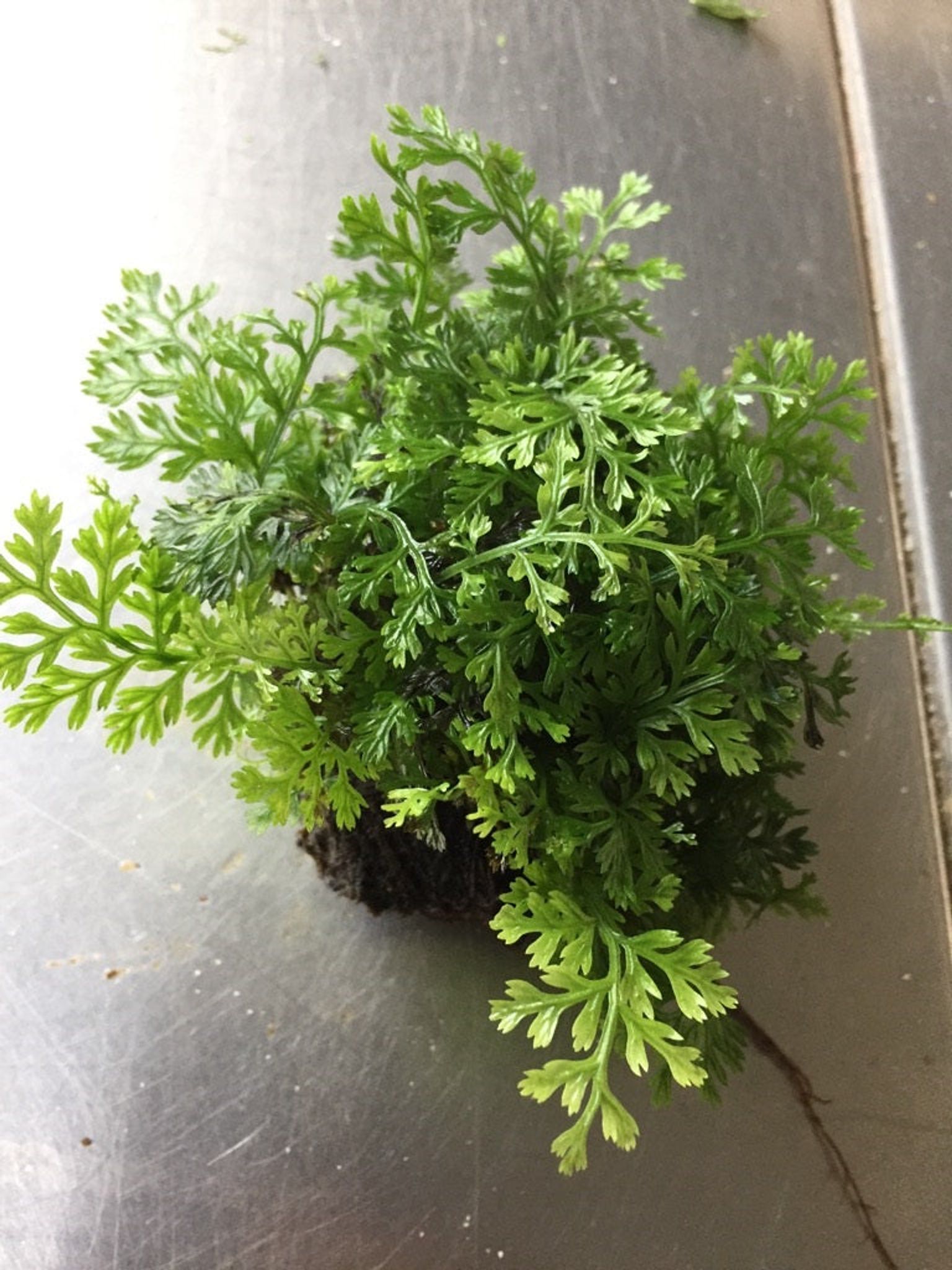
Bolbitis Care Guide: Light, CO2, Substrate and Growth Tips
Bolbitis is one of the most forgiving aquarium ferns you can buy, but it has one rule that trips up almost every new owner: never plant it in the substrate. This guide covers exactly how much light and CO2 it actually needs, how to mount it correctly, and what to expect from its notoriously slow growth so you don't mistake normal behavior for a dying plant.
What Is Bolbitis?
Bolbitis heudelotii, often called the African Water Fern, is the species you'll see most often. It's a rheophyte — in the wild it grows attached to wood and rock in fast-flowing streams rather than rooting in soil. That single fact explains almost everything about how to keep it successfully.
Two smaller relatives are increasingly available for nano tanks:
- Bolbitis heteroclita — a compact form with similar care needs to heudelotii
- Bolbitis difformis — a true dwarf species, typically 3-6 inches (8-15 cm), popular for foreground and midground aquascaping
All three share the same core requirements: no substrate, no CO2 requirement, and a slow, steady growth habit.
Species Comparison
| Species | Mature Size | Best Placement | Light | CO2 |
|---|---|---|---|---|
| Bolbitis heudelotii | 10-20 in (25-50 cm) | Midground to background | Low-medium | Optional |
| Bolbitis heteroclita | Compact, mid-sized | Midground | Low-medium | Optional |
| Bolbitis difformis | 3-6 in (8-15 cm) | Foreground/midground, nano tanks | Low-medium | Optional |
Lighting Requirements
Bolbitis wants low to medium light, and an 8-10 hour photoperiod is a sensible default for any of the three species. This is one plant where less is genuinely more.
Direct or intense light doesn't make Bolbitis grow faster — it causes brown or bleached patches on the fronds and invites algae growth on the plant's naturally slow-growing leaf tissue, since algae outcompetes the fern for any light surplus it can't use quickly. If your Bolbitis looks stressed, the fix is almost always to dial the light down, not up.
If you're unsure what "low light" means in practical terms, think in terms of intensity at the leaf surface rather than watts on the box — a fixture that produces gentle, diffused light without a strong shimmer or shadow-casting beam is usually in the right range. You can browse LED lighting options sized to different tank depths on FishyHub.
Does Bolbitis Need CO2?
No. CO2 injection is optional for every Bolbitis species, not required for survival. Think of it as a "nice-to-have, not a dealbreaker": adding pressurized CO2 will speed up an already-slow grower, but plenty of thriving Bolbitis specimens live their entire lives in tanks with no injected CO2 at all.
If you're building a low-tech tank and want a plant that won't punish you for skipping CO2 gear, Bolbitis is a solid choice.
Substrate: Why Bolbitis Should Never Be Planted
This is the single most important rule in Bolbitis care. Bolbitis is an epiphyte — it has no interest in growing roots into substrate, and burying its rhizome (the horizontal, root-like stem that the fronds grow from) is the most common mistake owners make.
A buried rhizome can't access enough oxygen and tends to rot from the inside out, which shows up weeks later as mushy, blackened tissue and fronds that detach on their own. Once rot sets into the rhizome, the affected section usually can't be saved.
How to Mount Bolbitis Correctly
Instead of planting it, attach the rhizome to hardscape:
- Choose a piece of driftwood or a rough rock with texture the roots can grip.
- Lay the rhizome against the surface with the fronds facing outward.
- Secure it with fishing line, cotton thread, or a small dab of aquarium-safe cyanoacrylate ("super") glue gel — avoid wrapping ties so tightly that they cut into the rhizome.
- Leave ties in place for a few weeks while the plant grows its own fine roots into the wood or rock surface.
- Once you can see or feel new root growth gripping the hardscape, ties can be trimmed away; glued mounts can typically be left as-is indefinitely.
Cotton thread eventually breaks down in water, which is convenient, but check on fishing line periodically so it doesn't girdle a growing rhizome. Both methods, along with cyanoacrylate gel, are considered shrimp-safe once fully cured, making Bolbitis a good fit for shrimp tanks.
Water Parameters
Consensus across sources varies slightly by species, but a comfortable range that works for hobbyists keeping any Bolbitis is:
| Parameter | Range |
|---|---|
| Temperature | 71-82°F (22-28°C) |
| pH | 6.0-7.5 |
| General hardness (GH) | Under 10 dGH |
| Growth slows below | ~68°F (20°C) |
Bolbitis heudelotii is happiest on the softer, more acidic end of that range (down to around pH 5.0), while difformis tolerates the higher end more comfortably (up to pH 7.5). If your tap water runs hard and alkaline, don't push heudelotii to the low end of its tolerance — the wider range above is the safer target.
Watch your hardness. Very hard or alkaline water is a frequently overlooked cause of chronic leaf dissolution, sometimes called "black leaf" or melt, that owners often misdiagnose as a lighting or fertilizer problem. If fronds are dissolving despite reasonable light and stable temperature, test your GH before changing anything else.
Flow and Placement
Because Bolbitis evolved in fast-flowing streams, it appreciates moderate water movement in the aquarium. Flow across the fronds helps keep them free of debris and discourages algae from settling on the leaf surface — a tank with a sponge filter or a filter outflow angled across the plant tends to keep Bolbitis cleaner than a stagnant corner.
For placement:
- Bolbitis heudelotii and heteroclita — midground to background, where their larger fronds have room to spread
- Bolbitis difformis — foreground or midground in nano and small tanks, where its compact size stays in scale
How Fast Does Bolbitis Grow?
Slowly. Even under ideal conditions, expect only a handful of new leaves per month when Bolbitis is grown fully submerged. This is a genus-wide trait, not a sign that something's wrong.
Growth speed framing varies a bit depending on the source: some simply call it "slow," while others draw a sharper line between submerged and emersed (out-of-water) growth. Both are true — submerged growth really is very slow, but the same rhizome grown emersed in a paludarium or high-humidity terrarium setup is noticeably faster and lusher. If you're impatient for growth, an emersed setup will get you there quicker than tweaking submerged conditions.
Realistic timeline: expect the first visible new growth within a few weeks of successful mounting, with a plant reaching a filled-in, established look over several months rather than weeks. Patience is part of the deal with this plant.
Propagation by Rhizome Division
Bolbitis only propagates by dividing the rhizome — there's no other practical method for the home aquarist.
- Use a clean, sharp blade to cut a healthy rhizome into sections.
- Each section needs at least 2-3 leaflets or growth points attached to survive.
- Reattach each piece to its own spot on hardscape using the same tying or gluing method described above.
Bolbitis resents disturbance, so only divide it when you actually need more plants or need to reduce an oversized specimen. Expect a slow recovery after division — new growth on freshly cut sections can take longer to resume than on an established, undisturbed rhizome.
Fertilization
Since Bolbitis has no substrate roots to draw nutrients from, it depends almost entirely on what's dissolved in the water column. Light liquid fertilization covering both macronutrients and micronutrients is generally more useful here than substrate-based fertilizers or root tabs, which the plant can't access.
Iron dosing in particular supports healthy frond color, but more isn't better — excess iron and other trace metals can actually darken or discolor leaves. Moderate, consistent dosing beats occasional heavy doses.
The Emersed-to-Submersed Transition (Why New Plants Melt)
Most nursery-grown Bolbitis is raised emersed (out of water) before being shipped and sold. When you submerge it in your tank, it's common for the plant to melt back its old emersed-form leaves before pushing new leaves adapted to life underwater.
This is normal, not a failure — as long as the rhizome itself stays firm. Use this quick checklist to tell normal transition melt from real trouble:
- Rhizome firm, green or brown: normal — keep parameters stable and wait it out
- Rhizome soft or mushy: trim the affected section immediately; rot doesn't reverse
- Rhizome black and disintegrating: cut back to firm tissue or remove and discard that section
- Individual fronds yellowing/browning while rhizome stays firm: expected melt — trim dead fronds, leave the rhizome mounted
Common Mistakes to Avoid
- Planting the rhizome in substrate like a rooted stem plant — leads to slow rot and melt.
- Blasting it with high light to "speed up" growth — this causes algae and leaf burn instead.
- Panicking during initial melt after purchase — wait it out as long as the rhizome stays firm.
- Moving or re-mounting it frequently — each move resets the plant's acclimation and slows recovery.
- Ignoring water hardness — hard, alkaline tap water is a hidden and common cause of chronic leaf dissolution.
- Under-securing the mount — a loosely tied plant that floats free can't root and may tumble and get damaged, especially with active tankmates.
Bolbitis as a Case Study for Low-Tech Planted Tanks
If you're building a low-tech planted tank — low to moderate lighting, no CO2 injection, minimal equipment — Bolbitis is close to a perfect example of what makes a plant suitable for that approach: undemanding light, no CO2 requirement, tolerant of a range of water parameters, and no dependence on a fertilized substrate.
Before adding any live plant to a tank, it helps to plan around a few basics:
- A fully cycled tank with stable water parameters
- Lighting duration matched to the plant's needs (8-10 hours works for Bolbitis)
- A fertilization plan appropriate to how the plant feeds (liquid dosing for epiphytes like Bolbitis)
- Patience for an adjustment or melt period after planting
- Confirming a plant's light and CO2 needs match your existing gear before you buy it
Tankmates and Compatibility
Bolbitis's fronds are relatively delicate compared to tougher-leaved plants, so tankmates matter. Peaceful community fish, dwarf shrimp, and small to medium bottom dwellers generally coexist fine with it. Large, boisterous cichlids or big herbivorous fish that uproot and shred plants are a poor match, since they can tear fronds or dislodge a mount before the roots have a chance to establish. If you keep bottom dwellers like loaches or corydoras alongside your Bolbitis, browsing FishyHub's plecos, corys and bottom dwellers selection can help you find species that won't bother a mounted fern.
Plants That Pair Well With Bolbitis
Because Bolbitis shares its core care requirements — low light, no CO2, epiphytic mounting — with a small group of other beginner-friendly plants, they're often grouped together in the same low-tech setups:
- Anubias — another epiphyte mounted to hardscape, similarly slow-growing
- Java fern — same no-substrate, low-light approach
- Mosses — attach to wood/rock and tolerate the same low-light, no-CO2 conditions
Together, these make up a common shortlist for beginner aquarium plants: what qualifies a plant for that label is generally undemanding light, no CO2 requirement, and tolerance for normal swings in water parameters. Bolbitis, anubias, and java fern show up on nearly every version of that list for the same reasons covered above.
Bolbitis rewards patience more than equipment. Get the mounting right, keep the light modest, and let it grow at its own pace — within a few months you'll have an established fern doing exactly what it does in the wild, just anchored to your own hardscape instead of a streambed. When you're ready to plan the rest of the tank around it, take a look at FishyHub's substrate and hardscape-adjacent categories to round out a low-tech setup built for slow, steady growers like this one.
Frequently Asked Questions
Does Bolbitis need CO2 to survive?
No. Bolbitis thrives without injected CO2 in any species. CO2 is optional and mainly useful for speeding up its otherwise slow growth rate, not for keeping the plant alive.
Can I plant Bolbitis in substrate like a normal stem plant?
No. Bolbitis is an epiphyte, and burying its rhizome in substrate causes rot rather than healthy growth. Tie or glue the rhizome to driftwood or rock instead, leaving it exposed to the water column.
Why is my Bolbitis melting after I added it to my tank?
This is usually a normal transition response, since most nursery stock is grown emersed and melts back old growth after being submerged. Monitor the rhizome for firmness, trim off mushy fronds, and keep water parameters stable while it adjusts.
How fast does Bolbitis grow?
Slowly — expect only a handful of new leaves per month when grown fully submerged. It grows noticeably faster and fuller when raised emersed in a paludarium-style setup.
What's the difference between Bolbitis heudelotii and Bolbitis difformis or heteroclita?
Heudelotii is the larger, more commonly sold species, reaching 10-20 inches (25-50 cm), while difformis and heteroclita are dwarf or compact alternatives around 3-6 inches (8-15 cm) suited to nano tanks and foreground placement. All three share the same core care requirements.
What light level does Bolbitis need?
Low to medium light with an 8-10 hour photoperiod is a solid default for every Bolbitis species. Avoid intense or direct lighting, which causes leaf damage and encourages algae rather than faster growth.
Can Bolbitis grow out of water in a paludarium?
Yes, and it often grows faster and lusher emersed than it does fully submerged. Most commercially sold Bolbitis is actually raised emersed before being shipped for aquarium use.
How do I attach Bolbitis to driftwood?
Tie the rhizome to the wood or rock with fishing line or cotton thread, or use a small amount of aquarium-safe cyanoacrylate gel, keeping the rhizome itself exposed rather than buried. Leave the ties in place for a few weeks until natural roots take hold, then trim them away.

