Bichir Care Guide: Tank Size, Diet, Water Parameters and Temperament
Bichirs are prehistoric-looking, air-breathing predators that can live 15 to 20 years and outgrow most beginner setups within a year or two. This guide covers exactly what size tank a bichir needs, what to feed it, the water parameters it tolerates, and how it behaves with other fish, so you can decide if one belongs in your home before you bring one home.
What Is a Bichir?
Bichirs belong to the family Polypteridae, a group of freshwater fish native to tropical West and Central Africa. Their lineage predates most modern bony fish, which is why hobbyists call them "dinosaur fish," "dragon fish," or living fossils.
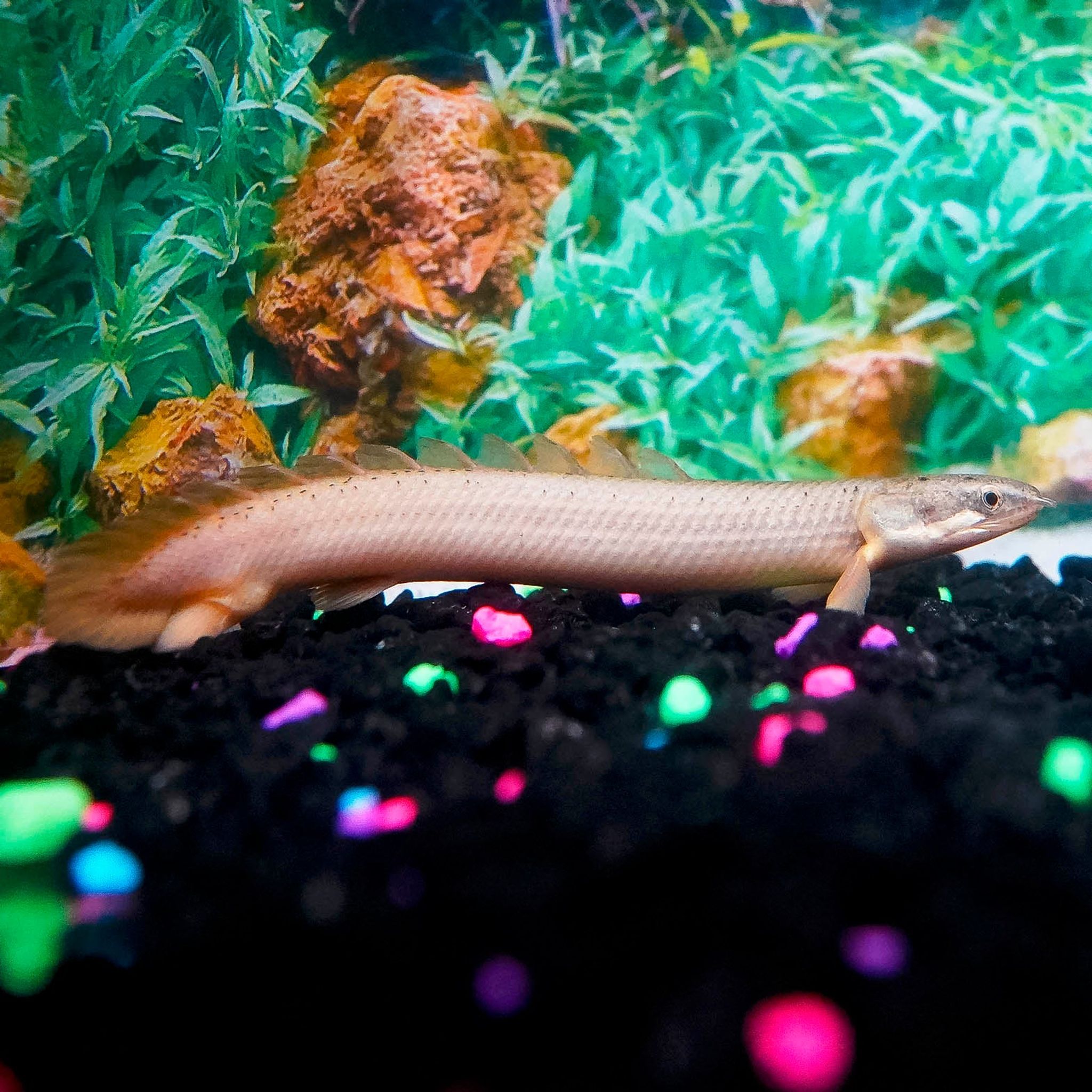
They have an elongated, eel-like body covered in hard, bony ganoid scales, paired pectoral fins that work almost like legs for pushing along the substrate, and a row of small dorsal finlets often called "flags." Most strikingly, bichirs have a modified swim bladder that functions like a primitive lung. This makes them obligate air-breathers — they must surface periodically to gulp air, and can actually drown if denied access to the surface, even in well-oxygenated water.
Bichirs also have poor eyesight. They hunt mainly through smell and electroreception, similar to sharks, and are largely nocturnal ambush predators that hide during the day and become active after dark.
Bichirs sit within a broader "oddball" or monster-fish niche that also includes gobies, reedfish, lungfish, pipefish, and knifefish. What unites this group is large adult size, unusual anatomy, specialist feeding habits, and a serious long-term tank commitment — bichirs are one of the more accessible entry points into that niche.
Tank Size: Plan for the Adult, Not the Juvenile
Tank size is the single biggest reason bichir keeping goes wrong. Stores commonly sell 3–4 inch juveniles that eventually grow into 18–24 inch adults, and a new owner who buys on impulse can end up needing to rehome a fish within a year.
Because bichirs are bottom-oriented and spend most of their time cruising along the floor, footprint (length and width) matters more than height. A tall, narrow tank is far less useful to a bichir than a long, low one.
| Species | Typical adult length | Minimum tank size (single adult) | Temperament |
|---|---|---|---|
| Senegal Bichir | 12–14 in (30–36 cm) | 75–90 gal (285–340 L) | Calm, most beginner-friendly |
| Delhezi (Armored) Bichir | 14–18 in (36–46 cm) | 90 gal (340 L) | Calm, slightly bolder |
| Ornate Bichir | 15–20+ in (38–51+ cm) | 125 gal (475 L) | Calm but needs serious space |
| Saddled Bichir | up to 24–30 in (61–76 cm) | 125+ gal (475+ L) | Robust, needs an experienced keeper |
Juveniles of the smaller species can be started in a 55–75 gallon (208–284 L) tank, but plan the upgrade path before you buy rather than assuming the fish will "grow into" a small setup. Since species can be mislabeled or sold too young to judge adult size, confirm the exact species before committing to a tank.
The Lid Is Not Optional
Bichirs are strong, determined jumpers and crawlers. A loose-fitting lid, a mesh-only cover, or an open gap around a filter cord or hose is often enough for one to escape, and a bichir found on the floor overnight rarely survives. Use a rigid, weighted glass or acrylic lid with no unsealed gaps.
At the same time, leave a few inches of air space between the water surface and the lid. Because bichirs gulp atmospheric air through that lung-like swim bladder, they need a lid that is secure but not sealed flush against the waterline.
Water Parameters and Filtration
Bichirs are considered fairly adaptable once established, but stability matters more than hitting an exact number.
- Temperature: 72–82°F (22–28°C), with most keepers centering on 75–80°F (24–27°C).
- pH: roughly 6.5–7.8, covering the neutral-to-slightly-acidic and slightly-alkaline range most sources agree on.
- Hardness: soft to moderate is generally preferred, though established bichirs tolerate a fairly broad window.
- Ammonia/nitrite: should stay at zero. Despite their hardy reputation, bichirs are sensitive to poor water quality and can mask stress until damage is advanced — cloudy eyes or red streaking on the fins and skin are late warning signs, not early ones.
Fully cycle a tank before adding a bichir, and keep up weekly partial water changes of roughly 25–30% given how much waste a large carnivore produces.
Filtration needs to handle a heavy bioload from a big, messy predator, so moderate-to-strong filtration — canister filters are a common choice — is worth budgeting for. Avoid pushing extreme current, though; bichirs aren't strong swimmers against fast flow and do better with turnover that keeps water clean without turning the tank into a river.
Substrate and Décor
Choose soft sand over gravel. Bichirs push their snouts and bellies along the bottom while foraging, and sharp gravel can scratch their sensitive underside, leading to abrasions and secondary infections.
For décor, provide driftwood, smooth rocks, caves or sections of PVC pipe, and dense-but-navigable plant cover. Since bichirs are nocturnal and territorial toward each other at rest, offer multiple hides — more hides than fish — even in a single-bichir tank.
Why the Air Gap and the Lid Both Matter
It's worth connecting the biology to the husbandry rule directly. A bichir's swim bladder works like a primitive lung, so it must break the surface regularly to breathe air, independent of how much oxygen is dissolved in the water. That's the whole reason for the air gap. But that same air-breathing habit is also why bichirs push against the surface and probe for gaps, which is why the lid has to be rigid and weighted rather than just resting on top. Skip either one and you either suffocate the fish or lose it over the side.
Low Oxygen: A Related but Separate Problem
Air-breathing doesn't mean a bichir is exempt from needing oxygenated water — its gills still need dissolved oxygen for normal function. Watch for gasping at the surface, lethargy, and clamped fins, which usually point to low dissolved oxygen from overstocking, high water temperature (warm water holds less oxygen), stagnant flow, excess organic waste, or plants consuming oxygen at night with no lighting. Fix it with surface agitation from air stones, spray bars, or powerheads, plus partial water changes — don't rely on the fish's ability to gulp air as a substitute for proper gas exchange in the water column.
Diet and Feeding
Bichirs are strictly carnivorous, nocturnal feeders. A varied rotation works better than any single staple:
- Earthworms and nightcrawlers
- Bloodworms, frozen or live
- Shrimp and mussel or clam meat
- Small strips of fish or lean meats
- Sinking carnivore pellets, once the fish is acclimated to them
Avoid making fatty mammal meat like beef heart a regular staple — it's fine as an occasional treat but too rich for long-term feeding. Feed juveniles daily and adults 3–5 times a week; overfeeding a low-activity adult carnivore leads to obesity fast.
Since bichirs hunt by smell rather than sight, drop food near the bottom rather than letting it drift, and feed in the evening or after lights-out to match their natural nocturnal rhythm.
Weaning a Bichir onto Pellets
Most bichirs will only accept live or frozen food at first. To move a new fish onto sinking pellets:
- Start with live or frozen foods to confirm the fish is eating and settled in.
- Introduce pellets alongside familiar food, dropped in the same spot each time so scent cues build an association.
- Use target or tong feeding to place pellets directly near the fish's mouth after dark, when it's naturally hunting.
- Gradually reduce the live/frozen portion over several weeks as pellet acceptance increases, but keep some variety in rotation rather than switching to pellets exclusively.
Patience matters more than persistence here — a fish that refuses pellets for the first few weeks is normal, not a sign of a health problem.
Temperament and Tankmates
Bichirs are better described as predatory by appetite rather than combative. They generally won't hunt down tankmates their own size or larger, but the rule of thumb is blunt: if it fits in the mouth, it's food. Small fish, shrimp, and anything slow or slender enough to be mistaken for prey will eventually disappear.
They can also spar with same-species or similarly-shaped tankmates (other bichirs, eel-like fish) over hiding spots, especially in a tank that's too small to establish separate territories.
Good tankmates are large, robust, and clearly too big to eat:
- Oscars and other large cichlids
- Jack Dempsey and Flowerhorn
- Large barbs, bigger tetras, and rainbowfish
- Compatible catfish such as Synodontis
- Knifefish and larger plecos
Avoid anything small, slender, or slow-moving enough to be swallowed or nipped.
If you're keeping more than one bichir, do it only in a large tank with multiple hides — expect some territorial squabbling even then, and treat single-keeping as the safer default in smaller setups. Breeding bichirs at home is rare and considered an advanced project requiring large groups and seasonal condition changes, not something to plan around as a beginner goal.
Common Species for the Hobby
- Senegal Bichir (Polypterus senegalus): the most common and beginner-friendly option, staying around 12–14 inches.
- Ornate Bichir (Polypterus ornatipinnis): a striking mottled pattern, but it grows to 15–20+ inches and needs an especially large, long-footprint tank to match.
- Delhezi (Armored) Bichir: a mid-size, hardy option similar in care to the Senegal but slightly larger.
- Saddled Bichir: large and robust, reaching up to 24–30 inches — suited to experienced keepers with 125+ gallon tanks.
- Albino Senegal: a color morph of the standard Senegal with identical care requirements.
Confirm the exact species before buying, since juveniles are frequently mislabeled or sold before their true adult size is obvious. You can browse available specimens in FishyHub's bichir category.
Related Species Worth Knowing
Reedfish (rope fish): a legless-looking relative in the same family, Polypteridae, sharing the same air-breathing biology and similar water needs. Reedfish are generally more peaceful and community-safer than bichirs, but their slim, snake-like body makes them even better at squeezing through small lid gaps — if anything, they need an even more escape-proof setup.
Dragon goby: a different oddball worth a quick mention if you like bottom-dwelling curiosities. It needs 50+ gallons (25 minimum for juveniles) with a 4-foot-plus footprint, tolerates brackish conditions around 1.006–1.008 specific gravity (or full freshwater once acclimated), and is a shy scavenger despite an undeserved reputation for aggression.
Queensland lungfish: another true "living fossil" air-breather, but far larger and longer-lived on a public-aquarium scale — a useful contrast that underscores why the bichir, not the lungfish, is the realistic home-aquarium entry point into living-fossil fishkeeping.
African freshwater pipefish: a much smaller, fragile, brackish-leaning oddball that eats only live food and competes poorly for it — essentially the opposite of a bichir's hardy, generalist nature.
If any of these other oddballs interest you, FishyHub's broader Monster Fishes category is a good place to browse large, unusual freshwater species alongside bichirs.
Common Mistakes to Avoid
- Buying on size at purchase, not adult size. A 3–4 inch juvenile can become an 18–24 inch adult within a year or two.
- Using a loose or mesh-only lid. Bichirs escape through remarkably small gaps.
- Housing with fish small enough to eat, even ones considered "peaceful" community fish.
- Sharp gravel substrate, which abrades the belly and sensory organs and invites infection.
- Feeding only pellets or only fatty meat. Rotate protein sources for balanced nutrition.
- Ignoring ammonia or nitrite spikes because the fish still looks fine — bichirs mask stress until damage is visible.
- Underestimating filtration needs for a large, messy carnivore.
- Panicking over daytime hiding. Nocturnal behavior is normal, not a sign of illness.
- Adding a second bichir to a cramped tank and expecting instant compatibility.
New arrivals, especially wild-caught or imported bichirs, should also go through a quarantine period, since they can carry parasites or arrive with skin issues that are easier to treat in a separate tank than in a display aquarium.
Frequently Asked Questions
How big do bichirs get?
It depends heavily on species — commonly 12 to 24 inches, with some reaching up to 30 inches. Always plan tank size around the maximum size for that specific species, not the size the fish is when purchased.
Can bichirs live with other bichirs?
Yes, in a large enough tank with multiple hides, though some territorial squabbling is normal. In smaller setups, keeping a single bichir is the safer choice.
Do bichirs need a lid?
Yes, without exception. Bichirs are prolific escape artists that can survive out of water for a surprising amount of time, but they usually die if not found and returned quickly.
What do bichirs eat in the wild versus in the aquarium?
In the wild, they hunt insects, crustaceans, small fish, and worms by smell at night. In the aquarium, aim to mimic that with a varied rotation of meaty foods rather than relying on a single staple.
Are bichirs aggressive toward other fish?
Not combative by nature, but predatory toward anything small enough to eat. They're generally fine with robust tankmates of similar size or larger.
Can bichirs breathe air?
Yes. A modified swim bladder functions like a primitive lung, letting them gulp atmospheric air at the surface, which is why both a secure lid and a surface air gap matter at the same time.
How long do bichirs live?
Typically 15 to 20 years with good care, and some reportedly longer — a decades-long household commitment, not a short-term pet.
Ready to plan a build around one of these prehistoric predators? Explore current stock in FishyHub's Plecos, Corys & Bottom Dwellers category for bichirs and other bottom-dwelling oddballs suited to a large freshwater setup.


