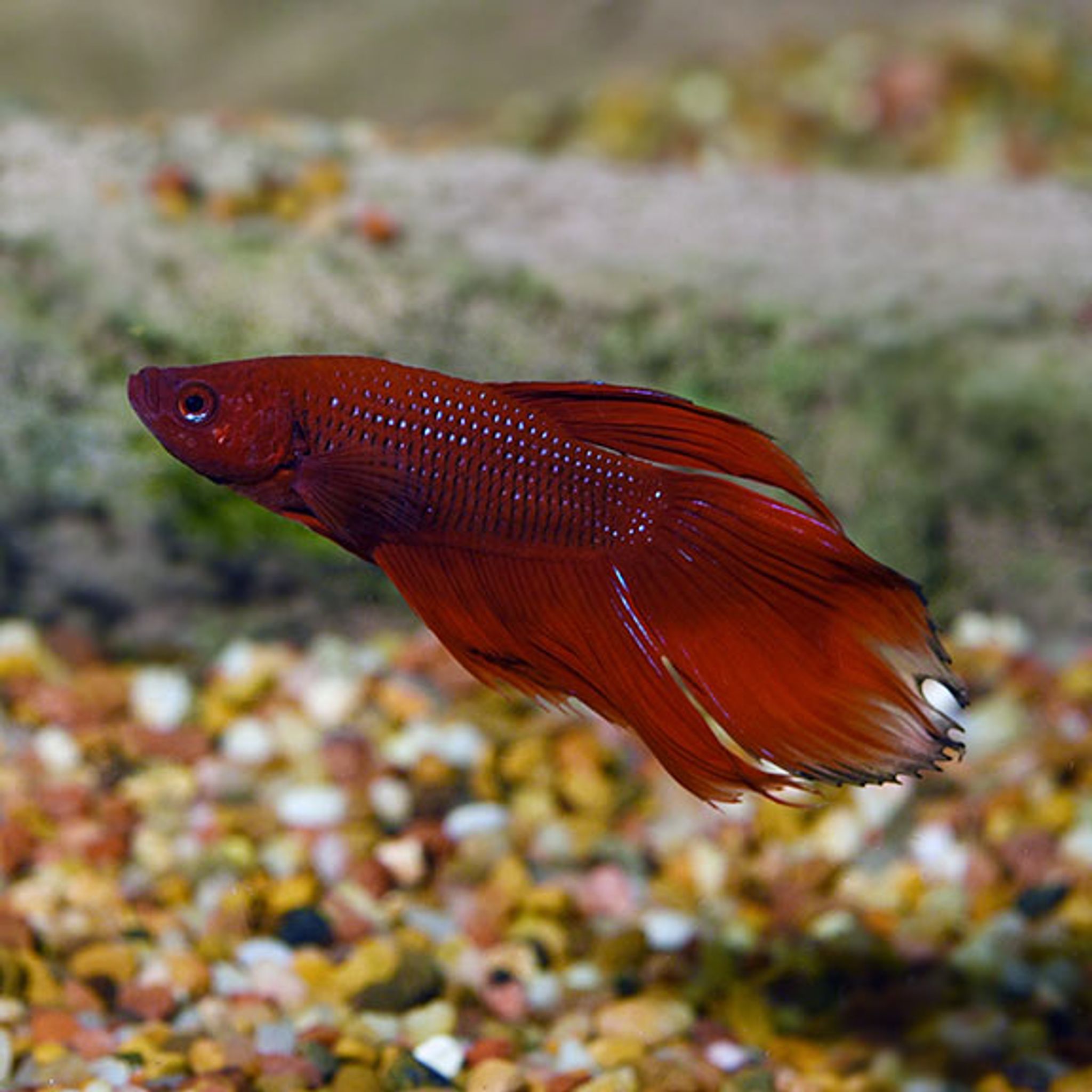
Betta Fish Care Guide: Tank Size, Diet, Water Parameters and Temperament
A betta needs a lidded, filtered, heated tank of at least 5 gallons, held at 78–80°F with zero ammonia, and fed a few high-protein pellets once or twice a day. That is the short answer. The rest of this guide covers the numbers, the reasons behind them, and the problems new owners run into most often.
Betta Care at a Glance
Print this or screenshot it. It works as your one-glance spec card.
| What | Target | Notes |
|---|---|---|
| Tank size | 5 gallons (19 L) minimum | 10 gallons (38 L) for tankmates |
| Temperature | 78–80°F (25.5–26.5°C) | Acceptable 76–82°F (24.5–28°C) |
| Heater | ~5 W per gallon | 25 W for 5 gal, 50 W for 10 gal |
| pH | 6.5–7.5 | Tolerates 6.0–8.0 |
| Hardness | 3–12 dGH (50–200 ppm) | Stability beats exact numbers |
| Ammonia / nitrite | 0 ppm | Always |
| Nitrate | Under 20 ppm | 40 ppm at most |
| Food | 2–4 pellets, 1–2 times daily | Eaten within about a minute |
| Water changes | 25–30% weekly (5 gal) | Every 1–2 weeks in 10 gal |
| Lifespan | 2–4 years | 5+ possible |
Where Bettas Come From (and Why It Matters)
Betta splendens, the Siamese fighting fish, lives in warm, shallow, slow-moving water in Thailand and nearby parts of Southeast Asia: rice paddies, marshes and ditches that are often low in oxygen.
To cope, bettas have a labyrinth organ that lets them gulp air from the surface. This lets them survive poor water, but it does not mean they thrive in it. Always leave an air gap under the lid and keep the surface easy to reach.
Betta Myths and a Little History
- "They live in puddles." Paddies dry down seasonally, but bettas come from much larger, connected wetlands.
- "They eat plant roots." Bettas are carnivores. The vase-with-a-plant setup starves them.
- "Bowls are fine." Small, unheated bowls swing in temperature and ammonia fast.
Bettas were bred for fighting in Siam in the 1800s and reached the West in the late 1800s. The flowing fins you see today come from later ornamental breeding.
Tank Size and Setup
Recommendations online range from 2 gallons to 10. The practical answer:
- 5 gallons (19 L) is the working minimum for one betta.
- 10 gallons (38 L) is more stable and the minimum if you want tankmates.
- Under 2.5 gallons (9.5 L), temperature and ammonia shift quickly, and small mistakes become emergencies.
A lid is required. Bettas jump.
The Best Betta Tank
Choose a lidded 5–10 gallon rimless or standard tank that is wider rather than tall. Bettas spend much of their time near the surface, and long-finned fish tire when swimming up a tall column. Pair it with a sponge filter and an adjustable heater.
Filtration: Gentle Flow Only
Yes, bettas need a filter, but a gentle one. Long fins act like sails, and strong currents push the fish around. Signs the flow is too strong: the fish is pinned in corners, fins clamped, or it avoids open water.
- Sponge filters are ideal.
- A hang-on-back filter works if you baffle the outflow and cover the intake with a sponge so fins don't get sucked in.
You can browse aquarium filters on FishyHub if you're still choosing one.
Decor and the Pantyhose Test
Use live or silk plants and smooth hides. Before adding anything hard or plastic, drag a piece of nylon pantyhose over it. If it snags, it can tear fins. Floating plants or a leaf hammock near the surface give your betta a resting spot it will use daily.
Temperature: Do Bettas Need a Heater?
Yes, in nearly every US home. Houses kept at 68–72°F (20–22°C) with AC in summer or modest winter heating are too cool for a tropical fish.
Sources quote ranges anywhere from 72–86°F. Aim for 78–80°F (25.5–26.5°C) and keep it steady:
- Low 70s: bettas turn sluggish and become prone to ich.
- Mid-80s and above: metabolism speeds up and the fish ages faster.
Heater sizing: about 5 watts per gallon, so 25 W for 5 gallons and 50 W for 10. In a cold room, go a size up. Choose an adjustable heater; preset "betta heaters" are often inaccurate. Confirm with a separate thermometer.
Power outages: wrap the tank in blankets or foam to hold heat, and keep a battery-powered air pump on hand.
Water Parameters and Cycling
| Parameter | Target | Acceptable |
|---|---|---|
| pH | 6.5–7.5 | 6.0–8.0 |
| General hardness | 3–12 dGH (50–200 ppm) | Adapts to harder water |
| Ammonia | 0 ppm | 0 ppm |
| Nitrite | 0 ppm | 0 ppm |
| Nitrate | Under 20 ppm | Up to 40 ppm |
Stability matters more than hitting exact numbers. If you live in a hard-water region, your betta will adapt. Skip chemical pH adjusters that cause swings.
Cycle First, Then Add the Fish
Cycle the tank before adding a betta. A fishless cycle takes about 4–6 weeks, or you can seed the filter with mature media from an established tank to speed things up.
Treat all tap water with a dechlorinator that also neutralizes chloramine. Many US cities use chloramine, and a chlorine-only product leaves it behind.
Weekly Maintenance
- Change 25–30% of the water weekly in a 5-gallon, or every 1–2 weeks in a 10-gallon.
- Vacuum the gravel as you go.
- Match the new water's temperature to the tank.
- Never do sudden 100% water changes; they shock the fish.
Diet and Feeding
Bettas are carnivores and insect eaters. The staple should be a quality high-protein betta pellet, with variety from frozen or live bloodworms, brine shrimp and daphnia.
Pellets or flakes? Pellets are easier to portion, but either works if protein is the first ingredient.
How much: 2–4 pellets once or twice a day, no more than the fish finishes in about a minute. An optional fast day once a week helps digestion.
Overfeeding causes bloating, constipation and ammonia spikes. If your betta looks bloated, fast it for a day or offer a small piece of blanched pea. Frozen and freeze-dried options are available in FishyHub's food and supplements section.
Temperament and Tankmates
Male bettas are territorial and will fight other males, sometimes to the death. Never house two males together. Mirrors should be brief sessions only; constant flaring is stressful.
Whether a betta can have tankmates at all depends on the individual fish. Some ignore neighbors; others attack anything that moves. In a 10+ gallon tank, try small, peaceful, non-nipping species, and have a backup tank ready.
| Good candidates (10+ gal) | Avoid |
|---|---|
| Ember tetras | Tiger barbs |
| Harlequin or chili rasboras | Serpae tetras |
| Pygmy or panda corydoras | Other gouramis |
| Kuhli loaches | Fancy guppies and other showy long-finned fish |
| Nerite and mystery snails | Goldfish |
Don't count on shrimp surviving; many bettas treat them as food.
Goldfish vs. Betta
Never keep them together. Goldfish need cool water (65–72°F / 18–22°C), produce heavy waste and need much bigger tanks. Bettas are tropical. Neither thrives in the other's conditions.
Female Bettas and Sororities
Females have shorter fins, often shorter bodies, and adults show a small white egg spot behind the belly fins. They are still territorial. One female alone in 5+ gallons is easy.
A sorority (a group of five or more females) is sometimes presented as simple, but groups often fail. They need 20–40 gallons (75–150 L), heavy planting and a backup tank. Treat it as an advanced project, not a first setup.
Are Bettas Good for Beginners?
Yes, for a beginner who sets up a heated, cycled tank. They are not a fish you put in a bowl and forget.
Plants for Betta Tanks
A low-tech planted tank suits bettas well: soft light, no CO2, slow-growing plants and a gentle filter.
- Attach to rock or wood: java fern, anubias, bucephalandra.
- Rooted: cryptocorynes, Amazon sword, cabomba.
- Floaters: red root floater, frogbit, salvinia. These give surface cover and anchor bubble nests.
Catappa (Indian Almond) Leaves
Catappa leaves release tannins, slightly lower pH, may have mild antimicrobial effects and give your betta a resting surface. Use about 1 leaf per 5–10 gallons, pre-soak or boil it first, and replace every 2–4 weeks. The tea-colored water is harmless.
Varieties and Fin Types
- Veiltail, crowntail, halfmoon, double tail, dumbo/elephant ear: long or showy fins.
- Plakat: short-finned, sturdier and a stronger swimmer.
- Colors and patterns: dragonscale, marble, koi, butterfly.
Heavy fins raise the risk of fin damage and fin rot, so long-finned types need the gentlest flow and smoothest decor.
The black orchid betta is a dark halfmoon-type with a black and iridescent blue body and fins. Care is the same as any betta. Marble genetics can shift its color over time, and breeders typically charge more for it.
Buying a Betta: US Shopping Checklist
Picking a healthy fish: look for active swimming, intact fins, clear eyes, bright color and interest in food. Store bettas are often close to a year old at purchase, so part of their lifespan has already passed.
Checklist (a proper setup typically runs about $80–150):
- Lidded 5–10 gallon tank
- Adjustable heater (~5 W per gallon) and a separate thermometer
- Sponge filter or baffled hang-on-back filter
- Chloramine-safe dechlorinator
- Liquid test kit for ammonia, nitrite, nitrate and pH
- Gravel vacuum and bucket
- Live or silk plants, smooth hide, floating plants
- High-protein betta pellets plus a frozen food
Quarantine Before Adding to an Existing Tank
Keep a new betta in a separate heated, filtered tank for a few weeks and watch for disease before adding it to a community. The same goes for new tankmates. Add fish gradually, never a whole tank at once.
Health, Color and Behavior
Bubble Nests
A bubble nest is normal breeding behavior in mature males and shows the fish is comfortable. No nest is also normal. Floating plants give nests an anchor.
Why a Betta Loses Color
Common causes: stress, cold water, poor water quality, illness such as fin rot, poor diet, age, and marble genetics (which change color naturally). Stressed females show horizontal stress stripes.
Bacterial and Fungal Infections
- Fin rot: ragged, darkened fin edges.
- Columnaris: white, cottony patches or saddle marks.
- Popeye, dropsy and fungus are other risks.
Fix water quality first. Use antibiotics only after a diagnosis, in a quarantine tank, with carbon removed from the filter, and finish the full course. Never dose "just in case."
Senior Bettas
Older bettas show fin fraying and slower movement. Lower the water level slightly, keep resting spots near the surface, feed smaller portions and keep flow minimal.
Common Mistakes and Quick Fixes
| Problem | Likely cause | Fix |
|---|---|---|
| Lying on the bottom, lethargic | Cold water or ammonia | Check temperature and test ammonia first |
| Pinned in corners, clamped fins | Strong filter flow | Baffle or switch to a sponge filter |
| Torn fins | Sharp decor | Pantyhose test; swap for silk or live plants |
| Bloating | Overfeeding | Fast a day, offer blanched pea |
| Tail biting | Stress | Reduce flow, add plants and cover |
| Sudden sickness after setup | Uncycled water, bowl, no heater | Cycle, heat and filter a 5+ gallon tank |
Frequently Asked Questions
Can a betta live in a bowl?
It might survive briefly, but it won't thrive. A betta needs heat, gentle filtration and enough stable water volume, which in practice means a lidded tank of at least 5 gallons.
How often should I feed my betta?
Once or twice a day, 2–4 pellets per feeding, no more than it eats in about a minute. Skip a day if its belly looks swollen.
Can two bettas live together?
Never two males; they will fight, sometimes fatally. Females can live in managed groups, but sororities need a large, heavily planted tank and a backup plan, so they suit experienced keepers.
Why is my betta building a bubble nest?
It's normal behavior from a mature male and a sign it feels comfortable. A betta that never builds one is just as normal.
Do bettas need a filter?
Yes. A gentle sponge filter or a baffled hang-on-back filter keeps ammonia down without buffeting long fins.
Can bettas live with snails or shrimp?
Nerite and mystery snails usually do fine. Shrimp are risky, because many bettas hunt them.
Ready to bring one home? Browse the betta fish selection on FishyHub once your heated, cycled tank is running steadily at 78–80°F.


