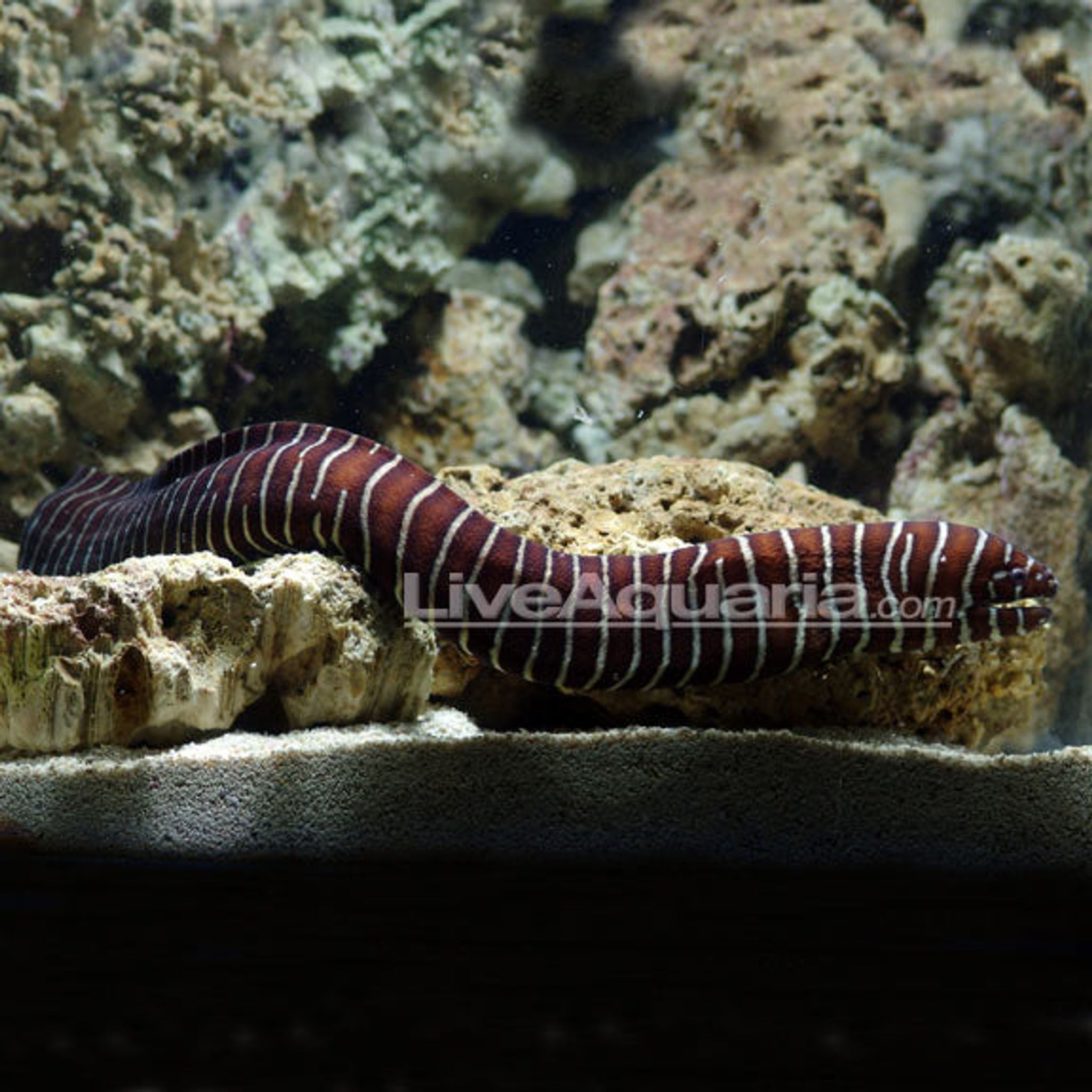
Best Tank Mates for Zebra Moray Eel: Peaceful, Risky and Incompatible Choices
A zebra moray eel (Gymnomuraena zebra) is one of the more fish-friendly large morays, but "fish-friendly" is not the same as "safe with everything." This guide sorts potential tank mates into three tiers — peaceful, risky, and incompatible — based on the eel's crushing teeth, poor eyesight, and dedicated appetite for crustaceans.
Why the Zebra Moray Is Different From Other Morays
Most compatibility advice for moray eels assumes sharp, needle-like teeth built for grabbing and piercing fish. The zebra moray breaks that mold. Its teeth are rounded and molar-like, shaped for crushing hard-shelled prey rather than spearing swimming fish. That single anatomical difference changes the entire stocking calculus.
Compared to popular sharp-toothed species, the risk profile looks like this:
| Moray species | Teeth type | Fish-aggression risk | Crustacean risk |
|---|---|---|---|
| Zebra moray | Rounded, crushing | Low toward large fish | Very high |
| Snowflake moray | Small piercing/crushing mix | Low-moderate | High |
| Fimbriated moray | Sharp piercing | Moderate-high | Moderate |
| Dragon (Chainlink) moray | Sharp piercing | Moderate | Moderate |
| Golden moray | Sharp piercing | Moderate-high | Moderate |
The takeaway: a zebra moray is genuinely one of the calmer large morays around appropriately sized fish, but it remains a specialized crustacean hunter. Anyone shopping the eels category and comparing species for a mixed community should weigh teeth type as heavily as temperament reputation.
Species Snapshot Before You Plan Tank Mates
- Size: 3–5 feet at full growth, with most captive adults settling around 3–4 feet.
- Lifespan: 15–20 years with consistent care.
- Origin: Indo-Pacific reef crevices and rubble zones.
- Vision: Poor — it hunts primarily by smell, which matters for both feeding safety and tank mate selection.
- Diet: Crustaceans first, meaty fish flesh second.
Any stocking decision has to account for a fish that will live in the tank for potentially two decades and grow substantially larger than it arrives.
Tank Size and Setup for Mixed Stocking
Sources disagree on the minimum footprint. Some say a young zebra moray can get by in 75–90 gallons (284–341 L) short term; others insist on 125–180 gallons (473–681 L) minimum for an adult. The sensible middle ground: plan for the adult from day one. A 100-gallon (379 L) minimum, ideally 150 gallons (568 L) or more, gives an adult eel and appropriately sized tank mates room to establish separate territories. Footprint (length and width) matters more than height — this is a bottom-dwelling, crevice-hunting animal, not a mid-water swimmer.
Setup essentials for a mixed tank:
- A tightly fitted, weighted lid. Morays are powerful escape artists and can force their way through gaps under an inch. This is non-negotiable in a community setup where the eel may be startled by tank mates.
- Ample rockwork with multiple caves — ideally one distinct hiding spot per animal, to reduce territorial friction between the eel and other large, cave-dwelling fish.
- Sand or fine substrate, since the eel burrows and rearranges the bottom layer regularly.
- Strong filtration and skimming, sized for a heavy bioload from meaty feeding, not just the fish census in the tank.
Standard reef parameters apply: 72–78°F (22–26°C), specific gravity 1.020–1.025, pH 8.1–8.4, and low nitrate. A well-filtered system matters more here than in a typical reef tank because meaty foods foul water fast.
Peaceful Tank Mates
The general rule: anything roughly the eel's own body diameter or larger, non-aggressive, and too big to be swallowed is a reasonable candidate.
- Tangs and surgeonfish — fast, deep-bodied, and not tempting as prey.
- Large angelfish — species-appropriate adult sizes.
- Groupers — sized appropriately to avoid them viewing the eel (or vice versa) as competition for the same prey.
- Lionfish — compatible in terms of size, though keepers should handle feeding and maintenance carefully given lionfish venom (a risk to the aquarist, not the eel).
- Puffers and triggerfish — robust, armored or thick-skinned enough to avoid being test-bitten.
- Large wrasses.
- Other robust morays or large eel species, provided the tank is large enough to give each animal its own cave.
- Larger boxfish.
These species share three traits: size that rules out being swallowed, enough speed or armor to avoid incidental harm, and temperaments that won't provoke the eel by nipping at its exposed gill openings.
Risky, Case-by-Case Tank Mates
This is where sources disagree most. Some describe zebra morays as "safe with small fish" because of their blunt, crushing teeth. More cautious guidance pushes back: teeth shape only affects how a fish is killed, not whether it fits in the eel's mouth in the first place. A fish that's swallowed whole doesn't need to be pierced.
The practical rule of thumb: if it fits in the mouth when the tank lights go out, it's at risk — regardless of how calm the eel has seemed during the day. Zebra morays lean nocturnal in feeding behavior, and an inactive, sleeping small fish at night is far easier prey than the same fish darting around in daylight.
Risky categories include:
- Small-to-medium fish that could be engulfed while sleeping — damsels, small gobies, small clownfish.
- Territorial fish that may nip at the eel's gills or invade its cave, provoking defensive aggression.
- Other eels in an undersized tank, where competition for hiding spots and food creates ongoing stress even without direct predation.
Rate the eel's temperament as genuinely peaceful toward fish in general, but treat "small enough to fit in the mouth" as an automatic yellow flag, independent of species reputation.
Incompatible: Do Not Combine
Some sources call zebra morays fully "reef safe"; others qualify that heavily. The accurate distinction is between reef-safe-with-corals and reef-safe-with-invertebrates. Zebra morays generally leave coral tissue alone and won't eat sessile invertebrates like clams attached to rock — but they are not safe with mobile ornamental crustaceans, which are their natural prey.
Never combine a zebra moray with:
- Cleaner shrimp, peppermint shrimp, and other ornamental shrimp
- Hermit crabs, crabs, lobsters, and crayfish
- Nano fish, small gobies, small clownfish, or chromis small enough to be swallowed whole as juveniles — even if the adult form of that species is normally considered too large
"Reef safe" claims for these species don't apply once a dedicated crustacean predator is added to the tank. A zebra moray will hunt them regardless of a shrimp's reputation as reef-safe with other fish. It's also worth noting the eel's burrowing habit — rearranging rockwork can topple an aquascape and knock over coral frags, so heavier rock placement and secure frag mounting help even where corals themselves aren't at direct risk.
Feeding Routine and Its Effect on Compatibility
Feed meaty foods — shrimp, clam, mussel, squid, crab, and occasional silverside or fish flesh — 2–3 times per week, always using tongs or a skewer, never by hand. Because of the eel's poor eyesight, hand-feeding risks an accidental bite; the animal is identifying food by scent and movement, not sight.
Target feeding with tongs has a compatibility benefit beyond bite prevention: it reduces the odds the eel mistakes a slow-moving tank mate for a meal. Irregular or infrequent feeding increases predation risk on smaller inhabitants, since a hungry eel investigates more opportunistically. Overfeeding, meanwhile, fouls water quickly in any tank without adequate filtration and skimming — a genuine risk given how meat-heavy this diet is.
Introducing Tank Mates: Order Matters
- Add the eel last, or otherwise plan size differentials carefully — an established eel is confident in its territory and will investigate new arrivals opportunistically, even if it previously ignored existing tank mates.
- Quarantine new fish before adding them to a display tank with a large predatory eel, both to protect existing stock from disease and to avoid introducing a stressed, disoriented fish into unfamiliar territory.
- Drip acclimate and minimize handling for both the eel and new arrivals.
- Provide multiple caves and crevices per animal from the start — this reduces the competition stress that drives aggression in mixed large-fish tanks.
Signs of Stress or Incompatibility
Watch for these warning signs in a mixed-stocking tank:
- Glass surfing or repeated attempts to escape near the lid
- Refusal to eat during normal feeding windows
- Constant hiding with little to no emergence, even at feeding time
- Tank mates disappearing one by one — worth distinguishing from other causes like jumping out of an unsecured tank, disease, or aggression from a different fish, before assuming predation
- Aggression clustered specifically at feeding time, suggesting food competition rather than general incompatibility
Common Mistakes to Avoid
- Assuming "peaceful" temperament means safe with everything — it doesn't extend to crustaceans or bite-sized fish.
- Running an undersized or poorly sealed tank — eels escape through surprisingly small gaps and can die out of water, and they also simply outgrow anything under 100 gallons.
- Hand-feeding instead of using tongs, risking an accidental bite from a fish that hunts by smell.
- Adding small fish or inverts to an established eel's tank and expecting a "shy" eel to ignore them.
- Skimping on hiding spots when combining the eel with other large, territorial species.
- Overfeeding meaty foods without filtration and skimming capacity to match, leading to ammonia spikes.
Sourcing Notes
Zebra morays are wild-caught and moderately priced, though less commonly available than snowflake morays. Because of this, sourcing may take patience, and quarantine before introduction to a display tank is strongly recommended given the potential for parasites or stress-related illness in a newly imported predator.
Frequently Asked Questions
Will a zebra moray eel eat my fish?
Generally low risk to fish too large to swallow, thanks to crushing rather than piercing teeth. However, any fish small enough to fit in its mouth is at risk, particularly overnight when it's inactive and easy prey.
Can I keep cleaner shrimp or crabs with a zebra moray eel?
No. Ornamental crustaceans are the eel's primary natural prey and will be hunted regardless of the eel's generally calm reputation around fish.
What is the minimum tank size for a zebra moray eel?
Plan for 100 gallons (379 L) minimum for an adult, with 150–180 gallons (568–681 L) preferred, and always a tightly secured, weighted lid.
Are zebra moray eels reef safe?
They're safe around coral tissue itself but not reef-safe in the broader sense, since they eat ornamental invertebrates and their burrowing can disturb aquascaping and topple frags.
Can two zebra moray eels live together?
It's possible in a large enough tank — 200 gallons (757 L) or more — with ample separate hiding spots, but compatibility isn't guaranteed. Monitor closely for territorial aggression.
What fish can live with a zebra moray eel?
Large, robust species such as tangs, angelfish, groupers, triggerfish, puffers, and other large morays or eels that aren't small enough to be viewed as prey.
Do zebra moray eels bite people?
They can, but it's typically from mistaking a hand for food due to poor eyesight rather than genuine aggression. Always feed with tongs or a skewer instead of by hand.
How long do zebra moray eels live and how big do they get?
Up to 15–20 years in captivity with good care, reaching 3–5 feet (91–152 cm) in length, with most captive specimens settling around 3–4 feet.
Ready to plan a stocking list around a zebra moray? Browse compatible large fish in the marine fish category on FishyHub, and steer clear of the marine invertebrates aisle for that particular tank.

