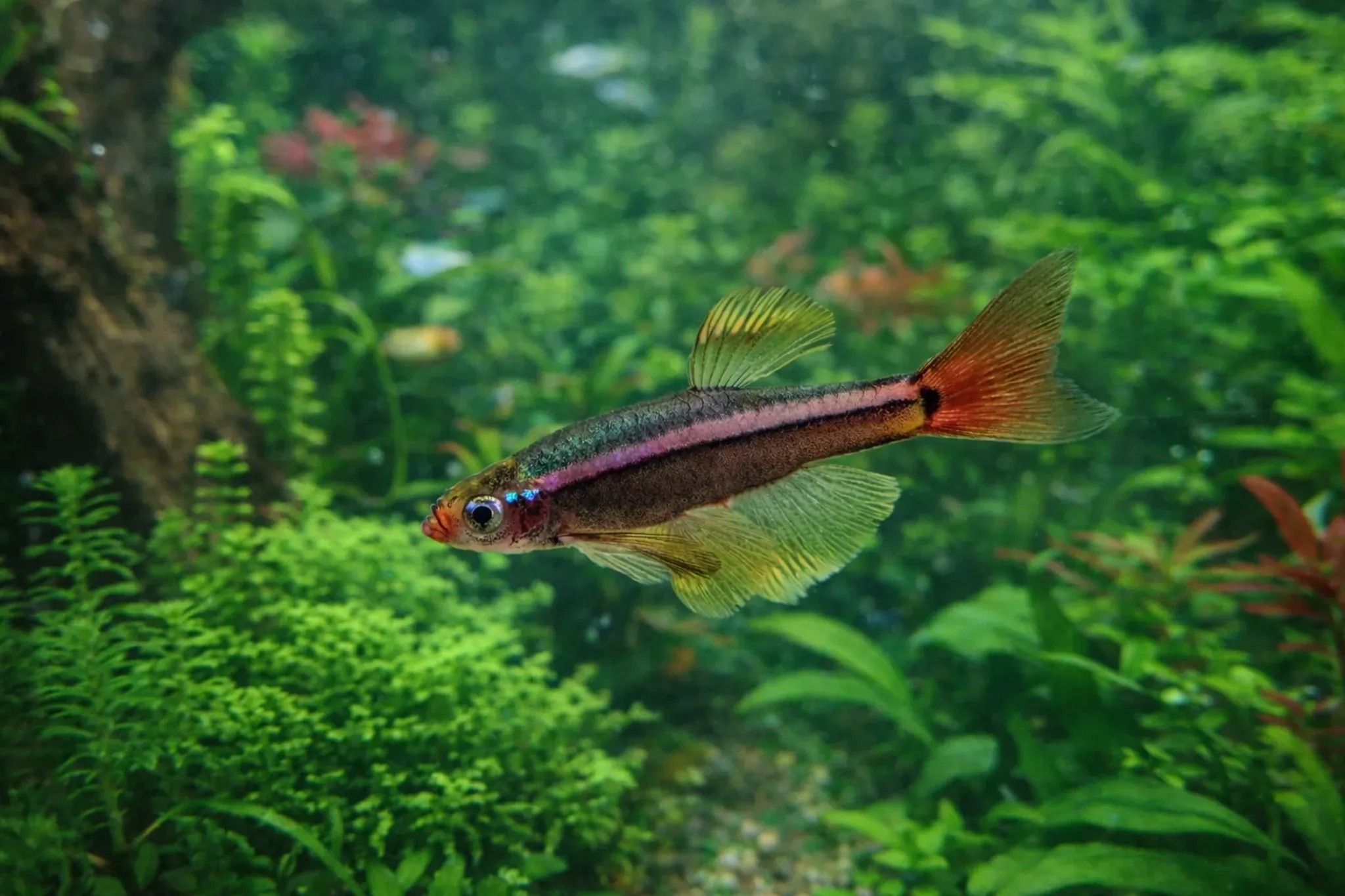

Best Tank Mates for White Cloud Mountain Minnow: Compatible Fish and Species to Avoid
The best tank mates for white cloud mountain minnows are small, peaceful fish that stay comfortable at 64–72°F (18–22°C), such as medaka, hillstream loaches, zebra danios, rosy red minnows and peppered corydoras, plus shrimp and snails. Bettas, goldfish, cichlids, nippy barbs and anything big enough to swallow a 1.5-inch fish should stay off your list. Below, companions are sorted by temperature overlap first, because that is where most compatibility lists go wrong.
White Cloud Mountain Minnow Basics
Before picking companions, it helps to know what you are matching against:
- Size: about 1.5 in (4 cm) as adults
- Temperament: peaceful, active schooler that uses the middle and upper water
- Lifespan: roughly 5–7 years with good care
- Group size: at least 6; a group of 8–10 or more gives better color, more male displays and far less skittishness
- Tank size: 10 gallons (38 L) is the practical minimum for a species-only school; a 20-gallon long (76 L) is the better choice for a community
- Temperature: ideal 64–72°F (18–22°C); tolerates brief dips into the 40s–50s°F (about 4–15°C); stressed when held above about 75°F (24°C) for long stretches
- pH and hardness: pH 6.0–8.0, with 6.8–7.5 ideal; soft to moderately hard water is fine
Footprint matters more than height. A long, shallow tank gives a school room to swim laterally, which is how these fish naturally move.
One more piece of context: Tanichthys albonubes nearly vanished in the wild, and only rediscovered populations in China remain. Nearly every white cloud sold in the US is captive-bred, which is part of why they are so hardy in home aquariums.
The Five Rules for Choosing Tank Mates
Any companion should pass all five checks:
- Small: under about 2–2.5 in (5–6 cm) as an adult.
- Peaceful: no bullies, no territorial brawlers.
- Cool-tolerant: genuinely comfortable somewhere in the 64–72°F range, not just surviving at the edge of its own range.
- Not a fin-nipper: especially important with long-finned "meteor" white clouds.
- Small mouth: a simple rule of thumb is to skip any fish whose mouth could fit a 1.5-inch minnow. If it can swallow one, eventually it will.
Temperature Overlap: The Table Most Lists Skip
Plenty of online lists pad their numbers with tropical fish that only share the white cloud's range at the very top end. This table shows the real shared window.
| Tank mate | Typical comfort range | Shared window with white clouds (64–72°F) | Verdict |
|---|---|---|---|
| Medaka / ricefish | 60–75°F (16–24°C) | Full 64–72°F | Excellent |
| Hillstream loaches | Cool, fast-flowing water | Most of the range | Excellent |
| Zebra danio | Cool to warm | Most of the range | Excellent |
| Rosy red / fathead minnow | Cool water | Full range | Good in 20 gal+ |
| Peppered and bronze corydoras | Upper 60s–70s°F | About 68–72°F | Good |
| Bristlenose pleco | Low 70s°F | About 70–72°F | Good at the warm end |
| Cherry barb, harlequin rasbora, ember tetra, bloodfin tetra, platy, Endler's livebearer | Tropical, lower end near 70–72°F | About 70–72°F only | Compromise option |
| Neon tetra, molly, fancy guppy | About 74–84°F (23–29°C) | Little to none | Avoid |
| Betta | 78–82°F (26–28°C) | None | Avoid |
The pattern is clear: the further a species' range sits above 72°F, the more one of the two fish is living under stress.
Tier 1: True Cool-Water Matches
Medaka / Ricefish
Medaka (also sold as rice fish or ricefish) are the top pairing. They grow to about 1.5 in, live happily at 60–75°F (16–24°C), handle pH 6.5–8.5 and do best in a school of 6 or more. Because medaka are surface feeders, they split the water column neatly with white clouds, which hang slightly lower in the mid-to-upper zone.
"Medaka fever" has become a big trend among US hobbyists, with dozens of color morphs now available, and both species do well together outdoors in patio ponds. One caveat: each species will eat the other's eggs and fry, so separate any spawns you want to raise.
Hillstream Loaches
These flat, algae-grazing loaches like cool, oxygen-rich water, which is exactly what a white cloud tank provides. Give them smooth rocks, some current and a mature tank with biofilm to graze.
Zebra and Other Small Danios
Zebra and leopard danios share the white cloud's tolerance for cooler water and are fast, hardy schoolers. Celestial pearl danios also work, but they prefer the warm end of the range. Keep danios in proper groups; small groups of danios can get nippy, which matters if you keep long-finned white clouds. You can browse danios on FishyHub if you want a second active schooler.
Rosy Red Minnows and Native Shiners
Rosy reds are a color variety of the North American fathead minnow. They are very hardy, but males reach 2–3 in (5–8 cm) and turn territorial when breeding. A 10-gallon tank suits 5–6 of them on their own; mixed with white clouds, plan on 20 gallons or more with plenty of cover. Expect a shorter life of about 2–4 years. Small native shiners fill a similar niche and suit cool US tanks well.
Corydoras and Bristlenose Plecos
Peppered and bronze corydoras tolerate the upper 60s to low 70s°F and clean up food that falls past the minnows. A bristlenose pleco is a good algae grazer if you keep the tank in the low 70s°F. Browse corydoras on FishyHub for bottom-dwelling options.
Dojo (Weather) Loaches: Large Tanks Only
Dojos are often suggested as white cloud companions, and they do love cool water. The catch is size: they reach 6–10 in (15–25 cm). Realistically, keep them only in tanks of 55 gallons (208 L) or more, or in ponds.
Tier 2: Options for a Warmer 72°F Tank
If you run your tank at a steady 70–72°F (21–22°C), a small group of tropical fish can overlap with white clouds:
- Cherry barb
- Harlequin rasbora
- Ember tetra
- Bloodfin tetra
- Platies
- Endler's livebearers
This is a narrow band where both species are content. It works, but it leaves little margin if your room cools down in winter or warms up in summer.
Rosy and Odessa Barbs
These barbs share the white cloud's wild habitat, and some keepers rate them highly, while others warn that barbs nip. A reasonable middle ground: they are acceptable in a tank of 29 gallons (110 L) or larger with a big school of each species, but never with meteor or other long-finned minnows.
Paradise Fish
Paradise fish come from the same region and handle cool water well, but a large male can bully or even prey on small fish. Consider them only for bigger, densely planted tanks, and watch closely.
Invertebrates
- Amano shrimp: too large to be prey; great algae crews.
- Cherry and other neocaridina shrimp: adults are safe, but white clouds will pick off shrimplets. Dense moss improves baby survival.
- Snails: nerite, mystery and ramshorn snails are all compatible.
If you want a cleanup crew, browse shrimp on FishyHub.
Species to Avoid
- Bettas: they need 78–82°F and may nip or hunt small fish.
- Tiger barbs and other nippy barbs: constant fin damage.
- Cichlids of any size: territorial, and most need warm water.
- Clown loaches: grow large and need tropical temperatures.
- Goldfish: they grow big, will eat minnows and produce heavy waste. Sharing a "coldwater" label does not make them compatible.
- Large semi-aggressive fish such as Congo tetras.
- Discus, rams and similar warm-water fish: far outside the white cloud's range.
- Any predator that can fit a 1.5-inch fish in its mouth.
Where Sources Disagree on Tropical Picks
Some lists name neon tetras, fancy guppies, mollies, swordtails and even bettas as good fits. Their preferred ranges sit around 74–84°F, which pushes white clouds into their stress zone or forces the tropical fish to live cold. Keep neons, mollies, fancy guppies and bettas off your list, and use the 70–72°F overlap group if you want some tropical color.
Sample Stocking Plans
| Tank | Stocking | Notes |
|---|---|---|
| 10 gal (38 L) | 8 white clouds + nerite or ramshorn snails | Species-focused; no extra fish |
| 20 gal long (76 L) | 10 white clouds + 6 medaka + a few amano shrimp | Splits surface and mid-water nicely |
| 29 gal (110 L) | White clouds + zebra danios + peppered or bronze corydoras + hillstream loaches | Needs some flow and smooth rocks; run near 68–72°F for the corys |
Setup Tips for a Peaceful Community
- Plants: a planted tank calms the school and gives fry and shrimplets cover.
- Flow: gentle to moderate.
- Substrate: fine gravel or sand, which also suits corydoras.
- Lid: fit a tight one; white clouds can jump.
- Timing: add companions only after the tank is fully cycled.
- Quarantine: keep new fish separate for 2–4 weeks before adding them.
Can White Clouds Live Without a Filter?
White clouds are sometimes pitched as filterless fish. A heavily planted, lightly stocked tank can work, but a sponge filter is cheap insurance and best practice. Many "no-filter" fish lists also include bettas, which are not compatible with white clouds anyway.
Feeding a Mixed Tank
White clouds are micro-predators. Offer quality small flakes or micro-pellets, plus frozen or live daphnia, baby brine shrimp and bloodworm pieces. Feed small meals once or twice a day, and make sure some food reaches bottom dwellers. In well-fed, mossy tanks, it is common to see eggs and fry survive.
Heaters, Water Temperature and Too-Warm Water
Most US homes sit at 65–75°F (18–24°C), so white clouds usually need no heater. If your room gets cold, a low-wattage preset or adjustable heater set to 66–68°F (19–20°C) is good protection.
Warm water holds less oxygen and speeds up metabolism. Long stretches above 78–80°F (26–27°C) shorten lifespan and invite disease. To cool a summer tank:
- Point a fan across the water surface
- Remove the lid during heat waves (while watching for jumpers) to improve evaporation
- Use room air conditioning
- Never add ice directly to the tank
Remember that the temperature you choose also decides which tank mates are possible.
Power Outages
Coldwater fish handle heat loss better than tropicals, so the main outage risk is oxygen, not cold. Keep a battery air pump on hand, wrap the tank in blankets to hold temperature and stop feeding. Once power returns, do small daily water changes and test ammonia for about a week. A UPS or a smart plug that sends an alert can buy time.
Outdoor Ponds and the US No-Release Rule
White clouds can live outdoors in many USDA zones from spring through fall, often alongside medaka in patio tubs. They survive cool water but not freezing solid, so bring them indoors or keep them in a deep pond in colder zones.
White clouds are non-native, so they must never be released into US waterways or used as bait. Rehome unwanted fish through a local club or store instead.
Common Mistakes and Fixes
| Problem | Likely cause | Fix |
|---|---|---|
| Fish hide and look pale | Only 2–3 kept | Increase to 6+, ideally 8–10 |
| Faded color, short lifespan | Kept with a betta or warm community at 78°F | Move to 64–72°F and choose cool-water mates |
| Minnows disappearing | Goldfish or another large fish added | Remove the predator |
| Ragged fins on meteor types | A nipper, such as barbs or danios in small groups | Remove the nipper or enlarge its school |
| Shrimplets vanishing | Normal predation | Add moss for cover |
| Fish found on the floor | No lid | Fit a tight lid |
| Sudden deaths after a heat wave or outage | Low oxygen | Add aeration and test water |
Frequently Asked Questions
Can white cloud mountain minnows live with a betta?
Generally no. Bettas need 78–82°F, which is well into the white cloud's stress zone, and bettas may nip or hunt small fish. Keep them in separate tanks.
Can white clouds live with goldfish?
No. Goldfish grow large enough to eat white clouds, and their heavy waste load is hard on a small-fish tank. Both being "coldwater" fish is not enough to make them compatible.
Can white clouds live with neon tetras?
Only as a short overlap at about 72°F, and it is not ideal long term. Neons prefer warmer water, so one species is always slightly off its best range. Ember or bloodfin tetras are better warm-end choices.
How many white cloud minnows should I keep?
Keep at least 6, and ideally 8–10 or more. Larger groups show better color, more male displays and less hiding.
Do white cloud minnows need a heater?
Usually not indoors in the US, since most homes stay between 65 and 75°F. Use a heater only if the room drops below about 60°F (16°C), and set it to around 66–68°F.
Will white clouds eat shrimp, and can they live with medaka?
They eat only baby shrimp; adult cherry and amano shrimp are safe. Medaka are one of the best pairings of all, sharing the same temperature range and occupying the surface layer above the minnows.
Build Your Cool-Water Community
Match temperature first, then size and temperament, and a white cloud tank can hold a lively mix of schoolers, bottom dwellers and invertebrates. When you are ready to choose companions, browse small community fishes on FishyHub.


