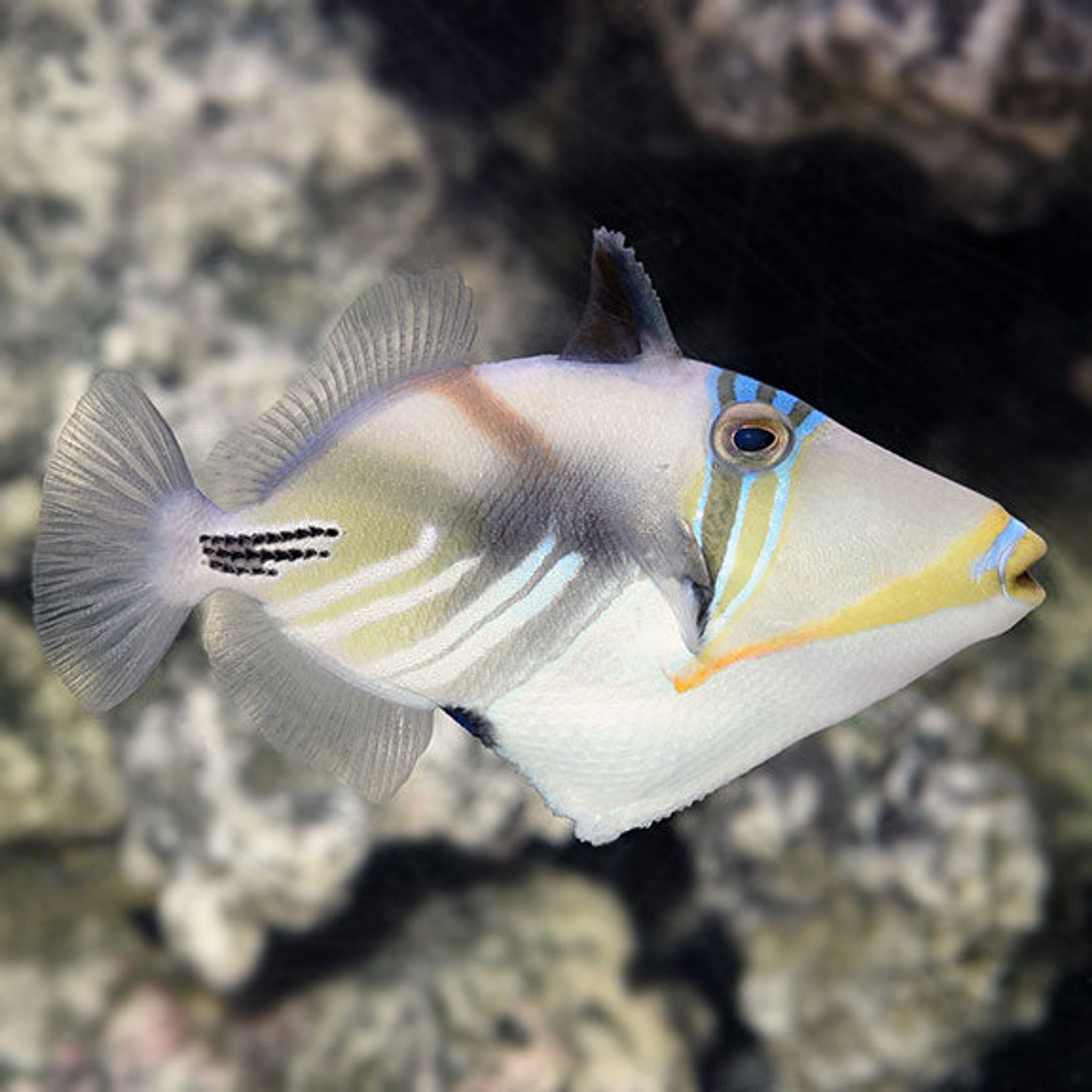
Best Tank Mates for Picasso Triggerfish: Peaceful, Risky and Incompatible Choices
The Picasso triggerfish (Rhinecanthus aculeatus) is one of the more sociable members of a famously feisty family, but "sociable" is relative. This guide breaks tank mate options into peaceful, risky, and incompatible tiers, explains the reasoning behind each one, and covers the stocking order that determines whether the plan actually works.
Species Snapshot
The Picasso, also called the Humu Humu trigger, reaches 8–10 inches (20–25 cm) as an adult. It is a carnivorous, ground-patrolling reef fish with a powerful beak-like set of teeth and a genuinely strong bite for its size. Compared to other Rhinecanthus and larger trigger genera, it's often described as moderately aggressive rather than outright hostile — but individual temperament varies a lot, and a calm juvenile can turn into a territorial adult.
Core water parameters:
| Parameter | Range |
|---|---|
| Temperature | 72–78°F (22–26°C) |
| Specific gravity | 1.020–1.025 |
| pH | 8.1–8.4 |
| Nitrate | Low |
Triggers are hardy and more forgiving of parameter swings than many marine fish, which makes them a comparatively easy carnivore to keep — the real challenge is picking who shares the tank.
Sizing and Tank Shape
Minimum tank size is a point where sources disagree: some cite 100 gallons, others 120. Treat 100 gallons as an absolute floor for a single juvenile, and plan for 125+ gallons as the realistic comfortable minimum for an adult — especially once tank mates are added.
Footprint matters more than depth. A Picasso trigger is an active, laterally-swimming fish that patrols along the bottom and mid-water, so a long, wide tank gives it (and any tank mates trying to avoid it) more usable escape routes than a tall, narrow one of the same volume. If your long-term plan includes several large tank mates — a tang, a puffer, an eel — budget for an upgrade path rather than trying to fit everyone into the minimum footprint from day one.
The Core Compatibility Rule
Every tank mate decision comes down to the same three questions:
- Size: Is the fish too large to be swallowed, even as an adult?
- Speed and toughness: Can it outswim or shrug off nips rather than getting cornered?
- Temperament: Is it assertive enough to hold its own, without being another territorial trigger competing for the same space?
A fish that fails any one of these is a liability, no matter how attractive the pairing looks on paper.
Peaceful and Workable Tank Mates
These are fish that regularly coexist with a Picasso trigger in FOWLR (fish-only-with-live-rock) setups because they match it on size, speed, or toughness:
- Larger tangs and surgeonfish — hippo, yellow, and sailfin tangs are commonly cited, though the exact species named varies by source; the underlying rule is "large, fast, robust," not a fixed checklist.
- Large angelfish
- Groupers
- Hawkfish
- Larger wrasses
- Lionfish
- Puffers — dogface and porcupine puffers are frequent examples, again interchangeable as long as size and toughness match.
- Snowflake and other large eels
- Big damsels, such as domino damsels
- Other robust, semi-aggressive fish of similar or larger size
You can browse marine fish options, including tangs and surgeonfish, when planning this tier.
Risky Tank Mates
These fish sometimes work, but the odds are less favorable, and outcomes hinge heavily on the individual trigger's temperament and the amount of rockwork available:
- Smaller or more timid tangs
- Smaller wrasses
- Clownfish and other small peaceful reef fish, which can be nipped or simply outcompeted for food
- A similarly-sized triggerfish of a different species — territorial fighting is a real risk
- Any fish just barely too large to swallow, which may still get bitten or repeatedly tested
If you go this route, build in flexibility: extra rockwork, multiple sightline breaks, and a spare tank or divider as a contingency if aggression escalates.
Incompatible: Never Pair These
- Any fish small enough to fit in the trigger's mouth
- Slow-moving or shy species that can't escape or hide effectively
- Ornamental shrimp, crabs, and snails
- A second Picasso trigger in anything under a very large system
Reef Safety and Invertebrate Compatibility
Picasso triggers are not reef safe. They will eat or harass ornamental shrimp, snails, hermit crabs, and small crabs, and they pick at, knock over, or outright eat most coral frags and clams. If you're arriving from a reef-tank search expecting to blend a trigger into a mixed reef, reconsider the build: this fish belongs in a FOWLR setup with rock and PVC caves, not alongside corals or delicate marine invertebrates.
Diet and How Feeding Ties to Tank Mate Choice
As a carnivore, a Picasso trigger needs hard-shelled foods — shell-on shrimp, clam, crab, and snail — to grind down teeth that grow continuously. Feed small amounts 2–3 times daily rather than one large meal.
Feeding time is also when aggression spikes, since meaty foods draw every fish in the tank to the same spot at once. Reduce food-driven conflict with a few practical habits:
- Drop food in multiple locations simultaneously so the trigger isn't guarding a single feeding point.
- Target-feed shier tank mates on the opposite side of the tank.
- Watch the first few feedings after adding any new fish closely, since this is when competition is most visible.
Mistake to avoid: feeding only soft foods like frozen mysis long-term. Without hard-shelled items to wear down the beak, teeth can become overgrown to the point where the fish eventually struggles to eat normally.
Tank Setup to Reduce Aggression
- Rockwork with multiple caves and sightline breaks, so a bullied tank mate has somewhere to disappear.
- Wide open swimming space in addition to the rockwork — the trigger needs room to patrol, and tank mates need room to retreat.
- A sturdy, well-anchored sand bed, since triggers dig and rearrange substrate regularly.
- A tight-fitting lid. Triggers are strong jumpers, especially when startled or actively chasing a tank mate.
- Enough total swimming room that a stressed fish can get fully out of sight, not just a few inches away.
Equipment note: the same digging and rock-moving behavior that makes triggers entertaining can topple loose rockwork or bury and clog powerhead intakes. Anchor all rock securely to the tank bottom, not just stacked against the glass, before stocking begins.
Stocking Order Strategy
Sequencing matters as much as species selection. Two approaches work well:
- Add the trigger last or near-last. Let larger, more assertive tank mates establish territory first, so the trigger arrives into an already-divided tank rather than claiming the whole space unopposed.
- Introduce it young, into a tank still being built up. A small juvenile is far less likely to bully incoming fish than a mature, territory-holding adult — this is the key age-related distinction most general care guides skip.
Common mistake: adding the trigger too early into a bare tank lets it stake out the entire territory before anyone else arrives, making every later addition harder regardless of species.
Introducing a New Trigger to an Established Tank
When adding a Picasso trigger to a tank that already has fish, or adding new fish to an established trigger's tank:
- Rearrange the rockwork before the introduction. This resets territorial boundaries for everyone, not just the newcomer.
- Choose new tank mates that are equal or larger in size to what's already present.
- Monitor closely for the first 24–48 hours, when most aggression surfaces.
- Have a backup plan — a spare tank or a tank divider — ready in case one fish turns out to be an unusually territorial individual.
Multiple Triggerfish: Can Two Picassos Coexist?
Generally, no — plan for one Picasso trigger per tank. Juveniles sometimes tolerate each other in a shared system, but adults usually will not, and territorial fighting between similarly-sized triggers is a real, well-documented risk. A pairing can occasionally work in a very large system (think 200+ gallons) with heavy rockwork dividing sightlines into separate territories, but even then it carries meaningful risk of fighting and should be attempted only with a contingency plan already in place.
The same caution applies to mixing a Picasso with a different trigger species of similar size — the aggression dynamic is driven by size and territorial overlap, not species identity.
Common Mistakes and Troubleshooting
- Undersizing the tank, then attributing resulting problems to "trigger aggression" when the real issue is insufficient territory.
- Adding small, delicate, or slow fish — firefish, small gobies, clownfish, small wrasses — and expecting them to be ignored.
- Keeping ornamental shrimp, crabs, or snails "for cleanup." The trigger will eat them regardless of their intended job.
- Skimping on rockwork, leaving a bullied tank mate with nowhere to hide.
- Feeding only soft foods, which can cause overgrown teeth over time.
- Leaving the tank uncovered. A startled or chasing trigger can and will jump.
- Housing two triggers without enough rockwork divisions or a backup plan if fighting starts.
Frequently Asked Questions
Can a Picasso triggerfish live with a clownfish?
Generally risky to no. Clownfish are small and relatively slow, which puts them at real risk of being bullied or eaten by an adult trigger. Juvenile or larger clownfish in a very spacious tank are sometimes tolerated, but it's not a dependable pairing.
Can Picasso triggerfish live in a reef tank with corals?
No. Picasso triggers are not reef safe and will nip, rearrange, or eat many coral types along with ornamental invertebrates. Keep them in a FOWLR setup instead of a mixed reef.
How many Picasso triggerfish can be in one tank?
Generally just one, unless the system is very large — 200+ gallons — with heavy rockwork dividing sightlines. Even in a large tank, pairing two triggers carries real risk of fighting.
What fish can't live with a Picasso triggerfish?
Anything small enough to be eaten, slow or passive fish, ornamental shrimp, crabs, and snails, and most delicate reef fish all belong in the incompatible category.
Do Picasso triggerfish get along with tangs?
Yes, generally. Larger, robust tangs such as hippo, sailfin, or yellow tangs are commonly kept successfully alongside a Picasso trigger because they're fast swimmers and too large to be swallowed.
Will a Picasso triggerfish eat cleaner shrimp?
Yes, almost always. Cleaner shrimp and other ornamental crustaceans are treated as food, not as a functional cleanup crew.
Can Picasso triggerfish be kept with puffers or eels?
Yes, in general. Larger puffers like dogface or porcupine puffers, along with bigger eels such as snowflake eels, are frequently compatible thanks to comparable size, toughness, and similar tank requirements.
What's the best way to introduce new tank mates to an established Picasso trigger?
Add fish that are equal to or larger than the trigger in size, rearrange the rockwork first to reset territorial boundaries, and monitor the tank closely for the first couple of days after introduction.
Ready to plan your stocking list? Browse marine fish on FishyHub to compare size and temperament across potential Picasso triggerfish tank mates.


