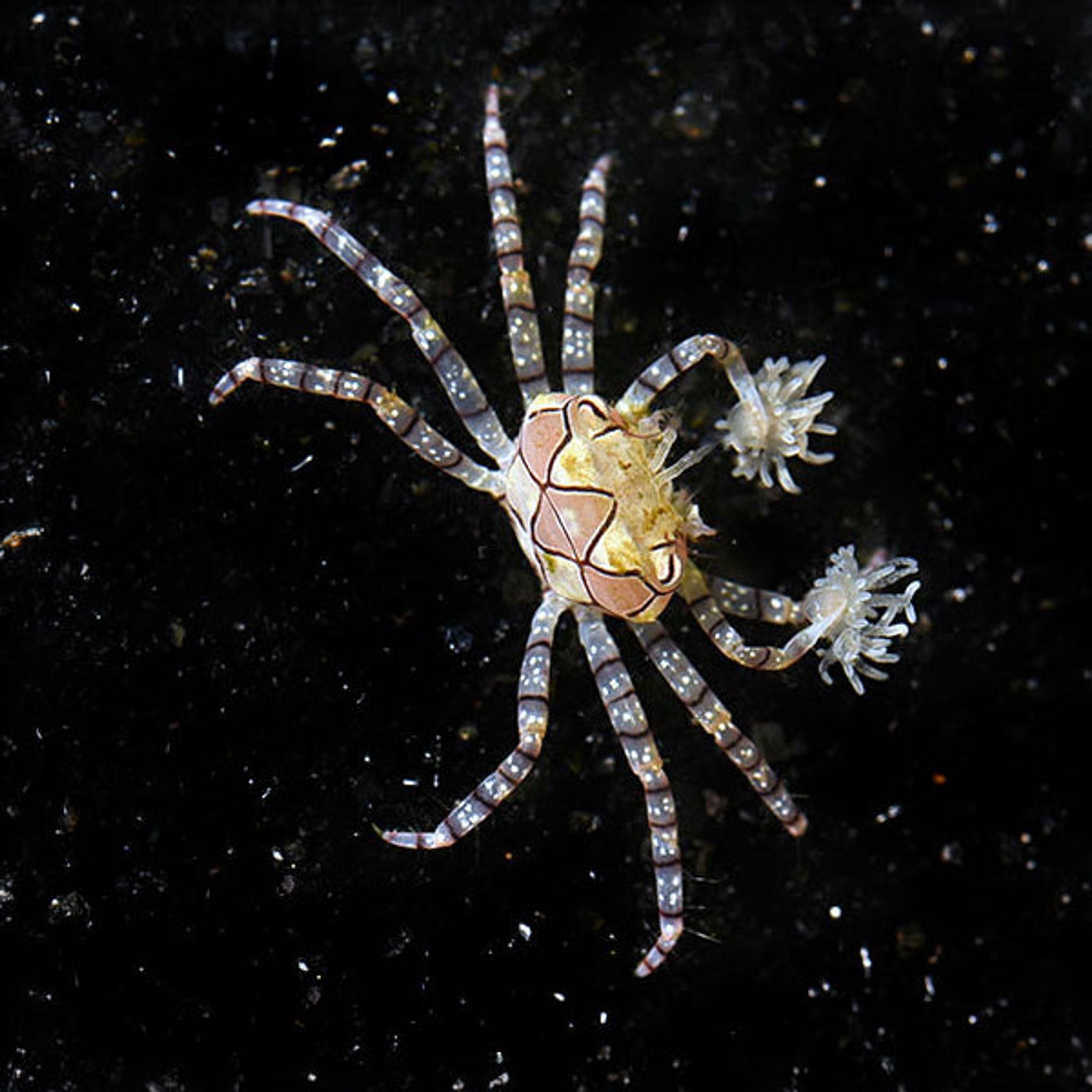

Best Tank Mates for Freshwater Pom-Pom Crab: Safe Fish and Invertebrate Companions
The freshwater pom-pom crab is one of the few aquarium crabs that can genuinely share a tank with fish, shrimp, and snails without turning into a predator. This guide covers exactly which species pair well with it, which ones to skip, and the tank setup details — hiding spots, molting protection, and parameters — that make mixed stocking succeed.
Why the Pom-Pom Crab Is Different From Other Aquarium Crabs
Most crabs sold for aquariums have a well-earned reputation as poor community tankmates. Species like red claw, banana, rainbow, fiddler, panther, matano, and halloween moon crabs carry large, muscular claws built for gripping and tearing. Even when they aren't actively hunting, their territorial behavior and opportunistic feeding habits put constant stress on fish and invertebrates sharing the tank — a slow-moving shrimp or a sleeping fish can become an easy target.
The freshwater pom-pom crab (Ptychognathus barbatus), sometimes mislabeled a "hairy" or "teddy-bear" crab, breaks that pattern. Its small claws are covered in fine, brush-like setae — the "pom-poms" it's named for — adapted specifically for straining detritus and food particles from water and substrate, not for gripping or shredding prey. This is a filter and scavenge feeder, not a hunter, and it's the anatomical reason this species is unusually peaceful compared to nearly every other crab in the trade. That said, individual temperament varies, so caution and observation still matter even with a species this mild-mannered.
Tank Setup That Supports Compatibility
Before adding tankmates, the tank itself needs to be built around the crab's needs — a well-designed setup reduces conflict before it starts.
- Tank size: 5-gallon (19 L) minimum for one crab or a small colony; 10 gallons (38 L) or more once mixing multiple species or several crabs together.
- Temperature: roughly 68–80°F (20–27°C), with the mid-70s°F (around 24°C) considered ideal. Avoid pushing into the low 80s°F.
- pH: approximately 6.5–7.5, with neutral (about 7.0) as the sweet spot.
- Hardness: moderate to low.
- Water type: fully freshwater — this species does not need or tolerate brackish conditions, unlike some other crabs sold alongside it.
- Substrate and decor: fine sand for burrowing, plus driftwood, rockwork, dense plants, and floating plants to create crevices. These aren't just aesthetic — they give the crab somewhere to retreat and give shrimp and fry places to hide.
- Lid: tight-fitting and secure. Pom-pom crabs are capable climbers and will escape through any gap, often at night.
Best Fish Tank Mates
The safest fish are small, peaceful, and spend most of their time in the upper or middle water column, away from the substrate zone the crab patrols.
- Neon tetra
- Pearl danio and other small danios
- Celestial pearl danio
- Dwarf gourami
- Mollies
- Guppies
- Small rasboras
- Endler's livebearers
Beyond the specific names, look for the underlying traits: calm temperament, small adult size, and a swimming pattern that keeps fish mostly off the bottom. Avoid large, aggressive, or fin-nipping fish outright — they can injure a crab, particularly during the vulnerable molting window.
Bottom-Dwelling Fish: A Gray Area, Not a Flat Ban
General crab-compatibility advice often rules out every bottom dweller — corydoras, loaches, plecos — on the assumption that any crab might eat them. Pom-pom crab-specific guidance doesn't go that far; it simply recommends upper- and mid-water fish as the "best" choice without explicitly banning bottom-dwellers. A reasonable middle ground: because this crab's claws are built for filtering rather than gripping, outright predation on adult bottom fish is less likely than with claw-heavy crab species. Still, corydoras and loaches overlap heavily with the crab's foraging zone, which can mean competition for space and food, and occasional harassment. Treat bottom dwellers as a case-by-case risk rather than a hard no, and watch behavior closely after introducing them. Small, hardy corydoras species are the more forgiving option here — you can browse corydoras to compare options suited to nano and community setups.
Best Invertebrate Tank Mates
Invertebrates generally do well with pom-pom crabs as long as they're not small enough to be mistaken for food.
- Cherry shrimp (adults)
- Amano shrimp
- Bamboo shrimp
- Ghost shrimp
- Moderately sized snails — mystery snails and larger nerites hold up well
If you're stocking a shrimp colony alongside a crab, shrimp suited to community tanks are a good starting point, since adult specimens are large enough to avoid being an easy target.
Other peaceful crab species, such as the Thai micro crab, can sometimes cohabit with pom-pom crabs, but success is species- and individual-dependent — this is more of an experienced-keeper option than a default recommendation.
What to Avoid
- Very small or juvenile shrimp, including shrimp fry and young cherry shrimp — these are genuinely at risk from an opportunistic scavenger even though adults are fine.
- Tiny snail species and snail juveniles.
- Fish fry of any species.
- Aggressive or fin-nipping fish that could injure the crab, especially right after a molt.
- Overcrowded small tanks — cramming multiple crabs and fish into anything under 5 gallons invites territorial squabbles over food and hiding space.
Compatibility Quick Reference
| Tankmate type | Compatibility | Notes |
|---|---|---|
| Neon tetra, small danios, rasboras | Good | Upper/mid-column, peaceful, ideal default choice |
| Dwarf gourami, mollies, guppies, endler's | Good | Calm temperament, manageable size |
| Adult cherry, amano, bamboo, ghost shrimp | Good | Size makes predation unlikely |
| Mystery snails, larger nerites | Good | Shell size deters grabbing |
| Corydoras, loaches, small plecos | Case-by-case | Substrate overlap; watch behavior after introduction |
| Shrimp fry, juvenile shrimp, tiny snails | Avoid | Small enough to be eaten |
| Fish fry | Avoid | Vulnerable to opportunistic feeding |
| Large, aggressive, or fin-nipping fish | Avoid | Risk of injuring the crab, especially post-molt |
| Betta fish | Avoid | Mutual risk — see FAQ below |
Molting: The Most Vulnerable Window
Right after shedding its shell, a pom-pom crab is soft-bodied and effectively defenseless for a short period. This is the single highest-risk moment for any tankmate interaction, so plan around it:
- Provide sand for burrowing so the crab can bury itself out of sight during and after a molt.
- Keep dense plant cover and driftwood crevices available as secondary hiding spots.
- Avoid introducing new, curious tankmates right around a molt — unfamiliar fish or shrimp are more likely to investigate or harass a freshly molted crab.
- Don't disturb the tank (rearranging decor, netting fish) during an active molt if you can help it.
Feeding Strategy for Mixed Tanks
Because the crab feeds by filtering and scavenging rather than actively hunting, fast-swimming fish can out-compete it for food if meals aren't managed. Target-feeding — dropping a sinking gel food, blanched vegetable, or piece of shrimp near the crab's location rather than broadcasting food across the tank — reduces the chance it goes looking for alternative food sources among tankmates. Regular calcium supplementation also supports strong, complete molts; a crab that molts poorly is weaker and more vulnerable during that already-risky window.
Stocking Ratio Guidelines
There's no rigid formula, but a workable starting point for a mixed community:
- 5-gallon (19 L) tank: 1 crab, plus a small shrimp colony (6–10 adults) or a handful of nano fish — not both at full density.
- 10-gallon (38 L) tank: 1–2 crabs, 6–10 small fish, and/or 10–15 adult shrimp, adjusted based on how heavily planted and structured the tank is.
- Add tankmates gradually, and quarantine new fish or invertebrates before introducing them to an established tank, rather than adding everything at once.
Two Look-Alikes to Avoid Confusing With the Pom-Pom Crab
Banana Crab
Despite its small size and superficially similar appeal, the banana crab can be territorial and aggressive, particularly in crowded conditions. A breeding pair needs a considerably larger enclosure — 20 gallons (76 L) or more — and it does not share the pom-pom crab's community-safe reputation. It's a useful reminder that small size alone doesn't predict peaceful behavior.
Red Claw Crab (Perisesarma bidens)
The red claw crab is frequently mislabeled as a fully freshwater, community-friendly species, but it's actually semi-terrestrial and brackish, requiring a paludarium with land access rather than a fully submerged tank. It grows to roughly 4 inches (10 cm) in leg-span, is typically kept in trios (one male to two females), and needs an enclosure at least 24 inches (61 cm) long. Buying a red claw crab expecting pom-pom crab-style behavior and setup is one of the most common mistakes in the hobby — the wrong environment (no land access) and the wrong social assumptions (aggression, territoriality) both follow from this mix-up.
Common Mistakes to Avoid
- Assuming all "aquarium crabs" behave like pom-pom crabs and ending up with an aggressive species instead.
- Housing pom-pom crabs with shrimp fry or juvenile snails that get picked off despite the species' generally gentle reputation.
- Skipping a secure lid — crabs climb and escape, often at night, and are found dried out outside the tank.
- Adding new tankmates right after a molt or disturbing the crab mid-molt.
- Overcrowding a small tank with multiple crabs and fish competing for limited space.
- Confusing a brackish, semi-terrestrial species like the red claw crab with the fully freshwater, fully aquatic pom-pom crab.
- Skipping calcium supplementation, which weakens molts and raises vulnerability during the soft-shell period.
If you're assembling a community around a pom-pom crab, browsing small community fishes is a practical way to compare nano species with the calm, upper-water temperament this crab pairs with best.
Frequently Asked Questions
Can pom-pom crabs live with betta fish?
Generally, it's risky in both directions — bettas can nip at the crab's soft antennae and legs, and the crab's activity near the substrate can provoke a territorial betta. It's safer to choose calmer, non-aggressive species instead.
Will a pom-pom crab eat my shrimp?
Adult, reasonably sized shrimp such as cherry and amano shrimp are typically safe. Shrimp fry and very small juveniles are at greater risk, since the crab is an opportunistic scavenger that won't pass up an easy meal.
Can I keep multiple pom-pom crabs together?
Yes — they tolerate their own species reasonably well in adequately sized tanks with enough hiding spots. Occasional minor squabbles over food are normal and not a sign of real aggression.
Do pom-pom crabs need brackish water?
No. This species is fully freshwater, which is a common point of confusion since several other crabs commonly sold in the hobby, such as the red claw crab, do require brackish conditions.
What fish should I avoid with a pom-pom crab?
Avoid large, aggressive, or fin-nipping fish, since they can injure the crab, especially around a molt. Bottom-dwelling species that overlap heavily with the crab's foraging zone are a lesser but still worthwhile concern.
Is a pom-pom crab safe with snails?
Moderately sized snails, including mystery snails and larger nerites, are generally fine. Very small snail species are more vulnerable and worth avoiding.
How do I protect tankmates during the crab's molt?
Provide sand for burrowing and dense plant or driftwood cover so the crab can hide while its shell hardens. Avoid introducing new, curious tankmates right around a molt, since that's when the crab is most defenseless.
Ready to build out your community? You can browse freshwater fish, shrimp, and snails suited to a pom-pom crab setup in FishyHub's Freshwater Livestock category.


