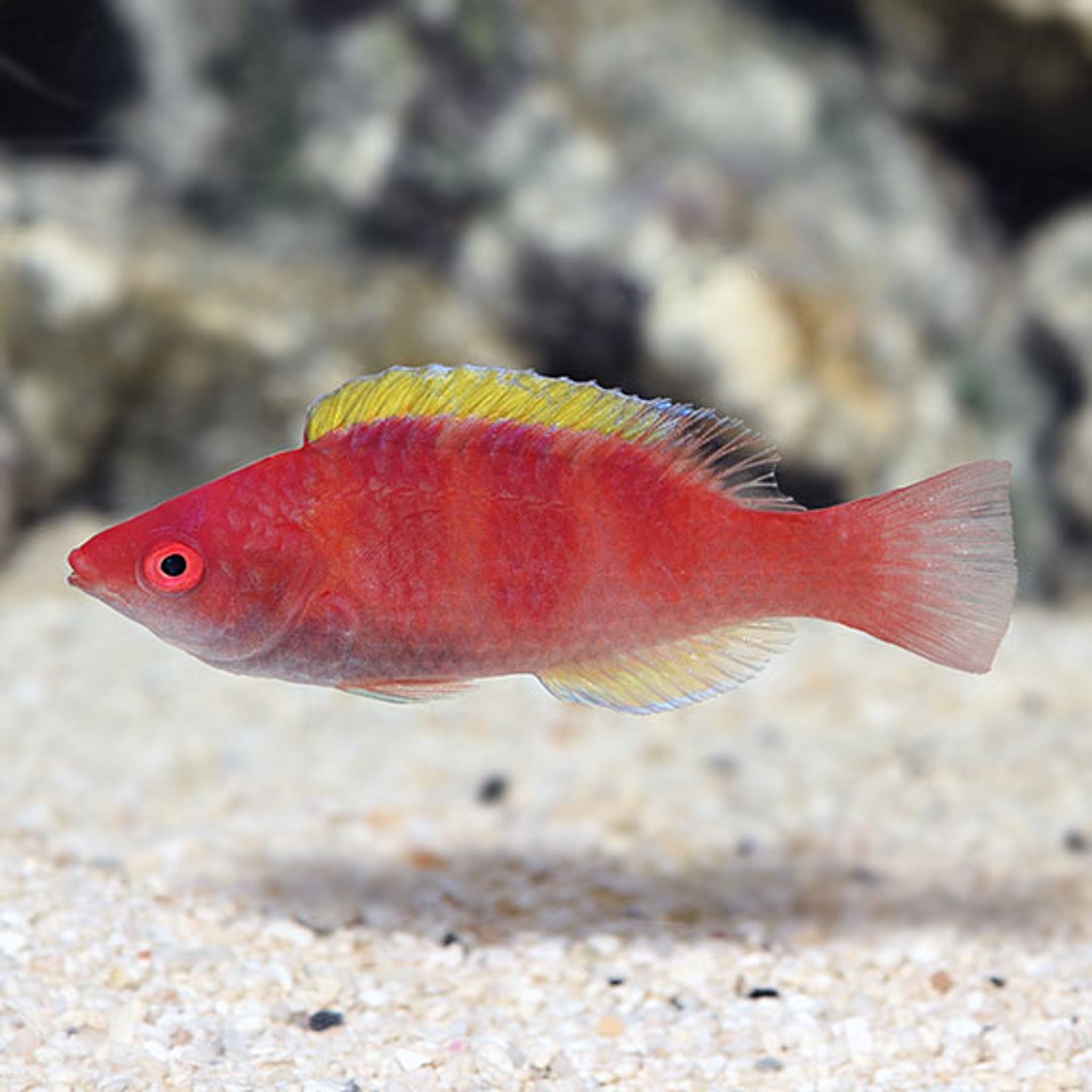
Best Tank Mates for Fairy Wrasse: Peaceful, Risky and Incompatible Choices
Fairy wrasses are among the most popular mid-water fish in the reef hobby, but their compatibility isn't as simple as "peaceful community fish." This guide breaks tank mates into clear tiers — peaceful, risky, and incompatible — and explains the behavior behind each ranking so you can build a stocking plan that actually works.
What Makes a Fairy Wrasse Tick
Fairy wrasses (genus Cirrhilabrus) are small, brightly colored, reef-safe wrasses that spend most of their time swimming in open water in the mid-to-upper part of the tank, rather than picking along the substrate like many other wrasse species. Adults typically run 2.5 to 5 inches (6–13 cm), and males display sexual dichromatism — they're usually far more colorful than females, sometimes described as "terminal phase" after changing sex from female to male.
Two behavioral facts drive almost every compatibility decision with this genus:
- They are generally peaceful toward unrelated species. Fights are rare with tangs, gobies, or damsels.
- Their aggression is almost entirely intraspecific or directed at look-alikes — other fairy wrasses, flasher wrasses, or anything with a similar body shape and color pattern. This is a territorial dispute over resembling a rival, not a family-wide grudge.
Keep those two points in mind and the rest of the stocking logic falls into place.
Peaceful Tank Mates
These species share the reef without competing for the same visual territory or triggering a wrasse's rivalry response:
- Clownfish — different swimming zone, host-anchored, no interest in a mid-water wrasse
- Gobies (watchman, clown, diamond) — bottom-dwelling, non-competing
- Blennies — rock- and glass-grazing, different niche
- Other peaceful wrasses of a different genus or coloration — as long as body shape and pattern don't overlap
- Tangs and surgeonfish — grazers, different diet and swimming behavior
- Cardinalfish — slow, shoaling, non-territorial
- Chromis and other peaceful damsels — schooling, low aggression
- Dwarf angelfish — generally tolerant of unrelated mid-water fish
- Most reef-safe community fish that aren't shaped or colored like a rival wrasse
You can browse a range of compatible options in FishyHub's wrasse category alongside classic pairings like clownfish and tangs and surgeonfish, both considered textbook-safe combinations since they occupy different zones and eat different foods.
Risky Tank Mates
These aren't automatic no's, but they need planning, careful individual selection, or close monitoring after introduction:
- Other fairy wrasses or flasher wrasses of similar size and color — the most common source of in-tank fighting
- Large or territorial damselfish — can bully smaller or newer arrivals
- Dottybacks — sources disagree here; some call them fine tank mates, others flag them as aggressive toward smaller newcomers. The sensible approach is to treat this as species- and individual-dependent: add the fairy wrasse first, choose the mildest individual dottyback available, and monitor closely for the first week or two
- Larger semi-aggressive wrasses that may outcompete a fairy wrasse for food
- Hawkfish — can occasionally pick at small wrasses, especially newly introduced ones
- Any fish that competes directly for the same mid-water plankton niche and swimming space
The Dottyback and Damsel Gray Zone
Because outcomes vary by individual temperament, treat these groups as "proceed with caution" rather than "safe" or "unsafe." Adding the fairy wrasse to the tank before a dottyback or aggressive damsel establishes territory, and reduces the odds of the wrasse being singled out as the newcomer.
Incompatible Tank Mates
These combinations should be avoided outright:
- Large predatory fish that can simply eat a fairy wrasse whole — lionfish, groupers, large triggerfish, large eels
- Larger, aggressive hawkfish species in the same category as predatory risk
- Aggressive large wrasses, such as bigger Halichoeres or adult Coris species, which will bully or outright eat a fairy wrasse
- Anything with a mouth large enough to swallow a 3–4 inch fish — a useful rule of thumb when evaluating any unfamiliar species
Peaceful vs. Risky vs. Incompatible: Quick Reference
| Tier | Examples | Why |
|---|---|---|
| Peaceful | Clownfish, gobies, blennies, tangs, cardinalfish, chromis, dwarf angelfish | Different zone, diet, or shape — no rivalry trigger |
| Risky | Other fairy/flasher wrasses, dottybacks, territorial damsels, hawkfish, larger semi-aggressive wrasses | Competes for niche, food, or resembles a rival |
| Incompatible | Lionfish, groupers, large triggers, large eels, adult Coris/Halichoeres | Predation risk or guaranteed bullying |
Fairy Wrasses vs. Flasher Wrasses and Other Look-Alikes
Hobbyists frequently confuse fairy wrasses with flasher wrasses, since the two occupy a nearly identical niche and have similar care requirements — small size, mid-water swimming, planktivorous diet. For compatibility purposes, treat flasher wrasses as functionally equivalent to fairy wrasses: mixing them carries the same look-alike aggression risk as mixing two fairy wrasse species.
Other wrasses in the broader family don't make good aquarium residents at all. Cleaner wrasses are not recommended for home aquariums due to poor survival rates in captivity — they have a specialized diet of parasites picked off other fish that's nearly impossible to replicate. Six-line and four-line wrasses are bolder than fairy wrasses and useful for pest control (they'll eat flatworms and small pests), but they're also noticeably more aggressive and can harass a shy new fairy wrasse. Not every "wrasse" belongs in the same stocking conversation — some grow far too large for home tanks, and others have diets that simply don't translate to captivity.
Tank Size and Setup Requirements
- Single specimen: 30–50 gallons is commonly cited, though the more conservative and sensible minimum is 40–50 gallons once you account for future tank mates
- Multiple fairy/flasher wrasses or a harem: 90+ gallons is recommended, ideally 100+ gallons
- Tight-fitting lid: essential. Fairy wrasses are notorious jumpers, especially when startled or newly introduced — check for gaps around cords, overflows, and light fixtures, not just the main lid
- Sand bed: a fine sand bed several inches deep is strongly recommended, since many species bury themselves in sand at night or under stress. Bare-bottom tanks increase both stress and jumping risk
Keeping Multiple Cirrhilabrus
It's possible to keep more than one fairy wrasse, but only under specific conditions:
- One male with several females (a harem) works best, and should be added simultaneously so no single fish establishes territory first
- Two males of a similar-looking species will almost always fight, regardless of tank size
- Only attempt multi-wrasse stocking in 90+ gallon tanks with abundant rockwork that breaks direct line of sight between fish — dense rockscaping gives subordinate individuals places to disappear from view, which reduces chasing
Stocking Order: Where the Fairy Wrasse Fits
A common mistake is treating tank mate lists as static, without considering the order fish are added. For fairy wrasses, follow this general sequence:
- Establish the tank first — sand bed, rockwork with hiding spots, and stable parameters before any fish go in
- Add peaceful, shy, or skittish residents early (gobies, blennies, cardinalfish) so they're settled before more assertive fish arrive
- Add the fairy wrasse mid-to-late in the sequence, once the tank has hiding spots but before more aggressive or territorial fish are established — this avoids introducing it into a battle-tested territorial hierarchy
- Add aggressive or territorial fish last (if at all), since a settled fairy wrasse copes far better with a new aggressive tank mate than a new fairy wrasse copes with an already-entrenched one
Introducing a Fairy Wrasse to an Existing Territorial Fish
If you already have a mildly territorial resident (a damsel or dottyback, for example) and want to add a fairy wrasse afterward, rearranging the rockwork at the same time as introduction helps reset established territories for everyone — not just the newcomer. This levels the playing field rather than dropping the wrasse into a fully claimed space.
Feeding Requirements
Fairy wrasses are planktivores, not grazers — a common mistake is assuming they'll pick at algae or leftover food like some other reef fish. In reality they need:
- Mysis shrimp, brine shrimp, and other meaty frozen foods
- Quality pellets as a supplement
- Multiple feedings per day (2–3x is typical), since their fast metabolism and constant mid-water activity burn through energy quickly
Underfeeding is one of the more common husbandry mistakes with this genus — a fairy wrasse left to "graze" like a blenny or goby will slowly decline.
Water Parameters
Fairy wrasses do well within standard reef parameters:
| Parameter | Target Range |
|---|---|
| Temperature | 72–78°F (22–26°C) |
| Salinity | 1.023–1.025 SG |
| pH | 8.1–8.4 |
Stability matters more than hitting an exact number — sudden swings stress fairy wrasses more than most reef fish, which compounds jumping risk.
Reef and Invertebrate Compatibility
Fairy wrasses are considered reef-safe and won't touch coral tissue. However, "reef-safe" doesn't mean "safe with every small invertebrate." They may occasionally pick at:
- Ornamental or pod-based invertebrates, including feather dusters and small crustaceans
- Bristleworms, opportunistically
- Very small ornamental shrimp, which larger wrasse species can occasionally view as a snack — cleaner shrimp are generally safe, but tiny decorative shrimp carry some risk
The First Two Weeks: A Jump- and Stress-Prevention Checklist
New fairy wrasses are far more vulnerable to jumping and stress-related illness in their first days than after they've settled in. Run through this checklist immediately after introduction:
- Seal every gap in the lid, including around cords, overflow boxes, and light fixture cutouts — mesh or covers over anything larger than the fish's body
- Dim the lighting for the first few days to reduce stress and skittish jumping behavior
- Watch feeding response closely — a fairy wrasse that refuses food for more than a day or two in a new tank is a warning sign, not a "give it time" situation
- Quarantine before display tank introduction — fairy wrasses are considered more delicate in shipping and prone to bacterial infections if stressed during transit and acclimation
- Acclimate slowly, using a drip method rather than a quick temperature-and-dump approach
Common Mistakes to Avoid
- Leaving the tank uncovered. A fairy wrasse jumping out overnight is one of the most frequently reported losses in the hobby.
- Adding a fairy wrasse alongside an already-established, similarly patterned wrasse and expecting peaceful coexistence.
- Introducing a fairy wrasse to a bare-bottom, hideout-free tank, causing prolonged stress and food refusal.
- Skipping quarantine or rushing acclimation, increasing susceptibility to stress-related illness.
- Underfeeding, based on the mistaken assumption that fairy wrasses graze like bottom-dwelling wrasse species.
- Assuming reef-safe means invert-safe — occasional picking at ornamental shrimp or pods does happen.
Frequently Asked Questions
Can I keep two fairy wrasses together?
Only with careful species and sex selection — one male with multiple females works best, added simultaneously to a large tank with plenty of rockwork to break sightlines. Two similarly colored males will almost always fight.
Are fairy wrasses reef safe?
Yes, they don't touch coral and are considered reef-safe. That said, they may occasionally pick at ornamental invertebrates like feather dusters or small shrimp and pods.
What fish should never go with a fairy wrasse?
Large predators capable of swallowing a 3–5 inch fish — lionfish, big triggerfish, large eels, and groupers — are incompatible. So are closely related, similarly colored or sized wrasses that will either fight over territory or be mistaken for a rival.
Will a fairy wrasse jump out of my tank?
It's a real and common risk, especially in the first few weeks after introduction or whenever the fish is startled. A tight-fitting lid or mesh top is considered mandatory, not optional.
What tank size does a fairy wrasse need?
A single specimen is commonly kept starting around 40–50 gallons. If you plan to keep multiple fairy or flasher wrasses, or a male with a harem of females, budget for 90+ gallons.
Can fairy wrasses live with clownfish and tangs?
Yes — these are considered classic peaceful combinations, since clownfish, tangs, and fairy wrasses occupy different tank zones and eat different foods.
Do fairy wrasses need sand?
A soft, several-inch sand bed is strongly recommended. Many fairy wrasse species bury themselves in it at night or when stressed, and its absence can raise anxiety and jumping risk.
How many times a day should I feed a fairy wrasse?
Multiple small feedings — typically 2–3 times per day — of meaty frozen foods like mysis or brine shrimp suit their active, planktivorous metabolism better than a single large feeding.
Ready to plan your stocking list? Browse reef-safe options in FishyHub's marine fish category to find peaceful tank mates that match your fairy wrasse's temperament and tank size.

