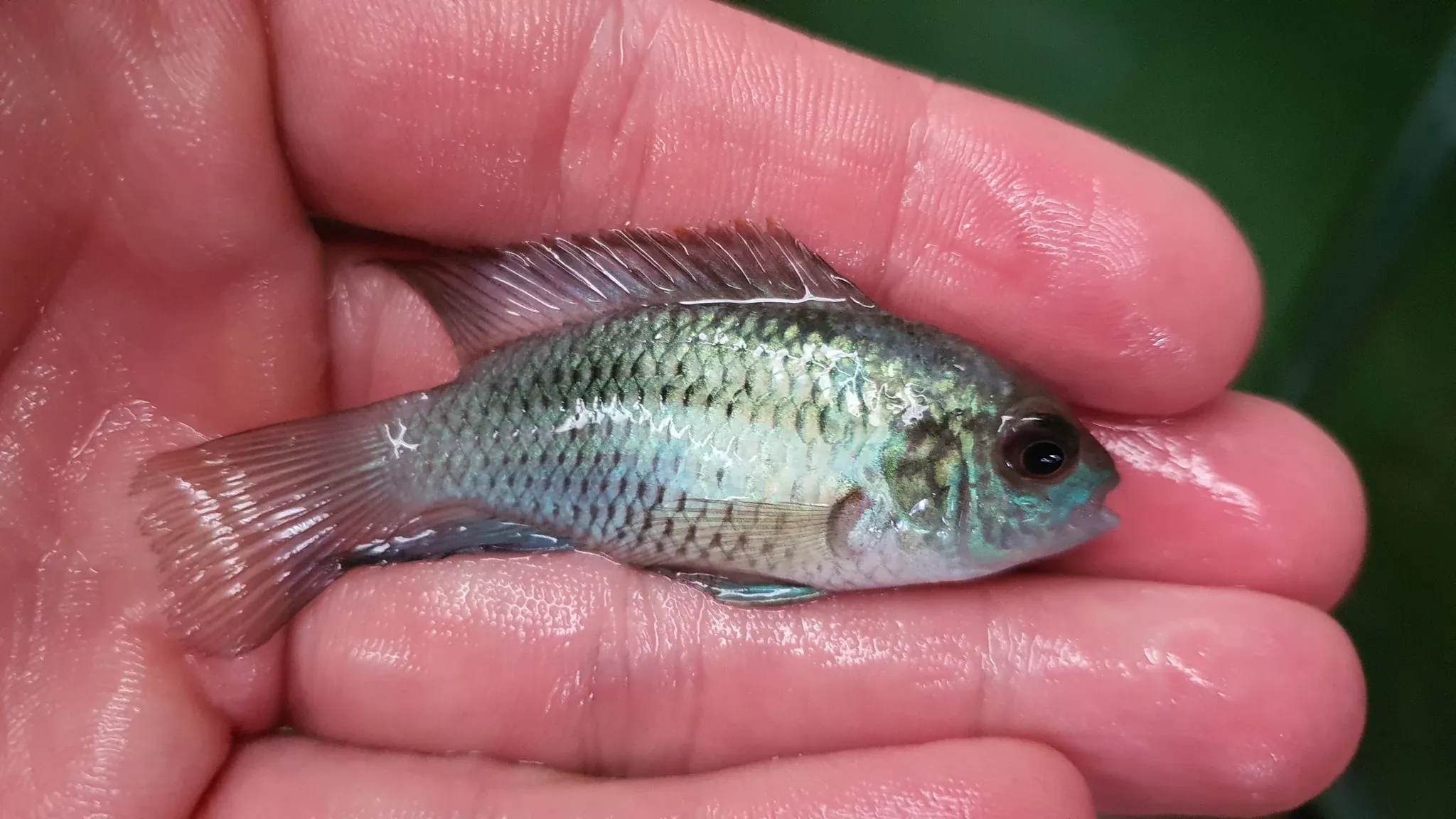
Best Tank Mates for Electric Blue Acara: Compatible Fish and Species to Avoid
The best electric blue acara tank mates are peaceful to semi-peaceful fish that reach at least 3 inches (7.5 cm) as adults and like soft to moderately hard water at 74–82°F (23–28°C). Good picks include angelfish, bristlenose plecos, larger Corydoras, rainbowfish, Congo tetras and mild cichlids such as severums. Skip anything small enough to swallow and any heavyweight cichlid that will push a timid acara around.
Below you'll find the rules behind those picks, a compatibility table, a list of species to avoid, and sample stocking plans for 40, 55, 75 and 125 gallon tanks.
Know Your Acara Before You Pick Its Neighbors
The electric blue acara (EBA) is a line-bred color form linked to the blue acara (Andinoacara pulcher). It doesn't occur in the wild. Compared with wild-type blue acaras, EBAs are often a bit less robust and slightly smaller, so buy healthy stock. Look for fully open fins, even color and active swimming, and pass on fish with clamped fins.
Key facts that shape compatibility:
- Adult size: 5–7 inches (13–18 cm), with males larger.
- Lifespan: roughly 7–10 years, so a stocking choice is a long commitment.
- Maturity: around 4 inches and about one year old, which is when pairing and territorial behavior start.
- Temperament: one of the calmest New World cichlids. The "semi-aggressive" label comes mostly from pairs defending a spawning site. Rougher cichlids can bully them.
- Water: 74–82°F (23–28°C), pH about 6.0–7.5 (6.5–7.2 is the sweet spot), soft to moderately hard water with KH around 2–10 dKH.
Every tank mate needs to fit inside that water range. A peaceful fish that wants hard, alkaline water or very warm temperatures isn't a real match.
The Three Rules of Acara Compatibility
1. The mouth-size rule
Any fish under about 3 inches as an adult will eventually be eaten, usually at feeding time when the acara is in hunting mode. That covers neon tetras, ember tetras, guppies, endlers, small rasboras and cherry or other dwarf shrimp. It makes no difference that they got along as juveniles. Plan your stocking list around adult sizes, not the size of the fish in the store tank.
2. Match temperament and size
Good mates are mid-sized, calm and confident enough not to hide all day, but not so pushy that they take over the tank. Very aggressive cichlids flip the problem around: the acara becomes the one getting hurt.
3. Use the space the acara doesn't
EBAs mostly patrol the middle of the water column. Bottom dwellers are the safest category because they stay out of that zone. Fast top-to-mid schooling fish such as rainbowfish and giant danios do well too, since they're too quick and too large to be targets.
Tank Size: How Many Gallons You Really Need
Recommendations run anywhere from 30 to 55 gallons as a minimum. The difference comes down to what else is in the tank:
- Single EBA: 30–40 gallons (114–151 L)
- Bonded pair alone: about 40 gallons (151 L)
- EBA in a community: 55 gallons (208 L) minimum
- Pair plus mid-sized cichlids: 75 gallons (284 L) or more is preferred
A 30 gallon tank is fine for one fish on its own. Once you add tank mates, go to 55 gallons or larger. You can browse glass tanks on FishyHub if you're sizing up.
Compatibility Table: Best Electric Blue Acara Tank Mates
| Fish | Tank zone | Min. tank | Temp overlap with EBA | Notes |
|---|---|---|---|---|
| Bristlenose pleco | Bottom | 55 gal | Full | Bottom dweller; give it driftwood and a cave |
| Corydoras (larger species) | Bottom | 55 gal | Full | Groups of 6+, sand bottom; choose the larger species |
| Angelfish | Mid, tall tanks | 55 gal (tall) | Full | Classic pairing; watch during either species' spawning |
| Boeseman's / turquoise rainbowfish | Mid to top | 55 gal | Full | Groups of 6+; fast mid-to-top swimmers |
| Congo tetra | Mid | 55 gal | Full | One of the few tetras big enough |
| Pearl or moonlight gourami | Upper | 55 gal | Full | Calm upper-level fish |
| Giant danio | Top to mid | 55 gal | Full | Active schooler; good dither fish |
| Denison's (roseline) barb | Mid | 55–75 gal | Full | Peaceful barb; better than tiger barbs |
| Zebra loach | Bottom | 55 gal | Full | Bottom dweller, keep in a group |
| Clown loach | Bottom | 75–125+ gal | Full | Group fish that needs a big tank long term |
| Synodontis catfish | Bottom | 55–75 gal | Full | Bottom dweller; check the species' adult size |
| Silver dollar | Mid | 75+ gal | Full | Keep in groups; they eat plants |
| Severum | Mid | 75 gal | Full | Mild cichlid, similar water |
| Firemouth | Mid to bottom | 55–75 gal | Full | Mostly bluff; give each fish its own territory |
| Geophagus | Bottom (sand) | 75+ gal | Full | Needs sand for sifting |
| Blood parrot | Mid | 75 gal | Full | Clumsy but usually peaceful |
| Uaru | Mid | 125 gal | Warm end | Only in large tanks |
| Discus | Mid | 75+ gal | Warm edge only (82°F+) | Advanced keepers only; see below |
Tank zone is where the fish spends most of its time; bottom and top zones keep it out of the acara's mid-water patrol. Temp overlap shows where each species' preferred range meets the EBA's 74–82°F. "Full" means the fish is comfortable across most of that range.
For bottom-level picks, you can browse plecos, corys and bottom dwellers on FishyHub.
Cichlid Companions That Usually Work
The easiest cichlid partner for an EBA is a second EBA of the opposite sex. A bonded pair is calm, beautiful to watch and less likely to fight than mixed cichlids. After that, the most reliable options are:
- Severum: a mild cichlid that shares the acara's water range.
- Firemouth: plenty of throat-flaring display, but rarely serious damage when there's enough room.
- Geophagus: peaceful sand sifters that need a soft bottom.
- Uaru: gentle, but large, so save them for 125 gallon setups.
- Blood parrot: usually peaceful; its small mouth makes it more of a target than a threat.
The "Maybe" Tier: Conditional Picks
Sources disagree on some species. Here's how to decide:
- Discus: They prefer 82–86°F (28–30°C) and very clean, soft water. That overlaps with the EBA only at the warm edge of its range. It can work for experienced keepers who hold the tank around 82°F and keep up strict maintenance. Not a beginner combination.
- Tetras: Size settles the argument. Congo, black skirt, bleeding heart and buenos aires tetras are big enough. Neons, embers and other small tetras will be eaten.
- Clown loaches and silver dollars: Both are good matches, but they need big tanks long term. Only add them if you already have (or plan to buy) 75–125+ gallons.
Species to Avoid
| Avoid | Why |
|---|---|
| Neon, ember and other small tetras; guppies, endlers, small rasboras | Prey once the acara grows |
| Cherry and dwarf shrimp | Prey |
| Oscars | Outgrow the acara, can bully or eat it |
| Jack Dempsey, convict, Texas cichlid, flowerhorn, red devil | Too aggressive for a timid EBA |
| African cichlids, including mbuna | Aggressive, and they need hard, alkaline water |
| Electric blue rams | About 2–3 in and prefer warmer water; risk of harassment or predation |
| Tiger barbs, serpae tetras | Fin-nippers, especially hard on angelfish |
| Tinfoil barbs | Reach 12+ in (30+ cm), far too big for most home tanks |
Some lists call oscars compatible in 125+ gallon tanks. We still recommend against it. The same goes for Jack Dempseys and convicts: some keepers rate them as moderate matches, but they're risky in anything under 75–90 gallons and a poor choice in general. If you want the look of a barb, go with Denison's barbs or giant danios instead of tiger or tinfoil barbs.
Sample Stocking Plans by Tank Size
These are starting points. Adjust based on your filtration and how often you do water changes.
40 gallons (151 L)
- One EBA, or one bonded pair, kept on their own
- Optional: a few nerite snails
55 gallons (208 L)
- One EBA
- 6–8 Corydoras (larger species) on sand
- 1 bristlenose pleco
- 6 rainbowfish or 6 Congo tetras
75 gallons (284 L)
- One bonded EBA pair
- 1 severum or 1 pair of angelfish
- 6 Boeseman's or turquoise rainbowfish
- 6–8 Corydoras and 1 bristlenose pleco
125 gallons (473 L)
- One bonded EBA pair
- A small group of geophagus or 1 uaru pair
- A group of clown loaches or silver dollars
- 1–2 Synodontis catfish and a bristlenose pleco
Rainbowfish work well as the schooling fish in any of the 55+ gallon plans.
Setup and Stocking Order to Reduce Conflict
- Substrate: fine sand or smooth gravel, since acaras dig and corys and geophagus need sand.
- Hardscape: caves, driftwood and flat stones placed so they break sightlines. If one fish can see the whole tank, it can start bullying.
- Lid: keep it tight, because stressed acaras may jump.
- Stocking order: add bottom dwellers and dither fish first and the EBA last. That way the acara doesn't treat the whole tank as its territory before anyone else arrives.
- Quarantine: keep every new fish in a separate tank for 2–4 weeks before adding it.
Feeding a Mixed Tank
EBAs are omnivores. Feed a quality sinking pellet and add frozen foods for variety. Acaras are pushy at feeding time, so drop some food near the bottom fish, or feed sinking wafers after lights-out, to make sure your corys and plecos get enough.
Invertebrates
Nerite and mystery snails usually do fine. Small shrimp are food. Keep crayfish out of the tank.
Breeding Season: What Changes
EBAs are monogamous open-substrate spawners. A pair lays roughly 100–200 eggs on a flat rock or piece of slate and guards an area of about 10–12 inches (25–30 cm) around it. Expect about 2–3 weeks of heavier chasing each cycle. Tank mates need open swimming space and cover away from the nest.
For the fry, plan ahead: move eggs or fry to a grow-out tank if you want to raise them, or let the tank mates keep numbers down naturally. A pair that spawns over and over can wear down a community. At that point, moving the pair to its own 40 gallon tank, or finding another keeper to take surplus fish, is often the kindest solution.
Common Mistakes and Troubleshooting
- Buying tiny juveniles together: a small EBA and small tetras look fine at first, then the tetras disappear as the acara grows.
- Mixing with heavyweights: Central American bruisers and mbuna are the wrong temperament, and mbuna need the wrong water chemistry too.
- Fin-nippers with angelfish: tiger barbs and serpae tetras will shred long fins.
- Too little cover: open sightlines let one bully control the tank.
- Sudden aggression: usually a pair forming or spawning. Add décor to block sightlines, use a divider, or move the pair out for a while. If a fish gets injured, rehome one of them.
- A pale or hiding EBA: likely bullying or poor water. Test ammonia, nitrite and nitrate, then look at who's chasing it.
- Overstocking: big fish produce a lot of waste. Keep up weekly 25–30% water changes.
Frequently Asked Questions
Can electric blue acaras live in a community tank?
Yes. Choose peaceful fish that reach at least 3 inches as adults and give them 55 gallons or more. Add plenty of hardscape, and add the acara last so it doesn't claim the whole tank.
Can two electric blue acaras live together?
A male–female pair usually does very well and is the easiest cichlid pairing for this species. Two males can squabble, especially in smaller tanks. If you're unsure of sex, a bigger tank with plenty of cover lowers the risk.
Will electric blue acaras eat neon tetras or shrimp?
Yes, once the acara is big enough to fit them in its mouth. Neons, embers, guppies and cherry shrimp are all at risk. Choose tank mates that stay above about 3 inches instead.
Can electric blue acaras live with angelfish?
Usually, yes. Use a tall tank with vertical cover such as driftwood or tall décor, and watch closely when either species is spawning. Keep fin-nippers out of the tank.
Can electric blue acaras live with oscars, discus or African cichlids?
Oscars aren't recommended because they outgrow and can bully or eat an EBA. Discus can work only for experienced keepers who hold warm, very clean, soft water around 82°F. African cichlids are a poor match because of both their aggression and their need for hard, alkaline water.
Are electric blue acaras aggressive?
They're mild most of the time and among the calmest New World cichlids. Pairs get territorial when breeding and guard a small area for a few weeks. Enough space and broken sightlines usually keep that under control.
Build Your Acara Community
An electric blue acara is easy to plan around if you choose mates by adult size, shared water and temperament, and give the tank enough gallons and cover. When your list is ready, browse angelfish, discus, rams and cichlids on FishyHub to find your acara and its cichlid companions.

