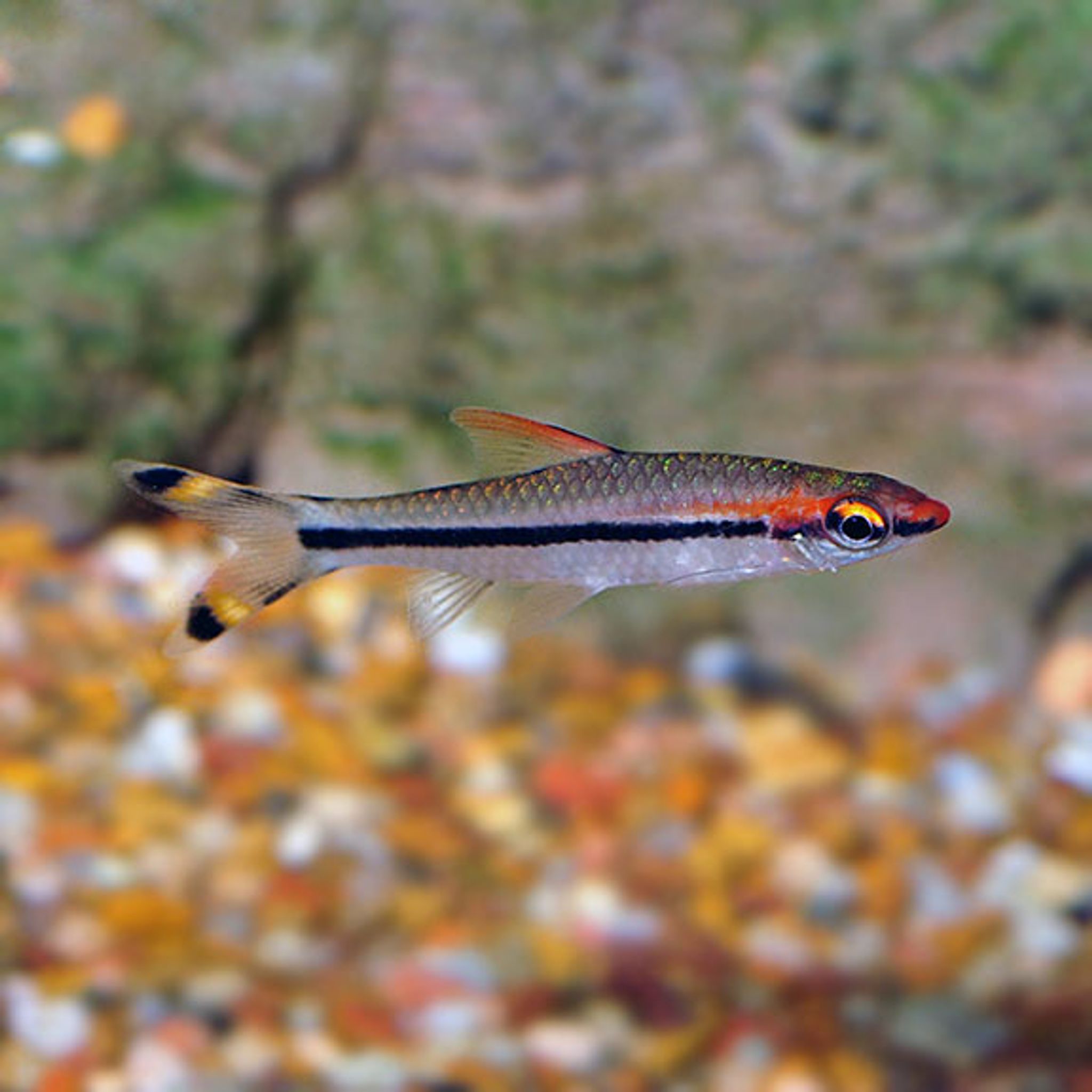
Best Tank Mates for Denison Barb: Compatible Fish and Species to Avoid
The best tank mates for Denison barb are fast, sturdy fish of at least 2 inches (5 cm) that handle cooler water and current. Good choices include rainbowfish, giant danios, Congo tetras, hillstream loaches and bristlenose plecos. Skip bettas, long-finned fish, nano species and warm-water specialists such as discus. Below you'll find a temperature-overlap check for each recommended mate, stocking plans for common US tank sizes, and a full "do not add" list.
Denison Barb Profile at a Glance
The Denison barb, sold in the US as the roseline shark or red-line torpedo barb, is Sahyadria denisonii (formerly placed in Puntius). It's a river fish from India's Western Ghats: big, fast, oxygen-hungry and happiest at the cooler end of the tropical range.
| Trait | Detail |
|---|---|
| Adult size | 4–6 in (10–15 cm) |
| Size when sold | Usually 1.5–2 in (4–5 cm), and they grow quickly |
| Lifespan | 5+ years |
| Minimum tank | 55 gal (208 L) with a 4-ft (1.2 m) footprint; 75 gal (284 L)+ preferred |
| Group size | 6 minimum, ideally 8–10 or more |
| Temperature | Sources range 60–77°F (16–25°C); practical target 68–77°F (20–25°C) |
| pH / hardness | Sources list pH 6.6–7.8 and 5–25 dGH; aim for pH 6.8–7.6 |
| Care level | Intermediate |
Conservation note
The species is listed as endangered in the wild, largely because of heavy collection for the aquarium trade. Captive-bred Denison barbs are now common in US stores, so choose them. They also tend to adapt to aquarium life more easily.
What they need before you add anything else
- Space to swim. The footprint matters more than gallons. An open midwater lane over sand or fine gravel, with plants or rock along the edges, suits them.
- Strong filtration and high dissolved oxygen, with moderate to strong flow.
- A tight-fitting lid. They jump.
- A varied omnivore diet: quality flakes or pellets, frozen or live daphnia, brine shrimp and bloodworms, plus greens such as spirulina or blanched vegetables. Feed 2–3 times a day, only what they finish in about 2 minutes.
Temperament: Why Tank Mates Matter
With a proper school and room to move, Denison barbs are peaceful. Put them in a cramped tank or keep only two or three, and they get pushy, chase, and may start nipping. Even when they behave well, their speed can stress slow or shy fish, which end up outcompeted at feeding time or pushed into corners.
Juveniles cause some confusion here. A 2-in Denison looks harmless next to a school of nano fish, but the risk grows as it heads toward 5 in and its mouth grows with it. Stock for the adult fish, not the one in the bag.
The ideal tank mate profile
A good companion is:
- At least 2 in (5 cm) as an adult, ideally a similar size
- Fast and active, or a bottom dweller that stays out of the way
- Comfortable at 70–75°F (21–24°C) and in current
- Short-finned
- Not large enough to eat a 4-in (10 cm) fish
Flow and oxygen make a useful filter. Species that come from streams, such as hillstream loaches and danios, suit the setup Denisons already need.
Best Tank Mates for Denison Barbs
Sources list the low end at 60°F, but that is too cool for most community mates. 70–75°F (21–24°C) is the sweet spot where everything below overlaps.
| Tank mate | Temperature overlap at 70–75°F | Tank zone | Notes |
|---|---|---|---|
| Rainbowfish | Good | Mid to top | Similar size and energy; a top pick |
| Giant or larger danios | Good, tolerate cooler water | Top | Fast and love current |
| Congo tetras | Good | Mid | Robust tetra with a matching size |
| Black skirt tetras | Good | Mid | Larger, sturdier tetra |
| Buenos Aires tetras | Good, suit cooler setups | Mid | Can nibble plants |
| Larger rasboras | Good | Mid | Choose the bigger species |
| Rosy and odessa barbs | Good | Mid | Easygoing barb companions |
| Dawkinsia barbs | Good | Mid | Fellow Western Ghats natives |
| Hillstream loaches | Good, like cooler water and flow | Glass and rock | Need high oxygen, which you already provide |
| Zebra loaches (Botia striata) | Good | Bottom | Also Indian; keep a group |
| Bristlenose pleco | Good | Bottom | Handles algae and adds little conflict |
| Kribensis | Prefer 74–77°F (23–25°C) | Bottom | Territorial when breeding |
| Apistogrammas | Prefer 74–77°F, softer water | Bottom | Big tanks only |
| Amano shrimp, snails | Good | Bottom | Adult Amanos usually survive |
Top picks
Rainbowfish are the most natural pairing: similar size, constant movement, and bright color that sets off the Denisons' red stripe. You can browse rainbowfish on FishyHub when planning the midwater school.
Giant danios keep up in the current and don't mind the cooler end of the range. Congo tetras add size and shimmer without being bullied.
For the bottom, hillstream loaches, zebra loaches and a bristlenose pleco make use of space the barbs ignore. Look through the loach selection for groups suited to a flowing tank.
Borderline choices
- Tiger barbs: often listed as ideal, but they nip fins and add chaos. They work in a big tank with large groups of both species, but they aren't a first pick.
- Cherry barbs: small enough to be pushed around. Only try them in a large, heavily planted tank.
- Kribensis and apistogrammas: they stay low and mostly avoid the barbs. They do defend territory while breeding, though, and they prefer warmer, softer water. Keep them at 74–77°F (23–25°C) in a big tank.
A note on shrimp
Shrimp are often listed as compatible, but Denisons eat baby dwarf shrimp and small cherry shrimp. Amano shrimp or other larger adult shrimp are the realistic option. Don't expect to keep a breeding colony.
Species to Avoid
| Avoid | Why |
|---|---|
| Bettas | Slow, long-finned and a target for chasing |
| Fancy guppies | Long fins, slow, easily stressed |
| Long-fin angelfish | Slow and long-finned, and they prefer warmer water |
| Discus | Need much warmer water; temperatures don't overlap |
| Rams | Warm-water specialists; no temperature overlap |
| Fancy goldfish | Slow, heavy waste, and only partial temperature overlap |
| Neon tetras and other nano fish | Small enough to fit in a 5-in fish's mouth |
| Celestial pearl danios | Under about 1 in (2.5 cm); risk of bullying or being eaten |
| Oscars and large South American cichlids | Predatory and big enough to eat a Denison |
One source lists celestial pearl danios as compatible. The safer rule is to skip fish that stay under about 1 in, because adult Denisons can bully or eat them.
Sample Stocking Lists by Tank Size
A 6-in fish produces real bioload, and a full school of Denisons is a significant load before you add anything else. One rule of thumb adds about 5 gal (19 L) per Denison beyond six. Build up slowly, and watch nitrate as you add fish.
55 gallons (208 L), 4-ft tank
- 6–7 Denison barbs
- 6 Congo tetras or 6 larger danios
- 1 bristlenose pleco
- A few Amano shrimp or snails
Keep it simple. This is the minimum, so choose one midwater companion group, not two.
75 gallons (284 L)
- 8–10 Denison barbs
- 6–8 rainbowfish
- 5–6 zebra loaches
- 1 bristlenose pleco
125 gallons (473 L)
- 10–12+ Denison barbs
- 8 rainbowfish or 8 giant danios
- 8 Dawkinsia barbs or rosy barbs
- A group of hillstream loaches
- A pair of kribensis or apistogrammas if you run the tank at 74–77°F (23–25°C)
- 1 bristlenose pleco and Amano shrimp
How to Introduce Tank Mates
- Quarantine every new fish for 2–4 weeks. Ich outbreaks after new arrivals are one of the most common problems in Denison tanks.
- Choose an order. Either let the Denison school settle first and then add companions, or add everything together.
- Buy the school in one purchase. Denisons cost more than typical barbs, which tempts people to buy a few at a time. Adding them all at once keeps social stress low.
- Rearrange the decor when you add new fish so no one has an established territory.
- Watch feeding time for the first week to make sure slower fish get food.
Common Mistakes and Troubleshooting
- Two or three juveniles in a 20–29 gal (76–110 L) tank. They outgrow it and become skittish or nippy. Plan for a 55 gal or larger from the start.
- Pairing with warm, slow fish such as discus, bettas or fancy goldfish.
- Low oxygen or weak flow. Gasping, faded color and more disease follow. Add a powerhead or an airstone.
- Faded red stripe. This signals stress, poor water or a poor diet. Keep nitrate under 20 ppm and check the school size.
- Chasing tank mates. Enlarge the school, add sight breaks with plants or rock, or rehome the fish being chased.
- Jumping losses. Close every gap in the lid.
- Ich after new additions. Quarantine prevents most cases.
Frequently Asked Questions
Can Denison barbs live with goldfish?
Generally no. Their temperature ranges only partly overlap, fancy goldfish are too slow to keep up, and goldfish produce heavy waste in a tank that already carries a big bioload.
Are Denison barbs fin nippers?
Rarely, when they're kept in a proper group. Nipping becomes more likely when they're kept alone or in groups of two or three, so a school of 6 or more is the best prevention.
Can Denison barbs live with angelfish or bettas?
Bettas, no. Angelfish are risky: their long fins, slow swimming and warmer preference make them a poor match, so only consider them in a very large tank.
Will Denison barbs eat shrimp?
Yes. Baby shrimp and small dwarf species will be eaten. Adult Amano shrimp usually survive, which makes them the practical cleanup crew choice.
What is the minimum group and tank size?
Keep at least 6 Denison barbs in a 55 gal (208 L) tank with a 4-ft footprint. A 75 gal (284 L) or larger tank is preferred for a full school of 8–10.
Are Denison barbs good with tetras, and do they need other barbs?
Larger, robust tetras such as Congo, black skirt and Buenos Aires tetras work well. Neons are at risk of being eaten. They don't need other barb species, only a school of their own kind.
Build Your Denison Barb Community
A roseline shark tank works best when every fish shares the same basics: cooler-leaning water, strong flow, plenty of oxygen and room to swim. Start with a captive-bred school, pick companions from the compatible list, and quarantine everything. When you're ready to stock, browse the barb collection on FishyHub for your school and its companions.

