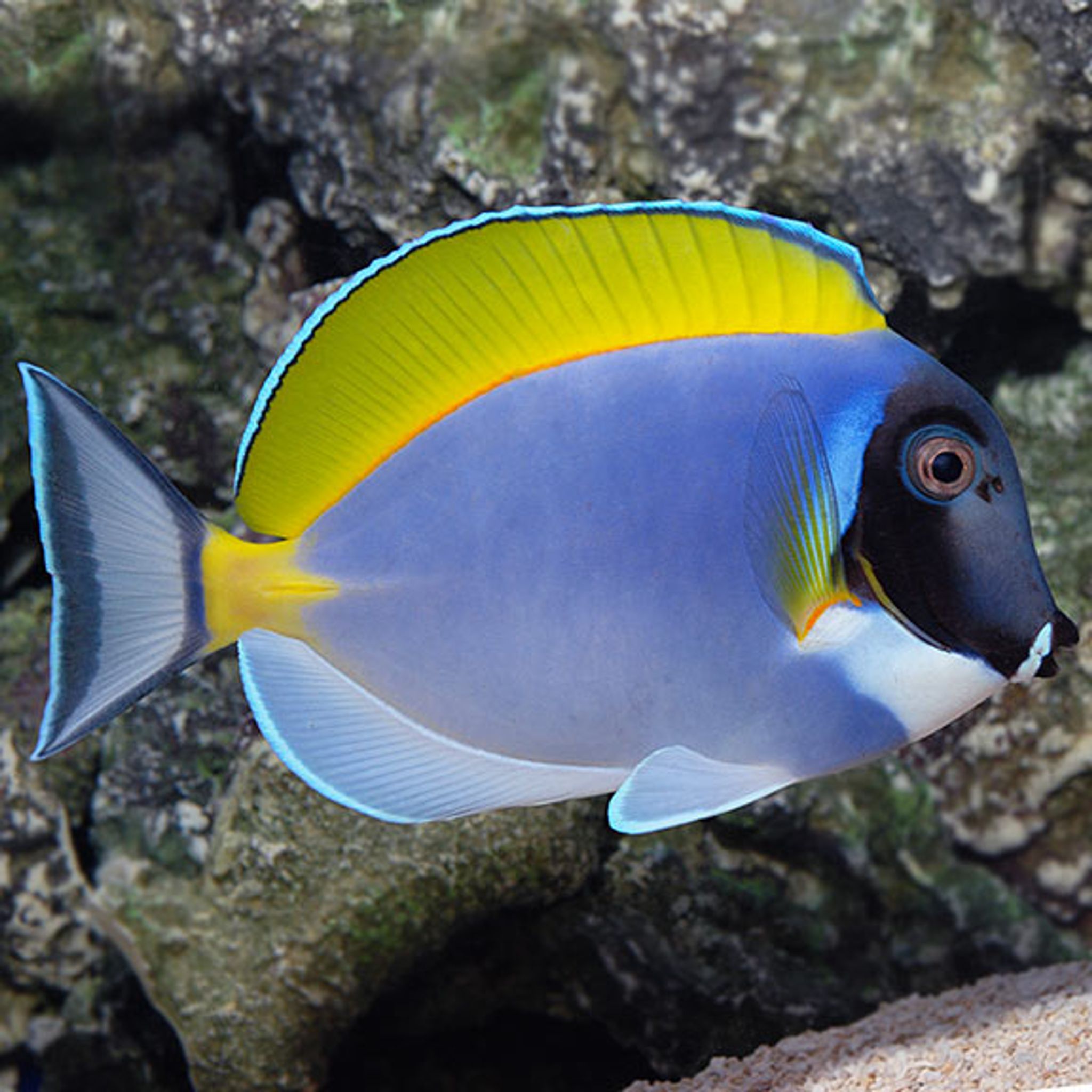
Best Tank Mates for Blue Tang: Peaceful, Risky and Incompatible Choices
The Blue Tang (Paracanthurus hepatus) is one of the calmest tangs toward most tank mates, but it turns into a completely different fish around other surgeonfish. This guide sorts realistic candidates into safe, risky and avoid-entirely categories, and explains the tank size, aquascape and introduction order that make the difference between a peaceful community and a fin-shredded one.
Species Snapshot
The Blue Tang is also sold as the Hippo Tang, Regal Tang, Palette Surgeonfish, or simply "the Dory fish." It's native to Indo-Pacific reefs, reaches roughly 10-12 inches (25-30 cm) as an adult, and with consistent water quality and a proper herbivore diet can live 8-20+ years in captivity. That longevity is exactly why tank mate choices made on day one matter for the next decade.
Core water parameters:
| Parameter | Target Range |
|---|---|
| Temperature | 74-78°F (23-26°C) |
| pH | 8.1-8.4 |
| Specific gravity | 1.020-1.025 |
| dKH | 8-12 |
| Ammonia / Nitrite | 0 ppm |
| Nitrate | Under 20 ppm (lower for reef tanks) |
Tank Size and Swimming Space
100 gallons (378 L) is the bare-minimum entry point for a single juvenile, but that's a short-term arrangement, not a forever home. Once the fish reaches full size, 125-180+ gallons (473-681+ L) is the realistic long-term range, and 180+ gallons becomes the sensible floor if you're keeping multiple tangs or a full reef community. Sources disagree on the exact cutoff — some retailer profiles flatly state 180 gallons as the minimum — but 125 gallons as a genuine adult home, scaling up from there, is a workable middle ground.
What matters more than raw volume is tank length. Blue Tangs are constant open-water swimmers, so a long, low tank with a wide swim lane serves them far better than a tall, narrow one with the same gallon count. A 6-foot (180 cm) or longer footprint is what actually lets a tang cruise, and it's also the length threshold that makes multi-tang stocking even worth considering.
Temperament and Why Tangs Fight Tangs
Toward non-tang species, the Blue Tang is one of the more easygoing surgeonfish — it doesn't hunt, stalk, or bully fish outside its own family. But it is strongly territorial toward other tangs and surgeonfish, especially anything similarly shaped or colored, and most of all its own species. Stress in a Blue Tang shows up visually: a healthy fish holds bright blue and yellow, while a stressed or bullied one goes darkened, blotchy, or pale.
This split personality — calm with community fish, combative with lookalikes — is the single most important thing to understand before stocking around one.
Peaceful Tank Mates
These are generally safe pairings for a Blue Tang in a reef or FOWLR (fish-only-with-live-rock) setup:
- Clownfish (ocellaris or percula) — you can browse clownfish as a low-conflict, hardy starting point for a tang-anchored community
- Gobies — clown gobies, watchman gobies, and other gobies occupy the substrate, not open water, so there's no territorial overlap
- Blennies — bottom- and rock-dwelling, no interest in contesting swim space
- Dartfish — small, fast, and generally ignored by tangs
- Chromis — kept in a school of 4-6 for security and natural schooling behavior
- Cardinalfish — slow-moving, peaceful, and active at different times of day
- Dwarf or pygmy angelfish — best added after the tang or at the same time, not before
- Wrasses — six-line wrasses, fairy wrasses, and similar species from the broader wrasse selection round out an active, peaceful reef community
Adding the Blue Tang while it's young and small — and before any other tangs are introduced — lets it establish territory gradually rather than fighting for it against already-settled fish.
Risky Tank Mates (Case-by-Case)
These pairings can work, but only with a large tank, careful stocking order, and realistic expectations that it might still fail:
- Other tang or surgeonfish species — feasible mainly in a 6-foot-plus tank, with all tangs added simultaneously, and only when the species differ noticeably in body shape and color from each other and from the Blue Tang
- Larger semi-aggressive fish — dwarf lionfish, larger angelfish, and foxface can coexist but need enough space that the tang never feels cornered
- A second Paracanthurus — never house two Blue Tangs, or two of any similarly shaped tang, together; this is the one "risky" category that's really closer to "don't"
Sources are split on multi-tang tanks in general: some say it's achievable with the right setup, others advise against mixing tangs at all. The realistic middle ground is that it's only doable in a 6-foot-plus tank, with visually distinct species added at the same time — and it is never appropriate with a second Blue Tang specifically.
Incompatible / Avoid Entirely
- Large aggressive triggerfish — can harass or physically injure a tang
- Large groupers and eels — predatory enough to view a tang as prey
- Very aggressive damselfish — small but relentless, capable of bullying a peaceful tang into chronic stress
- A second Blue Tang, or any similarly shaped tang, at any tank size — same-species and same-shape aggression in Paracanthurus hepatus is high enough that "they'll work it out" almost always ends in chasing, torn fins, or a dead fish
Tank Mate Decision Checklist
Before adding any candidate to a Blue Tang tank, run it through these four questions:
- Body shape overlap — Is it a similarly shaped, disc-bodied swimmer (another tang or surgeonfish)? If yes, treat it as risky at minimum.
- Temperament tier — Is it passive, semi-aggressive, or aggressive? Passive fish are safe; aggressive fish are a hard no regardless of size.
- Tank size available — Does your actual footprint (length, not just gallons) support the swim space this pairing needs?
- Feeding niche — Does it compete directly with the tang's grazing behavior, or occupy a different niche (substrate, rockwork, open water)?
Reef Safety
The Blue Tang is best described as reef-safe with caution. It won't eat corals or invertebrates outright, but a hungry or undernourished tang can occasionally nip at large-polyp or soft corals, and its constant swimming pattern can knock over unsecured frags. For most well-fed setups it behaves as a genuine reef community fish — the caution is really about nutrition and aquascape stability, not predatory intent. It also won't bother clownfish, shrimp, or other tank mates on a predatory basis; any conflict that arises is territorial, not feeding-related.
Diet and the Aggression-Health Connection
Blue Tangs are primarily herbivorous grazers. They need dried seaweed or nori 3-5 times per week, supplemented with marine algae and spirulina, plus occasional protein from mysis or brine shrimp. This isn't just a nutrition footnote — it connects directly to tank mate compatibility. An undernourished tang is more prone to disease, more likely to nip at coral out of hunger, and can develop Head and Lateral Line Erosion (HLLE), a condition linked to poor diet and water quality. A poorly fed, HLLE-prone tang is also a more stressed, more territorial one, which raises the odds of aggression toward every other fish in the tank.
Introduction Order and Aquascape
Where you place the Blue Tang in your stocking sequence matters as much as who you stock:
- Add it mid-stocking, not first and not last. First puts it in a position to become overly territorial over the whole tank; last means it's entering a tank where every good hiding spot and open-water lane is already claimed by established residents, which raises the odds of it being bullied instead of bullying.
- If you're adding multiple tangs, add them simultaneously so no single fish has an established home-field advantage.
- Build rockwork with multiple line-of-sight breaks and a genuine open swim lane — a rockscape with no escape route turns a minor squabble into sustained bullying, because the losing fish has nowhere to retreat.
Disease-Outbreak Prevention: A 4-Step Framework
Blue Tangs are notoriously Ich-prone, partly due to a thinner slime coat and partly because their constant swimming maximizes exposure to parasites in the water column. Whether you frame this as species-specific vulnerability or general tank risk, the practical response is the same:
- Quarantine every new arrival for 4-6 weeks in a bare or separate tank before it ever touches the display.
- Observe daily for early warning signs — flashing against rock, visible spots, clamped fins, or color loss — both during quarantine and after the fish joins the display.
- Run a full prophylactic treatment course during quarantine (such as a copper or hyposalinity/prazi regimen), completed in full rather than stopped early or used reactively once the display is already infected.
- Keep water quality stable and stress low — correct stocking order, adequate swim space, and good nutrition all reduce the immune suppression that lets latent parasites take hold. This is where tank mate selection and disease prevention overlap directly: an aggression-stressed tang is a disease-prone tang.
Bioload and Filtration
Open-water swimmers like the Blue Tang need strong water movement for both comfort and turnover, plus robust protein skimming to keep nitrates low and stable. Tangs are unusually sensitive to poor water quality — sustained high nitrates are linked to HLLE — so filtration capacity should be sized for the adult fish's bioload from the start, not upgraded reactively after problems appear.
Common Mistakes
- Buying a Blue Tang for a tank under 100 gallons because it's small now — it grows fast and becomes stressed and aggressive in cramped quarters.
- Adding a second tang, especially another Blue Tang, expecting them to "work it out" — this usually ends in chasing, torn fins, or death of the weaker fish.
- Skipping quarantine — this is the single biggest cause of new-tank disease crashes with this species.
- Underfeeding herbivore matter — a tang fed only meaty foods can develop nutritional deficiencies, HLLE, and weakened immunity, which shows up as increased aggression or illness.
- Poor aquascaping with no open lane or escape route, which turns minor territorial disputes into serious, sustained bullying.
- Adding the tang last into an established, territorial tank, increasing the odds it gets bullied by residents who already claimed the best real estate.
If Aggression Starts After the Fact
If a Blue Tang starts chasing tank mates (or gets chased itself) after your tank is already stocked, don't wait it out:
- Rearrange the rockwork to break sightlines and reset territorial boundaries — fish re-map territory based on landmarks, so changing the aquascape can genuinely reset the dynamic.
- Use a temporary divider to separate the aggressor while you plan a longer-term fix.
- Consider rehoming as a last resort if aggression is severe and ongoing — a tang or tank mate that's constantly stressed is at serious risk of secondary disease on top of physical injury.
Frequently Asked Questions
Can I keep two Blue Tangs together?
Generally no. Same-species aggression in Paracanthurus hepatus is very high, and it's only feasible in exceptionally large tanks with careful simultaneous introduction — even then, it's a gamble that often ends badly for one fish.
What is the minimum tank size for one Blue Tang?
100 gallons (378 L) is a bare minimum for a juvenile short-term. For a full-grown adult long term, plan for 125-180+ gallons (473-681+ L), with length mattering as much as volume.
Is a Blue Tang reef safe?
Yes, for most reef tanks, provided it's well-fed on a herbivore-heavy diet. Occasional nipping at soft corals or clams is possible, especially if underfed, so monitor its behavior around sessile invertebrates.
Will a Blue Tang eat my clownfish or shrimp?
No. It's herbivorous and non-predatory toward tank mates like clownfish or shrimp. Any conflict that occurs is territorial in nature, not feeding-related.
Can Blue Tangs live with other tang species?
Sometimes. It's realistic in a 6-foot-plus tank when the species look and behave differently from one another and are introduced together rather than one at a time.
Why does my Blue Tang chase other fish?
Usually territorial stress — insufficient swimming space, being added after another fish already claimed the open-water zone, or a similarly shaped or colored fish triggering rivalry instinct.
How do I quarantine a new fish before adding it to a tank with a Blue Tang?
Isolate the new fish for 4-6 weeks in a separate, cycled tank, observe it daily for signs of disease, and run a full prophylactic treatment course before ever transferring it to the display.
Why did my Blue Tang's color fade or go blotchy?
This is usually a stress response — from aggression, poor water quality, or a mismatched tank mate — rather than illness alone, though persistent blotching can also signal early disease and warrants closer observation.
Ready to plan your stocking list? You can explore compatible options in FishyHub's Tangs & Surgeons category to compare species before you buy.

