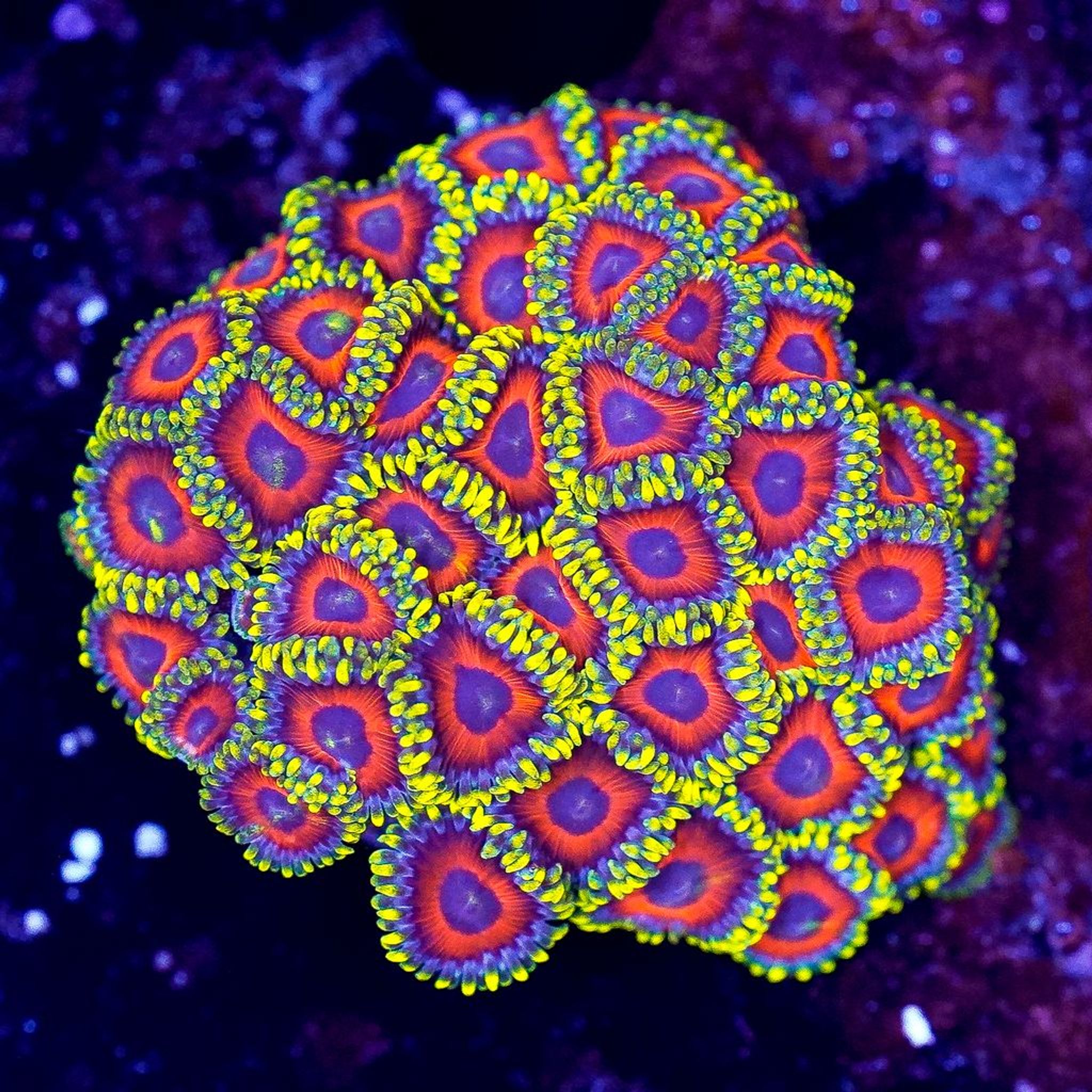
Best Placement for Zoanthids: PAR, Flow and Space Requirements
Most zoanthids do best in moderate light, roughly 100–250 PAR, with medium, indirect flow and a few inches of open rock around the colony. In most reef tanks that puts them on the middle to lower rockwork or the sand bed rather than right under the lights. Below is how to pick that spot, how to adjust it for your particular morph, and how to tell when a colony needs to move.
Why Placement Matters So Much for Zoanthids
Zoanthids (zoas) and their larger relatives, palythoas (palys), are colonial polyps linked by a shared mat of tissue called the stolon. They get much of their energy from photosynthetic zooxanthellae, and they also take in dissolved and particulate food from the water. Because of that, where they sit in the tank decides three things:
- How much energy they get from light, which drives growth and color.
- Whether their polyps can open and shed waste, which depends on flow.
- How far they can spread before running into a neighbor or a gap in the rock.
Zoas adapt well, which is one reason they are popular with new reefers. That flexibility has limits, though, and most "my zoas won't open" problems come down to placement or acclimation rather than water chemistry.
PAR Requirements for Zoanthids
PAR (photosynthetically active radiation) measures usable light for photosynthesis, in µmol/m²/s. A PAR meter gives the most reliable reading, but many hobbyists borrow one from a local reef club or use the PAR map published for their fixture.
Target PAR Ranges
Keepers disagree on exact numbers, and results change with spectrum, photoperiod and nutrient levels. The ranges below are widely used starting points:
| Zoa type / situation | Suggested PAR | Typical tank position |
|---|---|---|
| Most common zoanthids | 100–200 | Mid rockwork |
| Bright, "neon" or high-color morphs | 150–250 | Mid to upper-mid rockwork |
| Palythoas and large-polyp palys | 75–200 | Lower to mid rockwork, sand |
| Freshly added or recently shipped frags | 50–100 at first | Sand bed or low rock |
| Upper limit before stress is common | ~300+ | Near the surface (usually avoid) |
Some reefers keep zoas in SPS-level light above 300 PAR with no trouble, and others see bleaching well below that. The safe approach is to start low and move a colony up in steps.
Signs Your Zoas Have Too Much Light
- Polyps stay closed or half-open during the peak of the photoperiod.
- Colors turn washed out or pale, or the centers bleach.
- Polyps shrink and the skirts curl inward.
- The colony opens fine in the morning and closes as intensity ramps up.
Signs Your Zoas Need More Light
- Polyps stretch on long stalks toward the light.
- Colors brown out or look muddy as zooxanthellae density rises.
- Growth is slow even though the polyps open fully.
Stretching and browning both point to moving the colony a few inches higher or closer to the center of the light spread.
Acclimating to Your Lighting
Corals from a supplier or another tank rarely match your light exactly. A common method:
- Place the new frag on the sand bed or lowest rock for the first one to two weeks.
- Alternatively, lower your fixture's intensity by about 20–30% and bring it back up over two to three weeks.
- Move the colony up 3–4 inches (7–10 cm) at a time, waiting several days at each level.
- Stop when the polyps open fully and show their best color.
If you are shopping for a fixture that can be dimmed and ramped this way, you can compare options in the aquarium lighting category on FishyHub.
Flow Requirements for Zoanthids
Zoas like moderate, indirect, alternating flow. The goal is water that moves the polyps gently from side to side, not current that folds them flat.
What Good Zoa Flow Looks Like
- Polyps sway but stay open and round.
- Detritus does not settle on the colony or the rock around it.
- The mat shows no film of cyano or slime building up between polyps.
Too Much vs. Too Little Flow
| Symptom | Likely cause | What to try |
|---|---|---|
| Polyps pinched shut, skirts folded back | Direct, laminar blast from a powerhead | Aim the pump away or move the colony out of the stream |
| Colony only open on one side | One-directional flow | Add a second pump or use a wave/alternating mode |
| Debris or film collecting on the mat | Too little flow, dead spot | Increase random flow or relocate a few inches |
| Polyps closed with a slimy coating | Waste not being shed | Boost flow and check for pests |
Zoas also need enough flow to shed their mucus coat, which they produce from time to time. A colony that stays closed for a day or two and then opens clean is usually shedding, not dying.
Flow Placement Tips
- Avoid spots directly in front of a return nozzle or powerhead output.
- Rock ledges and the sand bed near the front glass often catch gentle, turbulent flow.
- In smaller tanks, from about 10 to 30 gallons (38–114 liters), a single wavemaker on a random or pulse mode is often enough.
Space Requirements and Spread
Zoanthids spread across rock by growing new polyps along the stolon. In good conditions a colony can cover a surprising amount of rock over a year or two, so plan for that early.
How Much Room to Leave
- Leave at least 2–4 inches (5–10 cm) of bare rock around a new frag.
- Keep a wider gap, about 6 inches (15 cm) or more, between zoas and corals with long sweeper tentacles such as torch, frogspawn, galaxea or some chalices.
- Leave space between different zoa morphs if you want to keep them separate. Mixed colonies grow into one another and are hard to split cleanly later.
Using Gaps and Islands
Many reefers build a zoa garden: several morphs on one rock or on separate frag plugs, with sand or a gap between them so each colony stays contained. Zoas generally will not cross sand, so an island rock is an easy way to keep a fast grower from spreading over your scape.
Neighbors to Think About
Zoas are fairly peaceful, but some neighbors cause problems:
- Green star polyps and some leathers can outgrow and smother them.
- Aggressive LPS can sting them at night when sweepers come out.
- Mushrooms sit at a similar light level and compete for the same rock space.
Many hobbyists keep zoas with other colonial polyps, and you can browse compatible options in the polyps category on FishyHub.
Putting It Together: Picking the Spot
A practical order of operations for a new zoa frag:
- Check water stability. Most zoa keepers aim for 76–80°F (24–27°C), salinity of 1.025–1.026 specific gravity, alkalinity around 7–10 dKH and low but detectable nitrate and phosphate. Ultra-low nutrients are a common reason zoas shrink or fade.
- Start low and indirect. Sand bed or lower rock, out of the direct pump stream.
- Watch for a week. Note when the polyps open fully and what color they show.
- Move up gradually if they stretch or brown, and move down if they close or pale.
- Glue it down once you are happy with the spot. A frag plug in a rock hole or a dab of reef-safe gel glue on dry rock both work.
- Leave room to spread, and keep sweeper-tentacle corals at a distance.
A Safety Note on Handling
Many zoanthids and palythoas contain palytoxin, a potent toxin. Wear gloves and eye protection when moving, fragging or scrubbing them. Never boil or pressure-wash rock covered in zoas or palys. If you get splashed in the eyes or feel unwell after handling them, seek medical help.
Frequently Asked Questions
Can zoanthids be placed on the sand bed?
Yes. The sand bed is a good starting spot for new frags because PAR and flow are usually gentler there. Mount the frag on a plug or small rock so the polyps sit above the sand and do not get buried by sand shifted around by fish or flow.
How long should I wait before moving zoas higher in the tank?
Give each position several days to a week before judging. Zoas often stay closed for a day or two after any move. If they open fully and look healthy, move them up another 3–4 inches (7–10 cm) and repeat until color and growth look right.
Why are my zoas closed after I moved them?
Short-term closing after a move is normal. If they stay closed longer than about a week, check for too much light, a direct stream of flow, or pests such as zoa-eating nudibranchs and sundial snails. An inspection with a flashlight after lights-out often turns up pests.
Do zoanthids need to be fed if they get enough light?
Light meets much of their energy needs, and many colonies grow well without direct feeding. Some keepers occasionally spot-feed small foods such as reef roids or finely minced frozen food to boost growth, especially in low-nutrient systems. Keep feedings small so the extra food does not pollute the water.
Find the Right Zoas for Your Reef
With moderate light, gentle alternating flow and a little room to spread, zoanthids reward you with years of steady growth and bright color. When you are ready to add new morphs or build a zoa garden, browse corals on FishyHub.

