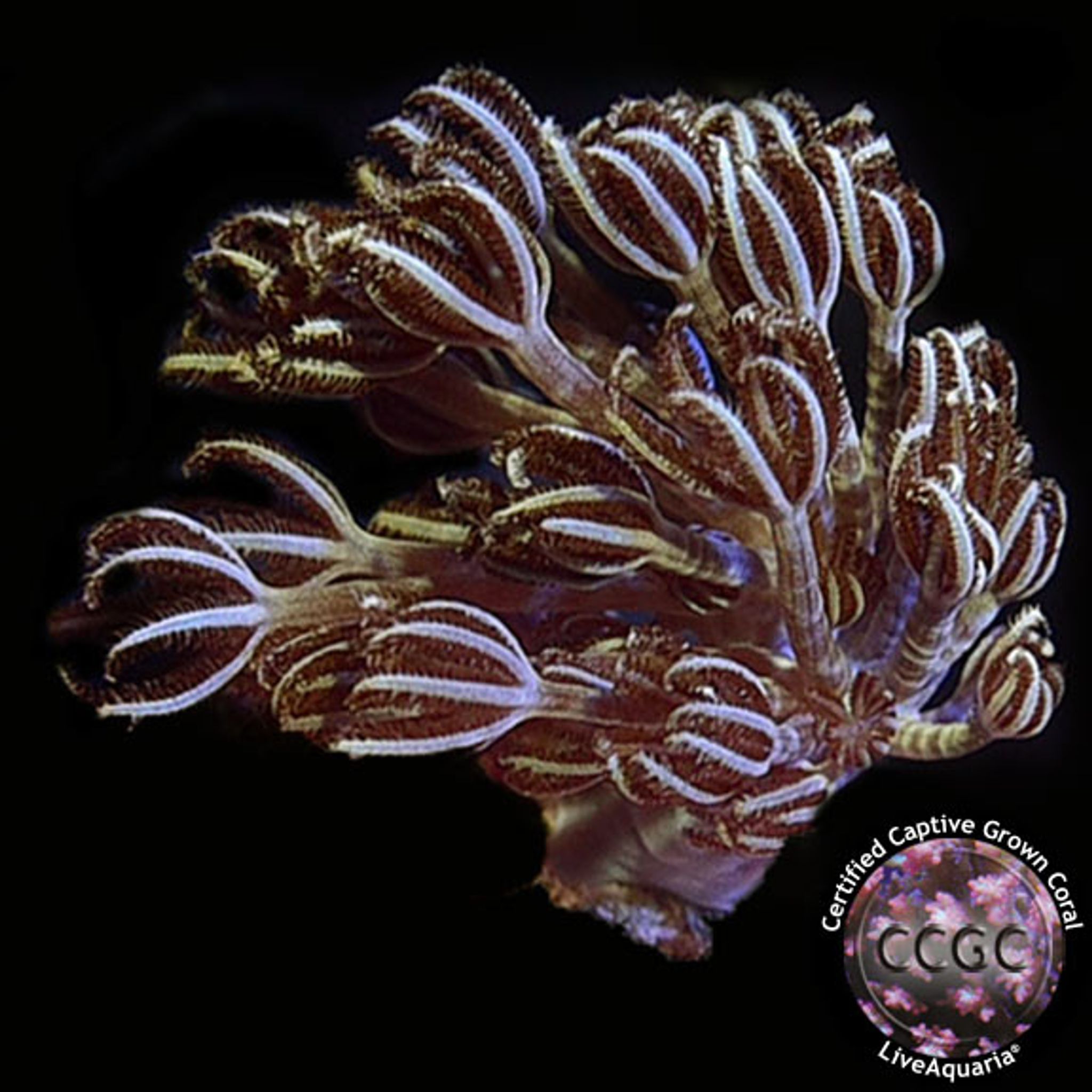

Best Placement for Xenia: PAR, Flow and Space Requirements
Xenia stops pulsing for one of three reasons almost every time: the light is too intense, the flow is aimed wrong, or it hasn't been left alone long enough to settle in. This guide covers the PAR range, flow style, and space budget that keep pulsing xenia and pom-pom xenia happy — plus how to stop a thriving colony from taking over the tank.
What Xenia Actually Is (and Why That Changes the Rules)
Xenia — including pulsing xenia, pom-pom xenia, and blue/waving xenia (genus Xenia/Heteroxenia, sometimes lumped in with Anthelia) — is a soft coral, not a stony coral. It has no hard skeleton, which means its light and flow tolerances are noticeably wider than SPS or LPS. Placement advice built for stony corals (bright light, strong direct current) will usually stress xenia rather than help it.
That distinction matters because Xenia and Anthelia are traded almost interchangeably as frags, but their care needs differ slightly — Anthelia tends to tolerate a bit more light variation and spreads over rock in sheets rather than forming the tree-like stalks typical of true Xenia. If a frag is unlabeled, treat it as a low-light soft coral until you see how it behaves.
PAR: How Much Light Xenia Actually Needs
Xenia is a low-light soft coral. Most colonies do well in the 50–150 PAR range, and plenty thrive even lower — around 30–80 PAR in a shaded spot under a rock ledge. It does not need SPS-level intensity, and pushing it toward 250+ PAR without slow acclimation is a common way to bleach a colony or cause it to clamp shut and stop pulsing entirely.
Reef-lighting guides written for general "coral color" often push hobbyists toward higher output across the board. That advice doesn't transfer well to xenia. The safer approach is to start conservative — 50–100 PAR — and only raise intensity gradually if the colony looks pale and isn't pulsing well after a few weeks.
Why light matters at all, for any coral:
- It drives photosynthesis in the coral's symbiotic algae, which supplies most of its energy.
- It affects color and pigmentation — too little light leaves corals pale, too much can trigger bleaching-type stress.
- It shapes behavior, including polyp extension and, in xenia's case, the pulsing motion itself.
- It affects tank ecology broadly — mismatched spectrum or intensity relative to bioload is a common driver of nuisance algae.
Translating PAR Targets to LED Settings
Most sources give a PAR number without saying how to dial it in. As a rough starting point on a common reef LED fixture running full-spectrum white and blue channels:
| Fixture output style | Approx. setting for xenia | Mounting height guide |
|---|---|---|
| High-output single fixture | 20–35% intensity | Raised 20–24 in (50–61 cm) above the water, or shaded by rock |
| Mid-range all-in-one LED | 30–45% intensity | Standard mounting height, xenia placed low in the aquascape |
| Lower-output nano LED | 50–65% intensity | Standard height, mid-to-low placement |
These are starting points, not fixed numbers — always confirm with a PAR meter where possible, since fixtures vary widely in output per watt. Browse LED lighting options if you're setting up a shaded, softie-friendly zone.
Placement in the Aquascape
Put xenia in low-to-middle rockwork, on the sides or back of the aquascape rather than on top where light and flow are strongest. Two placements work especially well:
- Sand bed at the base of rockwork — naturally shaded, moderate flow, easy to isolate.
- A separate rubble pile or frag rack — keeps it away from showpiece corals and makes pruning simple.
Avoid the highest points of the rock structure, which usually get the most direct light and the most direct pump wash — exactly what xenia doesn't want.
Flow: Turbulent Beats Direct
Xenia wants low-to-medium, turbulent flow — the kind a wavemaker produces on a random or pulsing mode — rather than a straight, laminar blast from a single powerhead. Some water movement actually helps trigger the pulsing motion, so completely dead water isn't ideal either. The goal is movement that changes direction, not a fixed jet.
There's a real split in hobbyist opinion here: some keepers say direct current keeps xenia pulsing more vigorously, while others insist only indirect, turbulent flow prevents detachment. Both camps are partly right. Alternating, turbulent flow satisfies the need for "some current" without the risk of a fixed jet ripping polyps loose.
How to tell which way flow is wrong:
| Symptom | Likely cause | Fix |
|---|---|---|
| Colony stays closed, won't pulse, tissue looks slack | Flow too weak / stagnant water | Add gentle circulation, reposition slightly off the sand |
| Polyps retracted, tissue looks stressed, frags knocked loose | Flow too strong / direct jet | Redirect the pump, move colony out of the direct wash |
| Pulses weakly but never fully opens | Flow present but too weak to trigger motion | Increase circulation slightly, keep it turbulent, not direct |
Space: Xenia Is a Fast, Invasive Spreader
Xenia is one of the fastest-growing and most invasive soft corals in the hobby. A healthy colony can double in a matter of weeks and creep across rock, glass, and even flow-pipe fittings if left unchecked. This isn't automatically a problem — it just needs a plan from day one.
A concrete space budget:
- Give each xenia frag or small colony a minimum of 3–4 in (7.5–10 cm) of open sand or bare rock margin on all sides.
- Keep at least 4–6 in (10–15 cm) of buffer between xenia and slower-growing SPS or LPS neighbors — xenia can shade or lightly sting corals it grows into.
- Mount it on its own frag plug or a small isolated rock "island" surrounded by open space, rather than directly fused to the main rock structure.
- If growth outpaces the display, move the colony (or excess cuttings) to a frag tank or sump instead of letting it spread unchecked in the main display.
Some hobbyists treat xenia purely as a pest; others love it for filling a tank fast. Both views are valid — the difference is whether you isolate it intentionally or end up reacting after it's already spread across the glass.
Controlling an established colony:
- Cut back stalks at the base with sharp shears or a scalpel during routine maintenance — xenia frags readily and roots take from cuttings, so trimmings can be re-homed or traded rather than wasted.
- Physically peel or scrape small runners off glass and overflow pipes before they anchor.
- Treat regular pruning as routine maintenance, not a one-time fix, since a healthy colony will keep pushing back into the space you clear.
The "Garden Reef" Style
A softie-forward aquascape — xenia, zoanthids, mushrooms, and leathers packed for dense, swaying coverage — has become a popular style, especially with newer or budget-conscious reefers. These corals tolerate a wider PAR and flow range, which means cheaper lighting and pump setups can still produce a colorful, full-looking tank. The tradeoff is active management: without regular pruning and space discipline, a garden reef built around fast growers like xenia can drift into a monoculture where one coral crowds out everything else.
Chemistry, Stability, and Handling
Beyond light and flow, two other factors decide whether xenia thrives:
- Nutrients: Xenia tends to prefer systems with some measurable nitrate and phosphate rather than an ultra-low-nutrient setup tuned for SPS color. A very clean, nutrient-starved tank is a common cause of decline even when PAR and flow look correct on paper.
- Stability: Sudden swings in temperature, salinity, or alkalinity affect xenia's pulsing and health as much as placement does. Consistent parameters matter as much as finding the right PAR number.
Handling and acclimation: Xenia dislikes being moved repeatedly. Relocating a colony over and over to "find the right spot" resets its acclimation each time and delays or prevents pulsing. Research placement first, position it once, and give it 1–2 weeks before judging how well it's pulsing.
Because xenia is traded frag-to-frag so frequently, it's also worth dipping and quarantining new frags before adding them to a display — hitchhiking pests move between systems easily on soft coral frags.
Common Mistakes to Avoid
- Placing xenia directly under a high-output LED set for SPS intensity, causing bleaching or a closed, unresponsive colony.
- Aiming a powerhead straight at the colony, which knocks off polyps and frags and can prevent pulsing altogether.
- Moving the colony repeatedly to test different spots, which resets acclimation and delays results.
- Running an ultra-low-nutrient system tuned for SPS color, which often causes xenia to decline or "melt" even with correct light and flow.
- Letting a colony grow unchecked next to slower corals, leading to overgrowth and shading — fix by fragging back regularly and keeping a buffer zone.
A separate, less understood issue is the "xenia crash" — a thriving colony, or even an entire tank's worth of xenia, suddenly receding or dying off. The exact cause isn't settled; it's often linked to a parameter swing, a buildup of dissolved organics, or a bacterial or algae bloom. Stable parameters reduce the risk, and keeping a backup frag in a separate system is a common insurance policy among keepers who've been through it.
If you're building out a softie-forward setup, browsing soft corals alongside SPS corals can help you plan which zones of the tank go to fast growers like xenia and which stay reserved for slower, higher-light species.
Frequently Asked Questions
Where's the best spot for xenia in a reef tank?
Low-to-mid rockwork or a sand bed at the base of the aquascape works best. Keep it out of direct high-intensity light and away from a strong direct flow path.
What PAR does xenia need?
Roughly 50–150 PAR, with many colonies doing fine at 30–80 PAR in a shaded spot. It's a low-light soft coral, unlike SPS, which typically wants much higher intensity.
Does xenia need high flow?
No. Moderate, turbulent or indirect flow works better than a direct jet from a single powerhead. Some water movement helps trigger pulsing, but a fixed blast can knock polyps loose.
Why did my xenia stop pulsing?
The usual culprits are flow (too little or a direct blast), a light intensity mismatch, stress from recent relocation, or a swing in water parameters. Check flow and light first, then rule out recent moves.
Is xenia invasive — will it take over my tank?
It can spread quickly across rock and glass if left unchecked. Isolate it on its own frag plug or rock island with several inches of open space around it, and prune regularly to keep growth contained.
Why is my xenia melting or crashing?
The exact cause isn't fully settled, but it's commonly tied to unstable parameters, nutrient levels that are too low, or a buildup of dissolved organics. Keeping parameters stable and holding a backup frag elsewhere are the most common safeguards.
Can xenia live with SPS corals?
Yes, but keep several inches of distance between them. Xenia grows fast and can shade or lightly sting slower neighbors, and SPS generally wants higher light and flow than xenia needs to thrive.
Does xenia need to be fed?
It relies mainly on light for energy through its symbiotic algae, so target feeding isn't a priority. Supplemental nutrients already present in the water column matter more than direct feeding — an ultra-low-nutrient tank is more likely to cause problems than a lack of feeding.


